book recommendation

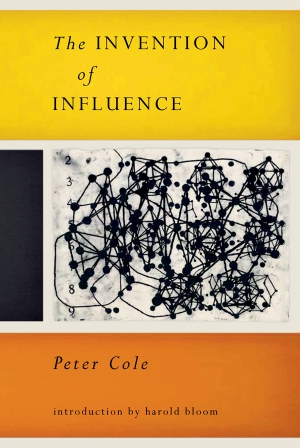
Read This or Kill Yourself: The Invention of Influence by Peter Cole

Invention_of_Influence_300_448

Austin Duck

In Read This or Kill Yourself we get tough with you about your bookshelf and what had damn well better be on it.

“Who wants to read Kabbalist poetry?” asked no one, ever. In fact, when this book was recommended to me (I’m a sucker for New Directions Press and a friend said it was pretty good), I didn’t have any sense of what a Jewish poetry might even look like, much less a Kabbalistic Jewish poetry. Yet here we are, and I can’t recommend it enough.

Really, truly, this book (parts of it anyway) are knock-your-face-off-shit-your-pants good. And I don’t say that often. A drunk and very sad guy I know recently sent me a tweet-manifesto decreeing, “contemporary poetry has stagnated.” Obviously, this is stupid. Fields don’t stagnate.

What this guy was actually talking about (though he was likely far too drunk to realize it) is that his own particular expectation of poetry — his idea of poems — wasn’t being met. And that’s fine; I get that. In fact, on a particularly good day (today isn’t one), I might go so far as to make the claim that if you don’t find that, largely, current poetry (i.e. a body of poetry that hasn’t been eroded to its core by time, if you will) is unsatisfying, (though not stagnant), then you’re fucking stupid, but I won’t because I don’t feel well, and I’m tired of defending myself against the anyone-can-write-poetry crowd who believe that phone books, framed in just the right way, are art. What I will say is this: there’s a reason that, Charles Wright (in some poem I spent half an hour looking for but couldn’t find) writes “make your song/your favorite”; that with something so diverse, so culturally and intellectually and ideologically differentiated within itself as poetry is, idiosyncratic preferences are going to express themselves, whether or not you’re too lazy or drunk to realize it.

I say all this to impress upon you two separate things:

1) that this book speaks to me, my sensibilities and concerns as a poet and a human being, it is the ice-axe to break the frozen sea inside [me] (Kafka) that I’ve been looking for for about six months and, more importantly,

2) my little aside gets at the core of the book’s intellectual project: that (in the Kabbalist idiom) angels, which become synonymous with epiphanies and artworks throughout the text, are the product of influence… but not in a bad way. Rather, the angel/epiphany/artwork is the result of what’s learned, inherited, through blood and culture and socialization, internalized by you, and changed so that, when you see it/speak it/write it in the outside world, it is both you and not, an unknown knowledge you’ve received and re-articulated as your self. It is both you and not you, and, in being so, it changes you.

Now, I know that last paragraph reads like heady grad-school crap. I know it. So, let me try to make a metaphor (though Cole’s are much more arresting): Imagine moving to a new, profoundly regional part of the country (say, Alabama) and moving into your grandmother’s old house. By living there, interacting there, you’ll be inherently changed, you’ll adapt and adjust without even realizing it, but you’ll still retain who you were prior to the move. Some day, you look in the mirror and think: Fuck, I’m not who I used to be at all. That’s the sort of commonplace, everyone-has-experienced-this-thing dulling of Cole’s project. Now, take that experience of moving and internalizing and realizing, and amplify it to mystico-spiritual, super-introspective heights. Are you starting to get the picture?

At the center of this book (literally, section II of III), the titular (title poem) “The Invention of Influence: An Agon” rests, a behemoth of a poem completely obsessed with (and in many parts, comprised of the writing of) the tragic Victor Tausk, a suicide and disciple of Freud who was the first to use the language “The Influencing Machine” to consider a schizophrenic’s perception of his/her own mental capacity. The “influencing machine” Cole-as-Tausk writes “makes them see pictures. It produces/thoughts and feelings, and also removes them,/by means of mysterious forces./It brings about changes within the body—/ sensation and even emission,/ a palpable kind of impregnation,/ as one becomes host.” With this idea, Cole weaves a thread through mental illness, the Kabbalist Jewish experience (which he takes very seriously), and Tausk’s suicide (resulting, it seems, from his inability to stop doing the work Freud was doing, to remove the influence of his teacher and to do his own work, to see that he has his own, individuated vision of psychoanalysis (as opposed to regurgitation of another master’s thoughts)). And what’s amazing, what truly sets all this apart, is, formally, just how well he does it.

I’m sure the non-poetry crowd is, at this point, thinking I don’t give a fuck. Stop talking or I’ll stop reading. They’re thinking please don’t talk about how nearly the entire book is written, classically in couplets or quatrains and then juxtaposed, fragmented, against each other, or how most poems are rhymed (some not quite so silently as I’d like, though maybe that’s the point), how the poem “On Coupling” argues that couplets are used to join unlike things (remember the vision of the angel as simultaneously the self and the internalized influence??) and that rhyme creates the effect of simultaneously going backward (into what we’ve internalized) and forward (into the exterior world in the present moment and beyond), that quatrains, two rhymes set in four lines, are as “Ezekiel’s/four-faced cherubs facing at once/every direction.”

So I won’t. I won’t talk about it. Instead, I’ll suggest that you give a long, hard thought to why Cole might write in such a kind of modern/postmodern, jagged classicism, or in a verse-form itself so dedicated to joining two things at once, so appropriate for moving backwards (in rhyme) and forwards (because we can’t read the same two goddamn lines forever) when talking about influence and artwork and angels.

This book walks a fine line between the pointedly post-modern—pastiche, fracture and juxtaposition, and ambiguity—and the pointedly classical—rhymed, measured, searching for “wisdom” and “truth” and all that shit no one believes exists anymore—, and it’s gorgeous. Really.

What I’ll leave you with is a great, difficult, short poem from the book. If you don’t read the book, kill yourself. If you don’t read this poem, kill yourself twice.

The Reluctant Kabbalist’s Sonnet

It is known that “desire” is, numerologically, … “the essence of speech.”

Avraham Abulafia, “The Treasures of the Hidden Eden.”

It’s hard to explain What was inside came
through what had been between, although it seems
that what had been within remained the same
Is that so hard to explain It took some time
which was, in passing, made distinctly strange
As though the world without had been rearranged,
forcing us to change: what was beyond
suddenly lying within, and what had lain
deep inside—now… apparently gone
Words are seeds, like tastes on another’s tongue
Which doesn’t explain—how what’s inside comes
through what is always in between, that seam
of being For what’s within, within remains,
as though it had slipped across the lips of a dream

Austin Duck lives and blogs in DC. He can be reached at jaustinduck@gmail.com.

Image source: New Directions

Read This or Kill Yourself: Seiobo There Below by Laszlo Krasznahorkai

seiobo

Austin Duck

In Read This or Kill Yourself, we get tough with you about your bookshelf and what had damn well better be on it.

If you haven’t heard of Laszlo Krasznahorkai, you’re not in the minority. To be completely honest, the only reason I’m aware of him (and this book) is that I was trying to impress the book reviewer at The Washington Post so he’d help me get a better job (look how well that worked out).

Cool story, huh?

Anyway, Krasznahorkai is Hungarian, super allusive, and has only had a handful of books translated into English over the last decade or so. To us readers of English literature (even us grad school pricks), he’s pretty fucking remote. But, as with many things we’ve never heard of (or are just starting to see creeping up on our cultural radar screens), this guy is really, really good. Just read this excerpt. Can you believe how. fucking. good. this. guy. is?

Let me start again.

It might help to describe the basics of this book first. It’s hard to say whether Seiobo There Below (henceforth STB) is a novel or a collection of stories, but I’m not sure that the distinction between the two would be, in any way, meaningful to the understanding of the book. It’s definitely divided into sections (that are numbered using primes to imply a kind of “golden spiral” relationship between the sections [hence the impossibility of determining whether to read it as a whole or as discrete stories]), none of which are connected in any way but by theme. All of these pieces, in their own ways, are obsessed with the moment of transcendence through art, following various makers, protégés, and tourists through strange times, places, and works of art.

For example, in STB, you’ll read incredibly thorough accounts of a character consumed by the process of crafting a mask for the Japanese Noh Theater, another wandering through Italy to stare at an artwork he’s seen before, another exploring the Alhambra trying to make sense of the impossibility of knowing what the architectural masterpiece could have possibly been intended for, and another watching a bird standing in the middle of a river. Even as I’m writing this, I’m thinking to myself, it’s impossible that this book isn’t the most boring, most pretentious thing in town, but it’s not! It just isn’t. And I think I know why.

While some people love a good plot, some love great characters, and some (academic assholes) get off on meaning or cultural implication or philosophical value, I find that (and it seems like others agree) what really matters in the creation of great, meaningful literature—what really sets it apart from journalism, grocery-store fiction, bad genre fiction, etc.—is the sentence. That’s it. Now, perhaps it’s because I’ve thought about ways to aggrandize my life as a poet for a bit too long (because, shit, I still have to explain that to myself each morning), but for me (and a lot of other people much smarter and less pretentious than me) the sentence is what separates the good from the bad, what can create empathy with the reader or destroy the possibility of it. Think about it.

Sentences comprise our entire material experience of any book; sure, they are the units of thinking used to build meaning, understanding, and communication, but, left at that, all you have is really good journalism or a really meaningfully essay. Great sentences, on the other hand, call attention to themselves as sentences. Yes, they carry logic and information, but they have rhythms, they pause strategically, they themselves (as opposed to the content they carry) create ironies with what you expect sentences to be. Sentences are the basic units of organization, and organization in art is what allows us to experience it, to feel it rather than just read it. Sentences are fucking cool, y’all, and there’s no doubt in my mind that Krasznahorkai is one of our living masters of such.

I’d really like to show you one, but the average sentence in this book is easily 15-20 pages long, so I’ll spare you (and my genius editors here [ed note: thanks). If you’d like to see one, check out the link above. In a nutshell, these sentences are long (lol), difficult, and unlike anything I’ve seen in American literature. They are different (and difficult) because, unlike Faulkner’s, or Foster Wallace’s, or even our old ex-friend Frank Bidart’s, contrary to the basic logic of a sentence, they don’t build forward momentum. Let me say that another way (so you don’t kill yourself with boredom): the average sentence (even the more wonderful, more artful one) operates like a car rolling down a hill toward a brick wall; the speed increases and the overall tone gets more dire, an expectation is created (i.e. that the car will hit the wall) and, in some ways, you’re waiting for and preparing yourself for the full stop, the experience of collision with meaning.

Krasznahorkai’s sentences in STB, on the other hand, are a bit more like taking a tour bus around an unfamiliar city. You get on, somewhat oriented, and go and go and go, and there’s a tour guide saying look here and did you know about this; things feel assembled piecemeal, there’s chatter, honking horns, you stop briefly at stoplights (ahhh, the semicolon) and, yes, there’s a destination, but that seems less important, or, rather, distantly important; you’re here to get lost in the miscellany one piece at a time so that when you finally arrive at the conclusion, you know that you’ve had a meaningful experience that had more to do with the sum of the tour, all of the little meaningful (or not so much) pieces of your experience, than it did where you ended up.

But where you end up is important too; after the tour, after you get to know the texture and contours and history of the place, winding up in the Upper West Side can be pretty revelatory, despite the fact that you only started a few blocks away in Times Square.

These are not the sentences of a beach read (unless you like to inflict this kind of work on yourself while on vacation); these are the sentences of a major artwork that you will feel working on you, changing you, bending you around its purpose. You will get tired of them; you will beg the sentences to end, the paragraphs to end, the sections to end, because my God I just wanted something to read on the subway, let me out of your fucking world, but, in a way, I think that’s the point. Just as there’s the ambiguity between short-story collection and novel at play, so too is there a sense that these sentences could be shorter, should be shorter, but, because they’re all joined, some larger book-length, sentence-length ritual is being enacted, something vital you could miss if you don’t stick around. And that’s the pleasure of this book: it wraps you up meaningfully; it makes you work meaningfully. It’s written, sentence by sentence, section by section, in such a way that you can’t help but see the structure, feel its constraints, and experience the pleasures of the each section’s yield as the result. This book is a full-scale interrogation of art as holy and will force you into the repetitions, the rituals, and the cramped spaces of the makers; you will see and feel what is so large, so vital, in objects so small.

Image source: NPR