hbo

Hate-Watching the Girls Season Finale

girls_ep9_shoshana_g_mp_576

Jonathan May

Jonathan May’s original explanation and defense of hate-watching Girls can be found here. This post covers only the season finale, which aired on Sunday.

[Editor’s note: An earlier version of this post erroneously identified this in one instance as the series finale of Girls. It is actually the season finale. We apologize for the wishful thinking.] 

What can I say? All’s well that ends well, and end well this doesn’t. (Pro tip: Never make a Girls/Shakespeare comparison). I spent most of this disaster of an episode hating Marnie for hurting Shoshanna; I do admit that if Shoshanna hadn’t pushed Ray away, it might not have happened at all, but such is the wanton heart. I find myself thinking about the show purely in terms of the romantic engagements, which hearkens back to my theory that the show is in no way (and under no uncertain terms) a comedy, but rather a romance. But for a show all about girls, there is certainly a lot of attachment to boys.

This episode attempts to wrap up a season’s worth of false starts and prolonged miseries. Adam’s sister reappears, and tada!—she’s living with Laird, with whom she’s expecting a child. Then she promptly disappears from the plot. (Situation: resolved?) Marnie, no shocker, feels it necessary to reveal to Shoshanna that she and Ray slept together.Why she feels it necessary is beyond me. In a Western world of privilege, Marnie feels it’s her duty to unburden herself of guilt, rather than keep silent. She does this not for Shoshanna, but for herself, using the guise of truth as a way to assuage her own loneliness by bringing Shoshanna into co-misery. So, my real shocker for this episode was hating Marnie more than Hannah.

Which brings us to Hannah, unavoidably so. Her acceptance to Iowa was a trite and tawdry move on the part of the plot; Hannah lives in a world of limitless opportunity as a writer, even though we never see her writing. Comparisons to Sex and the City noted, Carrie’s main grace as the central protagonist was that the narration began and normally ended with her writing, her articles, because she was a writer. We never see any articulation or actualization of Hannah’s writing, just its end results. Where are the hard hours alone? The time spent putting together an application for a tough-to-get-into program like Iowa? We see none of that, and we’re the worse for it. Missing those moments cheapens the idea of work behind creative writing. We see Adam practicing constantly, Ray reading, Marnie singing, but we never see Hannah writing.

All in all, the episode closes with dramatic flourish typical of an inflated season of histrionics, with Hannah clutching her torn acceptance to Iowa like a sad, frumpy Vivien Leigh. Jessa’s arc throughout the season was the most interesting, and her courage in helping the photographer to end her life (and then save it) was the strongest point of the episode. Jessa makes it clear that at least some of the Girls aren’t just living for themselves.

My predictions for next season: We open in media res after something (?) happens to Hannah at Iowa, forcing a return to Brooklyn. Jessa has finally found herself. Adam is wildly successful. Marnie does something better with her hair. Shoshanna leaves the drama behind.

Jonathan May watches too much television, but he’s just playing catch-up from a childhood spent in Zimbabwe. You can read his poetry at owenmay.com, follow him on Twitter at @jonowenmay, or email him at owen.may@gmail.com.

Image source: Grantland
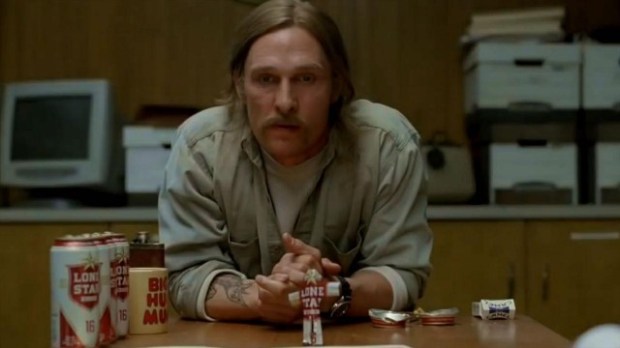
Galveston, a Novel: True Detective’s Nic Pizzolatto Fails to Find the Spirit of Noir

tdew

Austin Duck

Typically, and, most likely, to your chagrin, I write about high-minded (read: pretentious) writing because, honestly, that’s what does it for me. I’m a bit of a douchebag, yes, (though who in English grad school isn’t?), but, more than that, I’ve spent so much time reading around, trying to find something that was intellectually and emotionally nourishing…

See, I stopped reading for fun or to be entertained a long time ago (I’ve never forget a lit. theory professor walking into our undergrad class and explaining “If you love to read, get the hell out of here. If you want to work, you’re where you belong” [she was a superbadass lady, obvs.]) and, instead, have grown to expect, even delight in reading a page and thinking to myself: What the fuck just happened? Where could this possibly be going? Why would the author say/do that, make that move, allude to that, etc.?

Sure, it gives me pleasure to think that I can keep up with, even anticipate, the moves of some of our most sophisticated artistic minds (again, because I’m a douchebag), but it also works to shape how I (and a lot of people I know) do other things: watch TV (just look at Jon May’s writing on this site), see movies, hell, sometimes (not always, but sometimes), it’ll affect how you read a restaurant menu. What I’m trying to say is that a pursuit like this, as needless (arguable) and pretentious (assuredly) as it may be, is powerfully altering.

And that’s why I get so mad when something that could be outstanding — that, with all available evidence, should be outstanding — simply isn’t. I know a lot of you watch True Detective; you should; it’s completely excellent. I certainly won’t be trashing TD here because, various misguided (or not so) criticisms of gender, pacing, and over-dramatization aside, True Detective is an outstanding television show, and one that easily rivals (in its acting, its plot, its engagement with larger philosophical ideas) any Breaking Bad-esque show that keeps fanboys salivating and arguing its Shakespearean merits. Yes, it’s really that good. And what seems to make it so good is that the entire series (eight episodes) is directed by one person and written by one. There’s no room of writers kicking around ideas on this one; instead, it’s a developed, articulate, and extremely focused exploration of human depravity, corruption, and negativist philosophy.

So obviously, I was sold. I was like Nic Pizzolatto, where have you been all my life? Seriously. Noir and detective novels have always been something that I enjoyed, and, when I found out this guy started as a fiction writer and an academic, I was fucking stoked. Like the closet Homer Simpson that I am dutifully set aside my (now pretty serious) foray into contemporary Hungarian literature (I know, I’ll kill myself later), got some bourbon, and prepared myself for a good, old-fashioned page turner.

And then the problems started. Perhaps, though, my expectations just weren’t primed for the experience; I, after all, expected a sort of crime thriller, a novel similar in apparatus and execution to the show that’s put Pizzolatto on the map. Galveston (Scribner, 2011), however, is a completely different beast, a true noir centered around that a classic noir-trope: a search for a home that doesn’t exist, that was invented to give meaning to, and soothe the wounds of, the present.

It starts with seedy “bag-man” Roy Cady discovering he has lung cancer, learning that his girl has gone on to fuck his boss, and him being sent to do a “job” that he clearly isn’t meant to survive. However, of course, he does (as does the young prostitute Rocky) and the rest (or, at least, the majority thereof) is spent with these characters running from said boss, to Galveston specifically, to stay in the seediest ocean-front motel imaginable with a cast of characters that seem to be in constant competition to determine who’s the most revolting and outrageous.

So far, so good, right?

Wrong. Pizzolatto makes two fatal mistakes, ones that haunt the book through and through in their miscalculations. First (and foremost), what we know about Roy, the man we’re supposed to empathize with, to see ourselves in, to discover the nature of the American noir in: he’s dying, he has no problem killing people, and, sometimes, he’s willing to sacrifice himself for other people. That’s it. Obviously, this is a problem. The novel begins with this and, coupled with Roy’s fumblingly hard-boiled persona (one that works so well in classic noir fiction because, there, the impetus is plot over personal revelation), he never… really… grows. Sure, he’s a little bit of a softy, but we know that at the beginning when he takes Rocky along for the ride rather than leaving her for dead (and from his insistence that she’s too young for him, that he’ll never have sex with her). In fact, throughout, nothing about Roy, except the currency for which he kills (first for money, later for someone else’s well-being), changes dynamically.

As a result, Galveston seems to want to have it both ways: to show us Roy the hard-boiled bagman, the seedy, intentionally flat noir anti-hero who finds his way through a troubling and increasingly grotesque situation and to characterize, to develop, in Roy and Rocky, a wandering loneliness, a longing for things to go back to a way that they never were. Unfortunately, here, these points don’t converge.

Roy is always a bit aloof (though we follow him for the entirety of the novel), a little too-constructed by the traditional demands of the noir- and detective-genres, a little too flat, for his despair to be real. He’s just a variation on a cliché: a hitman with a heart of gold, a man who, in seeing his coming death, decides to help others. It all seems a little too easy. Instead, we’re left with a book that, though it is a page-turner and will quickly pass a lonely evening, doesn’t understand the story it wants to tell, doesn’t want to commit to the tragedy of being a piece of human garbage with a conscience (as we see in True Detective’s Rust Cohle), or to the remove and plot-focus of a dime-store mystery novel. Instead, it wants to walk a line between the two, a plot-driven noir with a bit of humanistic MFA-fiction learning (developing characters, creating emotional/philosophical centers that revolve around memory and trying to get back what’s lost) and, unfortunately, Pizzolatto doesn’t quite pull it off. The characters just simply aren’t present enough to join the two threads. And maybe that’s where True Detective succeeds; actors (especially really good ones) do have a way of injecting a little humanity.

Austin Duck lives and blogs in DC. He can be reached at jaustinduck@gmail.com.

Image source: EW

On Hate-Watching Girls

girls_ep9_shoshana_g_mp_576

Jonathan May

I must admit that I love to hate-watch shows. I don’t apologize for it. Many people love to hate things all of the time: other people, their Facebook pages, movies everyone loves, Republicans. So I claim Girls as my love-to-hate show. Besides the obviousness of it, that these are girls you are supposed to not-like, the show offers little in terms of episode-to-episode flow, the most appalling examples of which fall in the most recent and unfolding season (Adam’s sister, anyone?). For the first two seasons, I also held the show to be a comedy, which it fails at disastrously. The only funny moments involve Shoshanna, a character rendered tangential by her lack of “worldliness”—a quality which Lena Dunham and her ilk hold highest.

The problem with this is that these girls, apart from Jessa (sometimes), live out their petty dramas in the TV-bubble of New York City. Unlike Sex and the City, however, this works against the girls, casting them as Jenny-come-lately poseurs in a city that Carrie and crew embraced full and well years ago. This is more than just a problem of looking at two groups of women in completely different points in their lives/careers; as a result of hipster influx into Brooklyn (among myriad other U.S. locales), these girls don’t even recognize their status as interlopers, which is the root cause of their unhappiness. Marnie spends a lot of time alone; she has no friends because she has chosen to move to a city where sacrifice could mean something greater, but often doesn’t. Hannah never escapes her insular world made up of Adam and the occasional friend and the writing she is literally never doing. Each of the Girls revolves in a world populated by just a few.

Now, back to the hate-watching. I hate-watch Girls not only because I can and am free to, but also because I hate-read a few hundred romance novels when I worked at a used bookstore over the course of nine years. Girls’ formula is unfortunately so formulaic as to be laughable; it follows the exact arc of most good romances, which is lucky because the show fails as a drama and a comedy. So, why is everyone, myself included, obsessed with this new brand of romance? What does it offer? Well, I hate-but-don’t-hate to burst your bubble, but the show offers nothing besides pure romantic entertainment. There are no higher messages or coded morals; there are no expressions of the Zeitgeist or proclamations of culture. We have ripped tank tops and party dresses; we have unanswered texts. What we have is romance, and all proper romances end in marriage. So I guess we’ll see if Girls fails in that regard as well.

Image source: Grantland