Movies

Obvious Child is a Romantic Comedy About How People Actually Meet. Should You See it?

obviouschild

Alex Russell

In our rarely-running kinda-series Should You See It? we talk about movies that just came out. You can figure out the rest of the premise from the title of the series. That’s right: we talk recipes. Should you see Jenny Slate’s romantic comedy Obvious Child?

One of the weirdest parts of pop culture now is that if you really love something, it starts to feel like it’s one of the biggest things in the world even when it isn’t. You can follow a hashtag or go down a Tumblr or YouTube hole and suddenly that one Comedy Central show you really, really like feels like it just must be something everyone you know is all about.

Obvious Child inundated my digital life last week. It’s a movie that did well enough at Sundance earlier this year to earn a bigger release this month. Jenny Slate (Kroll Show, Parks and Recreation, Bob’s Burgers) did a sort of “comedy nerd” press junket to promote it on a lot of podcasts, but it’s entirely possible you haven’t heard much about it.

Jenny Slate plays a stand up comic who gets dumped after being too open on stage about her relationship. She’s in that mid-20s period where people have to make decisions about how to stop taking money from their parents, how to have a stable relationship and still be their own person, and how to get and keep a job that doesn’t suck. It’s a relatable premise.

Then, well, let’s get this out of the way: even though the director has said it’s not “an abortion comedy,” it is definitely a film that deals with abortion. Jenny Slate’s character has a one-night stand and decides to have an abortion. That’s not giving anything away; it’s the hook of the whole experience.

Questions come up. How do you have a conversation about this with someone you don’t know? How do you tell your parents? How do you tell your friends? How do you tell a group of strangers that you talk to with a microphone?

Obvious Child will rub people different ways based on their feelings about abortion, but it may also have the same effect based on how people feel about relationships in general. Jenny Slate’s character is funny and goofy, but she’s also “independent” even though that word has lost some specific meaning in some ways. The portrayal of her decision to have an abortion is absolute; she asks a friend if the experience hurts or not, but it’s clearly not part of the decision. This is not a movie that wants to tell you if you should have an abortion or not, but Jenny Slate’s character is a look into what the process looks like for someone who has their mind made up.

Should You See It? 

Well, someone sure should. Obvious Child made $133,000 this weekend in 18 theaters. It’s still in limited release (Frozen is still in more theaters than that in week 30 of release and The LEGO Movie is in over 15 times that many in week 20) but you should try to see it if you can. It’s an extremely refreshing romantic comedy both in subject matter and in characterization; these are real people who meet because they get a little drunk and flirt with each other. Every movie should try to show an interesting version of an emotion you understand or feel on some level, and the weight of an important decision when life is already weighing very heavily is spot damn on for that.

Obvious Child is in limited release until June 27, when it is released everywhere. See the trailer here.

Image source: Sundance

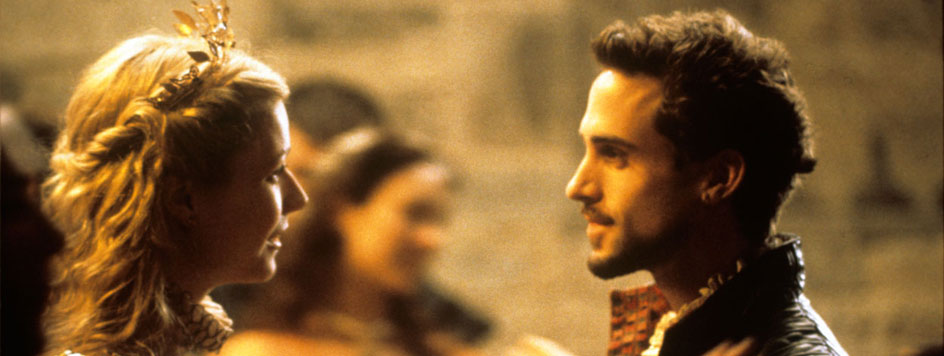
Worst Best Picture: Is Shakespeare in Love Better or Worse Than Crash?

1999_iconic_picture_actress_paltorw_fiennes

Alex Russell

In “Worst Best Picture” we search every single Best Picture Oscar winner of all time from 1927 to present to uncover the worst of them all. Conventional wisdom says that 2005’s winner Crash is the worst winner in history. We won’t stop until we’ve tested every last one. Read the the first, our review of Crash, here. Posts will be relatively spoiler free, but there may be some details revealed. Today’s installment is the 1998 winner Shakespeare in Love. Is it better than Crash?

While most Western storytelling owes an indirect debt to Shakespeare, there are two Best Picture winners that are directly Shakespearean: 1948’s Hamlet and 1998’s Shakespeare in LoveHamlet will have to wait.

The whole point of watching all 86 Best Picture winners is to gain an appreciation for nearly a century of film history. I wanted to see where film had come from and to watch that transformation through the films that the Academy had deemed “the best” every year. It’s not a perfect science for a number of reasons — taste chief among them — but it’s as good as guide as any.

hated Crash when I saw it. I hated it so much that I thought that it couldn’t possibly be as bad as I remembered it and I bought it to watch it again. It was worse — much, much worse — and thus this began. This is the 25% mark. We’re 23 down, 63 to go. Shakespeare in Love, a movie often called romantic but forgettable, seems as good as any for a benchmark.

Shakespeare in Love is the story of young Shakespeare trying to write what would eventually become Romeo and Juliet. He struggles, he falls in love with a woman who is promised to a man she does not love, and he finds his muse through a secret love affair. It’s a fine movie, the same way that waffles without butter and syrup are still fine.

There is absolutely nothing in Shakespeare and Love that is challenging or interesting. It’s just a series of events, well told and well acted, but not one that really engages. I didn’t get into The Artist, but I saw how someone could. I’m not entirely sure how someone could be swept away by Shakespeare in Love. It’s a film without challenges.

I’m loathe to invoke the odious “chick flick” as a term, and I won’t, but this movie feels like it’s just attempting “heart.” It feels like someone telling you to feel “warm” rather than making you feel warm. I was a sucker for the warmth of It Happened One Night, so I’ve got red blood in my veins. You don’t have to have Clark Gable to make me care about a love story, but man, this one just feels hollow. It certainly isn’t bad, but then again, it isn’t much of anything.

The Best Part: The acting is all over the map in this one, but Judi Dench is phenomenal as Elizabeth I. She gets in most of the movie’s best lines, which is good, because it would be a shame to waste her. I also like Gwyneth Paltrow’s portrayal of the female lead, and I haven’t really liked her in anything other than The Royal Tenenbaums.

The Worst Part: A movie about Shakespeare is obviously going to have to use some Shakespearean plot devices, but the scene where a man must portray a female servant to gain knowledge of someone’s plans is as subtle as an aircraft carrier. Gender swapping is a crucial part of the movie, and that’s fine, but still… eh. The whole movie just seems to have this lack of effort surrounding it, but I may be heavily influenced by the weirdness of Ben Affleck in the whole deal.

Is It Better or Worse than CrashForgettable is better than horrible. I cannot imagine what would cause Shakespeare in Love to be someone’s favorite movie, but I would want to know. If Crash is anyone’s favorite movie, that’s an entirely different story. That needs to inspire some kind of quarantine area situation.

Worst Best Picture Archives: Crash | Terms of Endearment | Forrest Gump | All About Eve | The Apartment | No Country for Old Men | Gentleman’s Agreement |12 Years a SlaveThe Last Emperor | The Silence of the Lambs | The Artist | A Man for All Seasons | Platoon | The Lord of the Rings: The Return of the King | The King’s Speech | Rain Man | The Departed | The Bridge on the River Kwai | Marty | Gigi | It Happened One Night | Driving Miss Daisy |

Alex Russell lives in Chicago and is set in his ways. Disagree with him about anything at readingatrecess@gmail.com or on Twitter at @alexbad.

Another Look at Maleficent: Should You See It?

Maleficent

Brent Hopkins

In our rarely-running kinda-series Should You See It? we talk about movies that just came out. You can figure out the rest of the premise from the title of the series. That’s right: We talk recipes. Should you see Maleficent?

I saw this with my sometimes girlfriend and I will admit I had no idea what it was, going into it. I had forgotten the name of the antagonist from classic animation and I just didn’t put the pieces together until the film started. As Mr. May put it, the film is about pleasing boththe parents and children of the audience with a reimagining of a simple good vs. evil story. This is something I think it does rather poorly, as I could not imagine enjoying this as a child because it is a gritty retelling. There are all the magical elements and attempts at humor to please younger audiences, but throughout I never got a lighthearted vibe from the film.

The film is awkwardly chopped up into three acts with the real weight of the story in the beginning and the end. The middle tries to be fun and happy, but the setup is so grim it feels truly empty. You are introduced to Maleficent and the humans and you instantly are slammed with the knowledge that humans are the worst things to ever exist. Maleficent is tricked in probably one of the most uncomfortable rape analogies that will assuredly go over a child’s head but will not for any adult. She is drugged and has her power (the most important thing to her) forcibly taken from her by someone she thought she could trust. Once this happens there is no point in time where I wanted anything but for Maleficent to reclaim her power. Angelina Jolie is captivating in this role and I am not sure any other actress could have owned the role as well. That being said, most of the other characters are flat in comparison.

Should you see it?

Yes, much like the movie Noah, which I wrote about before, Maleficent has its fair share of flaws and pacing issues, but I think any adult who has seen the original animation from Disney will be stunned that the same company put out this film. I can’t say if it was good or bad, but just that it left thinking about it more than the new X-Men movie did.

Brent Hopkins considers himself jack-o-all-trades and a great listener. Chat with him about his articles or anything in general at brentahopkins@gmail.com.


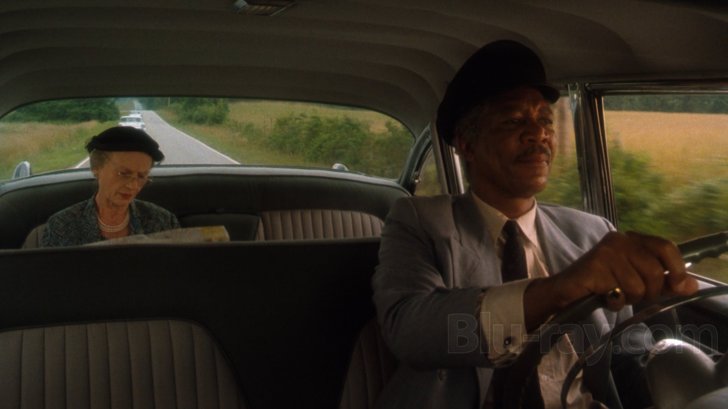
Worst Best Picture: Is Driving Miss Daisy Better or Worse Than Crash?

dmd

Alex Russell

In “Worst Best Picture” we search every single Best Picture Oscar winner of all time from 1927 to present to uncover the worst of them all. Conventional wisdom says that 2005’s winner Crash is the worst winner in history. We won’t stop until we’ve tested every last one. Read the the first, our review of Crash, here. Posts will be relatively spoiler free, but there may be some details revealed. Today’s installment is the 1989 winner Driving Miss Daisy. Is it better than Crash?

I was a history major in college. In every good discussion of race through American history, someone always mentioned that context was king. It’s easy to say “times were different and people were worse,” but you have to be able to put yourselves in some historical shoes to really get it. It’s not just about America’s troubling past, it’s about why people believe what they believe and act like they act.

A movie like Driving Miss Daisy does a lot of “what” without a lot of “why.” It’s a story you probably know to some degree: Morgan Freeman drives an old white lady around. That’s basically it. The old white lady (Jessica Tandy) in question is also Jewish, which I wasn’t aware of going in, but most of the “otherness” of the movie is all in white vs. black.

I gave it away in the intro, but if you had to guess what year a movie about an older black man driving an older white woman around as they learn about cultural differences and how to overcome them came out, would you have said 1989? The year the Berlin Wall reopened? That’s the craziest part, to me. The movie spans a few decades around the 50s and 60s, which helps to complicate the “should I feel this gross watching this?” element of it all.

It’s not a racist movie. The duo talks about MLK. They experience racial violence and are disgusted. They get stopped by racist cops. They share experiences over most of the twilight of their lives. It’s not racist, but it’s… awkward.

There’s just not a lot going on here. The lesson seems to be that if you’re already not racist in Georgia, you won’t be extra racist to Morgan Freeman. It just feels so unnecessary and so hokey outside of a few genuinely touching moments. It’s not quite sunny enough to feel as surreal as Gigi but it certainly is on-the-nose enough about race to feel at home on the shelf with Gentleman’s Agreement. The journey isn’t “mean racist lady” to “nice old lady,” it’s “mean old lady who hates Morgan Freeman” to “somewhat less mean old lady who loves Morgan Freeman.”

Watching this in 2014 is weird, but not for the same reason a lot of these are weird. With this one you just start to wonder what people will think about 1989 that people then needed this movie. It’s a well done buddy movie with an interesting pairing — James Earl Jones and Angela Lansbury are playing the duo now, and man, what? — but it ends up feeling pretty slight compared to some movies on this list.

The Best Part: The near-universal love for Morgan Freeman is deserved. He’s pretty spectacular in this role. He’s warm and hopeful, but he’s also a complete character. He’s loyal to the characters he’s sided himself with, but he’s not above making a play for a raise through leverage. He’s fascinating, and he’s what saves this from being a full-on weird relic.

The Worst Part: Dan Aykroyd was nominated for a Best Supporting Actor Oscar for his role as the son who hires Morgan Freeman. I’ll admit I’m sour on Aykroyd a little now because he’s become somewhat of a professional weirdo and hasn’t been in a good movie for a very long time, but he’s still downright bizarre in this movie. His Southern accent involves lots of “o” sounds, and he’s given the unfortunate task of violating “show don’t tell” to remind the audience they’re watching a movie set in Georgia. He keeps walking on screen and announcing things like, “You sound like Governor Talmadge!”

Is It Better or Worse than Crash? The character of Miss Daisy is Sandra Bullock’s character from Crash, but with some sort of a lesson. I talk about this part of Crash a lot. If you’re curious, most of her part of the movie is actually on YouTubeCrash is all built on people going from bad to worse in one way or another, but only poor Sandy goes from worse to… no change at all. They don’t redeem her or punish her. She’s just left as a constant device. Miss Daisy’s character doesn’t have much of an arc, either, but at least her relationship with her chauffeur does. Once again, the world of Crash is a meaner place than a movie where two cops call Morgan Freeman “boy.”

Worst Best Picture Archives: Crash | Terms of Endearment | Forrest Gump | All About Eve | The Apartment | No Country for Old Men | Gentleman’s Agreement |12 Years a SlaveThe Last Emperor | The Silence of the Lambs | The Artist | A Man for All Seasons | Platoon | The Lord of the Rings: The Return of the King | The King’s Speech | Rain Man | The Departed | The Bridge on the River Kwai | Marty | Gigi | It Happened One Night |

Alex Russell lives in Chicago and is set in his ways. Disagree with him about anything at readingatrecess@gmail.com or on Twitter at @alexbad.

Maleficent Tries to be Sleeping Beauty for Both Children and Adults: Should You See It?

Maleficent

Jonathan May

In our rarely-running kinda-series Should You See It? we talk about movies that just came out. You can figure out the rest of the premise from the title of the series. That’s right: We talk recipes. Should you see Maleficent?

Trying to make a movie appeal to everyone can be problematic. If it’s meant for children, studio executives/producers feel the need to also make sure the adults are in on the laughs and tears. While this might satiate everyone slightly, the end result is something almost unclassifiable: a hybrid movie with all the plot motivation and CGI a child could want with the postmodern self-consciousness and humor an adult would expect. Many times in the theater, I heard a child whisper to the attendant parent, “What’s happening?” If this question is asked during the run of a children’s film, then it is almost certainly a failure. The beauty of the original Sleeping Beauty film is in its simplicity; Maleficent, however, adds complication after plot complication, giving “adult” realness and motivation to the main character, ultimately making her more relatable to adults than children. This is the movie’s main flaw.

I wouldn’t want to spoil the ending in any way, but the complexity the film tries to attain through this ending certainly confused this viewer. I had assumed the Raven fellow (a stand-in for the companions of Odin: Huginn and Muninn) would end up being the one to break the spell; in that regard, I was wrong. However, I feel like the way the story was built (with Maleficent and her servant watching over Aurora), we were supposed to feel that way. I’m by no means begrudging the ending and its representation of the many different kinds of true love; I was just mystified by the movie’s many attempts to lead us astray in order to keep us guessing.

Should you see it?

Will this film be watched with the same fervor as Sleeping Beauty in 20 years? I quite doubt it. Though Angelina Jolie was a powerful force in this film, her power almost mutes the depiction of the other characters. Ultimately, this film falls between two worlds, an ever-widening divide as long as studio executives are calling the shots rather than the story-makers.

Jonathan May watches too much television, but he’s just playing catch-up from a childhood spent in Zimbabwe. You can read his poetry at owenmay.com, follow him on Twitter at @jonowenmay, or email him at owen.may@gmail.com.

Neighbors: Should You See It?

Neighbors (from The Daily Mail)

Jonathan May

In our rarely-running kinda-series Should You See It? we talk about movies that just came out. You can figure out the rest of the premise from the title of the series. That’s right: We talk recipes. Should you see Neighbors?

Neighbors is a movie that tries to bridge two kinds of comedies: the buddy comedy and the relationship comedy. The couple (Rogen and Byrne) uses the standard “bros before hos” as part of its trap against the fraternity invaders, backfiring wildly into what seems to be the start of a very different film. Needless to say, the film is billed as a comedy, so by stricter terms, it follows on its promise, reaffirming the relationship between the couple at the film’s heart. However, when I asked my friend Elizabeth what she thought about the focus of the film, she said it was more of a misguided bildungsroman for Zac Efron’s upper half, and I would have to agree. The movie tries to affirm some kind of epiphany on the part of the fraternity president as to what must come after graduation, yet it also clings more so to the couple’s determination to face what they must together. The new parents commit vandalism, trespassing, and (some may say) negligence to enact their wild schemes against the admittedly loud and obnoxious fraternity house 24-hour party machine; does this bring them down, or make it clear that some people will do almost anything to achieve comfort?

I’m no stoic; I laughed out loud plenty of times. Sex and drug jokes abound, reaffirming pot as the social drug of the new century. What really held the film together were the ancillary characters: Lisa Kudrow as the Dean, Hannibal Buress as the policeman, the fraternity as its own character. While I was compelled by the main plot(s) of the film as a comedy of manners, I found Efron to be stiff in front of the camera in contrast to the couple, a veteran pair in their own rights. Perhaps it’s because the film is of two minds that he seems weak in comparison; I’d never seen him in a movie previously. I did appreciate the continuation of the depiction of the American couple as two people who can be fun together, despite their seeming nefariousness as they manipulate others.

Should you see it?

What to take away? We get older, and it sucks sometimes, but sometimes it’s really cool. Abs help?

Jonathan May watches too much television, but he’s just playing catch-up from a childhood spent in Zimbabwe. You can read his poetry at owenmay.com, follow him on Twitter at @jonowenmay, or email him at owen.may@gmail.com.

Image: The Daily Mail

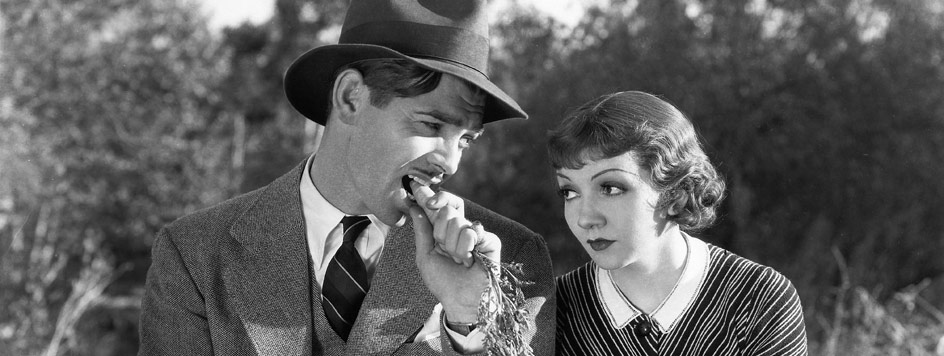
Worst Best Picture: Is It Happened One Night Better or Worse Than Crash?

ithappenedonenight

Alex Russell

In “Worst Best Picture” we search every single Best Picture Oscar winner of all time from 1927 to present to uncover the worst of them all. Conventional wisdom says that 2005’s winner Crash is the worst winner in history. We won’t stop until we’ve tested every last one. Read the the first, our review of Crash, here. This is intended to be mostly spoiler-free, but there may be minor details mentioned. Today’s installment is the 1934 winner It Happened One Night. Is it better than Crash?

It’s very strange to consider what has become the “canon” of romantic films. Movies like CasablancaRoman Holiday, and Annie Hall are the standards by which every portrayal of romance is judged. It Happened One Night escaped my radar for the most part, but it’s definitely a movie that is in that list of ideal films.

As I watch every Best Picture Oscar winner I am struck by how few of these I’ve actually seen. There are a ton of movies — How Green Was My Valley comes to mind whenever I look at the full list — that I am vaguely aware of, but mostly they just don’t exist in my mental database. I don’t claim to be a qualified judge of all of film history, but I do appreciate a good movie. It Happened One Night is a good movie.

Clark Gable is a down-on-his-luck reporter, and he stumbles across the biggest news story in the country when Claudette Colbert enters his life. She’s on the run from her rich father and on the way to New York to be with her new husband. There’s a reward for her return, and Gable plans to either collect or to cash in by telling her story. He’s just gotta not fall in love along the way, d’awww!

I won’t pretend I walked into a movie from 1934 expecting something genuinely sweet and funny. There are an insane number of cuts — one extremely important scene in a bedroom cuts three times in as many minutes — and some of the wackier stuff doesn’t really work. In the opening scene, Claudette Colbert jumps off of a boat to swim to Florida. A man runs into a swamp because he’s afraid. Another man is tied to a tree and left to die, and that story is just abandoned. A guy lands a helicopter at a wedding. There’s some wild madness going on in the background, but the leading couple carries the load of it well. They both give superhuman performances; they’re both interesting, memorable, and sincerely funny even by modern standards.

Some classics are “important” and some are good. I can’t speak to how crucial It Happened One Night is to the rom-com as a genre, but it’s a movie from eight decades ago that wouldn’t need much updating to be released this summer. It’s worth your time, even if you aren’t watching all 86 of these.

The Best Part: On their first night alone together the couple is forced to pretend to be married to avoid suspicion. It’s a very sweet scene, and it’s played with a mix of playfulness and restraint. Paired with a scene in the morning where they throw a fake fight/screaming match to convince the cops they’re actually married, it’s damned excellent. It would need zero updating to work in 2014.

The Worst Part: On the way to New York the couple hitchhikes with a guy who sings everything he says. He is completely unexplained. I cannot tell you why this man sings his sentences. At one point someone flies an “autogyro” into a wedding, and I can explain that more than this man.

Is It Better or Worse than CrashIt’s a Clark Gable romantic comedy from the 1930s. You don’t need me to write this to know it’s “a good movie.” It’s the kind of movie that makes this whole thing silly. Is it better than Crash? It has Clark Damn Gable in it. The point of this project is to explore the idea that awards and praise don’t necessarily mean a movie is “great,” but of course this one is. Above all else it’s fascinating how timeless much of it is. Some plot elements — a woman runs away and is front page news for weeks in a row — are absurd now, but the jokes all still work. It’s actually funny even in 2014. Crash was instantly dated and will get more so as time advances. This, so long as people can forget some of their cynicism for a second, will endure.

Worst Best Picture Archives: Crash | Terms of Endearment | Forrest Gump | All About Eve | The Apartment | No Country for Old Men | Gentleman’s Agreement |12 Years a SlaveThe Last Emperor | The Silence of the Lambs | The Artist | A Man for All Seasons | Platoon | The Lord of the Rings: The Return of the King | The King’s Speech | Rain Man | The Departed | The Bridge on the River Kwai | Marty | Gigi |

Alex Russell lives in Chicago and is set in his ways. Disagree with him about anything at readingatrecess@gmail.com or on Twitter at @alexbad.

 Image source: Oscars.org

Worst Best Picture: Is Gigi Better or Worse Than Crash?

Gigi Still #1

Alex Russell

In “Worst Best Picture” we search every single Best Picture Oscar winner of all time from 1927 to present to uncover the worst of them all. Conventional wisdom says that 2005’s winner Crash is the worst winner in history. We won’t stop until we’ve tested every last one. Read the the first, our review of Crash, here. All posts should be considered to have a blanket “spoiler alert” on them. Today’s installment is the 1958 winner Gigi. Is it better than Crash?

I don’t read a lot (any?) BuzzFeed, but when they put together a ranking of all of the movies that had won the Oscar for Best Picture, Gigi came in dead last. Since the stated goal of this whole thing is to find a worse movie than Crash that has earned the award, I figured the musical from 1958 deserved some immediate attention.

Leslie Caron plays the title character, a (very) young French woman in the process of learning to be a courtesan. Her older friend Gaston (yep) is famous for being rich, or something, and the two are star-crossed if for no other reason than they seem to be the only two people they’ve each ever met that aren’t immediate blood relatives.

They never say Gigi’s exact age, but she’s absolutely supposed to be a young teenager. She spends the entire first hour of the musical in ridiculously infantilizing clothing as her aunt teaches her the finer points of accepting jewelry and living to serve a man who owns her. I point this out to say that, yeah, it’s definitely a movie about some weird sexual politics, but it’s also completely divorced from “romance.” It’s about transactions.

BuzzFeed’s wrong on this one; I’m only 20 movies into the entire 86-film roster at this point and I know this one’s not the worst. That said, it’s assuredly strange six decades years later. There’s no place in modernity for a two-hour explanation of why you don’t have to put on the red light, and if there is, there isn’t a place for it to pretend that it’s one of history’s great romances.

The Best Part: Maurice Chevalier plays a ridiculous perpetual bachelor who spends the entire movie telling everyone how awesome it is to be old and not in love. He shares a song about it with an old lover and though I’m no big musical buff, I couldn’t help but smile at “I Remember It Well.” It’s “funny for a musical” but it’s very close to “actually funny.” It’s a big improvement over the supremely strange “Thanks Heaven for Little Girls.”

The Worst Part: Poor Eva Gabor shows up for about five minutes as the “cheating mistress.” She’s sleeping with another guy — note this is “another guy” on top of someone who treats her as property — and when she is discovered it gets put in the newspaper. This in the first 20 minutes of the film, so I can say this without a spoiler: Everyone then has a bunch of literal laughs about Eva Gabor’s character’s supposed attempted suicide. The movie explains this away as just part of being a bought woman in 1900, but this movie pairs well with The Apartment as tone-deaf with suicide jokes. How many more movies with suicide jokes could there be?

Is It Better or Worse than CrashGigi is a musical, so your milage may vary based on how much you can stand a movie with 15 songs in it. Both movies certainly have roughly the same message about women: Only miraculous ones can escape the social ties that bind their respective times. They differ in that Gigi is a kind of loud, proud class warfare movie about how awful it is to be low status, and Crash thinks that status doesn’t matter at all. Everyone in Crash is awful, and that’s sorta the whole point of the world it sets up. They’re both “mean” messages, but Gigi‘s is delivered in an oblivious song with bright costumery. There is an argument that a big dumb musical about how love doesn’t matter as much as being rich is a bad movie, but it feels more like a historical oddity than the death-march against social change that is Crash.

Worst Best Picture Archives: Crash | Terms of Endearment | Forrest Gump | All About Eve | The Apartment | No Country for Old Men | Gentleman’s Agreement |12 Years a SlaveThe Last Emperor | The Silence of the Lambs | The Artist | A Man for All Seasons | Platoon | The Lord of the Rings: The Return of the King | The King’s Speech | Rain Man | The Departed | The Bridge on the River Kwai | Marty |

Alex Russell lives in Chicago and is set in his ways. Disagree with him about anything at readingatrecess@gmail.com or on Twitter at @alexbad.

 Image source: oscarwinningfilms.blogspot.com

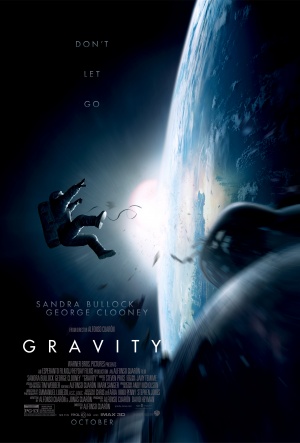
Life After the Star Wars Expanded Universe: Alfonso Cuarón’s Gravity

 Gravity_Poster

Andrew Findlay

In Life After the Star Wars Expanded Universe, we take a look at science fiction and fantasy, why they’re great, and what they say about where our species has been and where it’s going. 

Gravity is a space film. It is also the winningest movie of the 86th Academy Awards, bringing home seven Oscars. It deserves every single one. It took me half a year to actually watch this, which is strange considering how I prioritize my media consumption mostly by putting anything that involves spaceships on the top of the pile. What I watched when I finally got around to it was a sparse, tightly-woven film about what happens when something minor goes wrong in an extremely hostile environment. Gravity is devastating in its simplicity. After a fairly brief intro period, there is only one character, and her only enemy is the title of the movie – the force of gravitation.

Gravity’s great! It keeps you from flying off the face of the Earth! Wonderful! However, if you are in orbit, your relationship to gravity becomes markedly less benevolent. Orbit amounts to controlled freefall. In orbit, you are falling at an exact velocity and an exact trajectory that maintains you or your craft in a circle around the planet. At the end of the day, you are still just falling, so if anything at all goes wrong, your orbit will turn into a more everyday type of fall, and you will catch fire and burn to death in the mesosphere. In addition to the falling problem, Earth’s gravity keeps an impressive amount of space debris in a cloud around the planet (19,000 discrete pieces over two inches). It’s fine if it’s just sitting there, but if it or you is moving fast, there is a significant collision danger. The International Space Station orbits at around 17,000 mph. Imagine getting hit in the face with a professionally-thrown baseball (90 mph). Now imagine one or many baseball-sized things hitting your orbital craft at 200 times that speed. This is basically what happens in the first fifteen minutes of Gravity.

750px-Debris-GEO1280

Each white dot is something that could kill you

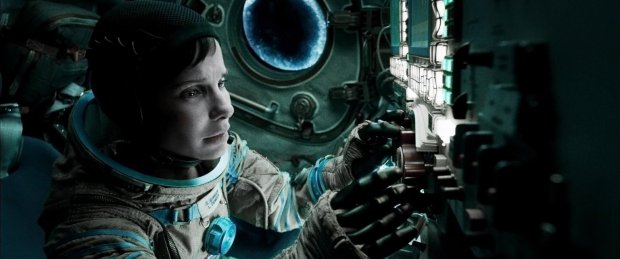
The initial destruction caused by space debris leaves Dr. Ryan Stone (Sandra Bullock) completely alone in space, desperate to find a way back home. Well, a survivable way back home. If she lowered her standards, she could get home by simply pushing off in the general direction of Earth. In addition to the general destruction of devices and networks meant to keep humans alive in low Earth orbit, communications satellites are also down, which means Stone is alone not only physically but psychologically. With absolutely no communication with Houston and the nearest human being about 200-300 miles straight down, Bullock’s character becomes the most isolated individual in human history. This isolation and Stone’s lopsided struggle with a hostile and decaying environment combine to make one of the cleanest, most perfect pieces of suspense fiction of the past few years.

With only one main character bouncing around in a terrifying situation she neither asked nor prepared for, all the the viewer’s chips are in one pot, so to speak. In Aliens, everyone around Ripley just dies and dies and dies, and that only serves to ramp up the tension for Ripley’s own survival. In Gravity, you only get one, and if you break it, that’s it. From almost the beginning of the conflict, this dynamic forces a stronger level of investment in the character and results in a higher level of terror. The total focus on one character also allows the deep exploration of that character’s psyche – she talks to herself because there is no one else to talk to, and she talks about her daughter, her life, her hopes, and her fears. Following her on her journey from space installation to space installation in her desperate quest to survive is one of the most enjoyable narrative achievements of the past year.
MV5BMTc0ODc4NjM4MV5BMl5BanBnXkFtZTgwMTgwNzIyMDE@._V1__SX1537_SY680_

Probably the best-done female character in all of science fiction

Gravity is billed as a science fiction film, and an interesting question is why? There is no futuristic technology, no aliens, no psychic powers or mutation. This film uses no technology that does not exist, so why is it science fiction? SF is about more than the future, time travel, and warp drives. It is about technology, the changes engendered by it, and the relationship of humanity to it. One of the best science fiction novels out there, Cryptonomicon by Neal Stephenson, has at its core cryptography and information science. The science fictional aspects of the book focus on a well-developed technology that has existed since time. It specifically explored its use and misuse in WWII and the 1990s. As the pace of change and technological development increases, science fiction becomes more and more just normal fiction. It is not the milieu into which we project our imaginations, but the milieu in which we live. In the Middle Ages in Europe, the life the grandfather led was the life the father led was the life the son led. My grandfather started a family when color television was a pretty swell new thing, my father started a family when personal computers could process text, process numbers, and play Snake, and now I’m living in a world where this single machine on which I am typing gives me access to more information than I could process in my entire life, videophones are a reality (FaceTime and Skype), people walk around with mobile computers in their pocket more powerful than the NASA computer that sent men to the Moon, medical professionals can literally print human organs, and human beings temporarily live in space. We cannot escape from SF as the basis of many of our stories because the future arrived yesterday, and continues arriving yesterday every time the sun rises. It is simple to build an entire narrative from the basic theories and problems of space habitation as they exist now.

Candy_Crush_Saga_game_setup_example

Pictured: the OS mission control used during the Apollo 11 flight

Cuarón built Gravity on the theory of gravitation (sure) and the problem of the Kessler syndrome. I’ve already discussed the problem of orbit as a controlled fall, but the Kessler syndrome is a very real concern of space agencies today. Basically, there’s so much crap floating around above us that one little explosion or impact could cause an ablation cascade, wherein the fallout from one event then collides with and destroys other objects, the fallout from which then collides with and destroys more objects, on and on until everything upstairs is well and truly fucked. NASA’s main concern with this possibility is that it could take out many of our satellites and render space unusable for generations, but in Gravity, this ablation cascade directly threatens the main character’s life. Bonus: due to gravity, she gets to deal with 17000 mph debris circling around the Earth and returning for another hit every 90 minutes! The danger, isolation, and unknowability of space come to the fore in this film. Terror in the face of the unknown or in the face of forces much larger than we could control or comprehend is a main theme of SF. Gravity shows us that we do not need to go to Alpha Centauri to find those forces – one of them exists right here, keeping our feet firmly glued to the ground.

Andrew Findlay has strong opinions about things (mostly literature) and will share them with you loudly and confidently. You can email him at afindlay.recess@gmail.com.

Worst Best Picture: Is Marty Better or Worse Than Crash?

Ernest_Borgnine-Betsy_Blair_in_Marty_trailer

Alex Russell

In “Worst Best Picture” we search every single Best Picture Oscar winner of all time from 1927 to present to uncover the worst of them all. Conventional wisdom says that 2005’s winner Crash is the worst winner in history. We won’t stop until we’ve tested every last one. Read the the first, our review of Crash, here. All posts should be considered to have a blanket “spoiler alert” on them. Today’s installment is the 1955 winner Marty. Is it better than Crash?

Clara (Betsy Blair) meets Marty (Ernest Borgnine) after being left on the dance floor by her terrible date. The two see themselves as similar and hit it off. It’s a date movie! Love is in the air! Kinda.

Marty is a fat — I mention the “fat” because he does a lot — butcher and the last single person in his family. His ma is ready to be rid of him, so she sends him down to the dance hall to meet a nice Italian girl. He meets Clara, a “dog” of a woman — I use that term only because every single character does even more than you can imagine for real it is crazy — who also has the audacity to be a schoolteacher. There’s a lot of 50s mores going on in this movie: Marty is obsessed with talking about how being a butcher makes him no good, everyone is worried about dying alone in their 20s, one character has to be talked down from saying every man should be 20 years older than their wives, etc.

The world of the 50s explains a lot of what’s going on, but it doesn’t explain Clara’s personality. Nathan Rabin invented the term “manic pixie dream girl” to describe a specific character archetype in film: poorly written female characters that exist solely to further the emotional development of sad, lonely men. Marty is plenty sad — he talks about suicide on his first date with Clara — but Clara isn’t even enough to be considered the shell of a personality that the manic pixie occupies. Clara is nothing; she almost never even speaks. She’s upsetting in a 2014 sense because she struggles in a world that can’t accept her, but she’s ridiculous even in a 1955 sense because she just seems so damn bored in her world.

The Best Part: Marty is a great character, even if the rest of his world is pretty damned mean-spirited. The movie goes pretty far to establish his happy-go-lucky attitude by raining emotional garbage on him from every direction, but it’s a testament to the performance that Ernest Borgnine still seems to be playing a real, unfortunate person.

The Worst Part: It seems like my “worst part” is “the female characters aren’t developed” fairly often, but in a movie like Marty it becomes really impossible to ignore. Everyone in the world of Marty is fairly simple and awful — aside from Marty, of course — but his blushing would-be bride is full-on tabula rasa. She gets no dialogue outside of some short responses and one monologue full of information Marty tells her to say. Betsy Blair does as much as there is to do, but damn there’s not much to do.

Is It Better or Worse than CrashLet us consider a part of Crash we have not considered thus far: Could it be seen as a love story? It’s an absurd way to view a movie that is best summed up as “a defense of racism as the only justifiable ethos,” but it is the way we must view it to compare it to Marty. Both films have essentially only one married couple. In Marty it’s the main character’s miserable brother and his new bride. In Crash it’s a black television director and his wife. Both sets of couples are miserable, but only in Marty is it treated as a sad situation. In Crash, like all the other awfulness, marriage is treated as a sad, unavoidable result of living in the miserable world that Crash creates. In this way, yet again, Marty is a better movie because even a film about loneliness and almost giving up is more hopeful than a boot stomping on the face of joy forever.

Worst Best Picture Archives: Crash | Terms of Endearment | Forrest Gump | All About Eve | The Apartment | No Country for Old Men | Gentleman’s Agreement |12 Years a SlaveThe Last Emperor | The Silence of the Lambs | The Artist | A Man for All Seasons | Platoon | The Lord of the Rings: The Return of the King | The King’s Speech | Rain Man | The Departed | The Bridge on the River Kwai |

Alex Russell lives in Chicago and is set in his ways. Disagree with him about anything at readingatrecess@gmail.com or on Twitter at @alexbad.

 Image source: Oscars.org