books

Infinite Entertainment: Postmodern Maximalism and the Serial Television of Today

Austin Duck

Pages want to be filled” –Stanley Plumly

Lately (and by lately I mean over the past five years or so), I’ve become transfixed by two things: postmodern maximalist literature (read: big fucking books written after 1970) and serial television. I would actually go so far as to argue that they produce the same effect across two different mediums, that great serial television and long, long novels employ the same techniques toward the same effect, but in different mediums. And they both completely obsess us. They drive us day after day to watch hours of Netflix, to lug around huge tomes like Infinite Jest or 2666 or The Luminaries or Seiobo There Below on the subway while looking like assholes, to have us struggling and stuttering when we’re asked things like “doesn’t that seem like a waste of time,” because really, no, it doesn’t, but it’s not easy to say why I can justify watching 30 hours of TV in a weekend or spending a month reading a novel, but I know it’s vital. I know it is.

Yes, both require time, considerable time, hours and hours of our lives invested in both plots and characters, but also in the cities of their settings, the minutiae of daily lives, and the large-scale, totalizing cultural patterns that exist in the narrative’s “eye.” (Sorry, I don’t know how to talk about both the scope of a novel and a TV show simultaneously in a non-pretentious way… it is, after all, an ‘eye/I’ that we’re watching all this though… Okay, my head’s out of my ass now). And, ultimately, as simple as it seems, that is what unites these two mediums; they take a lot of time, and give themselves the space to be simultaneously obsessed by individuated lives while archetypalizing (is that a word?) those thousands of individual patterns to make a larger statement about the “eye’s” culture(s).

For too long, people have tried and tried to equate film and novel, and it just doesn’t work. Novels, in general, are too complex. I’ll assume that you all read in high school and acknowledge that Baz Luhrmann’s The Great Gatsby was a colossal pile of crap. Yes, you can hack out the basic plot of a novel for a movie, and yes, you can create period sets and costumes and just really evoke the shit out of culture of the text, but you’ll never get it. And you’ll never get it for this reason: film, like poetry, can rarely (if ever) accommodate more than a handful of characters. Think about it.

Poems can rarely handle more than one character and, while exceptions do exist, primarily revolve around a single “I” speaking the text. Everything included, then, is meant to weigh on the I, to create empathy with the I so that you, the reader, can experience the revelation as the “I.” While I know better than to make totalizing statements about “what poems do,” I’ll say that, majority of the time, in English language poetry from the mid 18th century to now, the object has been to create empathy with a speaking I (“Dead white-guy poetry,” I think they call it). As I’m sure you already know, movies are, by and large, the same. Rarely can a film tell the story of more than one person, unless the other parties involved are directly linked to and involved in the action of the primary character, the hero (think any of the Ocean’s movies, for example). In film, the hero’s narrative controls the landscape of other characters, creating a singular story.

This is where those train-wreck movies like Love Actually and Valentine’s Day fail; they create too many narratives that become, in a way, abstract. They fail because they take on the architecture of a maximalist novel (or of serialized television), but they don’t have the space to become stories; instead, they watch as hypothetical, as constructed; we feel their intentions because we are having the same single-sentence synopsis (“You will find the love you deserve on Valentine’s Day”) reiterated 10-12 times over the course of 100 minutes. Sure, these movies are great cash-grabs, packing the screen-time with more celebrities than I can even pretend to know (I’m more of a TV guy, remember?) but they have always failed and will always because there’s no texture, no space, no way to allow these characters to transition from an undergraduate thesis statement to living, breathing characters.

Postmodern maximalism, on the other hand, is all-space all the time; it comes with a commitment of its own. Its investment lies not in telling a quick, punchy story; you will literally never read a book over 600 pages and think “wow, that went by fast,” and this will never happen for a reason: one cannot sustain that kind of attention or argument (because, honestly, all art is argument) on plot alone. Instead, these works (just like serial television) rely on small details of characters, what they eat for breakfast, what kind of drugs they take, a complete filmography documenting the life’s work of their auteur father, etc. They rely on multiple compelling plots coming to the surface, creating mirrors of one another to make a single, more complex point (the “eye’s culture” as I pretentiously claimed before) without actually saying it aloud. Think about it this way: maximalist literature and serial television work less to “tell a good story” than they do to build a kind of collage, you know the kind, where they use a bunch of little pictures to make a big picture. That’s what this kind of art does; it’s meta.

But so the fuck what, right? What do you care? Postmodern pastiche and cultural meta-analysis belong in one place (and that’s up the asses of bearded white guys with thick plastic glasses, amiright?) Well, yes, you are, in a way. But think about it my way (says the bearded white guy with thick plastic glasses): these serial TV shows are drawing us to our Netflix queues (do they still call them that?) day after day for these binges. I don’t think a day goes by when I don’t hear someone talking about Girls, The Wire, Mad Men, or Breaking Bad and there’s a reason for that. I don’t know what it is, but I think this is my forum for guessing, and I’ll take a shot. We’re fucking tired of the simplicity of narrative transmission. That doesn’t mean the old way is bad (or that postmodernism is better than anything else, because jesus shit, it’s really not); it simply means that, for most of us consuming this stuff, we’ve grown up in a “multicultural, multilingual, linguistically and epistemologically decentered” world. We live in a world of relativism where there is no Truth, no God, only small, subjective truths and gods. And maximalism represents that complexity.

We don’t have a hero because there are no heroes; instead, we have a foreboding structural presence (whether it is economics, bureaucracy, neo-liberal capitalism, or the entertainment) that drives all of our poor stories to play out in one way or another while we, as silly as we are, try being human despite it all.

Image credit: The Guardian

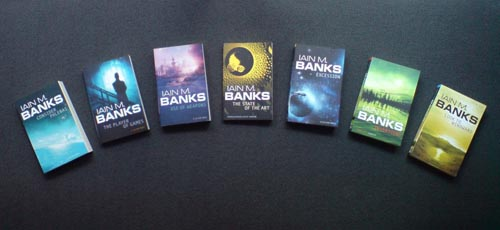
Iain M.Banks: Life After the Star Wars Expanded Universe

Andrew Findlay

Iain Banks died last June. He announced a couple months beforehand that he had been diagnosed with gallbladder cancer and that he didn’t have long to live. He was not mistaken. Iain Banks’ first really popular novel was The Wasp Factory. It was published in 1984, and it was about a kid that kills animals, murders siblings, and is just generally fucked up. It was very well received in the literary community, so much so that Banks made a list of the top fifty British writers of the 20th century. That’s not the Banks I knew. I knew Iain M. Banks. Iain M. Banks wrote science fiction.

The need for many in the literary community to separate science fiction from literary fiction is something I’ve been whinging about for years. The assumption that a novel with spaceships cannot also have well-developed prose, plot, and characterization has kept a lot of people from reading a lot of really good fiction. In general the plots of SF novels are put together a lot more tightly and with a lot more craftsmanship than those of a lot of modern literary fiction novels, the worst of which consist of a lot of standing around, speaking words, and doing nothing. I’m reminded of the Eddie Izzard bit about British cinema (“What is it Sebastian, I’m arranging matches”). You can’t eat popcorn to that.

In any case, Banks started to write science fiction while continuing to write literary fiction, and his publisher decided that, to prevent confusion, Iain Banks would be his Serious Fiction name, and Iain M. Banks would be his science fiction moniker. I have read nothing with Iain Banks on the cover. I have read almost everything with Iain M. Banks on the cover. What exactly does Iain M. Banks write about? He mostly writes about the Culture.

The Culture is present in almost all of Banks’ science fiction books. It is arguably his greatest creation – this galactic society is the cornerstone of his vast fame in the science fiction community. The Culture is an extraordinarily advanced post-scarcity society. It’s an anarchistic civilization, but in a society that has the material means to make anarchy a feasible proposition, “being an anarchist” isn’t really a considered position as much as it is a fact of life. Energy is limitless, technology meets every physical need of every citizen, and there is true equality because, with all of their basic needs more than met, people basically just hang out. Healthcare is at such an advanced stage that Culture citizens are freed from nearly every constraint that comes with being a meatsack. People are biologically immortal unless they decide not to be (which happens often – people get sick of breathing after a millennium of it). Most are implanted with drug glands that generate any of many combinations of drugs – uppers to stay awake, downers to relax, mind-enhancing cocktails for high-stress situations, etc – without any type of hangover effect or physiological drawback.

All these biological hacks are great, but what highly advanced spacefaring society is really worthy of the name without really cool spaceships? Culture ships are more than just transport – they also house the entities that make the Culture possible – the (capital M) Minds. A Mind is an AI in the post-bootstrap stage. Skynet became sentient and decimated humanity, the Minds became sentient and were a whole lot nicer than Skynet. They like humanity, and they work with humanity to help improve everyone’s lot. Each ship houses a Mind in a relationship in which the ship is the Mind – what your body is to your brain, the ship is to the Mind. Each Mind has a distinct personality, and its name reflects an important aspect of that personality. These names range from fairly silly or esoteric for standard vehicles (What is The Answer and Why?, Experiencing a Significant Gravitas Shortfall) to vaguely threatening for warships (the firmly tongue-in-cheek Frank Exchange of Views, the terrifyingly ominous You’ll Clean That Up Before You Leave).

Wait, why does a perfect utopian society need warships? Well, there are other people in the universe, and the general attitude of Culture Minds is that you can’t really be free if you can’t also blow the hell out of anyone who might threaten that freedom. In order to ensure their own growth and survival, the Culture created a covert branch called Special Circumstances. Life is unadulterated freedom and happiness if you actually live in the Culture, but that would be boring as hell to explore (Sebastian, Matches). SC is where the mayhem is, and as a result, it attracts an element that most members of the Culture find strange or even distasteful. Impatient, violent, impulsive, both ship Minds and people. This is where you see fewer ships with names like Not Invented Here and What Are The Civilian Applications? and more ships with names like Hand Me The Gun and Ask Me Again or Outstanding Contribution to the Historical Process. Banks almost always sets the Culture up against a less advanced civilization. The end result of the massive technological gap between the two societies in conflict is one of the great pleasures of the series, where the protagonist usually outmatches their enemy to such a ridiculous extent that it creates a strange feeling of glee, like when some asshole with a switchblade tries to attack Batman in a dark alley. He doesn’t have a chance, that’s not the point, but it’s so fun to watch Batman give him what’s coming to him. It is fiction candy to watch dumb, violent thugs get obliterated by the frighteningly intelligent, violent psychopaths in Special Circumstances.

But wait wait wait – how is this type of meddling and big-stick-carrying not imperialism, pure and simple? It seems diametrically opposed to the love, peace, and understanding vibe of the Culture as a whole. This is addressed somewhat in the books, but mostly Banks explains it away with the “those decisions are made by unimaginably advanced and hyperintelligent AIs, so just Trust Them” defense. Morally, it’s not really an acceptable position, but this is where suspension of disbelief comes in. It’s not really harder to accept that Minds really do know best when it comes to waging just war than it is to accept that superhuman intelligence manifests and then decides to be humanity’s best buddy.

The series is amazing, but some of the individual books suffer from plot momentum, wherein the major issues of a 627-page book barrel into the last twenty pages at full steam, entirely unresolved. Those twenty pages are absurdly entertaining, but the overall fabric of the plot frays a little if the ending is this rushed. Each separate book is not the point though. The world Banks builds is the greater gem by far. You have to take each book as a part of the whole, and the whole is a massively free, open, and just society where humanity (or a single humanoid society at least) is untrammeled by hierarchy, taboo, or power.

The belief that such a society could exist under any circumstances is an act of optimism. The future of humanity on Earth will branch one of two ways – either we’ll utterly destroy ourselves with any one of hundreds of man-made catastrophes or hang in there long enough for our technology to propel us to what we poor 21st-century slobs would consider Garden of Eden status. I choose the act of optimism. It’s important to be able to look through a window at a place that is not insane, in this time when people are still killing each other for worshiping a different man in the sky, when the basic climatological makeup of our world is about to change drastically and irreversibly, and when twenty percent of children in the most obscenely wealthy nation on this rock have trouble getting enough food to eat. Flirting with and making entertainment out of our imminent self-destruction is a very popular pastime – just look at The Road, Fallout 3, The Walking Dead, 1984, etc. This is all well and good, and it’s important to process just how fucked we all might be, but it’s equally important to hold on to a little optimism, to believe in what could be, and to hope that, against all odds, our dumb-as-hell, shoot-yourself-in-the-foot little species can make it somewhere nice. I recommend starting your journey with Player of Games.

Image credits: Wiki, NASA, space.com