film review

Is Paprika the Best Movie of All Time?

This is Best Movie of All Time, an eternal search for the greatest film ever. Read the full archives here.

Where do you start on search for the greatest movie of all time? The temptation to start with Citizen Kane or something similar is strong, but I am going to start with an anime. Wait, c’mon, stick around. I promise, this is all about something you’ve seen. No, really! Just read to the end.

I’m more comfortable talking about things I don’t like than things I do like. I spent a year watching every single movie that ever won Best Picture at the Oscars just to dunk on Crash, which I still think is the worst movie to ever win the Academy’s most prestigious award. Crash opens with a discussion of coffee and spaghetti. I really can’t get into it here, you can read my 90+ part series if you want to know more.

Crash is not the worst movie I’ve ever seen. I grant that title to mother!, which makes me mad to even stylize that way, but director Darren Aronofsky insists that it is lowercase and ends in an exclamation because that symbolizes the climax. I am not going to spend much time on it, but the audience in the theater when I saw it literally laughed and booed at mother! and they were right to do so. It’s a disaster and a divisive allegory that may not be the worst movie ever made, but it’s certainly the experience I enjoyed the least. Aronofsky says it’s about environmentalism, but that seems like an impossible reading of a movie about the power of creative people and how they misuse it. I could spend forever on this, but I’ll just leave my cards on the table and say that’s the bottom of the barrel for me.

I mention it because I think Darren Aronofsky is a great director. Pi is haunting, even all these years later. Requiem for a Dream is a masterpiece. But I want to talk about Black Swan.

Black Swan is a movie about ambition. You’ve probably seen it, but even if you haven’t we aren’t going to spend much time on it. It’s about a ballerina trying to reach professional heights and the fears and challenges that come along with that journey. It deserves a lot more space, but this is all an introduction to another movie. It’s not even an Aronofsky movie! What are we doing?

Black Swan is not a shot-for-shot remake, but it borrows really, really heavily from the anime Perfect Blue. You can watch YouTube essays if you want to know more, but it’s enough to say that Perfect Blue is a horror movie about a star reaching for more and finding the journey more complex than anticipated. It’s definitely not a “rip off” or anything, but it’s clear that Aronofsky saw Perfect Blue and made his own version. He says that’s not what happened, but you can watch for yourself. Black Swan is an excellent movie and I don’t personally think it matters that he got some inspiration from an anime, but he seems to be pretty touchy about it.

This is how we get to Paprika. Satoshi Kon directed both Perfect Blue and Paprika, among other movies and series, and he was asked about the similarities in major Hollywood fare and his movies somewhat often. You can look up his reactions, but it seems to me like he always acknowledged the similarities but didn’t seem to care. Quentin Tarantino has made an entire career out of “homage” which can border on “theft” and directors seem to do the same thing to Kon.

Inception steals some images directly from Paprika. Several content creators have done a better job than I could do proving it, but the most striking is a scene where Elliot Page approaches a mirror and ruins the illusion of the dream in Inception. This is directly, exactly, lifted from Paprika, where it happens for the same reason. Does that matter? It’s weird, to be sure, especially if you’ve seen Paprika first.

I hated Inception when I saw it new. It felt impossible to follow and it felt deliberately messy. I rewatched it this year and liked it a great deal more, but it still feels like it forces you to look really closely at the magic eye drawing it presents and it doesn’t necessarily reward you for “getting it” so much as it does string you along. I am finding myself less and less interested in what Christopher Nolan has to say as a filmmaker, but even with that caveat I think Inception is better as an action movie than it is as a puzzle.

Paprika, then. It’s an anime from 2006, from Satoshi Kon, who also made Perfect Blue, Tokyo Godfathers, and Millennium Actress. Paprika is about a technology that allows people to go inside dreams. Inception is deeply concerned with the “how” and spends a tremendous amount of time making sure you follow how it’s all possible. Paprika doesn’t give a damn. Put this headset on, it’s time for a parade.

I think that’s why Paprika works. It’s enough that we buy that this is possible because some handwaving, technical explanations from science-types tells us it’s possible. That’s how it would actually work, anyway. We wouldn’t need someone to take us in a dream and tell us a long story about the physics of dreams, we’d just see it on Twitter and accept it. Paprika spends more time on the experience and ends up being a more enjoyable film as a result.

Christopher Nolan clearly saw Paprika. Both movies are about going in dreams and solving a problem. Both movies are about getting lost in an experience. Both movies are about the hero being the one person who can navigate this impossible, mysterious space. But it all kinda ends there.

Inception is dark and horrible. Everything is black and gray. Everyone has an assault riffle and everyone works for a shady military organization. Everyone has a tie. Everything is Extremely Serious All The Time. That’s Christopher Nolan’s whole aesthetic and it seems to be working for him, Tenet excluded.

The character Paprika in Paprika is the dream avatar of our main heroine and it works exactly like Leonardo DiCaprio’s character in Inception. The difference is that she seems to be still having fun with it, transforming into multiple forms and dancing around in a red shirt and constantly smirking through the dreams she invades. The tone isn’t all that different in the two movies, but the presentation couldn’t be more different. The nightmare in Paprika isn’t a train crashing through a city block, it’s a parade of frogs and statues that sings a happy nonsense tune. It’s dire, obviously, but what fun!

If Inception has a message, it seems to be that dreams are sacred. Our characters muck around in someone else’s experience and are forever changed. Paprika also wonders if this is something we all should be doing, but finds a slightly different answer. Satoshi Kon isn’t Christopher Nolan, but you probably got that from the box art. I recommend you watch both. It’s a better transformation than Aronofsky was able to make, at least.

Paprika is all about the visuals. It’s an explosion, from start to finish, and the logic behind it never really matters all that much. We learn about the bad guy late in the narrative and his motives never go beyond surface level. It’s all about what you see and how they render it. Anime can tell a story, obviously, but it is best when it does so in a way that live action cannot. The medium matters here and I think it’s a great first watch even if you’re not the kind of person that would normally watch something like this. Christopher Nolan certainly did.

Is it better than the last movie we looked at? It is the first one. In future entries, we’ll answer this question, starting with Paprika.

Is it the best movie of all time? It is the first one we’ve looked at, so yes, for now, Paprika is the best movie of all time.

You can watch Paprika on Amazon for $2.99, at the time of this writing. You can also watch Inception for free on Amazon (if you have Prime). You can recommend a movie to me for this series through email at readingatrecess @ gmail.com or on Twitter @alexbad and I will watch it, no matter what. Try to pick something good.

Dracula Untold: Should You See It?

image source: ign

image source: ign

Brent Hopkins

In our rarely-running kinda-series Should You See It? we talk about movies that just came out. You can figure out the rest of the premise from the title of the series. That’s right: We talk recipes. Should you see Dracula Untold?

October has finally rolled around and with it comes the ghouls and ghosts of the season in movie form. Living out in South Korea, I rarely have information about new releases beyond “Oh, this is in English, so I can watch it.” That being the case, I had been itching to see something in theaters for about a week and this looked like it would be a passable movie to quell that urge. The movie follows Vlad the Impaler, who was taken by the Turkish as a boy and then rose back to power in his hometown of Transylvania to resist their power. Vlad is well-known as a badass in this universe for his ruthless habit of impaling folks in fields. The story picks up with Vlad having retired from the shish kebab business and becoming a family man. The Dracula element is kinda thrown in as the Turkish legion wants 1,000 boys to join the Turkish army, including Vlad’s son. Vlad obviously says “eff dat noise” and decides to make a deal with a vampire. This vampire has been chilling in a cave for a long time and a trade is made where Vlad gets the vampire’s powers for three days but if he drinks human blood he becomes a permanent vampire and “something” happens with the original vampire. I know that last part is vague, but for the life of me I did not understand what the point of the cave vampire was other than the magical element. He gives up the powers and then is a complete non-factor for the remainder of the movie.

image source: bloody-disgusting.com

image source: bloody-disgusting.com

“I am a power piñata”

The movie itself is a complete mess. There are a ton of characters that get no explanation and seem to serve no point other than to patch plot holes. Vlad has decently cool powers, but it is a bit boring watching a one man army destroy normal people (Superman syndrome). The pacing is also a big issue in this movie as there just seems to be too much information to relay to the audience while also trying to be an action movie.

My biggest issues are the action sequences towards the end of the film. Things get ridiculous in a hurry and they stay that way for around 35 minutes. At one point, I turned to my date with my mouth agape at how stupid this all felt and she pushed my head back forward only for us both to see a scene that was even more ridiculous than before. She quietly shook her head and I went from muffled laughter to head-shaking disgust until the credits rolled. We both apologized for the film afterwards and vowed to do a little research before going to see the next movie.

Should You See It?

This movie has the framework of a potential blockbuster but it felt like the screenplay was written by a 10-year old, on set. I do respect it for getting so insanely bad that I wanted to see if it could maintain this level of failure, because it isn’t just mediocre throughout, it gets exponentially worse from start to finish. Watch it if you like films that are unaware that they are terrible, but otherwise steer clear.

“Rowdy” Roddy Piper’s 80s Movie About… Frogs: Should You See Hell Comes to Frogtown?

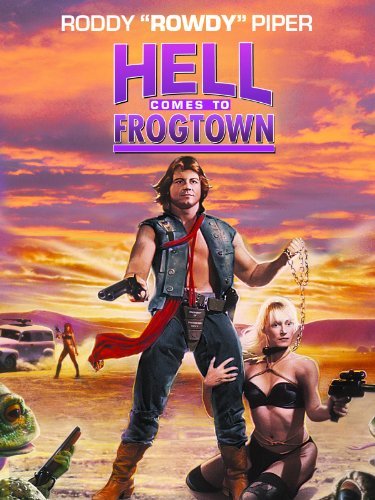
51bWelauwVL._SX500_.jpg

Gardner Mounce

In our rarely-running kinda-series Should You See It? we talk about movies that just came out (or have “Rowdy” Roddy Piper in them). You can figure out the rest of the premise from the title of the series. That’s right: we talk recipes. Should you see Hell Comes to Frogtown?

Hell Comes to Frogtown is a 1988 movie about the last man on earth. Or maybe the last sexually active man on earth. Or at the very least, the last sexually desirable man on earth, given that what you find desirable is a fat Mark Wahlberg lookalike with a glans penis haircut. Piecing together what the movie is about is a pointless task. Most of the lines are mumbled and I had been drinking. But from what Wikipedia can tell me, it’s the story of a group of female scientists who kidnap a man named Sam Hell, put him in an explosive chastity belt, and use him to rescue some prostitutes from Frogtown (more on Frogtown in a bit). The movie is to Mad Max as Krull is to Star Wars. It’s one of those beautifully bad 80s clones that’s lovable for its earnestness (i.e. it’s sincere like The Room rather than purposefully campy like Sharknado).

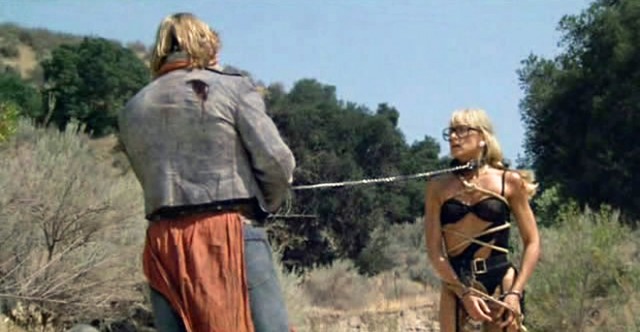
One reason to watch Hell Comes to Frogtown is that it’s like a time capsule for what was considered funny in 1988. Rape, for instance. Lots of rape and misogyny. You’re not going to believe me but the following still is from a scene that’s meant to be funny.

hell_comes_to_frogtown2-640x332.jpg

Oh, I get it! She’s like a slave but for sex! Zing!

I’m not saying that people don’t still make rape jokes, but how about this: in another scene, our heroes catch a female savage, give her a libido-boosting shot, and then Sam Hell rapes her. But, you know, in what is supposedly a “light-hearted way.” So light-hearted that the next morning the two are seen cuddling. Then the savage hugs and thanks Sam and we never see her again. She’s a plot device in the worst possible sense: she has no function in the movie other than as that which is sexually liberated (against her will). (Editor’s note: uhhh… whoa.)

All this happens before the heroes even make it to Frogtown. What is Frogtown? Frogtown is where the frogs live. Because of an Apocalyptic Scenario, frogs are now human-sized, speak English, and sometimes have three penises. The scenes in Frogtown are so sexually frustrated no one would be surprised if the writers all have frog fetishes.

frogtownbdcap6_original.jpg

No, please don’t. You’re so far out of my league.

There are details I could go into, but that would be a one-way ticket to Spoilertown. And trust me, you want to visit Frogtown firsthand.

The plot holes in Hell Comes to Frogtown are Mexican sinkhole-sized. Why does Sam Hell need to go with them to Frogtown to save the women when they have this girl who just sits in the car and polishes her guns?

Hell5.jpg

Why do characters inexplicably change outfits from one scene to the next?

Why would the scientists strap Sam in an explosive chastity belt when his dick is the only thing of importance to them?

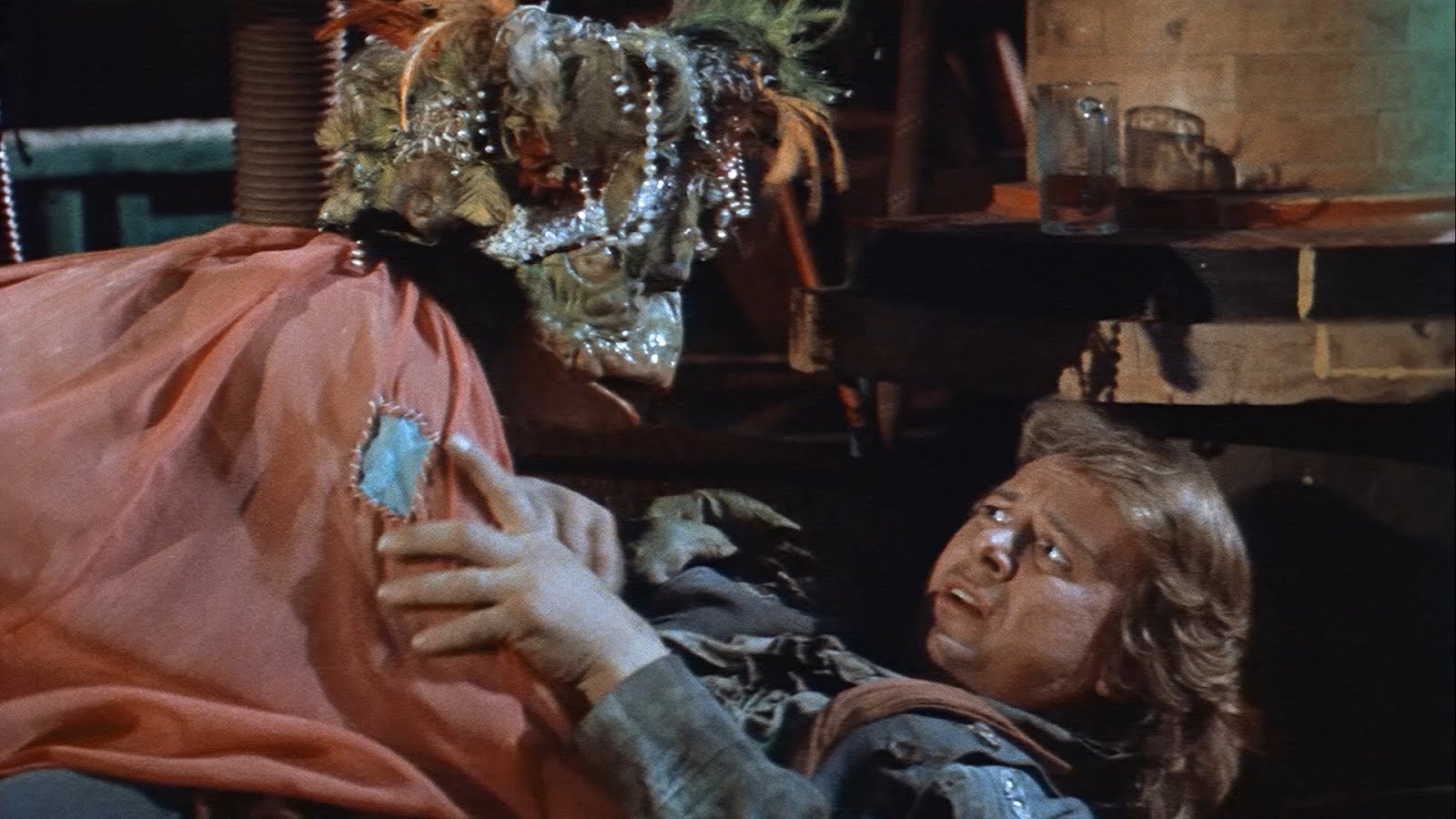
And who the fuck is this guy?

Hell%2BComes%2Bto%2BFrogtown%281987%29_011.jpg

God?

Should You See It?

Of all the reasons to watch Hell Comes to Frogtown, it’s the simplest reason that’s the most convincing. That’s this: in the late 80s a movie called Hell Comes to (Motherfucking) Frogtown was released, and for some reason you haven’t seen it.

Watch it on Hulu Plus or stream it on Amazon for $2.99.

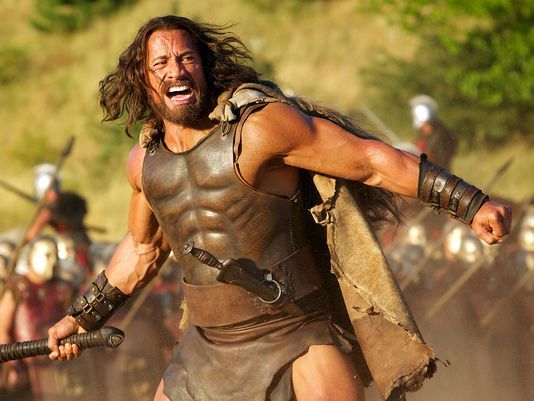
Is the Reality of Dwayne Johnson More Interesting Than the Myth of Hercules? Should You See “Hercules?”

hercules dwayne johnson

Brent Hopkins

In our rarely-running kinda-series Should You See It? we talk about movies that just came out. You can figure out the rest of the premise from the title of the series. That’s right: We talk recipes. Should you see Hercules?

Last week I had the opportunity to watch Brett Ratner’s take on the tale of Hercules. This film stars Dwayne Johnson, a.k.a. “The Rock” from wrestling fame, as the eponymous Hercules.

I, like many others, have grown to genuinely like Dwayne Johnson as a celebrity. There are so many things he could be — rude, egotistical, abusive — yet he has managed to break the mold for super-juiced up athletes and has this genuinely endearing air around him.

He is constantly doing stuff like this. His life is a perpetual Old Spice commercial.

Now, I could write an entire article about why Dwayne Johnson is awesome but I will leave you all to Ask Jeeves that question. This is about the movie Hercules and there honestly isn’t much good to say about it. Ratner decides to eschew the various trials of Hercules (a.k.a. the interesting stuff) to instead focus on how a super strong (but entirely mortal) Hercules deals with being known as a demigod.

We meet his team of super talented warriors that help him take on the various trials he is known for. His group is an Amazon archer-woman, a rogue who throws daggers, a battle mage who can see the future, a mute berserker, and Hercules as a heavily armored “tank” of sorts. We see that the trials are all just tricks set up by various evil people that have entirely rational solutions. We learn that Hercules becomes about as popular as the Emperor he is receiving patronage from due to these accomplishments and then he is suddenly outcast after a tragic night involving his family (spoiler alert: they dead y’all).

The plot focuses on Hercules doing one last job as a mercenary to help pay for his self exile to atone for his sins. This does not go as planned and an insidious plot is uncovered that requires Hercules to effectively unwin a war he just won. This is all incredibly stupid and never takes the viewer off guard. It truly feels like a poorly written tween version of 300, except with none of the cool supernatural stuff.

Dwayne Johnson honestly does well in the role, and he is one of the few celebrities I could imagine playing Hercules. The main problem I ran into is that the man playing Hercules is honestly more Herculean than the character he is portraying. If the entire film was just about him going to the gym, listing the food he eats on his cheat days, and making Vine movies I would have enjoyed this film more. The supporting cast is completely superfluous and you will not care about any of them in any way, shape, or form. This holds true for the villains as well, who are just dicks for the sake of being dicks.

Should You See It?

There is absolutely no reason to see this film. It is a bad film, and it falls into that category of movies that just don’t have enough heart to be memorable. I wasn’t angry that I paid money to see it like I have been with other films, I just instantly forgot about it when I left the theater.

Obvious Child is a Romantic Comedy About How People Actually Meet. Should You See it?

obviouschild

Alex Russell

In our rarely-running kinda-series Should You See It? we talk about movies that just came out. You can figure out the rest of the premise from the title of the series. That’s right: we talk recipes. Should you see Jenny Slate’s romantic comedy Obvious Child?

One of the weirdest parts of pop culture now is that if you really love something, it starts to feel like it’s one of the biggest things in the world even when it isn’t. You can follow a hashtag or go down a Tumblr or YouTube hole and suddenly that one Comedy Central show you really, really like feels like it just must be something everyone you know is all about.

Obvious Child inundated my digital life last week. It’s a movie that did well enough at Sundance earlier this year to earn a bigger release this month. Jenny Slate (Kroll Show, Parks and Recreation, Bob’s Burgers) did a sort of “comedy nerd” press junket to promote it on a lot of podcasts, but it’s entirely possible you haven’t heard much about it.

Jenny Slate plays a stand up comic who gets dumped after being too open on stage about her relationship. She’s in that mid-20s period where people have to make decisions about how to stop taking money from their parents, how to have a stable relationship and still be their own person, and how to get and keep a job that doesn’t suck. It’s a relatable premise.

Then, well, let’s get this out of the way: even though the director has said it’s not “an abortion comedy,” it is definitely a film that deals with abortion. Jenny Slate’s character has a one-night stand and decides to have an abortion. That’s not giving anything away; it’s the hook of the whole experience.

Questions come up. How do you have a conversation about this with someone you don’t know? How do you tell your parents? How do you tell your friends? How do you tell a group of strangers that you talk to with a microphone?

Obvious Child will rub people different ways based on their feelings about abortion, but it may also have the same effect based on how people feel about relationships in general. Jenny Slate’s character is funny and goofy, but she’s also “independent” even though that word has lost some specific meaning in some ways. The portrayal of her decision to have an abortion is absolute; she asks a friend if the experience hurts or not, but it’s clearly not part of the decision. This is not a movie that wants to tell you if you should have an abortion or not, but Jenny Slate’s character is a look into what the process looks like for someone who has their mind made up.

Should You See It? 

Well, someone sure should. Obvious Child made $133,000 this weekend in 18 theaters. It’s still in limited release (Frozen is still in more theaters than that in week 30 of release and The LEGO Movie is in over 15 times that many in week 20) but you should try to see it if you can. It’s an extremely refreshing romantic comedy both in subject matter and in characterization; these are real people who meet because they get a little drunk and flirt with each other. Every movie should try to show an interesting version of an emotion you understand or feel on some level, and the weight of an important decision when life is already weighing very heavily is spot damn on for that.

Obvious Child is in limited release until June 27, when it is released everywhere. See the trailer here.

Image source: Sundance

Another Look at Maleficent: Should You See It?

Maleficent

Brent Hopkins

In our rarely-running kinda-series Should You See It? we talk about movies that just came out. You can figure out the rest of the premise from the title of the series. That’s right: We talk recipes. Should you see Maleficent?

I saw this with my sometimes girlfriend and I will admit I had no idea what it was, going into it. I had forgotten the name of the antagonist from classic animation and I just didn’t put the pieces together until the film started. As Mr. May put it, the film is about pleasing boththe parents and children of the audience with a reimagining of a simple good vs. evil story. This is something I think it does rather poorly, as I could not imagine enjoying this as a child because it is a gritty retelling. There are all the magical elements and attempts at humor to please younger audiences, but throughout I never got a lighthearted vibe from the film.

The film is awkwardly chopped up into three acts with the real weight of the story in the beginning and the end. The middle tries to be fun and happy, but the setup is so grim it feels truly empty. You are introduced to Maleficent and the humans and you instantly are slammed with the knowledge that humans are the worst things to ever exist. Maleficent is tricked in probably one of the most uncomfortable rape analogies that will assuredly go over a child’s head but will not for any adult. She is drugged and has her power (the most important thing to her) forcibly taken from her by someone she thought she could trust. Once this happens there is no point in time where I wanted anything but for Maleficent to reclaim her power. Angelina Jolie is captivating in this role and I am not sure any other actress could have owned the role as well. That being said, most of the other characters are flat in comparison.

Should you see it?

Yes, much like the movie Noah, which I wrote about before, Maleficent has its fair share of flaws and pacing issues, but I think any adult who has seen the original animation from Disney will be stunned that the same company put out this film. I can’t say if it was good or bad, but just that it left thinking about it more than the new X-Men movie did.

Brent Hopkins considers himself jack-o-all-trades and a great listener. Chat with him about his articles or anything in general at brentahopkins@gmail.com.


Maleficent Tries to be Sleeping Beauty for Both Children and Adults: Should You See It?

Maleficent

Jonathan May

In our rarely-running kinda-series Should You See It? we talk about movies that just came out. You can figure out the rest of the premise from the title of the series. That’s right: We talk recipes. Should you see Maleficent?

Trying to make a movie appeal to everyone can be problematic. If it’s meant for children, studio executives/producers feel the need to also make sure the adults are in on the laughs and tears. While this might satiate everyone slightly, the end result is something almost unclassifiable: a hybrid movie with all the plot motivation and CGI a child could want with the postmodern self-consciousness and humor an adult would expect. Many times in the theater, I heard a child whisper to the attendant parent, “What’s happening?” If this question is asked during the run of a children’s film, then it is almost certainly a failure. The beauty of the original Sleeping Beauty film is in its simplicity; Maleficent, however, adds complication after plot complication, giving “adult” realness and motivation to the main character, ultimately making her more relatable to adults than children. This is the movie’s main flaw.

I wouldn’t want to spoil the ending in any way, but the complexity the film tries to attain through this ending certainly confused this viewer. I had assumed the Raven fellow (a stand-in for the companions of Odin: Huginn and Muninn) would end up being the one to break the spell; in that regard, I was wrong. However, I feel like the way the story was built (with Maleficent and her servant watching over Aurora), we were supposed to feel that way. I’m by no means begrudging the ending and its representation of the many different kinds of true love; I was just mystified by the movie’s many attempts to lead us astray in order to keep us guessing.

Should you see it?

Will this film be watched with the same fervor as Sleeping Beauty in 20 years? I quite doubt it. Though Angelina Jolie was a powerful force in this film, her power almost mutes the depiction of the other characters. Ultimately, this film falls between two worlds, an ever-widening divide as long as studio executives are calling the shots rather than the story-makers.

Jonathan May watches too much television, but he’s just playing catch-up from a childhood spent in Zimbabwe. You can read his poetry at owenmay.com, follow him on Twitter at @jonowenmay, or email him at owen.may@gmail.com.

Neighbors: Should You See It?

Neighbors (from The Daily Mail)

Jonathan May

In our rarely-running kinda-series Should You See It? we talk about movies that just came out. You can figure out the rest of the premise from the title of the series. That’s right: We talk recipes. Should you see Neighbors?

Neighbors is a movie that tries to bridge two kinds of comedies: the buddy comedy and the relationship comedy. The couple (Rogen and Byrne) uses the standard “bros before hos” as part of its trap against the fraternity invaders, backfiring wildly into what seems to be the start of a very different film. Needless to say, the film is billed as a comedy, so by stricter terms, it follows on its promise, reaffirming the relationship between the couple at the film’s heart. However, when I asked my friend Elizabeth what she thought about the focus of the film, she said it was more of a misguided bildungsroman for Zac Efron’s upper half, and I would have to agree. The movie tries to affirm some kind of epiphany on the part of the fraternity president as to what must come after graduation, yet it also clings more so to the couple’s determination to face what they must together. The new parents commit vandalism, trespassing, and (some may say) negligence to enact their wild schemes against the admittedly loud and obnoxious fraternity house 24-hour party machine; does this bring them down, or make it clear that some people will do almost anything to achieve comfort?

I’m no stoic; I laughed out loud plenty of times. Sex and drug jokes abound, reaffirming pot as the social drug of the new century. What really held the film together were the ancillary characters: Lisa Kudrow as the Dean, Hannibal Buress as the policeman, the fraternity as its own character. While I was compelled by the main plot(s) of the film as a comedy of manners, I found Efron to be stiff in front of the camera in contrast to the couple, a veteran pair in their own rights. Perhaps it’s because the film is of two minds that he seems weak in comparison; I’d never seen him in a movie previously. I did appreciate the continuation of the depiction of the American couple as two people who can be fun together, despite their seeming nefariousness as they manipulate others.

Should you see it?

What to take away? We get older, and it sucks sometimes, but sometimes it’s really cool. Abs help?

Jonathan May watches too much television, but he’s just playing catch-up from a childhood spent in Zimbabwe. You can read his poetry at owenmay.com, follow him on Twitter at @jonowenmay, or email him at owen.may@gmail.com.

Image: The Daily Mail

The Wolf of Wall Street is About Excess and Debauchery: Should You See It?

wows

Stephanie Feinstein

In our rarely-running kinda-series Should You See It? we talk about movies that just came out. You can figure out the rest of the premise from the title of the series. That’s right: We talk recipes. Should you see The Wolf of Wall Street?

Spoilers, of course.

First of all, this was a really long 180 minutes, and the first 45 are just 2000’s Boiler Room all over again.

This is a true story: The real deal Jordan Belfort wrote a memoir about how he swindled the hell out of America, and Scorsese decided that would make a good movie. But unlike so many other debauchery-focused films, it lacks reflection and remorse.

This lack of victims, of consequence, of remorse, of pain, are my issues with Scorsese’s latest. The movie spirals down a hole of moral ambiguity, drowning in its own self-righteousness.

“But he gets caught!” You might argue, “He pays for his sins!” I disagree. A 36-month stint in a Nevada white-collar prison does not atonement make. Referring to the incarceration as a respite from his money-hungry life, he feels no remorse for what put him there.

There is a lack of remorse for cheating on his first wife, and we see no repercussions of divorce. There is no aftermath of her marriage, no additional hospitality or hurt. No or media backlash; no paparazzi-fueled tabloids.

When his yacht sinks during a hellacious storm, no one is harmed and only the yacht (which I assume to be heavily insured), suffers. His wife is fine, their friends are fine, no crew is lost. The plane coming to rescue them after the wreck? It explodes, killing three people. Do we see the funerals, the anguish of having ruined other lives? No. He does not even openly acknowledge the explosion, glossing over it in a smooth voice over, paving the way for his reluctant sobriety.

The two scenes that most display the lack of morality and compass do not use yachts, planes, or pussy to make a point. When Belfort Lemmon-ludes up and over at the country club, he chooses to drive his expensive-ass car home, despite a total lack of motor skills. He claims to have made it home without a scratch on himself or the gleaming Lamborghini. As the audience, we believe him until officers show up the next day, ready for an arrest.

If this were a tale of moral understanding and growth, more than just a fender and door would be damaged. In screenplay-land, this is the time to show us a bit of blood on the hood and imply that Belfort cost someone more than just their savings. This moral resolution does not appear; the charges of DWI are dropped without evidence.

Another car, a Mercedes with a passenger, and another great display. During Belfort’s slide further down the amoral rabbit hole, his model wife Naomi LaPaglia (Margot Robbie) challenges his life and he flips his shit. Destroying a sofa in search of his “small stash” (what I assume to be about ¼ pound of uncut cocaine), he buries his nose into the powder before snatching up his eldest child and attempting to flee the property. As expected, the car crashes, and although the child is absolutely not large enough or old enough to be in the front seat safely in an accident, no great harm is done.

As before, if this story was to have a lesson — a moral, an actual resolve beyond greed –that child would not have arrived unscathed. But like so many other things, Belfort’s life continues unruffled, no matter what he is facing.

As for the rest of the film, the side characters are by far the best. Cristin Milioti as the suffering first wife (Teresa Petrillo), has a beautiful emotional breakdown after finding DiCaprio’s Belfort cheating. A recent television sensation (she’s the mother in How I Met Your Mother), she plays the Jersey hairdresser delightfully.

Jonah Hill (Donnie Azoff) is another surprising standout, as I was not really expecting much from him (Protip: To understand how I feel about Jonah, please watch 2008’s Strange Wilderness.) His meandering, pseudo-improvised diatribes are often humorous, but feel disjointed. It was great to see him jacking off at the party, smoking crack, or rip-torn on blow and pills, but the “chops” didn’t feel as genuine.

Anyone out there remember Early Edition? Crime solving with psychic newspapers? Kyle Chandler remembers, as he plays ineffectual FBI agent Patrick Denham in Wolf, making little money and an even smaller impact in the financial world. (His will-they-won’t-they bribe scene is pretty great.). Would the story be stronger if Chandler was again paired with a psychic newspaper? Maybe.

The cameos of television actors don’t end there, as Kenneth Choi (Sons of Anarchy), Jon Bernthal (The Walking Dead) and Thomas Middleditch (Silicon Valley) make appearances with different ends. The addition of seasoned veterans Rob Reiner, Jon Favreau, and Jean Dujardin rounds out the strong cast, but no one can save the film. Even the real Jordan Belfort, cleverly hidden in the end as an announcer in Auckland, cannot give enough gravitas or remorse to save it all.

Best Part: Matthew McConaughey’s Mark Hanna. A single real scene, the introduction of drugs, a weirdly racist chest thumping, and the drive of the all-mighty dollar, McConaughey was better than the movie deserved. I wanted so much for him to return in the end, check up on Jordan, challenge him in some way, but to no avail. The chest-thumping remains, but McConaughey leaves us far too soon.

 2nd Best Part: DiCaprio’s worm flailing at the country club. Hilarious, as well as a great look at an actor not known for his physicality in roles (Gilbert Grape notwithstanding.) The fact it so delightfully mimicked his dancing at his wedding made it all the better.

Overall: In the kidnapping-car crash, Jordan receives a small wound on his forehead, and a trickle of blood is our only real indication of his pain. We see no recovery, no regret, no growth.

In The Wolf of Wall Street, Jordan Belfort bleeds, but it is never enough.

Should You See It? (Well, now rent it): Sure. I will say that I am super-duper glad I did not see this in theaters, as the debauchery of it all would have been too great, with no great Hunter S. reflection. At home, on the sofa, it’s a great watching experience. The story is surprisingly fun, once you get past all the moral ineptitude.

Stephanie Feinstein yells at her television daily, and you will never change that. You can challenge her at stephanie.feinstein@gmail.com.

Nymphomaniac is Five Hours of Lars von Trier Trying to Offend You: Should You See It?

Nymphomaniac poster

Jonathan May

In our rarely-running kinda-series Should You See It? we talk about movies that just came out. You can figure out the rest of the premise from the title of the series. That’s right: We talk recipes. Should you see Nymphomaniac?

“Beneath the gazes, beneath the hands, beneath the sexes that defiled her, the whips that rent her, she lost herself in a delirious absence from herself which restored her to love and, perhaps, brought her to the edge of death.” —from The Story of O

Parenthesis in Greek means ‘put in beside’ so it’s only fitting that the title of Lars von Trier’s latest film includes an empty set (it’s stylized as “Nymph()maniac“), a nothing story inside a nothing story. The story operates on the frame tale level; that is, our protagonist Joe relates her tale of sexual deviance from childhood forward to the eager ears of Seligman, an older male virgin (which later becomes important) after he finds her in an alleyway, obviously beaten up.

The main problem with the film is that Joe is constantly interrupted in her telling by Seligman, an obsequious listener if there ever was one. The film must center safely back around to its frame at the end, which deflates what’s at stake for the viewer. And center around it does; this was the moment of unexpectedness though. What transpires between Joe and Seligman in those final moments completely derails the film and its message, but I will not be the one to spoil it for the reader.

What I will take umbrage with is the fact that the more “salacious” aspects of the film (the erect penises, the S&M, the graphicness of the presentation, Joe screaming “Fill all my holes”) are not nearly as “offending” (though I’m very hesitant to use this word) as the moral statements made by the director through his characters. It becomes very obvious when Joe is talking and when Lars von Trier is talking through Joe. Von Trier all but preaches about how we should not silence aspects of our vocabulary for fear that we silence ourselves; but then he launches, through Joe, into a tirade about how pedophilia is like any other sexuality and how the 96% of pedophiles who don’t act on their urges should be “given a medal” for bravely squelching their desires. I take huge insult to these claims. Pedophilia is learned behavior, not innate. Not acting on desire or lust is not commensurate to bravery. Once again, von Trier sacrifices in terms of actual filmic development to focus on his status as a provocateur. Unfortunately this game is tired and boring, especially coming in the middle of a combined five-hour romp. I feel like I was constantly being prodded into offense; luckily for me, I’m offended by very little. But I still felt like the whole story amounts to nothing more than a way for von Trier to poke a stick at his audience. What he loses in this, of course, is the sincerity of Joe and her story. She unapologetically owns her sexuality at several points throughout the film. To have her become nothing more than a soapbox is typical of von Trier’s treatment of women.

Should you see it?

If you want original story, see the film Salo by Pasolini or read its precursor, The 120 Days of Sodom by the Marquis de Sade. Or you can read The Story of O by Pauline Reage. If it’s a good Lars von Trier movie you want to see, try Melancolia or Dancer in the Dark. But you can safely pass on Nymphomaniac.

Jonathan May watches too much television, but he’s just playing catch-up from a childhood spent in Zimbabwe. You can read his poetry at owenmay.com, follow him on Twitter at @jonowenmay, or email him at owen.may@gmail.com.