review

Games Worth Going Back For: Journey

journey-game-screenshot-1-b

Brent Hopkins

In Games Worth Going Back For we look at recent games that you may have skipped that should be picked up sooner rather than later. Today: Journey for the PlayStation 3.

Overview:

Journey is an indie game that was released exclusively for the PlayStation 3 in 2012. It was developed by Thatgamecompany, which also made two other exclusives for Sony: Flow and Flower.

Thatgamecompany is known for making incredibly atmospheric, short, and graphically intense games with a minimal yet heavy feel. Flow and Flower were two of my favorite games on the PS3, and I was ravenous to get my hands on this game. Those games each took a specific concept and made that the entire focal point of the game. This could run foul for some gamers expecting a meaty epic, but I feel like even for a single playthrough these games will always stick with you for years afterwards.

Sadly, I was unable to play Journey when it was first released, but I picked it up and promised myself I’d play through it this year.

Story

Journey doesn’t necessarily have a strong story tied to it, which is common for Thatgamecompany titles. You are a robed figure that is traversing a ruined city in an attempt to reach the summit of a mountain. Throughout the game you delve deeper and deeper into the city through sand, then water, and finally snow. Hence you are taken on a “journey,” physically as well as through history. The most interesting point for the story is that this is relayed entirely without words. The entire game is nothing but ambient sounds, with even the player character being unable to speak in any real language other than squeaks that blend in seamlessly with the music.

Gameplay

You explore the city through common means of modern-day transportation: walking, flying, and surfing. To advance further in the game, the player must “sing” to activate banners that cause various things to happen to the landscape.

These are simple puzzles and really feel more like an avenue to force the player to take in the sights that the game has hidden for you.

The game is also multiplayer, so you can tackle the puzzles and things with another player. The game doesn’t have lobbies or anything, instead at the beginning of each episode, a player will anonymously join your game and you can choose to stay together or take divergent paths towards the goal. If you complete the stage together you will continue along with one another, but if one finishes and the other doesn’t you will find yourself alone or with a new person to play with at the beginning of the next stage.

The multiplayer aspect of this game is critical to its success. I had a chance to play the first level alone and I was bored to tears by the game. It was not fulfilling in any way, shape, or form, as it really felt like a walking simulation as opposed to a game,

Since there is no communication in the game other than the singing you have to communicate nonverbally. I managed to find another person who wanted to play the entire game through and I found that if I didn’t see him or her on screen I would wait or search for them to make sure they were following along. It was a strong bond but one that was completely unspoken, like that of a friend you haven’t seen in years. This was in stark contrast to the misery I felt when I first loaded up the game. The drop-in/drop-out method of multiplayer here is completely necessary to get the true feel of the game.

Graphics

This game is stunning. There isn’t really much else to say about it, but the snow and sand effects are absolutely breathtaking and it feels like you’re playing through a photo journal at times. Hands down the sand surfing segments alone are worth the price of admission and will have you wanting to play them a few more times after the first.

Turn this on HD and just enjoy.

Sound

The music might actually be better than the graphics, and that is saying quite a bit. The music matches each level perfectly and the sound effects of your robed character meld into the music as if it were your own instrument. The songs are never annoying and set the atmosphere really well.

Overall

Aesthetically pure, aurally fascinating, and fantastic.

This is what it feels like to melt into a game.

This game contains probably two of the best hours you could spend on a console in the past two years and honestly, Thatgamecompany has compiled three games that I would recommend anyone play. If you have any friends with PS3s, buy their collection, which includes Flow, Flower, and Journey and sit down with them and enjoy all three together. If you like games like Ico and Shadow of the Colossus, these games are a nice way to hold yourself over while waiting for The Last Guardian‘s release.

Brent Hopkins considers himself jack-o-all-trades and a great listener. Chat with him about his articles or anything in general at brentahopkins@gmail.com.

Image: Thatgamecompany

Life Lessons from Episodes of Louie: “So Did the Fat Lady” and “Elevator (Part 1)”

louie-3

Alex Russell

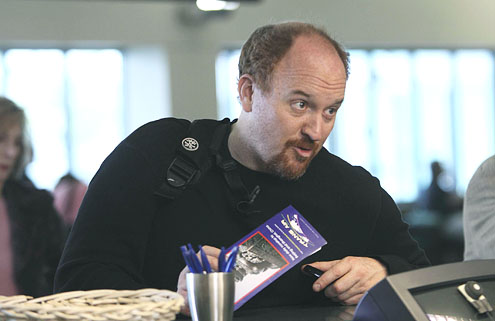
Louis C.K.’s critically acclaimed show Louie’s fourth season runs as two episodes every Monday night. Rather than just answering the question of “are these episodes good,” (because the answer is always yes) we’ll talk about the big lessons imparted in each episode. This week: Louie reluctantly goes on a date and almost loses his daughter.

Episode 3: “So Did the Fat Lady”

No one has perspective immediately. Right after watching a particular episode of a particular show, it feels more important. That one episode isn’t just 22 minutes of entertainment, it’s your Monday. It’s the time you sat in one specific chair and felt one specific way because someone who made something made you pay attention.

The third episode of Louie will get mentioned a ton this year as one of the best episodes of the show, and that makes it tough to digest fully just a few hours after its debut. In it, Louie presents the story of how he’s worn down into a date by a compelling woman at a comedy club that doesn’t fit the standard “expected weight” of a woman on television. It’s not an overdrawn morality play about how weight shouldn’t matter. It’s a story about how weight does matter (even when it shouldn’t), but how we treat people in life matters a heullva lot more.

Everyone will draw the obvious from it: It’s about being kind but still being realistic. It’s about how we think of ourselves as good people even though we sometimes click the “no thanks” button when Walgreens asks for money for breast cancer research. It’s about why we think of ourselves as honest even though we go without mentioning faults to our friends. It’s the story of the faults we all have that we don’t even always consider faults.

The episode will be a smash hit (as much as a Louie episode can be) because a 30-something woman talking about body issues in a real way is great television. It will stick with me because one of the secondary lessons is that it’s important to be a good person, whatever that means to you.

Episode 4: “Elevator (Part 1)

The second episode is a big step down in the “cultural issues” department, but it comes out of the gate with a ton of energy just the same. Louie tells his girls to repeat the “rules of the subway” as they get on the subway. Chekhov taught us that means that the subway rules are going to be broken, and sure enough…

…but the episode’s not really about losing the girls. It’s about Louie finding a woman stuck in an elevator and trying to help in a situation where he doesn’t have any real answers. There will assuredly be more in next week’s second part of this episode that explains how the subway scene relates to the scared woman in the stalled elevator, but right now we need to leave this one somewhat unfinished. It’s a great episode and it has something really sweet to say about language and shared experiences, though it isn’t a finished story yet. Both stories in it have the same lesson so far, though: Don’t bother running away from anything that can catch you.

Alex Russell lives in Chicago and is set in his ways. Disagree with him about anything at readingatrecess@gmail.com or on Twitter at @alexbad.

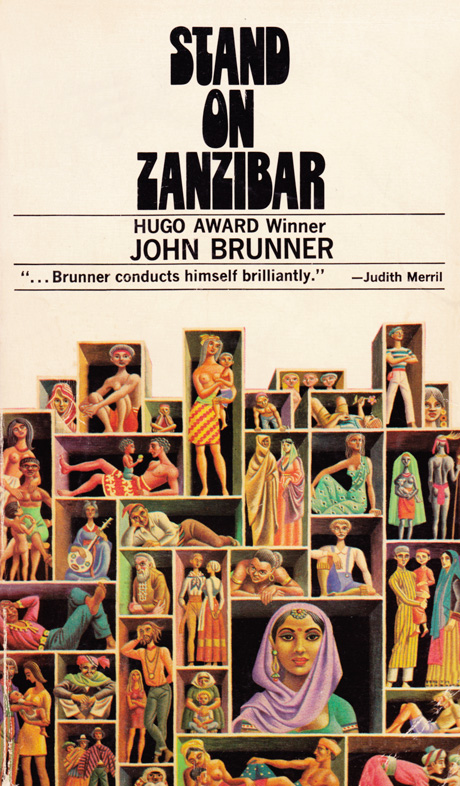
Life After the Star Wars Expanded Universe: John Brunner’s Stand on Zanzibar

Stand_on_Zanzibar_working

Andrew Findlay

In Life After the Star Wars Expanded Universe, we take a look at science fiction and fantasy, why they’re great, and what they say about where our species has been and where it’s going.

Isaac Asimov once predicted that by this time, many home appliances would run on atomic batteries. It would be so convenient: no need to use electricity and the battery would not run down within the consumer’s lifetime. Truly a marvel of modern science! In all seriousness, if Asimov’s failure to see anything wrong with a blender powered by nuclear fission does not clearly crown him as the king of all science nerddom, I don’t know what would. One of science fiction’s stocks-in-trade is predicting the future. Some suggestions are eerily accurate, and some are Jetsons-level laughable. Stand on Zanzibar is strange in that a weirdly high percentage of its predictions are absolutely correct.

The novel is set in 2010. The main pressure driving its plot is that there’s just too damn many of us. Brunner correctly placed the 2010 population of the world around seven billion, which is where the name comes from. Apparently, seven billion people, standing upright and shoulder-to-shoulder, would just barely fit on the island of Zanzibar. This foundational problem is not the only prediction Brunner gets right:

  1. “Muckers” go insane and go on senseless public rampages (Columbine, Aurora, Newtown)
  2. China is our main global competitor
  3. Europe has banded into a single political entity
  4. Detroit is a ghost town filled with abandoned warehouses
  5. Consumer culture is dominant
  6. News is highly processed and regurgitated on television in digestible bites
  7.  There is legislation against tobacco but marijuana is legal
  8. Rent is so ridiculous in New York that a high-level executive has to have roommates to help him pay it.

Brunner misses a few things and gets a few other things wrong (in response to the population problem, there is eugenics legislation – people cannot have children unless they prove their genetic health), but the amount that he predicts correctly in this future is impressive. He gives texture and substance to his future world by using the Innis mode.
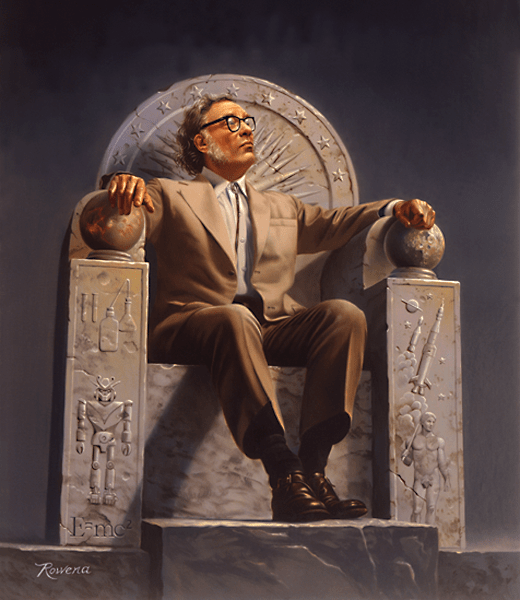
Isaac_Asimov_on_Throne

I found this while looking for Asimov quotations. Holy shit.

The book opens with a passage from Marshall McLuhan’s The Gutenberg Galaxy, which explains the Innis mode as constructing a mosaic of facts and events without perspective or unifying narrative. Brunner’s use of this mode strongly influences the structure of the book. There are four main types of “chapters.” Chapters labeled “continuity” follow the linear narrative of the story. “Tracking with closeups” present vignettes of characters not directly related to the main plot but part of the same world. “Context,” presents, you guessed it, context for the other parts of the story in the form of fake newspaper articles, works of sociology, and other types of analyses. Finally, “the happening world,” the most Innis-modian of these chapters, is a storm of assorted facts, sometimes as short as a single line, that assault the reader with the vibrance and freneticism of all the overwhelming information in the larger world outside the main narrative. The Innis mode generally and “the happening world” in particular serve to create an immensely dense world without sacrificing main narrative time to do it.

The main narrative consists of two parallel plots: U.S. intervention in an island nation in the Pacific, Yatakang, that is embarking on a “genetic optimisation program” to build a race of supermen, and a massive company called General Technics beginning a training program in a fictional West African nation in order to exploit mineral wealth off the coast. The Yatakangi storyline consists of a lot of great spy action and explosions. The U.S. intervenes because they either want to prove the genetic optimisation program is an impossible propaganda stunt or, if it is true, take steps to make it just an impossible propaganda stunt. One Yatakangi character tells the American spy that Americans just aren’t very good at letting other people be better than them at anything. The African storyline concerns Beninia, a country that is dirt poor, where education could be improved, and where starvation is a major concern. Beninia draws the interest of General Technics because, despite all of this, there has not been a murder there in the past 15 years, there is no open conflict or dissatisfaction, no vandalism, and no theft. In a world where people regularly run amok (the etymological basis for “mucker”) and kill as many people as they can before they are put down, the complete absence of murder indicates an inviting level of stability. GT agrees to put in place a 50-year program wherein they float the Beninians a huge loan, then use it to build all the most modern conveniences and supercharge their education so that, within those two decades, the Beninian population will be transformed into a nation of extremely skilled technicians and scientists with the knowledge set required to exploit the mineral deposits in the ocean nearby. This plan is created and vetted by the General Technics supercomputer, Shalmaneser. GT’s main claim to fame is this computer. It is next-level, near-A.I. type hardware, and its predictions are the main reason the company is so confident that their Beninia plan will work. They are in it for themselves, as they will be more than paid back by the wealth at the bottom of the sea, but they get to change the course of an entire nation for the better. The book tries very hard to sell the point that this is not neocolonialism pure and simple. The President of Beninia is complicit in the plan because he is dying and wants to leave a good future to his nation. Everyone involved in the project has their hearts in the right place and wants to help. Within the book, it is absolutely believable that this is a new and benign form of economic development. Outside of the book, this is basically a company owning a country outright, and in reality that never works out well for the owned. The disconnect between what happens in the book and the real-world probabilities make this conceit of the book ring a little hollow.

PCP283.feat3.body4-580-90

This is what Brunner means when he says “supercomputer.”

Speaking of things Brunner attempts that end up going wrong, he tries to extrapolate the future of race relations while sitting in front of a typewriter in 1968. He gets right that, due to anti-discrimination laws and the easing of overt racism, many positions of power are filled by African Americans, and racial tensions still simmer on. One of the main characters is a black vice president of General Technics. His roommate is white. They are both friends, but in their internal monologue, they each think really angry thoughts filled with racial slurs about each other. The problem is not that they get angry at each other, but that the sole source of a lot of their anger seems to be race. It seems outdated and strange, and indicates that Brunner, while trying to present a realistic future of race, was not fully free from many of his own preconceptions about it: In Brunner’s future, a relationship between equals of a different race seems not to be able to exist without some type of rancor. There is also no shortage of racist slurs against the Asian Yatakangi. Try as it might, this book is definitely a product of the sociocultural milieu of the 1960s.

Treatment of women in this book is just as big a problem as the treatment of race. There are no women involved as main characters, there are only two women in the entire book that have any real agency or power, and the current form of dating is something called the “shiggy circuit.” Codder is a mildly offensive term for a man, and shiggy is a mildly offensive term for a woman. Most young women participate in the “shiggy circuit,” a social construct in which women have no fixed abode and merely cycle around the city, moving in and out of the apartments of the men they sleep with, depending on them for food and shelter, and then moving on to the next one when either the woman or the man becomes bored. The easy interchangeability of women and the fact that they take up with the man and not vice versa necessarily places them at a disadvantage in relation to the men. This dynamic grows out of a problem that runs through many SF books written in the 50s and 60s. Most of the writers at that time were men, and many attempted to imagine new and more open sexual mores. The problem is that most of these new social systems ended up being not so much a representation of sexual progress as a result of the author’s subconscious thinking to itself, “Hey, wouldn’t it be cool if women were just naked? Like, all the time?” It comes off more as male fantasy than as balanced prediction (cf. Stranger in a Strange Land, The Gods Themselves).

la-et-mn-star-trek-into-darkness-writer-apolog-001

Glad we’ve stopped oversexualizing women in science fiction. She’s a weapons specialist on the Enterprise, by the way.

Despite the jangling treatment of race and women, the book, in the form of Chad Mulligan, delivers wry, incisive, and apt criticism of society and the humans who run it. Mulligan is a pop sociologist and is the author of The Hipcrime Vocab and the amazingly-named You’re an Ignorant Idiot. He is deeply in love with the human race, which of course means he is intensely enraged by its stupidity. He becomes a main character by the end of the book, but for most of it we see snippets of his angry, incisive writings as excerpts in the “context” or “tracking with closeups” chapters. His main thesis is that if we don’t all change drastically we are all going to die, so act a little less insane and a little more rationally and lovingly. To give an idea of what kind of vision he has, I’ve included a handful of definitions from his Hipcrime Vocab.

The Hipcrime Vocab by Chad Mulligan:

(COINCIDENCE You weren’t paying attention to the other half of what was going on.)

(PATRIOTISM A great British writer once said that if he had to choose between betraying his country and betraying a friend he hoped he would have the decency to betray his country. Amen, brothers and sisters! Amen!)

(SHALMANESER That real cool piece of hardware up at the GT tower. They say he’s apt to evolve up to true consciousness one day. Also they say he’s as intelligent as a thousand of us put together, which isn’t really saying much, because when you put a thousand of us together look how stupidly we behave.)

Mulligan is a great character: contemptuous, competent, snarky, and broken-hearted by what he sees humanity doing to itself. He moves through the book spouting wisdom and being right about things, which isn’t necessarily a problem, but “irreverent middle-aged dude who is wiser than others” is a bit of an overused archetype in older SF.

This book has a lot to recommend it. It is a feat of worldbuilding, giving a nuanced and exhaustive picture of the world as it might exist in the future. Its narrative structure is innovative and effective. Its driving conflict is a problem that has affected, is affecting, and will affect the human race for the foreseeable future: increasing population, decreasing resources, and the tension and problems created by that dynamic. Its hope is that humanity finds a method to stop feeding on itself, but it presents the alternatives in horrifying depth and detail. It is a pity that, while many of the facts and events predicted are impressively accurate (the fall of Detroit, senseless acts of public slaughter, 24-hour news, the European Union), the conceptualization of race and women are mere extensions of the patterns extant in 1968. It represents a failure of imagination and a victory of narrow-mindedness in a novel otherwise exultant in its inventiveness, insight, and breadth. You still need to read this for what it does right.

Andrew Findlay has strong opinions about things (mostly literature) and will share them with you loudly and confidently. You can email him at afindlay.recess@gmail.com.

Image: LA Times

Symbols and Sociopaths: Hannibal Season 2, Episode 10

hannibal, episode 10

Jonathan May

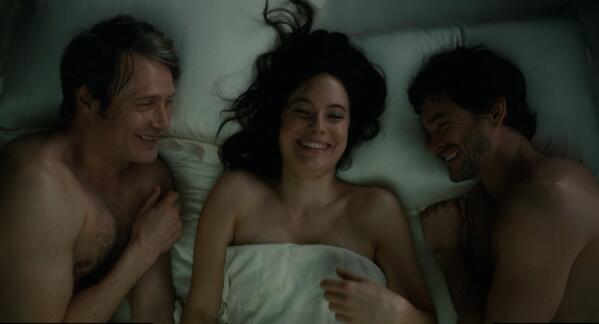
We always open inside Will’s head lately, and this episode was no different. (Here’s hoping we’re not Roseanned at the end!) He conflates his slaying of last week’s serial killer in a dream of also killing Hannibal, which ties in with the incredibly slow David Lynchian conflated sex scene wherein Dr. Bloom is “had” by Hannibal literally and Will projectively. The use of conflation in this episode is important because Will and Hannibal are finally merging. Before they do fully, however, we will be prone to their flirting (serial killer-style) with one another in front of Jack and Dr. Bloom and everyone else. I didn’t expect Will’s transformation to be so obsequious in regard to Hannibal, but if we take the whole sex scene a step further, then Will, by projecting that he has sex with Dr. Bloom through Margot, is able to “have sex” with Hannibal through that projection. I know, I know, I’ve been reading too much Harold Bloom. In any case, the episode ends with both Will’s and Hannibal’s faces conflated into one another, like some kind of ghoulish Chuck Close painting. If the effect is to heighten the “merging” aspect of these two, the production is laying it on a bit thick.

So, Will gets to (presumably) kill Freddie Lounds, ending the life of yet another part of the closed circle. But Margot and her sinister, pig-obsessed brother are uncovering the dark of the wings and heading for the limelight as we speak. As old ancillary characters die, so must new ancillary characters live. Will murdering Freddie didn’t bother me; she already had figured out, as Alana is coming around to now, what the game is. And tonight, it should come around to Jack, prompting (perhaps) the showdown with Hannibal that began the season. But I think we have to deal yet with further piggishness before we can get down to the bones. Other prediction for tonight: The whole Will and Margot (though I wouldn’t rule out Alana and Hannibal) pregnancy thing is another emotional red herring. Don’t let’s add another complication, Story Gods! This isn’t Passions.

My favorite moment of the episode: when Will is eating (presumably) a part of Freddie, that look on his face—transcendence.

Jonathan May watches too much television, but he’s just playing catch-up from a childhood spent in Zimbabwe. You can read his poetry at owenmay.com, follow him on Twitter at @jonowenmay, or email him at owen.may@gmail.com.

Hannibal airs Friday nights on NBC. You can read our pieces about previous episodes here.

Image: NBC

You Need to Watch Black Mirror: “The National Anthem” Episode Review

black-mirror

Jonathan May

Promise: I will not give away the ending. You must watch this show. Watch it immediately after reading this.

It’s been a long time since television has posed such an interesting question as this episode poses. Is the decency of one man worth more or less than the life of one other person? Such a fragile and horrifying situation. I found myself aghast at the cost of fame, wherein your personhood, known to all, is your own worst enemy. In this case, the British Prime Minister must have sex with a pig on live television or else the kidnapped Princess will be executed. The use of YouTube by the kidnappers (I’m not giving the end away, I promise) to facilitate a public interest reminded me, in a way, of the scene between the prisoners and citizens of Gotham in The Dark Knight. You bring the public into the situation, and that’s where the stake of fame comes in. It would be interesting to posit the same premise, but with an “ordinary citizen” at the center, instead of a Prime Minister. Would the greater public be just as interested in watching an everyday Joe have sex with a pig to secure the release of a princess? I’m not so sure, but then again, I’ve never wanted an office of power, where you become the target for statements thrust into the public sphere.

As far as this being a commentary on art, all I will say, without divulging the end, is that this episode conflates “Art” with “Statements.” For something to be artistic, it should be beautiful (a bold statement, but one I’ll stand by any day), and while the idea might be beautiful in a cold, intellectual way, the expression of the idea is far from beauty, focusing instead on art always being a performance, which I thought we had moved beyond.

But for the love of yourself, if you want to watch the most gripping thing produced for television in the past five years, seek out Channel 4’s Black Mirror, the first episode “The National Anthem.”

Jonathan May watches too much television, but he’s just playing catch-up from a childhood spent in Zimbabwe. You can read his poetry at owenmay.com, follow him on Twitter at @jonowenmay, or email him at owen.may@gmail.com


Life Lessons from Episodes of Louie: “Back” and “Model”

louie-3

Alex Russell

Louis C.K.’s critically acclaimed show Louie’s fourth season runs as two episodes every Monday night. Rather than just answering the question of “are these episodes good,” (because the answer is always yes) we’ll talk about the big lessons imparted in each episode. This week: Louie’s back hurts and he has to open for Jerry Seinfeld.

Welcome to this! Maybe it’ll work and maybe it won’t. That sentence had to come up in the pitch for Louie, so it’s as good of a place to start as any. I love Louie very deeply. I even loved Louis C.K.’s tonally similar movie. Louie is always going to mean different things to different people, but to me it means hope for the hopeless. The “world” of Louie is brutal and mean, but it is not without victory. After an extremely long hiatus, Louis C.K. had to come out swinging to remind people what both the world of Louie and the character of “Louie” are like. The first two episodes definitely do that.

Episode 1: “Back”

“Back” opens with the best joke structure possible: Big gets bigger. Louie wakes up in New York City to the sound of garbage men. Of course, they break into his house to jump on his bed and dump trash on him. His life literally gets worse from the moment he wakes up. It’s a fitting start to an episode that’s mostly about how hard it is to get older.

Louie always features stand up bits that weave the vignettes together; the one about hating a 31-year-old for complaining about aging will hit too close to home for a lot of people. Louie’s back goes out and a gruff doctor, an unfazed sexshop worker, and Todd Barry don’t have any time or interest in consoling him.

It’s tempting to label this “you have to take care of yourself,” but the doctor is insistent that everyone’s back hurts most of the time. The back pain is obvious both as a symbol for and the result of aging, so the first episode of the season is closer to the first line from the Serenity Prayer:

God, grant me the serenity to accept the things I cannot change,
The courage to change the things I can,
And wisdom to know the difference.

Episode 2: “Model

Anyone with a passing knowledge of Louie or a working sense of dread will see the first twist in “Model” coming. Louie has to open for Jerry Seinfeld at a benefit. He doesn’t get enough detail and thus ends up in a T-shirt at a black-tie affair full of millionaires. The first 10 minutes is every bit as agonizing as you’d expect, but it’s when the episode turns to the model herself that it socks you in the gut.

There’s some good stuff that I don’t want to spoil, but it is enough to say that this episode would have consequences for the characters on another show. The “continuity” of Louie is always up in the air — outside of two extended relationships on the show, not much carries over — but it will be interesting to see if the show cares about the big blow it deals its main character in “Model.”

Probably not, and that’s more than fine. What’s more interesting is the lesson itself, revealed in the scene with the credits: It’s never all bad.

Alex Russell lives in Chicago and is set in his ways. Disagree with him about anything at readingatrecess@gmail.com or on Twitter at @alexbad.

Life After the Star Wars Expanded Universe: Bernard Werber’s Empire of the Ants

cf4dc27a02a0dab1f700d110.L

Andrew Findlay

In Life After the Star Wars Expanded Universe, we take a look at science fiction and fantasy, why they’re great, and what they say about where our species has been and where it’s going.

Imagine this: you are absolutely crushed with exhaustion. You’ve been working for 12 hours straight, or you’ve just run 10 miles, or you’ve just moved all of your furniture to a new apartment and only one of your friends actually showed up to help. You are about to fall down with fatigue, but you turn to your friend, who offers you nourishment from his or her own stomach. Once you lock lips and do the exchange, you feel reenergized and ready to take on the world. This process is called trophallaxis, and for ants, it’s a way to bond, exchange pheromones, and get valuable caloric units to the members of the colony that need it most. I know this because I have just finished reading a book called Empire of the Ants.

This book is strange in that the majority of it is narrated from the point of view of ants. Werber weaves three distinct threads through the book’s narrative: ant POV passages, human POV passages, and fictional encyclopedia entries. The encyclopedia was written by a deceased mad scientist, the relatives of whom form most of the human characters in the novel. Its subject is unknown at the beginning of the novel, but its author, Edmond Wells, was deep into myrmecology and wanted to establish communication with the ants. His nephew, Jonathan, inherits his old apartment and finds a note saying “Never go into the cellar!” Following story logic, of course he ends up going down there, where he discovers a massive subterranean cavern. The narrative thread of the human POV section deals with the dangers, mysteries, and discoveries of the late Uncle Edmond’s secret underground laboratory. The ant POV sections actually dominate the book, which raises the question –  how do animals with brains the size of an asterisk (*) sustain any type of comprehensible narrative? This is where the fiction part of science fiction comes in.

A_Formica_rufa_sideview

Formica Rufa, the main character(s) of this novel

Ants undeniably use language. A lot of animals use basic pheromones, but ants employ a massive dictionary of them: scientists think that they can recognize hundreds of chemical combinations (side note: the scientist in that article is attempting exactly what the fictional scientist in the book is – translating and using the ant language). Werber takes this fact of ant society and expands chemical signals like “Food this way!” and “I am dying!” into a structure that can handle phrases like, “Something weird is going on here. We need to communicate this to the swarm.” It is an established fact that ants have language, and Werber simply asks his readers to apply suspension of disbelief and accept that ants have a language nearly as complex as ours. He does not abuse this anthropomorphization of his principal characters. They use their ant language to run around doing ant things – at no point do two disgruntled ants get drunk at a bar and whine about how the Queen is working them too hard. We see ants going out into the dangers of the world foraging for food, ants taking care of larvae, ants making war with a different species of ant, and any number of other antish activities. Werber does a good job illuminating the subtlety and complexity of life in an anthill and making these explanations part of the action of the story. For example, most ant colonies have a queen whose only responsibility or influence over the swarm is constantly laying eggs. Most of these eggs grow into sterile female worker ants, but some are fed better than others, and these better-fed larvae develop into sexually mature, winged females. Unfertilized eggs develop into male ants, which do nothing but sit around eating. When the weather is right, all the males and sexually mature females fly away from the colony, sometimes over very long distances, and mate along the way. The male deposits his gametes in the female then dies, and the female can then use this genetic payload to lay eggs for as long as the next thirty years. She then lands, tears off her own wings, starts digging a small burrow to lay eggs in, and builds the entire populace of a new city.

Meat_eater_ant_qeen_excavating_hole

This newly-landed queen is already stocked with every worker that will ever be a member of her colony.

Werber takes all of this information and weaves it into a tense action scene in the book. Out of the millions of virgin queens who swarm off, only a handful actually survive. They are eaten by birds, they are killed by competing ants, or they simply fail at setting up a new colony. This high failure rate allows Werber to add a lot of suspense to the situation when narrating the nuptial flight of one of the main ant characters. She flies hard as birds pick off her comrades left and right, she tires and can fly no more and falls in a river, she gets trapped in a spiderweb and faces almost certain death there, and then she lands, eats her own wings (high-protein nourishment after an exhausting ordeal), and starts the laborious process of bringing a new nation into the world. This melding of action and explanation throughout the book creates a strange phenomenon whereby, as Werber advances the plot, the reader learns a ridiculous amount about how ants work. I know about trophallaxy, the nuptial flight, where and how they store food, their symbiotic relationship with aphids, how they wake up after a long hibernation, how they use their antennae, how they care for their young, how they wage war (they can actually shoot acid from their abdomen!), and a host of other facts. The interplay between information and plot advancement creates a pleasurable sense of ambiguity around whether the book is a reference text or a fiction book. I mean, it’s a fiction book; it has talking ants for God’s sake, but from what you can learn from it, it may as well be an encyclopedia.

Which brings us to what might turn you off of this book: If you do not care about ant facts, you will be bored to tears. The main payoff of the novel is the painstaking exploration and elucidation of an extremely alien culture that exists just a few feet underneath the earth, and if you are not into that, your experience of the novel will be missing its main selling point. The humans are hands-down the weakest part of the novel. Their thoughts are simplistic, their dialogue is uninteresting, and their path through the narrative is not nearly as appealing as that of the ants. Werber does not construct solid mimetic aspects for his characters. James Phelan’s theory of character splits character creation into three aspects: The mimetic aspect is how much the character resembles an actual person, the thematic aspect is how the character serves to advance the ideas of the novel, and the synthetic aspect is how the character serves as an artificial construct that advances the narrative. Many SF novels skimp on developing the mimetic aspect of their characters (consistent character traits, subtle emotional responses, believable interactions with other characters). Having fully-developed characters along all three axes is often what separates SF books that escape the Science Fiction and Fantasy section of bookstores from more well-recognized (but not necessarily less worthwhile) SF. For example, The Handmaid’s Tale, 1984, and Fahrenheit 451 are not considered genre literature, whereas the less character-centric Starship Troopers, The Gods Themselves, and Planet of the Apes are almost always found next to the Star Wars books.

AtomicWar0401

One of these categories of SF has much better book covers than the other.

In some SF novels, the subsumption of character-as-person by character-as-idea is a symptom of SF as a literature of ideas – the SF novel is an exercise in philosophical extrapolation, and everything else takes a backseat to that. It is forgivable to have two-dimensional characters in the service of ideas, but Werber’s humans are stunted both mimetically and thematically. Their only purpose is synthetic – they stumble through the world of the book and advance the plot.

The flimsiness of the human characters and the relatively lackluster plot are the only sour spots in an exact, exciting, and enlightening study of how a society completely alien to our own might function if it had just a little bit more brainpower than we give it credit for. Ants are amazing. They are arguably the most successful animal on the planet. They are on every continent, everywhere except for the highest mountain peaks and the poles. They have been around for 140 million years (humanity = 200,000 years). The total weight of all ants on Earth roughly equals the total weight of all humans on Earth. If they can communicate the way they do in this book, and we piss them off, we’re screwed. Maybe you should read this as a primer on how best to welcome your new ant overlords.

Andrew Findlay has strong opinions about things (mostly literature) and will share them with you loudly and confidently. You can email him at afindlay.recess@gmail.com.

Symbols and Sociopaths: Hannibal Season 2, Episode 9

Hannibal episode 9

Jonathan May

(Massive spoilers, and I totally called Will being groomed by Lecter into becoming a serial killer like three episodes ago. C’mon, story gods!)

Everything in this episode acts in opposition to what has been. This week’s killer suffers from what Hannibal terms species dysphoria, but, on the whole, the episode operates thematically under what I like to call reverse personification. The killer, wanting to be an animal, acts not only in opposition to nature, but to his own nature as well. Will, on the other hand, finally actualizes as a killer, acting against what he knows to be good (akrasia) and aligning with what he knows to be wrong. When he brings up the question of right and wrong to Dr. Lecter, the good doctor responds that those are inconsequential to a God who enjoys human suffering and joy the same, and that he thinks of God when he kills; I think he’s really just thinking of himself, having been “resurrected” from the cross by Jack and Dr. Bloom in the foiled plot by Will against him.

When Will arrives at Hannibal’s door at the episode’s end with the killer’s body in tow, it’s as if he too has become animalistic, like a dog or cat bringing home a dead bird for the master. I almost expected Hannibal to pet him. So we know, or at least we think we know, that Will is now apt student to the good doctor; could this be a ploy on Will’s end to finally expose Lecter, or is this a genuine turn in character? I only bring up the former possibility because this season’s arc has been a bit wobbly, and I wouldn’t put it past the story gods to throw a big “Gotcha!” at us. But, as Will stated, now they’re both “even Steven.” All that said, I stand by my thoughts from three weeks ago: Will is becoming the monster Hannibal always meant him to become, his most successful therapeutic result. My predictions for tonight’s episode are that Will finally realizes some artistic killing projects of his own, something morbid will happen to Dr. Bloom or Jack’s wife (or is she dead? so far, we don’t know!), and Margot will continue to bore me to death. Did the production really need another affluent person to sit around the story’s perimeters this late in the game?

Minor note: Whoever put on Hugh Dancy’s eye makeup this week needs to calm down.

Jonathan May watches too much television, but he’s just playing catch-up from a childhood spent in Zimbabwe. You can read his poetry at owenmay.com, follow him on Twitter at @jonowenmay, or email him at owen.may@gmail.com.

Hannibal airs Friday nights on NBC. You can read our pieces about previous episodes here.

Image: NBC

Another Look at the Endings of Lost, Breaking Bad, and The Wire

Television_set_from_the_early_1950s

Andrew Findlay

In this so far nameless segment, regular contributor Andrew Findlay takes issue with another person’s opinions. Think of it as a “letter to the editor” except it’s always from the same defiant person and the “editor” in that example writes for the same site. This one has spoilers for The Wire, Breaking Bad, Battlestar Galactica, Lost, and a previous post on Reading at Recess about TV.

Extremely popular, long-running television shows struggle with sticking the landing. It is known. It has been known ever since the ending of Lost caused about half of its die-hard fanbase to swear never to watch another episode. It has been known since people internet-complained at the less-than-ideal end to Battlestar Galactica. However, it is strange to pick as the most relevant representatives of this phenomenon two of the most critically acclaimed shows of all time, one of which was showered with accolades for achieving the impossible and having a nearly perfect final episode.

Terrible endings exist and are unfortunate. At the end of Battlestar Galactica, the survivors sent their entire fleet into the sun so they could join/create humanity and live through the Dark Ages alongside them instead of significantly lessening human misery by holding on to their tech, which seemed like a weird choice. The ending of Lost, a show built almost entirely on mystery and suspense, completely dismissed the big final mystery and betrayed a legion of fans that had spent a significant portion of their lives tuning in every week. When you promise answers for years and years, and then the answer is “Oh, just unplug the island, any IT person worth his salt will tell you the usefulness of power cycling,” it creates a vast and deep well of rage. Who created the plug? What is that glowing room? Why are you just giving your viewership more mysteries instead of actually answering anything? When you go from a level of dedication that creates the YouTube video below to undiluted hatred, you have written a terrible ending.

I teared up watching this, remembering how it felt to be a part of the viewership of this show. Not sure if I’ll ever watch an episode again.

The Wire and Breaking Bad ended really well. Season five of The Wire may have been a little weaker compared to the others, but there was no nosedive. The state of affairs at the end of the final episode were either good or emphasized the whole underlying theme of the show: The game is the game, and the game never ends. It is absolutely believable that McNulty’s arrogant ass would get himself killed, but the detective’s wake in the last episode is actually fake, and he is actually escaping from his self-destructive career path. Omar, probably the most universally liked character on the show, is murdered in a convenience store by a little kid. This happens because he is not a civilian – he is a player of the game, and the game never ends, and anything can happen. Almost no one escapes, and if they do, they are lucky.

I don’t have as much an issue with that as with the idea of Breaking Bad’s final episode being a failure. It is almost universally praised as a near-flawless ending. It is almost perfect because Walt gets exactly everything he deserves, but he also gets everything he wants. This paradox exists because Walt, after five seasons of being driven by anger and pride, finally realizes and repents all the mistakes he made. He realizes what he deserves and is only concerned with doing right by those he loves. Who does he love (who is still alive at this point)? Jesse, Skyler, and his son and daughter. What has his arrogance done to them throughout the series? His family has lost everything, been terrorized, and been forced to abandon their home. Jesse has lost the woman he loves, been completely broken psychologically, and been enslaved by an Aryan Brotherhood gang. This is some bad shit that Walt has done. The reason that Walt can get what he deserves and what he wants is that, for the first time, what he wants is not centered around himself. He finally, finally, realizes what he actually needs to do, not for his own ego, but for the people he loves.

This is one of the greatest scenes in television, period.

This growth and shift of character makes the final episode what it is. He is out for money, but only for his family after he is gone. He is out for vengeance, but mostly to rescue Jesse from the position he put him in and to punish them for what they did to Hank. After so much greed and vanity and selfishness, Walt finally realizes what he has done and what he needs to do to make it right, whether he survives or not. Walt, after years of denial and repression and blame-shifting and anger, accepts who he is and what he does, and formulates a plan. This plan is absolutely successful. He finds a way to provide for the family he destroyed by intimidating his old work colleague. He rescues Jesse by single-handedly wiping out a gang. Then, after having actually done right by the people he loves, after five seasons of only paying lip service to that sentiment, he dies. It seems to me he dies from blood loss, as he’s been leaking for quite a while at this point and is leaving blood on everything he touches, but regardless of the cause, the important thing is that he died after achieving all of his goals. Walter White achieving all of his goals and then escaping from justice yet again would be a repugnant ending, but he does not escape justice, and he is not the same Walter White. Sure, he doesn’t get arrested, but he spends most of the second half of season five dealing with the consequences of his actions. The complete ruination of his own life, the life of his family, and the life of someone who is like a son to him, is consequence enough. What the hell are the police going to be able to do that he hasn’t already done to himself? These consequences and the pain of dealing with them set a process, if not of redemption, then at least of remorse and planning. The Walt of the last 20 minutes of the show is not the Walt who is in the “empire-building business,” but a Walt willing to sacrifice himself to do right by everyone else. This profound character transformation makes it possible for us to root for Walt again, and this is the trick that makes the ending of Breaking Bad so appealing. As for Jesse, who is driving away into the night, it doesn’t really matter where he’s going. He is free from the physical enslavement of the Aryan gang and the psychological enslavement of Walt. Wherever he is headed, it cannot possibly be worse than where he was.

This cultural moment has been called, many times, the Golden Age of television. It is an edifice built on the foundations of The Sopranos and The Wire. It is the result of a shift in perception, where television writers are responsible for creating a quality product and not just creating ratings. It consists of many different shows of deep emotional impact, strong plotting, and important thematic development. The result is that we consume our acclaimed television more like we consume our acclaimed novels, voraciously and as important art. The reason people are analyzing TV shows now is not that there is some mystical relationship between TV and novels or that one is replacing the other, but that TV has gotten really, ridiculously good in the past decade, and that humans love spinning commentary on really, ridiculously good things. Sure, there are some grievous missteps here and there, but The Wire and Breaking Bad are not examples of them.

Andrew Findlay has strong opinions about things (mostly literature) and will share them with you loudly and confidently. You can email him at afindlay.recess@gmail.com.

The Wolf of Wall Street is About Excess and Debauchery: Should You See It?

wows

Stephanie Feinstein

In our rarely-running kinda-series Should You See It? we talk about movies that just came out. You can figure out the rest of the premise from the title of the series. That’s right: We talk recipes. Should you see The Wolf of Wall Street?

Spoilers, of course.

First of all, this was a really long 180 minutes, and the first 45 are just 2000’s Boiler Room all over again.

This is a true story: The real deal Jordan Belfort wrote a memoir about how he swindled the hell out of America, and Scorsese decided that would make a good movie. But unlike so many other debauchery-focused films, it lacks reflection and remorse.

This lack of victims, of consequence, of remorse, of pain, are my issues with Scorsese’s latest. The movie spirals down a hole of moral ambiguity, drowning in its own self-righteousness.

“But he gets caught!” You might argue, “He pays for his sins!” I disagree. A 36-month stint in a Nevada white-collar prison does not atonement make. Referring to the incarceration as a respite from his money-hungry life, he feels no remorse for what put him there.

There is a lack of remorse for cheating on his first wife, and we see no repercussions of divorce. There is no aftermath of her marriage, no additional hospitality or hurt. No or media backlash; no paparazzi-fueled tabloids.

When his yacht sinks during a hellacious storm, no one is harmed and only the yacht (which I assume to be heavily insured), suffers. His wife is fine, their friends are fine, no crew is lost. The plane coming to rescue them after the wreck? It explodes, killing three people. Do we see the funerals, the anguish of having ruined other lives? No. He does not even openly acknowledge the explosion, glossing over it in a smooth voice over, paving the way for his reluctant sobriety.

The two scenes that most display the lack of morality and compass do not use yachts, planes, or pussy to make a point. When Belfort Lemmon-ludes up and over at the country club, he chooses to drive his expensive-ass car home, despite a total lack of motor skills. He claims to have made it home without a scratch on himself or the gleaming Lamborghini. As the audience, we believe him until officers show up the next day, ready for an arrest.

If this were a tale of moral understanding and growth, more than just a fender and door would be damaged. In screenplay-land, this is the time to show us a bit of blood on the hood and imply that Belfort cost someone more than just their savings. This moral resolution does not appear; the charges of DWI are dropped without evidence.

Another car, a Mercedes with a passenger, and another great display. During Belfort’s slide further down the amoral rabbit hole, his model wife Naomi LaPaglia (Margot Robbie) challenges his life and he flips his shit. Destroying a sofa in search of his “small stash” (what I assume to be about ¼ pound of uncut cocaine), he buries his nose into the powder before snatching up his eldest child and attempting to flee the property. As expected, the car crashes, and although the child is absolutely not large enough or old enough to be in the front seat safely in an accident, no great harm is done.

As before, if this story was to have a lesson — a moral, an actual resolve beyond greed –that child would not have arrived unscathed. But like so many other things, Belfort’s life continues unruffled, no matter what he is facing.

As for the rest of the film, the side characters are by far the best. Cristin Milioti as the suffering first wife (Teresa Petrillo), has a beautiful emotional breakdown after finding DiCaprio’s Belfort cheating. A recent television sensation (she’s the mother in How I Met Your Mother), she plays the Jersey hairdresser delightfully.

Jonah Hill (Donnie Azoff) is another surprising standout, as I was not really expecting much from him (Protip: To understand how I feel about Jonah, please watch 2008’s Strange Wilderness.) His meandering, pseudo-improvised diatribes are often humorous, but feel disjointed. It was great to see him jacking off at the party, smoking crack, or rip-torn on blow and pills, but the “chops” didn’t feel as genuine.

Anyone out there remember Early Edition? Crime solving with psychic newspapers? Kyle Chandler remembers, as he plays ineffectual FBI agent Patrick Denham in Wolf, making little money and an even smaller impact in the financial world. (His will-they-won’t-they bribe scene is pretty great.). Would the story be stronger if Chandler was again paired with a psychic newspaper? Maybe.

The cameos of television actors don’t end there, as Kenneth Choi (Sons of Anarchy), Jon Bernthal (The Walking Dead) and Thomas Middleditch (Silicon Valley) make appearances with different ends. The addition of seasoned veterans Rob Reiner, Jon Favreau, and Jean Dujardin rounds out the strong cast, but no one can save the film. Even the real Jordan Belfort, cleverly hidden in the end as an announcer in Auckland, cannot give enough gravitas or remorse to save it all.

Best Part: Matthew McConaughey’s Mark Hanna. A single real scene, the introduction of drugs, a weirdly racist chest thumping, and the drive of the all-mighty dollar, McConaughey was better than the movie deserved. I wanted so much for him to return in the end, check up on Jordan, challenge him in some way, but to no avail. The chest-thumping remains, but McConaughey leaves us far too soon.

 2nd Best Part: DiCaprio’s worm flailing at the country club. Hilarious, as well as a great look at an actor not known for his physicality in roles (Gilbert Grape notwithstanding.) The fact it so delightfully mimicked his dancing at his wedding made it all the better.

Overall: In the kidnapping-car crash, Jordan receives a small wound on his forehead, and a trickle of blood is our only real indication of his pain. We see no recovery, no regret, no growth.

In The Wolf of Wall Street, Jordan Belfort bleeds, but it is never enough.

Should You See It? (Well, now rent it): Sure. I will say that I am super-duper glad I did not see this in theaters, as the debauchery of it all would have been too great, with no great Hunter S. reflection. At home, on the sofa, it’s a great watching experience. The story is surprisingly fun, once you get past all the moral ineptitude.

Stephanie Feinstein yells at her television daily, and you will never change that. You can challenge her at stephanie.feinstein@gmail.com.