video games

Casual Commitments: Cook, Serve, Delicious!

cookserve

Brent A. Hopkins

In Casual Commitments, we explore the ups and downs of casual gaming.

Cooking is an art form and this game is the pepper grinder.

Today I will be reviewing Cook, Serve, Delicious!, another game that is available on mobile devices and then was recently ported to PC and released on Steam. It is a restaurant and time management simulation.

The premise of the game is the player taking the role of a chef who has taken over a former renowned restaurant that has gone from being a five-star pinnacle of culinary delight to a starless greasy spoon restaurant. As the chef in a newly revamped tower that houses your restaurant as well, you have to build your menu to mainly attract the tenants and reclaim the former five-star rating that was once held.

The game setup is split into two sections: one being the restaurant and the other being the management portion. The interfaces are both very clean and simple and there is a nice little tutorial to help the player become acclimated to the game. I will start off with the chef portion of the game as that is the games’ major selling point.

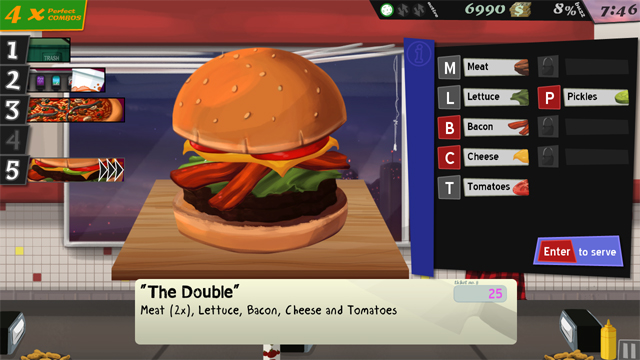
The restaurant that you run is owned and maintained solely by you. It opens at 9 a.m. and closes at 10 p.m. This means that over the course of a day you have to deal with all of the things that a real restaurant would have to handle, alone. The main job that you have is to handle customers’ orders. This works in a quick time event sort of way. The customer will come in and order something on your menu (I will explain the menu more later) this is assigned a number on the keyboard from 1 to however many order slots you have unlocked (I currently have 5). Once you acknowledge the customer you must finish their order. I will use one of the earliest and cheapest foods as an example, The Corn Dog.

The Corn Dog is simple but it can come in three ways: ketchup only, mustard only, or ketchup and mustard. The customer will come in and wait and when you acknowledge him or her they will say I want only mustard, for instance. The game has built in hot keys for each food on the menu so in this case ‘M’ is used for mustard on corndogs and then you press enter to serve the food. When the order has no mistakes you are given a rating from the customer. Rinse and repeat.

The rating system is how you are tracked throughout the day, with perfect orders giving you a chain which increases your restaurants’ “Buzz.” The higher the “buzz” the more people will come day-to-day. There are two other ratings you can get which are average and bad. Average doesn’t do anything but break your perfect streak, but bad orders hurt your “Buzz” and impact customers.

The other part of the restaurant section is the chores that you must do. These are all setup in the same interface as the food where they will show up as customers and you must choose and complete them quickly to keep customers happy. There are four chores to do: dishes, rat traps, toilet cleaning, and trash. These are all hot-keyed like the food menus, so once you memorize how to do them you can hit the keys without looking and complete them really quickly. The types of food you have on your menu affect what chores come up the most. When you have meals that require plates, you do dishes more. If you have fish, you deal with rats more. The chores become more of a slight inconvenience than a real problem.

The stress from the restaurant portion of the game is entirely rolled up in handling customers and chores quickly. When you have many things on your menu and they all take various amounts of preparation time it can become hard to juggle the steak orders with the ice cream orders. There is also rush hour to deal with, which hits at noon and 6 p.m., and this drastically increases the rate at which you have to deal with customers. Your fingers will have to fly to make sure you can keep your perfect scores up through them. The secret here is simply to memorize the keys for the foods on your menu so you can quickly read what the customer wants and bang it out without looking. Once you can do that the game is never really hard, with mistakes mainly stemming from fat fingers (in my case) hitting the wrong customer and effectively serving them too early.

The second part of the game is the management aspect. This takes place on a different menu and has a few parts to deal with. The parts you will use the most are the food menu and equipment menu. These are where you choose what food you serve day to day and also what equipment you will have available to you to enhance your cooking.

The food menu is really simple because all you have to do is save up enough money to buy an item and it is added to a pool of recipes that you know. Each food takes different types of preparation in the kitchen, and this would be hard to deal with without practice so the game allows you to practice before you have to suddenly make lasagna or nachos in an actual working day.

The menu itself is setup where you can only have a certain number of items to prepare each day. There is something called menu rot which forces you to take things off the menu after two days, or else people will refuse to order it because it is boring. To keep you from constantly having to rotate a wide variety of foods there are also staple items which you can keep on the menu every day to have some regularity in preparation.

The foods themselves are varied and tend to fall into culinary categories: American, Italian, Asian, Mexican, snacks, and drinks. These all can be upgraded which usually add more options for the customers to choose from, thus making the game harder. This is something that doesn’t really matter unless you’re going for achievements because there are never Mexican days or Italian days at the restaurant unless you choose to do that. The foods also have pluses and minuses attached to them that can increase the interest in them being ordered, cause them to require more cleaning, or even call for perfection when ordered. These are mildly important because the game still ticks along even if you are not min-maxing your food prices and buzz.

The other part of the post-work menu system is comprised of emails and events that you can partake in. The email system gives you updates about what customers will want on a rainy day, what new items are available to purchase, which foods you can upgrade, and so on. The most interesting thing I found here were the bets, dating, catering deals, and chef challenges. These all can increase your money and give you a reprieve from just going into ‘work’ every day. They aren’t that varied either, as they still take place in the kitchen but the best part about it is they give you mini-challenges to deal with for fun.

So those are the two portions of the game, now it is time for the problems. The game is fun… for a very short amount of time. It is obviously perfect for a casual phone or tablet game, but when it comes to a PC port it takes the will of Buddha and the wrists of Superman to play for lengthy amounts of time. I have been gaming for most of my life and I am no stranger to marathon sessions. This game, though, is the first to make me step away due to arm cramps from just rote typing and clicking.

Secondly, because the game is more about memory and speed than anything else, it doesn’t feel like it is skill-based once you have gotten a few of the high priced recipes down pat. Then you just find yourself grinding out days, rotating things off the menu occasionally, and never having hard recipes on your menu unless the game forces you to.

My final major gripe with this game is really simple: IT TAKES TOO LONG! The game starts you out with a zero-star restaurant and you have to fulfill certain requirements to get upgraded to a one-star restaurant. The requirements can be as easy as buy x amount of food for your menu to the slightly more difficult get x perfects on so many days. These are not a problem and help keep interest in the game, so I like them. My one problem is with the last requirement: serve 20 days in the restaurant at this rating. This is genuinely the one thing that makes me want to change all the keys on my keyboard to sandpaper and play by sliding my knuckles across the keys. There is nothing fun about finishing all of the requirements for your restaurant to be upgraded by day five and realizing that you have 15 more days to play with nothing to gain but money for equipment and upgrades. It is poorly paced and I find myself saying “Play ten days today then turn the game off so you keep your sanity.”

The game is sold as a restaurant simulation and that is not true in the least. You don’t have the full freedom of control that you would really want in a game like this, because you can’t make new recipes. You can’t customize the restaurant into serving a type of food and you can’t even manage your own restaurant look and feel, as the upgrades are all forced. I was really let down by this game because I was hoping to be a seller of fine deep-fried desserts and alcohols as a true Texan/Southern-bred foodie would and instead I found myself selling salads because I happened to memorize all of those ingredients quickly.

I give Cook, Serve, Delicious! 2 salt shakers out of 5 because the game is a great quick fix but falls flat when you realize you have to grind more than teenagers at a house party to get what you want.

Cook, Serve, Delicious! is produced by Vertigo Gaming.

Image source: Vertigo Gaming

Casual Commitments: When I Move, You Don’t Move

moving

Brent A. Hopkins

In Casual Commitments, we explore the ups and downs of casual gaming. Well, we usually do. Today, the author turns inward. Get to know our games correspondent Brent Hopkins today. And yes, that’s a Ludacris reference in the title.

This is my first time writing something that is far more personal and completely separate from gaming, so bear with me.

Over the… entirety of my life, I have been a bit of a roamer. My dad has always had jobs in sales and marketing and as a really outgoing man he tended to get promotions or jump at opportunities for advancement, which meant we moved all the time. This meant that I never really settled down in an area, because like any other social training I grew to expect a ‘reset’ of sorts every three or four years. This is not something unique to me as I have met many people who have moved over the years, but heck, this isn’t about them, this is about me.

The benefits of moving all of the time are many: I have almost no real fear of moving into areas where I know no on,and I actually tend to thrive as the new kid on the block. Tied to being the new kid, I have always had the ability to meet people and build relationships really quickly. When time isn’t on your side you figure out how to cut out the social fluff. This has made me two things. First, I’m a bit overly honest with my friends and family because I like people to take what I say at face value. Second, I’m a bit of a social moderator. I tend to see both sides of all situations even if I don’t entirely agree with one or the other (which I have been told by another writer here is quite annoying).

These are all skills that have proven invaluable moving forward in my life as I have decided to live overseas as an English teacher for the foreseeable future, and I was surprised that it crosses cultural boundaries as well. A part of me feels like I would have maybe done better as a counselor or a psychiatrist but hindsight and I are not ones to sit down and chat. I take solace in knowing that I am good at noticing the small things that are important to people and teaching has given me a chance to affect people using these roaming skills.

The bad aspects of always moving around are things that I have been dealing with very intensely recently. 2013 was what I like to call “shitty.” It was probably the worst year of my life since I was around 13 or 14 when the uncle I was closest to passed away. I always assumed bad years had spikes in crap that happened but I found that starting in February 2013 it was a pretty sustained level of ‘bleh’ with refresher ‘ohgodwai’ on about a bi-monthly to monthly basis. I spent a whole bunch of time thinking back on myself.

The general mindset I have nowadays isn’t particularly conducive to longevity in anything. I am not used to lengthy routines so the idea of settling down is something I can’t really wrap my mind around. This is obviously detrimental to any romantic relationship I have because I always feel like I have a clock ticking down to when I will suddenly leave again. This is something I used as an excuse as a teenager for my inability to date but has not suddenly vanished as I have bounced between South Korea and the USA and my current job has me hopping contract to contract. This has caused me to have long breaks between relationships because the energy of starting coupled with the emotions of leaving are, shockingly enough, huge deterrents.

I am also a jack-of-all trades, which is something I have always liked about myself. The problem (as there always is a problem, right?) is that when I moved I always tended to change interests so I never got amazing at anything that wasn’t a social skill. I am not complaining about this, really, but I found that when I start to get a decent level of skill at something I just stop practicing feeling content with it. Now, I will be honest, I actually am super-competitive behind my perpetual smile so I tend to get above average at things I set my mind to. There has always been a part of me that does envy those that can say I am really good at ______________ (insert skill or ability here).

Lastly, I have these strange moments (in my mind, probably not to others) where I think about having a home — not a house. Now, I have a home that I can go back to with my parents there but I am closer to 30 than I am to 20 now and I of course think about having my own home. Nothing that I am currently doing is getting me closer to that, which is mildly worrisome. I am at heart a homebody and I actually love days where I get to relax at home, cook for those I love, and be domestic. This is in stark contrast to this underlying urge to move when I am comfortable in a place because of that damn timer that is always ticking. This leaves me feeling like the single man/woman versus the married one, longing for the pinnacle that only the other can reach.

I always tend to analyze others and while that is a useful skill if done accurately I think I know now that I also need to look at myself and my behavior as well. I am spending a lot more time trying to get back to ideas and ideals I care about, which is something I lost a bit over the last year. Writing is one of those and ya know I haven’t been this content in awhile even with an impending move around the corner. At least now I am aware of some of the good and bad habits I have accrued over the years but I feel like constant moving is an interesting thing to mold an individual.

Here’s to a better year than the last.

Casual Commitments: Evoland

Brent A. Hopkins

In Casual Commitments, we explore the ups and downs of casual gaming.

Back again with another quick game review of a Steam-available gem called Evoland developed by Shiro Games.

Evoland is relatively unique in its class because it really is a throwback to three of the biggest RPG franchises out there. The art style is mostly focused around Zelda, the story and map setup is taken from Final Fantasy, and there is even a dungeon that switches to a Diablo-style loot-em-up. The whole experience is relatively short and sweet spanning about six-ten hours depending on how long you take to find all its secrets.

The Evo in Evoland comes from the evolution of the graphics and gameplay elements that you pick up in treasure chests scattered throughout the game. These are all given in small pieces as opposed to massive jumps so you can see how gaming really has evolved over time. You start out in this 8-bit classic Game Boy environment and slowly build up to PS1-flavor environments. As a person who has played the gamut of gaming consoles I will goofily admit that there were times, particularly with Mode7 and smooth scrolling, where I found myself chuckling a bit thinking back on games I played before these technological leaps.

(The pixels, kid, the pixels!)

The game itself is actually not too far from a Game Boy game really, utilizing two buttons one for actions and attacking the other for canceling and accessing a pretty useless pause menu. The obvious point of the game is more like a museum where you look at the relics from past generations while casually solving the simplest puzzles these games had to offer.

This is probably where the game suffers the most. The game is fun but the battle system is so tragically archaic that I may have misled you all when I said it was like a Game Boy game. This game actually has less going on when dealing with battles than some Atari games. You get the concept of Zelda and Final Fantasy battles but because there is zero customization and the evolutions stop at the most basic levels you will find yourself DREADING and I mean sighing in distress when you get a random battle.

I played the game with achievements in mind, like I do with most every game, and they are simple to get and pretty intuitive as well. There are a slew of lil’ jokes here and there and there is nothing like playing as Clink: a green-tunic-wearing-spiky-haired-blond with a rather huge sword. Don’t expect a lot from the battle system but you get a taste of enough different games that it will keep you interested, especially if you don’t have achievements in mind.

I give Evoland 3.5 out of 5 pixels because it is worth the play for those that like Zelda and Final Fantasy VII but there is no reason to play it again once the credits roll.

Evoland is produced by Shiro Games.

Image source: Theology Games and Indie Haven

Casual Commitments: Tiny Thief

Brent A. Hopkins

In Casual Commitments, we explore the ups and downs of casual gaming.

The second time waster on my list is called Tiny Thief, a game that has had a bit of controversy surrounding it thanks to the publisher, Rovio. You all probably know Rovio for its hyper-popular Angry Birds franchise, which has spawned more merchandise than Star Wars over the last few years, and when a company is making that kind of money one of the first things to slide is its morals. The issue is with the insane markup for Tiny Thief on the Steam platform compared to the App Store. The normal retail price on Steam is about 4,000% more expensive than the App Store version which has caused consumers to be, picket the Rovio offices, mad. I bought the game for two dollars, so I don’t have that same grief with the company.

In my opinion, Tiny Thief is to the adventure genre what Final Fantasy VII is to RPGs. This game is probably the best introduction to the genre that you can possibly have and it makes you want to try your hand at more difficult adventures once you have completed its journey.

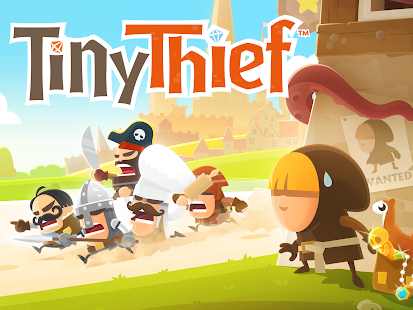
The whole atmosphere of the game is a bright fairy tale where you play the role of a Robin Hood like thief who must steal a particular item on each level to advance. This would be a bit simple even for a casual game, so there are also bonus items to steal and your pet ferret to find. Completing all of these nets you a star, with a perfect completion getting you three stars for the stage.

Most adventure games give you very few hints to progress the story, which can make them infuriatingly hard if you can’t wrap your mind around the puzzles. Oft times the developers make completely random connections like string-plus-alcohol-plus-birthday-candles makes a flamethrower. This flamethrower will be used with duct tape and a KFC bucket to make a hot air balloon. There is nothing clever about this and I personally hate that feeling of “ARE YOU F’ING SERIOUS!” that comes along with “solving” these riddles.

Tiny Thief gets big points from me because almost all of the interactions open to the player make sense. The interface is also very smooth as it is click to move and click to interact. The interactions come in two varieties: first is the thief that you move around and use to grab objects to solve puzzles and second are background interactions. The background interactions are things the player has to find on the level to solve separate puzzles and help the lil’ thief achieve his dreams of larceny.

That really sums up what you have to do. There is a story in the game but it is just the avenue through which the game is delivered. Tiny Thief falls for Tiny Princess and must steal his way to her. Sweet like aspartame.

New for Steam are Tiny Thief achievements. Most of these are just completion based where you finish a level or you don’t use the hint option for multiple rounds and at the end of the chapter (there are six, one being a tutorial) and you get the achievement. To add some more flair to the game there are hidden achievements which I won’t spoil here, but they tend to deal with humans being weirdoes and accosting the poor pixel people. It is an easy game to perfect if that’s your thing.

I will give Tiny Thief a 5 out of 5 Diamonds on PC (buy it on sale if possible). It is the perfect game to play for five to ten minutes and I look forward to some DLC levels if they ever happen.

Tiny Thief is produced by Rovio Entertainment.

Image source: Google Play

Casual Commitments: Triple Town

Brent A. Hopkins

In Casual Commitments, we explore the ups and downs of casual gaming.

Ah, PC gaming… how I have missed you.

To start, I describe myself as a gamer through and through. One of my first memories is sitting in my living room with my older brother and sister playing the original Nintendo. I remember we were playing two games in particular that day. Double Dribble (White Team: LA vs. Green Team: NY by Konami) and the classic Super Mario Brothers. That being said, I have grown old and bitter. I turned into a gamer hipster. Like most people who deem themselves purist of something I had a pretty lengthy phase where I hated casual games.

Things suddenly changed when I wanted to game and I was actually getting slammed with work and graduate classes. My stress relief has always been 1) gaming 2) shopping or 3) reading and I couldn’t sit and play an RPG for 10 hours or really anything for a lengthy period of time so I turned to Candy Crush. This game kept me from slowly ending all of my friendships with my old man grumpiness and I had to concede the casual market wasn’t so bad.

Then came the winter of 2013 and I was even busier with graduate school, my sister visiting me in Korea, looking for a new job, and work. So I turned on my computer, loaded up Steam, and bought between 60 and 80 games during the winter sale. I am not a man of moderation, by the way. Quite a few of the games were purchased with the intent of being used on my new tablet, the Microsoft Surface 2 Pro, and these two games have gotten the most play by far.

Triple Town

I picked this game up for around $2.50 on Steam with no actual knowledge of the game other than, “Dawww, look at the cute bears” and “Hey! The little citizens look like Mii avatars.” This was enough for me to install the game and I would say that is good advertising on developer SpryFox’s part. The game is an odd combination of space management, city design, and puzzle solving which you can’t really find anywhere else.

The game has two parts that the player has to deal with, the first being their hometown and the second being the towns that they go to and try and develop. I will explain the player’s town first as it is also used as the main hub for the game.

The player’s town is an open field that can be developed by matching three like resource nodes. This will upgrade to the next level and you can rinse and repeat this process leveling things up further and further. The difficulty arises when you have to match three of a high level resource with lower ones because there is a finite amount of space.

This is what the main game focuses on and it is much harder than you would think. The puzzle aspect of the game is that if you run out of spaces to place new tiles the round is over and you get money to upgrade your hometown and you must start over from the beginning. The towns are semi-populated with grass, trees, rocks, and houses that you must build around and use and the next piece you are given is randomly generated as well so you can’t rely on getting a piece you need to save you.

There are some amenities the player is given to help the town along, the most important of which are the crystal and the reserve space. The crystal is the wildcard of the game and matches two pieces into the next highest so two grasses and a crystal make a bush and so on. If the player does not have two matches on the board the crystal is a game ender because it turns into a rock which is almost impossible to match (you must use other crystals to make more rocks). The reserve space is a spot where you can keep valued pieces for later use but you only have one reserve space so while it seems like a great idea to save a crystal forever there is little to do when you have two crystals saved up.

The game is incredibly simple to get into but very hard to master, especially if you don’t think spatially. The first few rounds I just threw down bushes and trees and ended up with a lot of wasted spaces where I couldn’t build. This got me some coins but in the end my rounds were short and my scores were low. Then I started really trying to get the best buildings which go all the way up to floating sky castles. This is the part that really sucks you in.

The rounds take an extremely long time when you are doing well because you can’t just mindlessly click and I found myself playing for upwards of 30 to 40 minutes sometimes. This is actually a problem with the game because for a casual title you can’t always just drop it and go do something else, because your towns do not save.

There are different starting towns to choose from as well with various benefits and drawbacks. Some have more space but spawn bears and ninja bears; others get rid of the bear menace and leave you with less space to build on. I am an achievement hunter and this is something that the Steam game has over the app store versions of the game. When you build that new level of castle you get a nice achievement for your work and it helps motivate you to plan out your town and spend the 40 minutes getting floating cyber castles.

I would give the game 4 out of 5 stars. It is easy to play yet hard to master. As a casual game the rounds do tend to take too long if you are looking for a quick satisfying fix.

Triple Town is developed by SpryFox, LLC

The Game for People That Don’t Play Games: Gone Home

Alex Russell

If you play games, you have probably already made up your mind about Gone Home. You either played it on recommendation from just about everyone’s top 10 lists from 2013 or you decided it wasn’t for you and moved on. Whichever camp you fall into, I’m not going to be the deciding vote. I’m not going to be the reason you play Gone Home if you already play games.

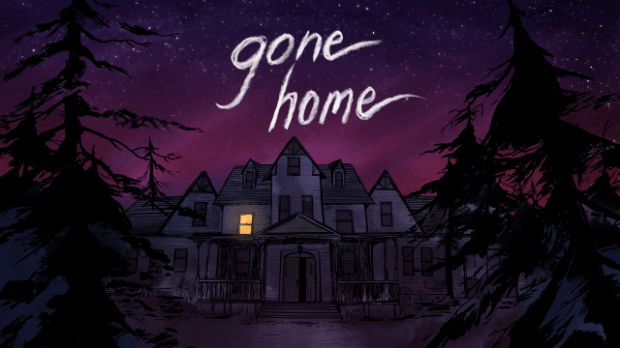
That’s because I don’t think it’s necessarily best suited for that crowd. Gone Home is entirely story-driven. You play a girl who comes home from a vacation abroad to find that no one is at home in her family’s house. You wander the creaky halls and get occasionally freaked out by the storm outside. From the moment you launch the game on the patio outside and start looking for clues, you are drawn into a world that doesn’t seem to have a lot of answers.

It raises plenty of questions. You find out about your own life from postcards that are collected on end tables. You uncover your mother’s struggles at work and your father’s minor downfall as a fringe author through the minutia of their lives in notes and letters. The more you pay attention to letters behind false backings in desks and the little details of the house itself the more you are likely to uncover the full story.

It’s tough to ignore the parallels with mystery. The meat of the story is your younger sister Sam, and the main storytelling device is her narration. As you find the different “big” parts of the story Sam speaks to you right out of her notebook. There’s no good way to talk about this and still have this serve as a call to action to play the game, so let it be enough to say that Sam has the conflict. The key to a good story is to make the character want something, and Sam definitely wants something.

On Metacritic, Gone Home has an 86 from critics and a 5.4/10 from users. That kind of disparity between critical success and the average person’s feelings on the Internet isn’t shocking. It’s easy to oversimplify and say that gamers don’t “get it,” but I don’t think that’s it. Gone Home probably isn’t what people expect to play when they hear that it is a “game of the year” candidate.

Gone Home is played from the same perspective and with the same ambiance as a million other games. The great majority of games that happen in worlds like this have zombies or ghosts or madmen or something else, waiting to stab you the shadows. Those games aren’t more or less than Gone Home, and I made it the entire way through the game still expecting something to jump out and ruin my world. I firmly believed this, all the way through the “last level” which is especially spooky. A run through the basement that I played with my lights in my apartment turned off got to me as much as any Resident Evil game ever did.

Gone Home is clearly happy to live in this expectation. They want the average gamer to expect to deal with the undead, but they probably also want to freak you out if this is the only game you play all year. The controls are as simple as any browser game and it’s impossible to not understand what’s being asked of you. It is a game that lives on expectations, tone, and mood.

So that’s probably why the response differs so much. It won’t challenge you in the way you might expect to be challenged by a video game. The “puzzles” boil down to things like finding a safe’s code in a book or figuring out how to knock something off a shelf by throwing a can at it. None of that matters to me.

What matters is that the critical praise for Gone Home says a little bit about the insecurity of people who play games. Gone Home is one of the greatest stories I’ve seen in a game, but it’s simple. Bioshock Infinite told a much more complex, winding story in 2013 and did so with a lot more of what I’d consider “gameplay.” But I walked away from Gone Home with a better experience.

A lot of people’s first criticism of video games is that they are violent, but Bioshock Infinite even got criticized by the best gaming journalists as too violent. People labelled the carnage distracting, and I certainly found myself frustrated sometimes that it wasn’t spending more time on the story I loved so much. We’re going in the right direction when that’s a criticism: more story, less traditional “game.”

People might argue, “why don’t you just watch a movie?” Gone Home is the best argument 2013 has, and it is definitely time for you to consider playing a game.

Gone Home is available on Steam for $19.99, and it does go on sale from time to time.

Image source: The Fullbright Company