music

Sexual Bravado and Permanent Eye Rolling: “Fight Night” by Migos

“Fight Night” by Migos
Produced by: Quality Control Music, Atlanta, GA

Jonathan May

As is typical of Southern rap music, “Fight Night” by Migos addresses its core audience of young men with all the traditional trappings of unearned bravado, sexual boast, and desperation to prove its own authority. The song is tight, but I’m not here to wax eloquent on the brilliant beat structure or seamless flow between verses and chorus. This song, like so many others, fails to provide even the barest newness beyond the trapping of the video itself: two female pugilists facing off against one another. Curious then that the lyrical content of the song focuses on “beating that pussy up like fight night” (obviously here meant to be sexual and not violent from the artists’ perspective). The problem with this verbiage is that tacitly the violence is inherent in how they would sex these ladies up, should they be present and willing. The camera work doesn’t help with this reading of the video; in it, the camera is often positioned beneath each of the three dudes as they rap, so as to heighten the “victor” effect on their end. Eerily enough, this camera position also functions as if looking up at any one of them in bed as they are “beating that pussy up.” Were I girlfriend to one of the three Migos rappers, I would live in a state of permanent eye rolling. Such bravado is obviously a mere construction, given that the song is not addressed to the women at all, assuring them of sexual prowess, but instead to the awkward, loping group of homies in the background. It certainly does not appear as if the two women boxers need any help from the men, at least not sexually within the confines of the video. If anything, they look like they could beat the crap out of the skinny, chain-laden trio in a second. I only poke fun because the bravado of their lyrics tempts such trying. There have always been songs of sexual boasting and conquest, but none showing such little effort. It is truly unfortunate that the beat is so catchy, as any number of better artists could have used it for a more thematically gestalt, summertime, trap-music hit.

Jonathan May watches too much television, but he’s just playing catch-up from a childhood spent in Zimbabwe. You can read his poetry at owenmay.com, follow him on Twitter at @jonowenmay, or email him at owen.may@gmail.com

Whimsy and Ire: Sparklehorse’s Southern Artistry

sparklehorse-s-opt

Gardner Mounce

Mark Linkous of the band Sparklehorse had a singular vision and improved it with each of his four studio releases. He was an auteur with enough DIY-ness to impress a Fugazi fan. He recorded his second album in a room of his Virginia home, and two subsequent albums in his backyard shed-turned-studio. It may not seem like a big change, but you can hear the difference. The final two albums teem with texture and shadowy sonic alcoves that demand repeat listening. But don’t get the impression that he’s a “difficult” artist. His music has that chest-crushing nostalgic quality that can only be compared to Mark Kozelek’s earlier work with Red House Painters. And as with Kozelek’s music, as soon as you get sucked in, you’re sucked in for good. Because Linkous possesses the practiced ability to instill in you, dear Southerner, the feeling of that April pre-storm heaviness in the boughs. If you will.

Like his ‘90s post-Pixies predecessors, Linkous found that balance between sweetness and raucous noise, but rode it better than Billy Corgan or even Kurt Cobain. On most tracks he sings with a gold-shot sweetness of dust mote attic worlds, haunted forgotten places. You get the feeling of post-industrial Southern ruralness, of places where machines lie ruined in the weeds. He fetishizes southern knick knacks to the point that you feel nostalgic for those boxes of broken dolls and nails in your grandmother’s attic. His lyrics are full of that warm summer madness.

“The toothless kiss of skeletons
And the summer hail
I’m the king of nails

– “King of Nails” (It’s a Wonderful Life, 2001)

or

I am
The only one
Can ride that horse
Th’yonder

I’m full of bees
Who died at sea

It’s a wonderful life

– “It’s A Wonderful Life” (It’s a Wonderful Life, 2001)

But he can also get boisterously angry. On tracks like “Pig” (Good Morning Spider, 1998) his guitar sounds like electrified chicken wire. And his lyrics are written to match.

I wanna be a stupid and shallow mutherfucker now
I wanna be a tough skinned bitch but I don’t know how
I wanna be a shiny new baby with a spongy brain
I wanna be a horse filled with fire that will never tame

– “Pig” (Good Morning Spider, 1998)

If that’s not the anthem for your sensitive Southern rocker, I don’t know what is.

It is pure conjecture (arrived at while watching a documentary on the band, and a background in special education) that I believe Linkous could have had Asperger syndrome. His lack of social graces, introverted nature, and disarming politeness convinces the listener of his starry-eyed tenderness. When he croons “It’s a wonderful life,” he does so without irony (his band’s name is Sparklehorse, for God’s sake). Add Linkous’ tragic suicide in 2010 and antecedent drug overdose and the listener more fully intuits Linkous’ headspace, that continental divide between whimsy and ire, between buzzing warm cicada fields and the buzzing roar of his electric guitar.

When he was alive, he was hailed by Radiohead as their new favorite band, offered a collaboration with Tom Waits and PJ Harvey, and adored by critics. It’s because he was authentic. And his music perfectly embodies the South: that point where dreaminess and dreariness conflate.

What to listen to

As was stated above, Sparklehorse had a vision that only got better with time. Listen to the albums in reverse chronological order:

  • Dreamt for Light Years in the Belly of a Mountain (2006)
  • It’s a Wonderful Life (2001)
  • Good Morning Spider (1998)
  • Vivadixiesubmarinetransmissionplot (1995)

Gardner Mounce is a writer, speaker, listener, husband, wife, truck driver, detective, liar. When asked to describe himself in three words, Gardner Mounce says: humble, humble, God-sent.

Tough Questions: What Would You Pick as Your Theme Song?

question-mark

Every week we ask everyone who hangs out around here to answer a tough question. This week:

What would you pick as your theme song?

Rules are simple: what’s your jam? At this year’s NFL Draft, they let the first round picks pick out the song that would play when they went on stage. The results are ridiculous. It got us thinking: what’s your personal theme song? What’s your at-bat music? More sports references! But really, if you’re not gonna go with No Doubt, what’s your theme song? I just assume everyone’s first choice is No Doubt… right?

Alex Russell

Musical tastes have a way of changing every few years. I don’t really listen to as much Ben Folds Five as I did in college, but “Best Imitation of Myself” is still hard to ignore as a candidate here. I think it might be sacrilege for me to not go with a song from my favorite band of my all time, though, so I have to go with “Ox Baker Triumphant” by The Mountain Goats. It’s a song about how you get through some shit and come back to defeat the people who started it all. I think we all have revenge fantasies, even those of us that don’t have revenge to enact. You can listen to John Darnielle explain why he wrote a song about a wrestler who wore a shirt that said “I Like to Hurt People” here, and I highly, highly suggest that you do.

Jonathan May

My theme song is constantly changing. I’m one of those people who listens to one song over and over again until it transcends its original pop intentions and becomes more like musique concrete, which I attribute to years of listening to experimental music and Björk. Currently, however, my song de jour is definitely “Baby’s On Fire” by Die Antwoord (June 2012). Those two crazy South Africans sure know how to make some sick dance music and hilarious videos. After all this time in America, it’s hilarious to me that I’ve become stuck on two Afrikaners and their irreverent, ballsy style of rap. In the particular song mentioned, I don’t actually much care for the chorus, which is comprised of Ninja shouting the same few lines over and over; what draws me in (and has kept me there for a bit now) is Yo-Landi’s infectious verses and voice. She works that little girl insouciance to perverse effect, rapping about her wild child interior and sexual antics. While lacking almost any higher moral value, the song definitely holds up its dance-y proposition.

Stephanie Feinstein

“Better Son/Daughter” by Rilo Kiley.

Andrew Findlay

“Cheese and Dope” by Project Pat. It’s not really my theme song (not about that life) as much as a song I listen to all the time. It is one of the greats. DJ Paul and Juicy J are two of the greatest producers that have ever been in the game, and it is obvious here. Multiple interwoven, complex beats throughout the song, beat switches, and that sweet Memphis tappity-tap with Project Pat’s smooth smooth flow riding over everything combine to make instant listening transcendence. Listen. Listen.

Brent Hopkins

I worked in a job where we had to do entrance dances and go through an interview process for students who were coming for week-long camps. I was quickly tagged as the guy who liked every woman (a playboy) so my song was Hyuna & Jang Hyun Seung – “Trouble Maker MV“. This lasted for two years and fit the whole time.

Gardner Mounce

I had trouble picking this because I was skating back and forth over the line: do I want my song to be cool like Pixies or TV on the Radio (because I’m so cool, duh) or do I want to be ironic and funny by choosing a song that shaped my formative years, which, sadly, happened to include Creed’s Human Clay. But, no, I’m going to try to honestly choose a song that represents me now. Today. So, I am choosing for my theme song: “Almost Ready” by Dinosaur Jr. First of all, it kicks ass. The guitars scream, the drums thunder, the bass chugs; juxtapose those with J Mascis’s warm drawl and boy, oh, boy. Additionally, the lyrics speak to where I am in life: mid-20s, in a job I like but wonder if, in the larger scheme of things, I’m making a dent. The song’s about that point, about being on the cusp of demanding something more of life, but hesitating, and about the recursive, messy way we all go about finding what the hell we’re doing with our lives, etc. and then, you know, guitar solos.

Iggy Azalea’s “Fancy” and Clueless

fancy

Jonathan May

Iggy Azalea – “Fancy”
Virgin EMI/Universal

You’ve definitely heard this song somewhere. I’ve heard it in the car, the grocery store, parties, and my head over the past few weeks. “Fancy” hails from Iggy Azalea’s debut album The New Classic, which dropped in April this year. Although she uses herself as the song’s main subject (my least favorite pop trope), the song transcends her individual usage and utterance of what the title implies. The music video further reinforces this; it takes on the 90’s classic Clueless in what, upon first viewing, I thought was blatant parody. However, the slight technological updates (iPad, smartphones) with the post 90’s sensibility really added a lot of fun to the video. In short, Azalea and the director made Clueless “fancier” by merely updating it, a common belief held among the post-Internet makers. Like the (mostly) audacious belief held by Hollywood revisionists, contemporary presentist thought allows for such remakings as harmless “reblogs” in a way, taking what was original and adding your own small spin (a la Tumblr); while this might be more true for movies, it’s true for music as well. The intersection here, using an “old” movie with a new song, resembles what many would call appropriation in the broadest sense of the word (and its most common unfortunate usage). What saves this song in particular from being a mere exercise in this vein of thought is its sense of fun. The infectious cuts between hook and verse as they bleed toward the inevitable chorus have all the energy a young singer (Azalea is 23) should possess. What I couldn’t help but shake, however, was the knowledge in the back of my head of poor, dead Brittany Murphy (dear Tai from Clueless); while her death wasn’t exactly the result of fame (read: excessive “fanciness”), her passing still stood in my mind as a warning to reveling in fanciness as a virtue. While the song respectfully uses Clueless to pay tribute to its “predecessors,” it fails to acknowledge that re-imaginings of the past must conflict with their actualities.

Jonathan May watches too much television, but he’s just playing catch-up from a childhood spent in Zimbabwe. You can read his poetry at owenmay.com, follow him on Twitter at @jonowenmay, or email him at owen.may@gmail.com

How Did I Like This? Limp Bizkit – “Faith”

e9ac49601d2ffd5a3747875fda0d3ad8

Brent Hopkins

In “How Did I Like This?” someone looks back at something they loved as a child and wonders how they were ever so wrong. Today Brent Hopkins listens to Limp Bizkit.

Limp Bizkit found its rock and died underneath it many moons ago, snuggling Fred Durst’s sex tape and probably their newest album, Stampede of the Disco Elephants, which will be dropped this year. Luckily, for Reading at Recess’ sake, sometimes your ankle gets grabbed by the rock dwellers and I had the pleasure of listening to not one, but two of their songs this morning on my carpool trip to work today: “Rearranged” and “Faith.”

“Rearranged” came on second and honestly, I have to admit I started singing along. I still remembered all of the words. It isn’t really played too much compared to much of their discography and I hadn’t heard it in somewhere in the vein of 10 years. As I am typing this I still can’t get the beat out of my head, so I am sure it will be stuck with me for the rest of the day.

For those that haven’t heard this song in a decade.

Faith came on first and I was mildly confused as to what I was hearing. Since living in Korea I have grown accustomed to singing in karaoke a few times a year and “Faith” by George Michael is hands down my most belted ballad. I don’t know why, but I absolutely love the song and that is where my singing zone is. Hearing Fred Durst sing the song for the first time in quite awhile (more recently than “Rearranged”) made me grind my teeth in dissatisfaction. I wasn’t too familiar with Michael as a kid so I thought Freddy Faith Bizkit was doing a pretty fine job of it. Wrong. I listened to every second of it and instantly thought: “Well, that’s definitely one of those wrong things from your childhood, Brent.”

http://www.youtube.com/watch?v=lu3VTngm1F0

This was the first thing I put on after booting up my PC at work to wash the sound of that other “Faith” away. All I have to do now is avoid listening to their cover of “Behind Blue Eyes” and I may be able to live a healthy life.

Brent Hopkins considers himself jack-o-all-trades and a great listener. Chat with him about his articles or anything in general at brentahopkins@gmail.com.

What is Reading at Recess? It’s (Popular) Cultural Reading

playground

Austin Duck

Recently, at a party, someone considering coming to write for Reading at Recess expressed her hesitation to me; she said “Austin, I don’t work in a field where we attempt to elevate things. The blog comes off as pretentious, as a bunch of guys with semi-valid credentials writing as if they actually know something, as if they have the cultural authority to write toward taste and value or the knowledge to sort out this from that,” and, I’ll admit, it took me aback.

I never really considered our project here at RAR to be about superiority or ethos-building, a kind of talking from the Silicon tower (if you will), but maybe it is. I don’t know. But I feel like, and perhaps I’m a bit misguided here, that our project is not so much pretentious (if you take a look back at the majority of the posts [mine excluded because I am, in fact, pretentious] you’ll see that most are just fan-boy diary entries) as it is an effort in cultural reading.

As you may have noticed, our title Reading at Recess has very little to do with reading in the traditional sense. Sure, I normally write about books, and Andrew Findlay writes about sci-fi, and Jon May definitely touches on the literary from time to time, but this isn’t, and has never been, a blog about books. Instead, RAR is about reading culture (well, elements of it anyway) and presenting responses to those readings (which, inevitably, are so intertwined with our particular tastes and our socio-economic positions as middle-class men who came of age in America that it’s impossible to separate the objective (Hah, that doesn’t exist! Suck it, Science) from the subjective). I don’t think, though, that this failure of impartiality or this desire to elevate our topics—video games, movies, television, or other cultural miscellany—is useless, invaluable, or altogether insensitive to the desires of our readers to access, be informed of, or make up their own minds regarding the texts (and I use text in terms of any piece of information that we interpret) we focus on. Instead, you could think of our discussions here at RAR as corollary to your own, as models for personal cultural inquiry (though that, I think, might be a bit of a self-aggrandizing vision on my part), or just as our desire to have these conversations with each other and ourselves, a kind of self-obligation we set forth toward always writing, being critical of what we see, using what we know and where we’re from to make some kind of sense of the element(s) of culture that obsess us.

And that’s what cultural reading really is. It’s engaging what obsesses you, exploring it far beyond what most people have with it, a casual relationship, and, most importantly, not interacting with it passively. At this point, I don’t read a sentence in a book without thinking why is that here? What’s it doing? and it’s not because I think I’m smarter than anyone else, nor because I want to be perceived as that guy who does those things. It’s because, at a baseline, I’ve become so involved with literary texts that I want to see what they really are, how they work, how they’re made, and why they’re made that way. Because, however they’re made (and for whatever reason), I too am made that way; I am a construction of the same language, the same culture—possibly we (the text and I) are separated by history, but in that way I am of it, a response to it, the next (or next to next) logical (or illogical but extant) step in linguistic, grammatical, philosophical, scientific, historical systems.

Sure, that sounds grandiose and crazy, and it is, but I’ve written it that way because it’s important. Because that’s how I experience it. I gave up on reading for pleasure a long time ago because I discovered that, through work, pleasure comes in the cultural (and, by extension, the self-reflexive) discovery of the real-to-me, those iterations and patterns and texts that become more than books or movies or games, that become part of my thinking and thereby reveal (if I’m willing to look) what elements of culture inform me and my decisions, what makes me up and allows me to see (a little) beyond the scope of myself precisely because I’m able to see a piece of my self’s scope.

If you’re starting to think to yourself that this project sounds very selfish, that’s because it is. But be real with yourself. You’re not reading this because you care about the content. Good content lives in straight journalism, where writing disappears and all that’s left are ideas. Go to Vox or The New York Times or something if you want that. You come to these blogs to learn about new things, movies you haven’t seen, games you might want to play, sure, but you come here, likely, not for what we’ve selected but why we’ve selected it; because we care. Because it obsesses us. Because every time we sit down to meet our weekly deadline, it’s not rote or filler or because we have to because we don’t. Each of us, in our own small, sometimes glib way, is engaged in a kind of cultural self-discovery and everything the comes with it: the biases, the crass reality, the meaningless, waste-of-time attentiveness, the existential void that opens up every time you realize your entire life is built on the words of others, TV shows, shitty commercials, and movies you were told were good but just aren’t. Cultural reading, then, fills the void, one text at a time, by making sense of it, at least from one perspective, so that we don’t get even more lost.

That’s not to say we’ll ever be found, or find ourselves, or that RAR specifically will help at all. It’s not about help, or us believing we know something you don’t. Yes, we’re writing to you because you are also we (just look at Whitman’s “Crossing Brooklyn Ferry”), but, more-so, to discover why we write, to ask questions we don’t know the answers to, to identify (and, in identifying, attempt to come to some understanding of) the fundamental impasses, paradoxes, hypocrisies, and identifications with the (popular) cultural of our moment that seem, to us, to mean something (or not).

For the love of god come write with us.

Austin Duck lives and blogs in DC. He can be reached at jaustinduck@gmail.com.

Image: NBC
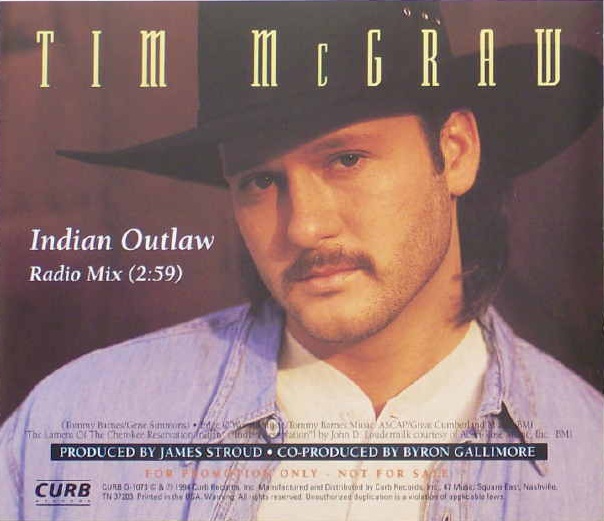
How Did I Like This? Tim McGraw’s “Indian Outlaw”

Tim_McGraw_-_Indian_Outlaw

Alex Russell

In “How Did I Like This?” someone looks back at something they loved as a child and wonders how they were ever so wrong. We start it off with Tim McGraw’s 1994 country single “Indian Outlaw.” Introduce yourself (or reintroduce yourself!) to the song and the video below: 

Almost everything is bizarre about Tim McGraw’s song “Indian Outlaw” except that it came out in 1994. This entire music video screams 1994 as loud as possible. This song is 20 years old, but even if you didn’t have a year to go off you could ballpark it with the video. What the hell was going on in 1994?

Music videos at the time had stories (every Aerosmith music video from the 90s is roughly 34 minutes long) presumably because every famous band in the 1990s looked like they belonged in the 1990s. Nothing looked good. Everything looked like a foreign language textbook. If you don’t believe me, dig up an old photo of yourself and return to this once you have died of shame twice.

Even if you don’t know country music from the 1990s –which you shouldn’t, but I’m from Tennessee, so I took it third period in school for three years– you probably still know Tim McGraw. He was one of the biggest names in music. He did a song with Nelly. He hosted Saturday Night LivePlaygirl magazine once named him one of the sexiest men in the world. I’m just listing the weird stuff from his Wikipedia now, so I’m just going to assume that you are at least vaguely aware of Tim “Live Like You Were Dying” McGraw.

He eventually became a massive success outside of his own genre (when country music started to show up in college students’ AIM profile quotes and every terrible bar’s “white trash” nights), but even before then he had chart success with songs like “Indian Outlaw.”

I don’t hate country music. I don’t really listen to it now, but a lot of the songs I liked when I was younger I can still listen to with a sort of wistful attitude. I regret that I was listening to Garth Brooks when other kids were getting music from their cool older brothers (television has told me that this is the experience of every other kid alive, so I have adopted this as true) but I cannot stand this song.

I pulled it up on YouTube a few months ago while listening to other things gone by. I found it, I watched it, and I was horrified. This shit is absolutely not okay. I mentioned I grew up in Tennessee, but not, you know, Tennessee.

The South has a complicated history (and present, and future, and any other parallel concept of time) with race but often the discussion of race leaves out Native Americans. There’s a certain blindness to it all that comes up whenever the debate over the name “Washington Redskins” flares up and a lot of us are forced to deal with the fact that whoa that is like, insanely racist that we say that!

But if the wheel of time on that change feels like it’s moving slowly, does this sound like something that only came out two decades ago?

You can find me in my wigwam
I’ll be beatin’ on my tom-tom
Pull out the pipe and smoke you some
Hey and pass it around

What would your guess of a release date be if you didn’t know? Would it be during Bill Clinton’s presidency? I damn well hope not.

People who didn’t grow up with this song get really uncomfortable when they hear it, rightfully so. I get uncomfortable with it. It’s racist — insensitive at best — but it’s also got this weird sexual element to it. A lot of country music talks about sex without talking about sex, but check it:

They all gather ’round my teepee
Late at night tryin’ to catch a peek
At me in nothin’ but my buffalo briefs
I got em standin’ in line

Gross, Tim McGraw. He followed this up with his first real monster hit, “Don’t Take the Girl.” That song is about a boy who learns to love a woman so much that he’d rather die than see ill will befall her. This song is… not about that. If you aren’t totally sold on hating this song, check out the dance mix. (Pro tip: Do not check out the dance mix.) It’s not even that different, but I guess this was too early for the Dubstep Indian Outlaw Remix… which I refuse to think about for another second.)

Alex Russell lives in Chicago and is set in his ways. Disagree with him about anything at readingatrecess@gmail.com or on Twitter at @alexbad.

Image source: Wiki

Versace, Versace, Versace, Versace: A Response to The Worst of Pitchfork’s Top 100 Songs of 2013

Alex Marino

Pitchfork put out their top 100 songs of 2013 a few weeks ago and naturally I hate a lot of them. I know it isn’t easy to make a list like that but after listening to the entire thing over the last few days there’s no way they didn’t pick out specific songs just to get people like me angry. WELL IT’S WORKING YOU DICKS.

Seriously fuck these songs:

Deafheaven – “Dream House”

I’ve never understood screaming for an entire song. I listen to The Mountain Goats more than the FDA recommends so you know I enjoy music about emotional pain and self-destruction, but I enjoy The Mountain Goats so much partly because I can understand what the hell they’re saying.

Want me to share in the emotion you’re bringing to this song? Stop acting like a fucking high school band that’s trying to cover up a lead singer’s shitty voice. The instrumental of this song is honestly great. And I can tolerate an amount of screaming in line with 30 Seconds to Mars and The Used but nine minutes of screaming is 8:50 too much.

Drake – “Worst Behavior”

I’ve always been hot and cold with Drake. Lyrically he’s always talking about how he made it, how he proved the haters wrong, and how he’s better than you. That’s okay if it’s only for a few songs but I feel like every Drake song I hear makes some mention about how successful he is and FUCK THA HATERZ. It’s getting old, man. And how lazy do you need to be to use part of Mase’s rap from “Mo Money Mo Problems”? There’s a tasteful way to pay respect to your elders but straight up copying their stuff isn’t it.

Migos – “Versace”

I love shitty rap. When I go home to Memphis I listen exclusively to our hip hop station (97.1) in the car. So when this song started up I was so excited. But seriously they say the word “Versace” well over 50 times in a row. Fuck that. Throw this song out and put in Juicy J’s “Bounce It,”

The Knife – “Full of Fire”

What the fuck kinds of drugs were they on when they recorded this song? This is the shitty song they’ll play in the shitty club scene of another shitty Scream movie where one of the secondary characters is about to get murdered. If you like this song I hope you fall in a ditch. Every song on this list is at least tolerable in some way except for this one.

There are some great songs on this list too and just because most of it is garbage doesn’t mean the entire list should be thrown into a digital wood chipper. Give these a listen if you haven’t already:

Image source: versace.com