reading

Book Review: Oryx and Crake/The Year of the Flood/MaddAddam, Margaret Atwood’s Dystopian Trilogy

Awtood trilogy

Jonathan May

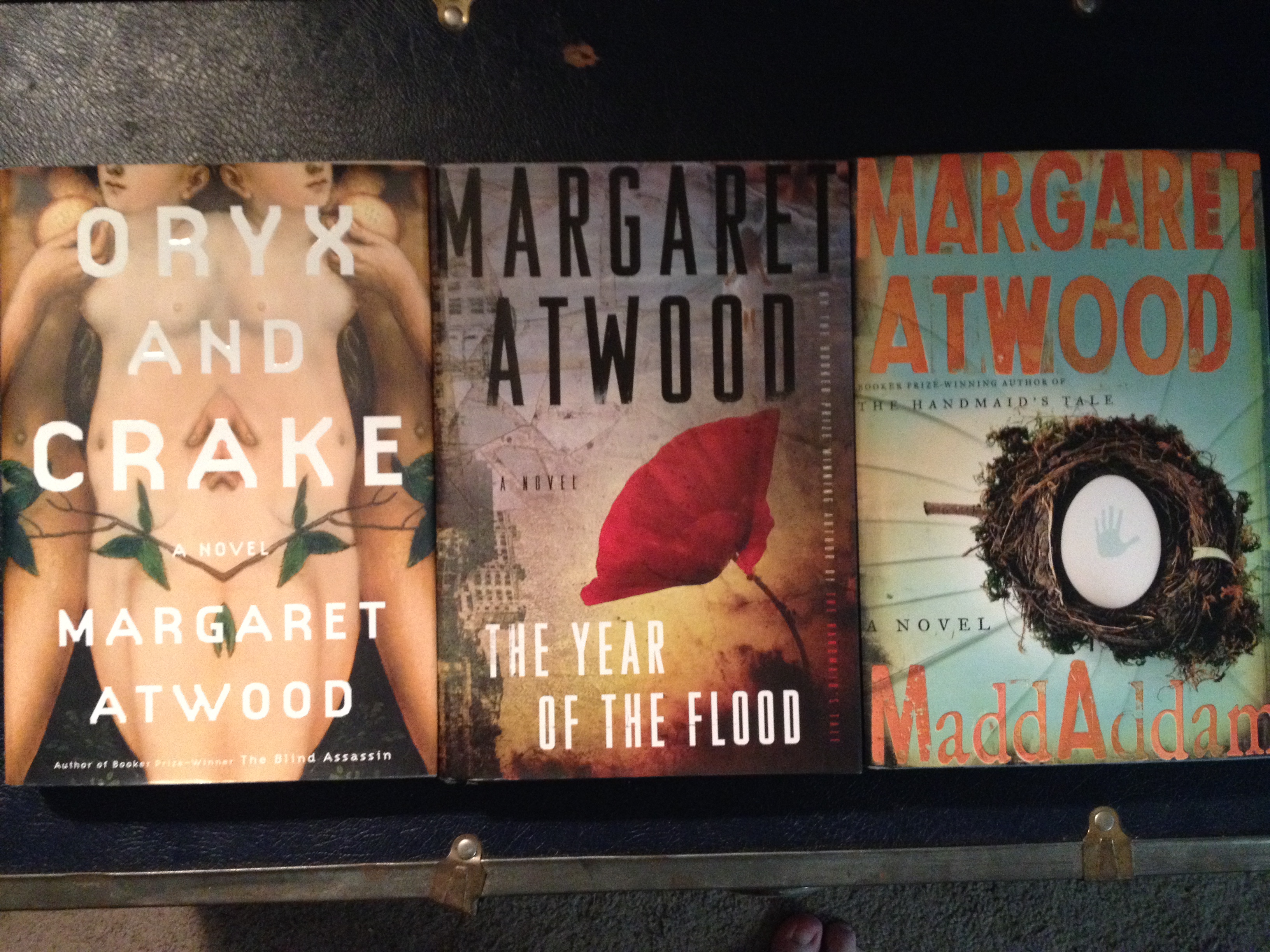
I read Oryx and Crake when it came out in 2003, certainly never anticipating two follow-up novels. I was given the next two books as gifts over the years as they came out, but would set them gently next to the first, like glass miniatures on a shelf. Facebook was blowing up recently with news of Darren Aronofsky adapting the three books into an HBO miniseries, so I decided it was time. I read all three books over the course of a week and a half, finishing just fifteen minutes prior to the composition of this piece. As always, I aim for brevity when I write for this site, so pardon my simplifications.

Oryx and Crake is Atwood’s only novel featuring a male, first-person protagonist (named Snowman); the other two novels vacillate between voices, with the third in the series having the most variety of narrators. I mention this only because it seems obvious that we need Snowman to contrast with one of the more prominent narrators in the latter two, Toby, a female Gardener. The whole world of the novels is a future wherein biological manufacturing is the norm and companies serve as the main units of life, housing families in compounds. Eco-groups like God’s Gardeners rise in reaction to the companies and their lapse of morality, maintaining “older” ways of life (keeping bees, gardening, etc.) Since all this doesn’t seem far off at all, the novels maintain a sharp sense of realism, even in the more absurd parts. Being grounded in a future that seems not only plausible but also eventual tethers the novel firmly to the ground, imbuing it with a prescience that I love about Atwood. Her characters and plots always surprise me in how true to life they are. So when you have pigs that think like people and invented bacteria that dissolve people into goo, it’s nice to be able to believe in them.

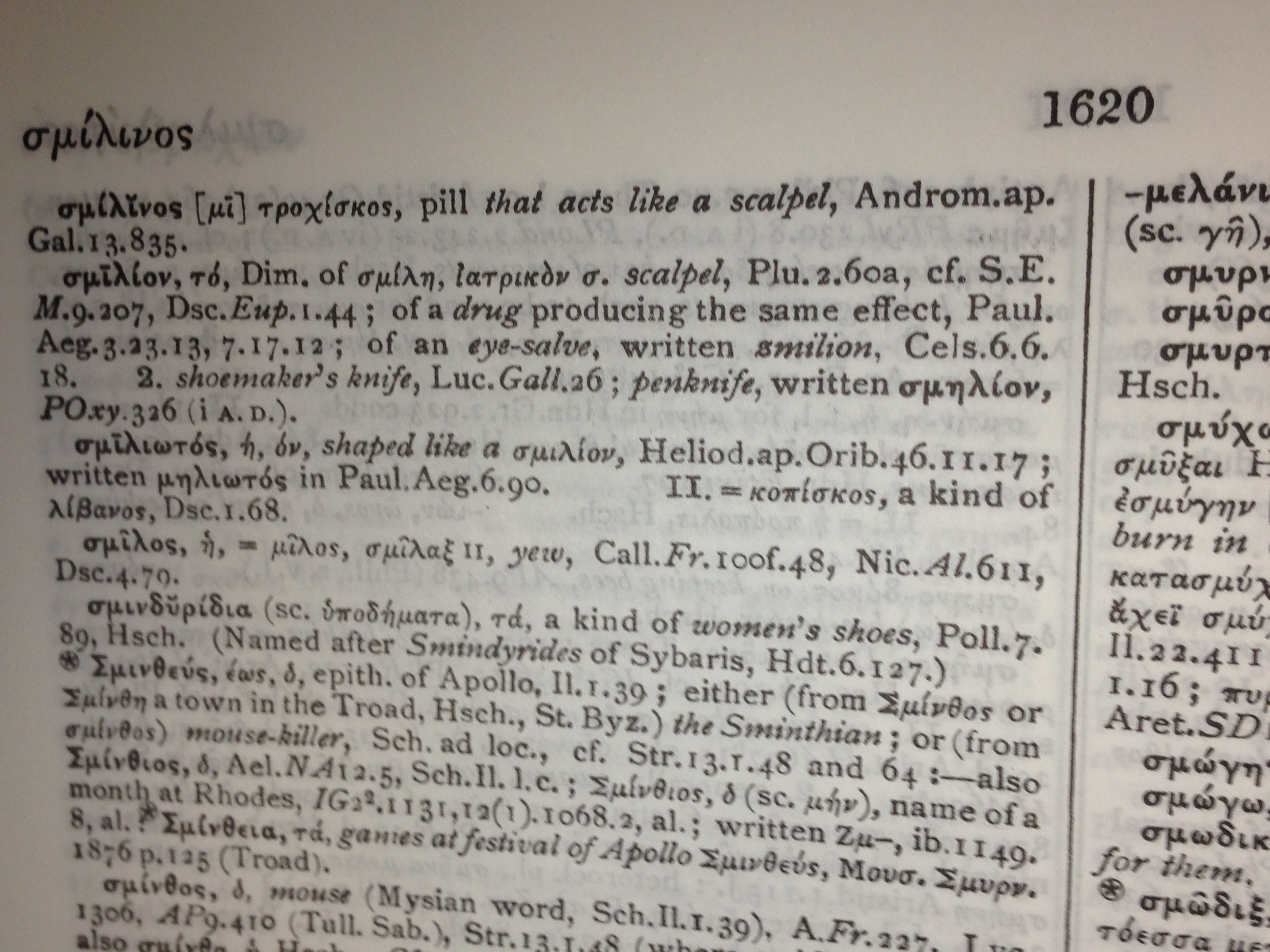
It’s obvious that Atwood favors Toby as a narrator; she is so true to Atwood’s other narrators, women who see the world as a series of mutable paintings. The only time I cried during the course of the trilogy was when Toby had to tell the bees of the death of a fellow Gardener who had taken care of the hive. The addition of things like talking with the bees and the word smile coming from the Greek for scalpel are classic Atwood (thank you to my Dad for help with the Greek there [see picture below]); I learn more from her books than almost any other author (except Cormac McCarthy, whom I read with a dictionary on hand). Just so you know, lambent means glowing or radiant.

Oryx and Crake, smile, Greek lexicon

All together, the novels function quite beautifully, weaving in and out of the chronology, fashioning from the whole a triptych of corporate dominance, human desire, and the ability to play God. Atwood’s world, before and after the Apocalypse, is so eerily close to our own that I felt an immediate desire to plant a garden and learn how to take care of an apiary, lest the grid fail tomorrow. It’s weird, but the novels most closely resemble morality tales than anything else. In other words, I feel only improved after finishing them.

Jonathan May watches too much television, but he’s just playing catch-up from a childhood spent in Zimbabwe. You can read his poetry at owenmay.com, follow him on Twitter at @jonowenmay, or email him at owen.may@gmail.com

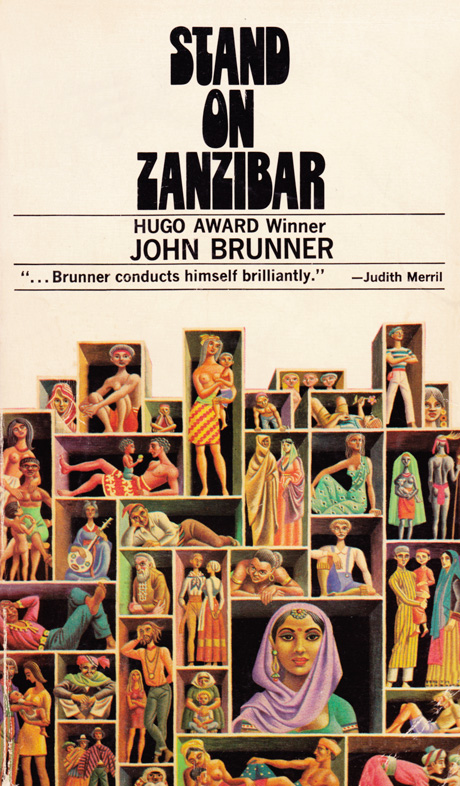
Life After the Star Wars Expanded Universe: John Brunner’s Stand on Zanzibar

Stand_on_Zanzibar_working

Andrew Findlay

In Life After the Star Wars Expanded Universe, we take a look at science fiction and fantasy, why they’re great, and what they say about where our species has been and where it’s going.

Isaac Asimov once predicted that by this time, many home appliances would run on atomic batteries. It would be so convenient: no need to use electricity and the battery would not run down within the consumer’s lifetime. Truly a marvel of modern science! In all seriousness, if Asimov’s failure to see anything wrong with a blender powered by nuclear fission does not clearly crown him as the king of all science nerddom, I don’t know what would. One of science fiction’s stocks-in-trade is predicting the future. Some suggestions are eerily accurate, and some are Jetsons-level laughable. Stand on Zanzibar is strange in that a weirdly high percentage of its predictions are absolutely correct.

The novel is set in 2010. The main pressure driving its plot is that there’s just too damn many of us. Brunner correctly placed the 2010 population of the world around seven billion, which is where the name comes from. Apparently, seven billion people, standing upright and shoulder-to-shoulder, would just barely fit on the island of Zanzibar. This foundational problem is not the only prediction Brunner gets right:

  1. “Muckers” go insane and go on senseless public rampages (Columbine, Aurora, Newtown)
  2. China is our main global competitor
  3. Europe has banded into a single political entity
  4. Detroit is a ghost town filled with abandoned warehouses
  5. Consumer culture is dominant
  6. News is highly processed and regurgitated on television in digestible bites
  7.  There is legislation against tobacco but marijuana is legal
  8. Rent is so ridiculous in New York that a high-level executive has to have roommates to help him pay it.

Brunner misses a few things and gets a few other things wrong (in response to the population problem, there is eugenics legislation – people cannot have children unless they prove their genetic health), but the amount that he predicts correctly in this future is impressive. He gives texture and substance to his future world by using the Innis mode.
Isaac_Asimov_on_Throne

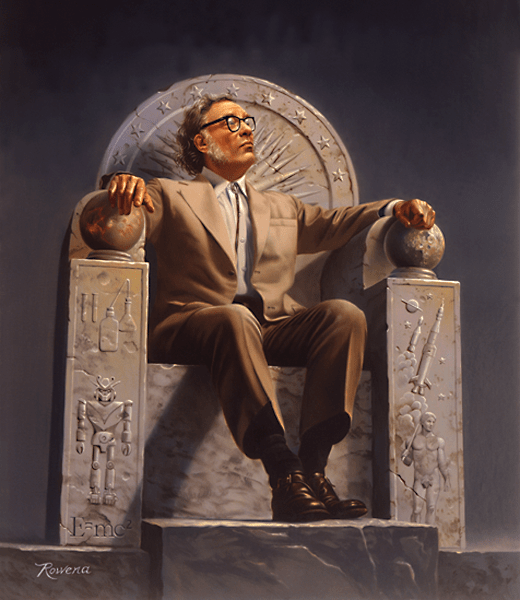
I found this while looking for Asimov quotations. Holy shit.

The book opens with a passage from Marshall McLuhan’s The Gutenberg Galaxy, which explains the Innis mode as constructing a mosaic of facts and events without perspective or unifying narrative. Brunner’s use of this mode strongly influences the structure of the book. There are four main types of “chapters.” Chapters labeled “continuity” follow the linear narrative of the story. “Tracking with closeups” present vignettes of characters not directly related to the main plot but part of the same world. “Context,” presents, you guessed it, context for the other parts of the story in the form of fake newspaper articles, works of sociology, and other types of analyses. Finally, “the happening world,” the most Innis-modian of these chapters, is a storm of assorted facts, sometimes as short as a single line, that assault the reader with the vibrance and freneticism of all the overwhelming information in the larger world outside the main narrative. The Innis mode generally and “the happening world” in particular serve to create an immensely dense world without sacrificing main narrative time to do it.

The main narrative consists of two parallel plots: U.S. intervention in an island nation in the Pacific, Yatakang, that is embarking on a “genetic optimisation program” to build a race of supermen, and a massive company called General Technics beginning a training program in a fictional West African nation in order to exploit mineral wealth off the coast. The Yatakangi storyline consists of a lot of great spy action and explosions. The U.S. intervenes because they either want to prove the genetic optimisation program is an impossible propaganda stunt or, if it is true, take steps to make it just an impossible propaganda stunt. One Yatakangi character tells the American spy that Americans just aren’t very good at letting other people be better than them at anything. The African storyline concerns Beninia, a country that is dirt poor, where education could be improved, and where starvation is a major concern. Beninia draws the interest of General Technics because, despite all of this, there has not been a murder there in the past 15 years, there is no open conflict or dissatisfaction, no vandalism, and no theft. In a world where people regularly run amok (the etymological basis for “mucker”) and kill as many people as they can before they are put down, the complete absence of murder indicates an inviting level of stability. GT agrees to put in place a 50-year program wherein they float the Beninians a huge loan, then use it to build all the most modern conveniences and supercharge their education so that, within those two decades, the Beninian population will be transformed into a nation of extremely skilled technicians and scientists with the knowledge set required to exploit the mineral deposits in the ocean nearby. This plan is created and vetted by the General Technics supercomputer, Shalmaneser. GT’s main claim to fame is this computer. It is next-level, near-A.I. type hardware, and its predictions are the main reason the company is so confident that their Beninia plan will work. They are in it for themselves, as they will be more than paid back by the wealth at the bottom of the sea, but they get to change the course of an entire nation for the better. The book tries very hard to sell the point that this is not neocolonialism pure and simple. The President of Beninia is complicit in the plan because he is dying and wants to leave a good future to his nation. Everyone involved in the project has their hearts in the right place and wants to help. Within the book, it is absolutely believable that this is a new and benign form of economic development. Outside of the book, this is basically a company owning a country outright, and in reality that never works out well for the owned. The disconnect between what happens in the book and the real-world probabilities make this conceit of the book ring a little hollow.

PCP283.feat3.body4-580-90

This is what Brunner means when he says “supercomputer.”

Speaking of things Brunner attempts that end up going wrong, he tries to extrapolate the future of race relations while sitting in front of a typewriter in 1968. He gets right that, due to anti-discrimination laws and the easing of overt racism, many positions of power are filled by African Americans, and racial tensions still simmer on. One of the main characters is a black vice president of General Technics. His roommate is white. They are both friends, but in their internal monologue, they each think really angry thoughts filled with racial slurs about each other. The problem is not that they get angry at each other, but that the sole source of a lot of their anger seems to be race. It seems outdated and strange, and indicates that Brunner, while trying to present a realistic future of race, was not fully free from many of his own preconceptions about it: In Brunner’s future, a relationship between equals of a different race seems not to be able to exist without some type of rancor. There is also no shortage of racist slurs against the Asian Yatakangi. Try as it might, this book is definitely a product of the sociocultural milieu of the 1960s.

Treatment of women in this book is just as big a problem as the treatment of race. There are no women involved as main characters, there are only two women in the entire book that have any real agency or power, and the current form of dating is something called the “shiggy circuit.” Codder is a mildly offensive term for a man, and shiggy is a mildly offensive term for a woman. Most young women participate in the “shiggy circuit,” a social construct in which women have no fixed abode and merely cycle around the city, moving in and out of the apartments of the men they sleep with, depending on them for food and shelter, and then moving on to the next one when either the woman or the man becomes bored. The easy interchangeability of women and the fact that they take up with the man and not vice versa necessarily places them at a disadvantage in relation to the men. This dynamic grows out of a problem that runs through many SF books written in the 50s and 60s. Most of the writers at that time were men, and many attempted to imagine new and more open sexual mores. The problem is that most of these new social systems ended up being not so much a representation of sexual progress as a result of the author’s subconscious thinking to itself, “Hey, wouldn’t it be cool if women were just naked? Like, all the time?” It comes off more as male fantasy than as balanced prediction (cf. Stranger in a Strange Land, The Gods Themselves).

la-et-mn-star-trek-into-darkness-writer-apolog-001

Glad we’ve stopped oversexualizing women in science fiction. She’s a weapons specialist on the Enterprise, by the way.

Despite the jangling treatment of race and women, the book, in the form of Chad Mulligan, delivers wry, incisive, and apt criticism of society and the humans who run it. Mulligan is a pop sociologist and is the author of The Hipcrime Vocab and the amazingly-named You’re an Ignorant Idiot. He is deeply in love with the human race, which of course means he is intensely enraged by its stupidity. He becomes a main character by the end of the book, but for most of it we see snippets of his angry, incisive writings as excerpts in the “context” or “tracking with closeups” chapters. His main thesis is that if we don’t all change drastically we are all going to die, so act a little less insane and a little more rationally and lovingly. To give an idea of what kind of vision he has, I’ve included a handful of definitions from his Hipcrime Vocab.

The Hipcrime Vocab by Chad Mulligan:

(COINCIDENCE You weren’t paying attention to the other half of what was going on.)

(PATRIOTISM A great British writer once said that if he had to choose between betraying his country and betraying a friend he hoped he would have the decency to betray his country. Amen, brothers and sisters! Amen!)

(SHALMANESER That real cool piece of hardware up at the GT tower. They say he’s apt to evolve up to true consciousness one day. Also they say he’s as intelligent as a thousand of us put together, which isn’t really saying much, because when you put a thousand of us together look how stupidly we behave.)

Mulligan is a great character: contemptuous, competent, snarky, and broken-hearted by what he sees humanity doing to itself. He moves through the book spouting wisdom and being right about things, which isn’t necessarily a problem, but “irreverent middle-aged dude who is wiser than others” is a bit of an overused archetype in older SF.

This book has a lot to recommend it. It is a feat of worldbuilding, giving a nuanced and exhaustive picture of the world as it might exist in the future. Its narrative structure is innovative and effective. Its driving conflict is a problem that has affected, is affecting, and will affect the human race for the foreseeable future: increasing population, decreasing resources, and the tension and problems created by that dynamic. Its hope is that humanity finds a method to stop feeding on itself, but it presents the alternatives in horrifying depth and detail. It is a pity that, while many of the facts and events predicted are impressively accurate (the fall of Detroit, senseless acts of public slaughter, 24-hour news, the European Union), the conceptualization of race and women are mere extensions of the patterns extant in 1968. It represents a failure of imagination and a victory of narrow-mindedness in a novel otherwise exultant in its inventiveness, insight, and breadth. You still need to read this for what it does right.

Andrew Findlay has strong opinions about things (mostly literature) and will share them with you loudly and confidently. You can email him at afindlay.recess@gmail.com.

Image: LA Times
Life After the Star Wars Expanded Universe: Bernard Werber’s Empire of the Ants

cf4dc27a02a0dab1f700d110.L

Andrew Findlay

In Life After the Star Wars Expanded Universe, we take a look at science fiction and fantasy, why they’re great, and what they say about where our species has been and where it’s going.

Imagine this: you are absolutely crushed with exhaustion. You’ve been working for 12 hours straight, or you’ve just run 10 miles, or you’ve just moved all of your furniture to a new apartment and only one of your friends actually showed up to help. You are about to fall down with fatigue, but you turn to your friend, who offers you nourishment from his or her own stomach. Once you lock lips and do the exchange, you feel reenergized and ready to take on the world. This process is called trophallaxis, and for ants, it’s a way to bond, exchange pheromones, and get valuable caloric units to the members of the colony that need it most. I know this because I have just finished reading a book called Empire of the Ants.

This book is strange in that the majority of it is narrated from the point of view of ants. Werber weaves three distinct threads through the book’s narrative: ant POV passages, human POV passages, and fictional encyclopedia entries. The encyclopedia was written by a deceased mad scientist, the relatives of whom form most of the human characters in the novel. Its subject is unknown at the beginning of the novel, but its author, Edmond Wells, was deep into myrmecology and wanted to establish communication with the ants. His nephew, Jonathan, inherits his old apartment and finds a note saying “Never go into the cellar!” Following story logic, of course he ends up going down there, where he discovers a massive subterranean cavern. The narrative thread of the human POV section deals with the dangers, mysteries, and discoveries of the late Uncle Edmond’s secret underground laboratory. The ant POV sections actually dominate the book, which raises the question –  how do animals with brains the size of an asterisk (*) sustain any type of comprehensible narrative? This is where the fiction part of science fiction comes in.

A_Formica_rufa_sideview

Formica Rufa, the main character(s) of this novel

Ants undeniably use language. A lot of animals use basic pheromones, but ants employ a massive dictionary of them: scientists think that they can recognize hundreds of chemical combinations (side note: the scientist in that article is attempting exactly what the fictional scientist in the book is – translating and using the ant language). Werber takes this fact of ant society and expands chemical signals like “Food this way!” and “I am dying!” into a structure that can handle phrases like, “Something weird is going on here. We need to communicate this to the swarm.” It is an established fact that ants have language, and Werber simply asks his readers to apply suspension of disbelief and accept that ants have a language nearly as complex as ours. He does not abuse this anthropomorphization of his principal characters. They use their ant language to run around doing ant things – at no point do two disgruntled ants get drunk at a bar and whine about how the Queen is working them too hard. We see ants going out into the dangers of the world foraging for food, ants taking care of larvae, ants making war with a different species of ant, and any number of other antish activities. Werber does a good job illuminating the subtlety and complexity of life in an anthill and making these explanations part of the action of the story. For example, most ant colonies have a queen whose only responsibility or influence over the swarm is constantly laying eggs. Most of these eggs grow into sterile female worker ants, but some are fed better than others, and these better-fed larvae develop into sexually mature, winged females. Unfertilized eggs develop into male ants, which do nothing but sit around eating. When the weather is right, all the males and sexually mature females fly away from the colony, sometimes over very long distances, and mate along the way. The male deposits his gametes in the female then dies, and the female can then use this genetic payload to lay eggs for as long as the next thirty years. She then lands, tears off her own wings, starts digging a small burrow to lay eggs in, and builds the entire populace of a new city.

Meat_eater_ant_qeen_excavating_hole

This newly-landed queen is already stocked with every worker that will ever be a member of her colony.

Werber takes all of this information and weaves it into a tense action scene in the book. Out of the millions of virgin queens who swarm off, only a handful actually survive. They are eaten by birds, they are killed by competing ants, or they simply fail at setting up a new colony. This high failure rate allows Werber to add a lot of suspense to the situation when narrating the nuptial flight of one of the main ant characters. She flies hard as birds pick off her comrades left and right, she tires and can fly no more and falls in a river, she gets trapped in a spiderweb and faces almost certain death there, and then she lands, eats her own wings (high-protein nourishment after an exhausting ordeal), and starts the laborious process of bringing a new nation into the world. This melding of action and explanation throughout the book creates a strange phenomenon whereby, as Werber advances the plot, the reader learns a ridiculous amount about how ants work. I know about trophallaxy, the nuptial flight, where and how they store food, their symbiotic relationship with aphids, how they wake up after a long hibernation, how they use their antennae, how they care for their young, how they wage war (they can actually shoot acid from their abdomen!), and a host of other facts. The interplay between information and plot advancement creates a pleasurable sense of ambiguity around whether the book is a reference text or a fiction book. I mean, it’s a fiction book; it has talking ants for God’s sake, but from what you can learn from it, it may as well be an encyclopedia.

Which brings us to what might turn you off of this book: If you do not care about ant facts, you will be bored to tears. The main payoff of the novel is the painstaking exploration and elucidation of an extremely alien culture that exists just a few feet underneath the earth, and if you are not into that, your experience of the novel will be missing its main selling point. The humans are hands-down the weakest part of the novel. Their thoughts are simplistic, their dialogue is uninteresting, and their path through the narrative is not nearly as appealing as that of the ants. Werber does not construct solid mimetic aspects for his characters. James Phelan’s theory of character splits character creation into three aspects: The mimetic aspect is how much the character resembles an actual person, the thematic aspect is how the character serves to advance the ideas of the novel, and the synthetic aspect is how the character serves as an artificial construct that advances the narrative. Many SF novels skimp on developing the mimetic aspect of their characters (consistent character traits, subtle emotional responses, believable interactions with other characters). Having fully-developed characters along all three axes is often what separates SF books that escape the Science Fiction and Fantasy section of bookstores from more well-recognized (but not necessarily less worthwhile) SF. For example, The Handmaid’s Tale, 1984, and Fahrenheit 451 are not considered genre literature, whereas the less character-centric Starship Troopers, The Gods Themselves, and Planet of the Apes are almost always found next to the Star Wars books.

AtomicWar0401

One of these categories of SF has much better book covers than the other.

In some SF novels, the subsumption of character-as-person by character-as-idea is a symptom of SF as a literature of ideas – the SF novel is an exercise in philosophical extrapolation, and everything else takes a backseat to that. It is forgivable to have two-dimensional characters in the service of ideas, but Werber’s humans are stunted both mimetically and thematically. Their only purpose is synthetic – they stumble through the world of the book and advance the plot.

The flimsiness of the human characters and the relatively lackluster plot are the only sour spots in an exact, exciting, and enlightening study of how a society completely alien to our own might function if it had just a little bit more brainpower than we give it credit for. Ants are amazing. They are arguably the most successful animal on the planet. They are on every continent, everywhere except for the highest mountain peaks and the poles. They have been around for 140 million years (humanity = 200,000 years). The total weight of all ants on Earth roughly equals the total weight of all humans on Earth. If they can communicate the way they do in this book, and we piss them off, we’re screwed. Maybe you should read this as a primer on how best to welcome your new ant overlords.

Andrew Findlay has strong opinions about things (mostly literature) and will share them with you loudly and confidently. You can email him at afindlay.recess@gmail.com.

Life After the Star Wars Expanded Universe: The Short Stories of George Saunders

Author George Saunders

Andrew Findlay

In Life After the Star Wars Expanded Universe, we take a look at science fiction and fantasy, why they’re great, and what they say about where our species has been and where it’s going.

George Saunders is one of the greatest short story writers alive today. He is currently positioned to become a household name (well, in houses lined with books), but he has been killing it for nearly two decades. The New York Times hailed his latest short story collection, The Tenth of December, as the “best book you’ll read this year.” Saunders came to the art by a strange path. He graduated from college in 1981 with a B.S. in geophysical engineering and spent some time prospecting for an oil company in Indonesia. He then found a job as a technical writer for an environmental engineering company. By the late 90s, he’d published CivilWarLand in Bad Decline and had gotten a professorship at Syracuse. His unorthodox literary training leads to a fresh and interesting style. Saunders himself describes the phenomenon as “just me working inefficiently, with flawed tools, in a mode I don’t have sufficient background to really understand. Like if you put a welder to designing dresses.”

A welder-designed dress would at least be an interesting and new thing, and that’s what Saunders’ stories are. The humor, language usage, and emotional impact of his stories are what makes them powerful. Saunders employs dark humor and tragicomedy to great effect. This feature of his stories has drawn comparisons between him and Kurt Vonnegut, and like Kurt Vonnegut, some of his humor is laugh-out-loud entertaining, but it is mostly the humor that comes from the sudden revelation of a deep truth, humor that does not manifest in laughter but in a swift body-blow to something a lot deeper in you than simple amusement. It is absurd humor, and it mostly arises from horrifying situations and people living through them as if they were more or less normal. The best example of this humor comes from the first sentence of “The 400-Pound CEO”

At noon another load of raccoons comes in and Claude takes them out back of the office and executes them with a tire iron.

Murdering animals is not ha-ha funny, but the shock of that situation, the world of the story in which a company exists that surreptitiously murders raccoons with automotive maintenance implements, and the realization that, if it were lucrative, there would probably be a company in real life that did exactly that, combine to create a much more profound, more affecting, and less flashy humor than the standard fare.

800px-Curious_Raccoon

You would not believe the profit margin on these things

Another example, from “Tenth of December,” is the interior monologue of a not-too-bright kid who is remembering his runaway father:

Dad had once said, Trust your mind, Rob. If it smells like shit but has writing across it that says Happy Birthday and a candle stuck down in it, what is it?

Is there icing on it? he’d said.

Dad had done that thing of squinting the eyes when an answer was not quite there yet.

Sure, basic humor comes from how stupid the kid is. Stupidity is a very deep well for amusement, but couched and laced throughout that more mundane entertainment is deep emotional involvement. The dad is gone, the kid is remembering his advice, the kid has to deal with being stupid, and the kid is remembering his dad “squinting his eyes” as he most likely thinks about how stupid his son is, which dealing with fatherly disappointment is par for the course vis-a-vis life, but this boy’s father actually kicked standard disappointment up to abandonment.

Award_misc_birthday_cake

Delicious.

The language Saunders favors tends to be simple and immediate, as most of his narrators spend a lot of time relaying the stream-of-consciousness of his main characters, and very few people think with showboating words while navigating the trenches of actual life. The informal style and immediacy add punch to the emotional impact, so the reader experiences what the character experiences with very little processing lag or separation. More so than simple language, the situations and descriptions of the characters creates a massive emotional impact. Saunders does not choose as his subject big heroes and villains. He explores not the grandness of exalted victory or crushing defeat, but the petty brokenness of everyday life and the small consolations wrested from it, which is what most people actually deal with. These small consolations are affecting because they are all we can manage, but also, if we shift our perspective, all we need.

It just so happens that a lot of his stories are science fiction. I got a chance to ask him about his sci-fi chops, and he responded that he wasn’t a superfan (as in, he has not seen every episode of Star Trek: The Next Generation), but that he really enjoyed writing in that mode and that it helped break you out of lame writing and bad habits, which, yes, a lot of self-consciously literary books are full of lame writing and bad habits (I really hated the 100 pages I read of that book). Saunders’ writing style is mostly absurd and surrealistic. Many of his stories are full of ghosts, ridiculous people, and nonsensical events. In a decent number of these stories, the enhanced-reality style turns to science fiction. Why am I reviewing this author as a science fiction author if he just dips his beak in every few stories? He is quite simply one of the best practitioners of the form. One of the methods by which SF gains it power is cognitive estrangement, wherein the author presents a reality that is clearly different from the empirical environment of both the author and the reader, but is a plausible extension of it. In this dynamic, the clash between the world of the story and the real world brings heightened clarity to the readers’ perception how things actually are. Saunders’ SF is great at this. It is only a hop, a skip, and a jump into the future, and only extrapolates the technologies and societal norms that form the most rampant pathologies at play in U.S. culture today, namely capitalism and fear. One story takes the form of a sales representative from KidLuv trying to dissuade a dissatisfied mother from returning her I CAN SPEAK!™, which is a molded mask you fit over your infant’s face that, through an implanted speaker, gives the impression that your child can talk. This is of course at the cost of the comfort of the infant. Another chronicles the penalties a man incurs by taking off his shoes to walk more comfortably in NYC, incidentally preventing the advertising sensors in the sidewalks from reading the identification tags in his shoes and projecting the most relevant ads in front of him as he walks.

800px-1_times_square_night_2013

Completely implausible storyline.

Another is about a new type of incarceration, where prisoners can opt to go to research stations, receive a MobiPak™ (an implanted drug delivery system) and participate in dangerous pharmaceutical research. The current ascendancy of consumer culture and capitalism make these possible futures all too plausible, and by forcing his readers to consider these futures, he highlights the dehumanizing and unsustainable nature of the present system. Above all, he hammers home the perennial truth, formulated by his forebear, that there’s only one rule: “God damn it, you’ve got to be kind.”

Read these stories. They hit hard, and they hit deep. Saunders has said that a novel is just a story that hasn’t yet figured out to be brief, and the power behind the brevity of his stories gives a lot of support to that statement. More than anything else I have been reading lately, they have an active effect on what I think and who I am. Read these to be changed, to be awoken. It sounds cliché as all hell to say that, but just because something is cliché does not mean it does not apply, and one of Saunders’ main goals in writing is to break us out of habitual thought patterns and to crack us open to what is really going on – in the world, with other people, within ourselves. If you’re still not convinced, my last shot is one of his quotations about literature, which is one of the most accurate I’ve ever read:

Fiction is a kind of compassion-generating machine that saves us from sloth. Is life kind or cruel? Yes, Literature answers. Are people good or bad? You bet, says Literature. But unlike other systems of knowing, Literature declines to eradicate one truth in favor of another.

Andrew Findlay has strong opinions about things (mostly literature) and will share them with you loudly and confidently. You can email him at afindlay.recess@gmail.com.

Image: The New York Times

Life After the Star Wars Expanded Universe: Jules Verne’s Twenty Thousand Leagues Under the Sea

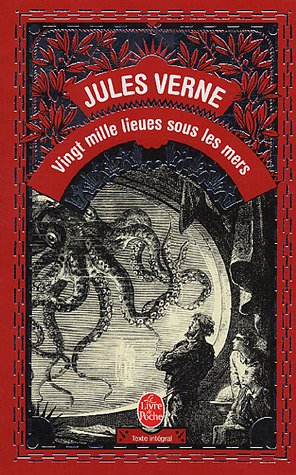
vernebook

Andrew Findlay

In Life After the Star Wars Expanded Universe, we take a look at science fiction and fantasy, why they’re great, and what they say about where our species has been and where it’s going.

Writing about Jules Verne is daunting. A science fiction enthusiast talking about a book like Twenty Thousand Leagues Under the Sea is like a music writer discussing Revolver. It’s important to talk about and remember, but Jules Verne, like The Beatles, had such an outsize influence on his field that it’s hard to even approach. There were others before him, sure. Voltaire’s Micromégas chronicles the adventures of a 20,000 foot tall man from the Sirian system, and Shelley’s Frankenstein introduces the world to mad scientists. The former is really more of a philosophical fable, and Frankenstein is to Mary Shelley what “Sex and Candy” is to Marcy Playground.

Sure, this song is great. Name another one they wrote.

Point is, Verne is the first author to focus specifically on the “science” part of science fiction and put out a huge body of work that is consistently centered around technology. This body of work is hugely popular – the only author translated into more languages than Jules Verne is William Shakespeare. Verne achieves this popularity by taking the science that’s available to him, exaggerating it, and weaving a story around it. Around the World in Eighty Days focuses on transportation technology, Journey to the Center of the Earth focuses on geographical exploration, and Twenty Thousand Leagues Under the Sea focuses on marine exploration.

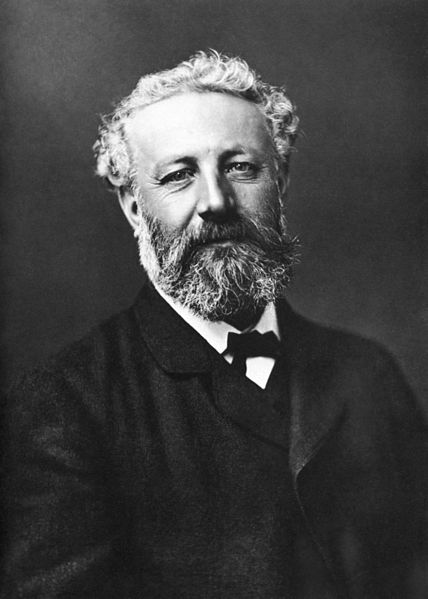
Félix_Nadar_1820-1910_portraits_Jules_Verne_(restoration)

Jules Verne. Just look at this magnificent bastard.

This book is, above all things, an adventure novel. One misconception that may be as widespread as “Frankenstein” being the name of the monster is that the titular 20,000 leagues is how deep the submarine goes. Seeing as how the average depth of the world’s oceans comes to three miles and that 20,000 leagues equal about 69,000 miles, the leagues in the title refer to how much ground (water?) the submarine covers. Nemo and his crew travel nearly far enough to circumnavigate the Earth three times. Who is in his crew, and how did they get there?

Nemo’s official crew are a bunch of faceless sailors recruited from here and there around the world. The main characters of the novel, however, enter his vessel, The Nautilus, in a much more interesting way. Early in the book, all the nations of the world decide that the Nautilus, which is observed going around sinking ships and surfacing while jetting water all over the place, is some heretofore unknown sea monster. Pierre Aronnax, scientist, Ned Land, harpoonist, and Conseil, Aronnax’s servant, are all on an American warship sent to dispatch this creature. The ship fails miserably, and Aronnax et al find themselves on the back of the creature, which surprisingly feels a lot like metal. Nemo appears, makes introductions, and informs his charges that they are his prisoners, as maintaining the secrecy of the Nautilus is important.

As prisons go, the Nautilus is not a bad one. Verne did not invent the concept of the submarine, but his version is a lot nicer than what was puttering about in the world in 1870. The Plongeur, the first machine-powered submarine, was launched in 1863. The Nautilus is extremely advanced compared to the Plongeur. Substrate of actual science, upon which Verne builds his fiction. First off, the Nautilus can travel underwater for five consecutive days thanks to its mercury-sodium batteries (the sodium for which is extracted from seawater). When it has to surface, it is to replenish the air supply in the ship. It also has distillation facilities to create drinking water and food processing facilities to draw all the nutrients the crew need from the sea (lots of kelp and fish). Finally, the luxury of the Nautilus sets it apart from its contemporaries. Captain Nemo has a massive viewing gallery with a huge wall of tempered glass affording views of the ocean, a dining hall, and a study/library with an organ, lounging chairs, biological specimens, and a massive collection of books.

20000_Nautilus_Salon

The Nautilus’ main room, complete with pipe organ.

Alright, so we have the setup. In Twenty Thousand Leagues Under the Sea, the main characters pretty much just go around in a submarine looking at cool shit under the sea. The most compelling part of the book is Nemo’s story. Nemo means “no one” in Greek, and Nemo is a man who has, after some barely-referenced atrocity, withdrawn himself from the society of men and started living for revenge. He takes his revenge by using the superiority of his vessel to sink pretty much any ship he runs across. He is kind of evil, but he is also a super-genius, and we all know how much audiences love intelligence and competence regardless of the moral questions involved. There are two parallel plots. One is what mostly defines the book in the cultural consciousness: going around the ocean and doing cool stuff. The other is the growing conflict between Captain Nemo and his three prisoners. I don’t want to spoil you on the latter, but talking about the former won’t hurt anything.

I said earlier this is above all things an adventure novel, and adventure novels are nothing without destinations. The destinations of the Nautilus include the South Pole, an enchanting underwater forest (through which the principal characters hunt using electric harpoon guns and scuba suits), old shipwrecks (the gold from which finances Nemo’s outfit), and the lost city of Atlantis (dead and gone, with columns sticking out of the ocean floor). Aside from the extremely technical descriptions of how all of Nemo’s gadgets work and the central maelstrom of Nemo’s dark personality, the main appeal of the novel comes from the ability of Nemo to take the reader into the unexplored regions of the world, for the narrator to describe outlandish adventures there, and for everyone to then retire to the comfort of a luxury liner and discuss their excursion over algae salad and walrus steak.

If you decide to read this, be careful not to get a bad translation. One of the main reasons Verne is considered more a literary author in France and more a genre author worldwide is that his work suffers from notoriously bad translations. While we’re talking about language, I’ll say that the linguistic feel of the book is a lot like a Charles Dickens novel – it might be a little work, and the formulation of character thoughts and dialogue may be a bit drier than we’re used to, but it’s more than worth it. Bad translation or not, outmoded dialogue or not, this is a seminal work of science fiction. Humanity’s fascination with the unexplored is what wins Verne’s masterpiece its place of primacy in today’s culture. The modern reader can still get a lot of mileage out of this book. After all, we have still only explored five percent of the ocean. Who’s to say Atlantis is not actually down there?

Andrew Findlay has strong opinions about things (mostly literature) and will share them with you loudly and confidently. You can email him at afindlay.recess@gmail.com.

Tough Questions: If You Had to Do Something Every Day for a Year that You Don’t Already Do, What Would You Pick?

question-mark

Every week we ask everyone who hangs out around here to answer a tough question. This week:

If You Had to Do Something Every Day for a Year that You Don’t Already Do, What Would You Pick?

Rules are simple: When are you gonna finally shape up? This tough question forces you to collect your aspirations and put them into one actionable damn thing. What would you fix about the crumbling house that is your life, if you had to pick one daily thing? Would you do good deeds? Or would you at least stop doing evil ones as often? Look, it’s rough out there. You don’t know my life.

Alex Russell

Pete Holmes (comedian, TV host, and fictional advertizing baby) often talks about the idea that to create an hour of stand up you only need to write a minute a day. It’s an easy idea, but we’re all terrible at compartmentalizing ourselves. We don’t think in chunks; we think in finish lines. I would want to write one joke every day. I’m a weird obsessive about stand up comedy and I liked the (VERY, VERY) brief experiences I had trying to sell my own bullshit on a microphone. A kick in the ass every day to do some more would do me some good and a lot of audiences a whole lotta bad.

Jonathan May

Since there’s no way I’m going to start doing CrossFit or yoga on the regular, I’m going to have to go with prank-calling people from the payphone in the mall. The calls will be short, so I really just need a little spare change every day. Now you may say, “Jon, the mall isn’t open every day,” and you would be right. So on days following holidays, I would make up the calls I’d missed. Heading into my thirties, it seems like I should pick something more sensible like doing crunches or household chores, but honestly, this will be much better for the soul.

Andrew Findlay

I would go to bed by 10:30 every weeknight. This is just the lamest personal goal ever, but six hours versus eight hours of sleep makes a huge difference in overall levels of happiness and effectiveness in life. The problem is, I never, ever recognize that at 10:3011:30, or 12:30. It always seems like reading a little bit more, watching some television, or wasting time on the internet will make my life better, then I wake up very sad in the morning. Seeing as how the phrasing of the question is if you had to, this unfortunate pattern probably won’t change anytime soon.

Austin Duck

If there was something I could commit to for a year but haven’t yet, it’d definitely be doing something every day that I’m proud of. I spend so much time making stupid fucking mistakes, but if I could exercise, read, and write every day (if I had the fucking willpower), I’d love to commit to it. 

Brent Hopkins

The one thing I would commit to would be some flavor of art. As a kid I always wanted to learn an instrument but after failing repeatedly I completely gave it up and it has been a chip on my shoulder for years. With the time to do it every day, I think I could will myself to stop being awful and at least learn something simple to play like the recorder or ukulele. That being said, I am also terrible at general art, so I wouldn’t mind learning to draw or learning to paint either. I like solo relaxing activities so these would meld best with my personality.

Mike Hannemann

The easy answer here is exercise. But if I went with the easy answer, this wouldn’t be a tough question.  I would probably commit to reading War & Peace, every day, for 30 minutes. Being able to claim that I have read that monstrous tome has been on my bucket list for years. However, when a book has over 130 characters and you’re used to consuming media with a character called “The Ice King,” this can be extremely daunting. At the end of the day, doing this every day for a year may not get me to the end of the seventh longest novel ever written, but maybe I’d be able to tell who at least four of the characters are. That’s something I can’t boast about the recent season of The Walking Dead.

Scott Phillips

I read every single day. No, I’m not talking about Twitter and Facebook and other internet material, I’m talking biographies and a lot of nonfiction books. As a career sports writer, I tend to be fascinated by nonfiction writing because I want to mold my writing to emulate some of my favorite authors that have followed sports teams or athletes like Jeff Pearlman, Jack McCallum, or David Halberstam.

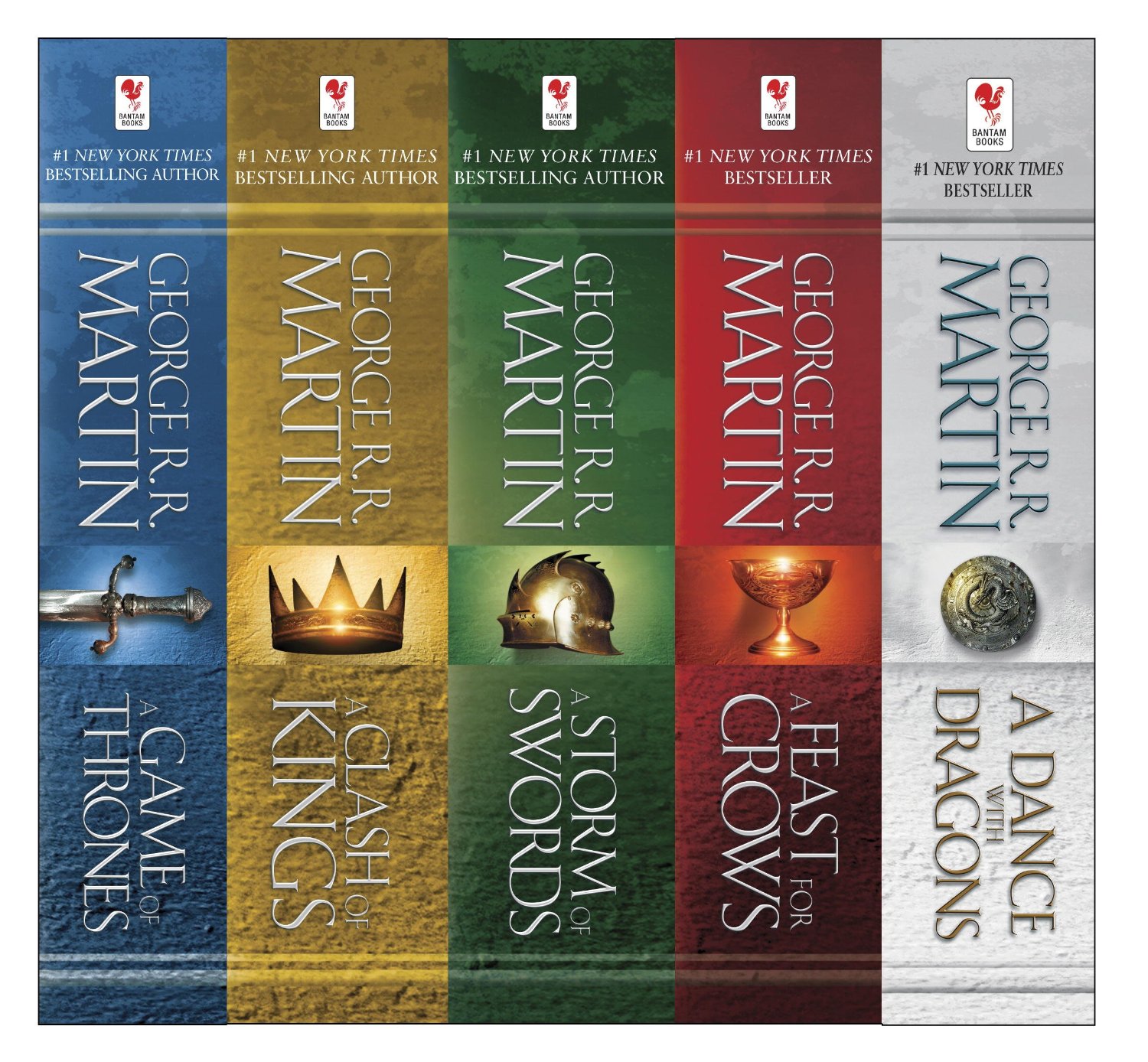
But between my job(s), my social life, and those nonfiction entries it doesn’t leave me a lot of time to read great works of fiction. I wish I read fiction every single day; it pains me deeply that I don’t. Most of my fiction reading comes in the form of the television shows that I digest while I work around the house or to give myself a break from writing or researching. I would love to dive into George R.R. Martin or Stephen King, or even re-discover Tolkien after my childhood hobbit fixation.

So I know I could easily commit to reading great works of fiction every day for a year, I just wish there was more time in a day.

Opinion: George R. R. Martin Is Not Your “Bitch,” He’s Your Dealer

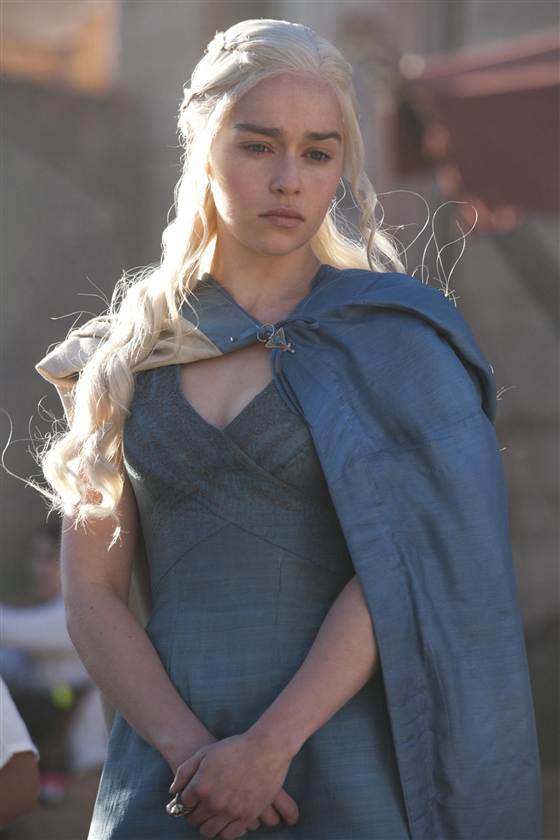
Game of Thrones

Andrew Findlay

Disclaimer: There are no direct spoilers in the review. You might be able to infer something, but that’s it. Also, the most recent book came out three years ago, so if you don’t want to be spoiled by anything ever again, go read that.

A Song of Ice and Fire is an amazing series. The gritty realism in a fantasy locale, the compelling characters, the whip-crack plotting and suspense – all of these traits combine to forge the cultural juggernaut that is ASOIAF. I love these books. I came a little bit late to the party. I read them around December 2010, 14 years after the start of the series, when the first four books had already been published. I read those four books in one month. The paperback versions for tally up to 3,844 pages, meaning that for the month of December, I read an average of 128 pages a day. That’s how good this series is. For an entire month, If I was not working or sleeping, I was what-the-fuck-noooo-i-loved-that-character-ing my way across Westeros. In the same time and at that rate, I could have read the Lord of the Rings three times, the entire Harry Potter series, or thirteen normal-sized (300 pages, let’s say) books. That is dedication. That is a clear sign of an enjoyable series. The problem is that George R. R. Martin has fans that read 128 pages a day, but he writes .76 pages a day.

The addictiveness and scarcity of the product creates a rabid fanbase composed of people who make strange decisions about these books. For example, a day after the release of A Dance With Dragons (book five, July 2011), I had to drive 15 hours from D.C. to Memphis with my fiancee for the purpose of marriage. She was behind the wheel the whole way, and I read that book the entire 15 hours. Relevant factoid: Reading in the car makes me violently carsick. I ignored nausea for 15 hours to get through as much of the book as I could. When I got home, in a city surrounded by family and friends I see only rarely, I still read at least four hours a day. Luckily, I finished the book before my marriage.

http://www.youtube.com/watch?v=ECewrAld3zw

Also luckily, no one played this at my wedding.

Since then, I have been trying not to think about the series at all, because that creates visceral longing for resolution to all the cliffhangers on par with what I imagine someone in the grip of a Schedule I drug experiences. GRRM has created a legion of addicts. Addicts do not respond well when they are cut off from their substance of choice, and in the past three years, there has not been another fix. This has famously led to fans expressing dismay that GRRM watches football on Sundays in the fall, that he works on other book projects, and that he basically does anything but sit in a box with one bald light swinging over his head and a typewriter in front of him. The most crass concern expressed is that GRRM, who is 65, will die before finishing the series. The first few are strange, because Martin has the right to do whatever he pleases. The last one is heartless, as those fans are placing the completion of a series they love over the life of a human being.

1C6694189-emilia-clarke-photo-keith-bernstein-hbo-2.blocks_desktop_medium

ASOIAF. Not even once.

The problem is that this series, originally planned to be three books but having since ballooned into seven, has been going since 1996. To compare, the entire Lord of the Rings trilogy was published from July 1954 to October 1955. All the way from Gandalf freaking out an innocent Frodo in the Shire to the final collapse and defeat of the Dark Lord (spoiler alert!), readers had to wait just over a single year for the conclusion to a story so massive its weight is felt in nearly every entry into the fantasy genre since (to be fair, Tolkien had basically written the whole thing before publishing the first part). I only jumped on this train five years ago, but some poor bastards have been waiting nearly two decades to get to the station. This ballooning and extension of the books is due to a phenomenon which is weakening the series as a whole: success killing editorial power. The first three books of this series are incredibly, world-changingly good. Books four and five aren’t necessarily bad, but really only bask in the reflected glory of what came before. In a series known for page-turning action, plotting, and suspense, there was a whole lot of material in book four that no one cared about, material that did not do much to advance the plot or tie the main threads of the story together more tightly. Why is this happening? Why are the editors allowing GRRM to bloat the series? It is because, at this point, if he published a book that just said “The North Remembers” and nothing else for fifty pages, everyone would still buy it. Why do we get point of view chapters from people we do not care about? Because GRRM is writing for addicts, and if he cuts the product, we will still buy it. The editors know this and thus give him free reign because their company makes money regardless. ASOIAF is a victim of its own success.

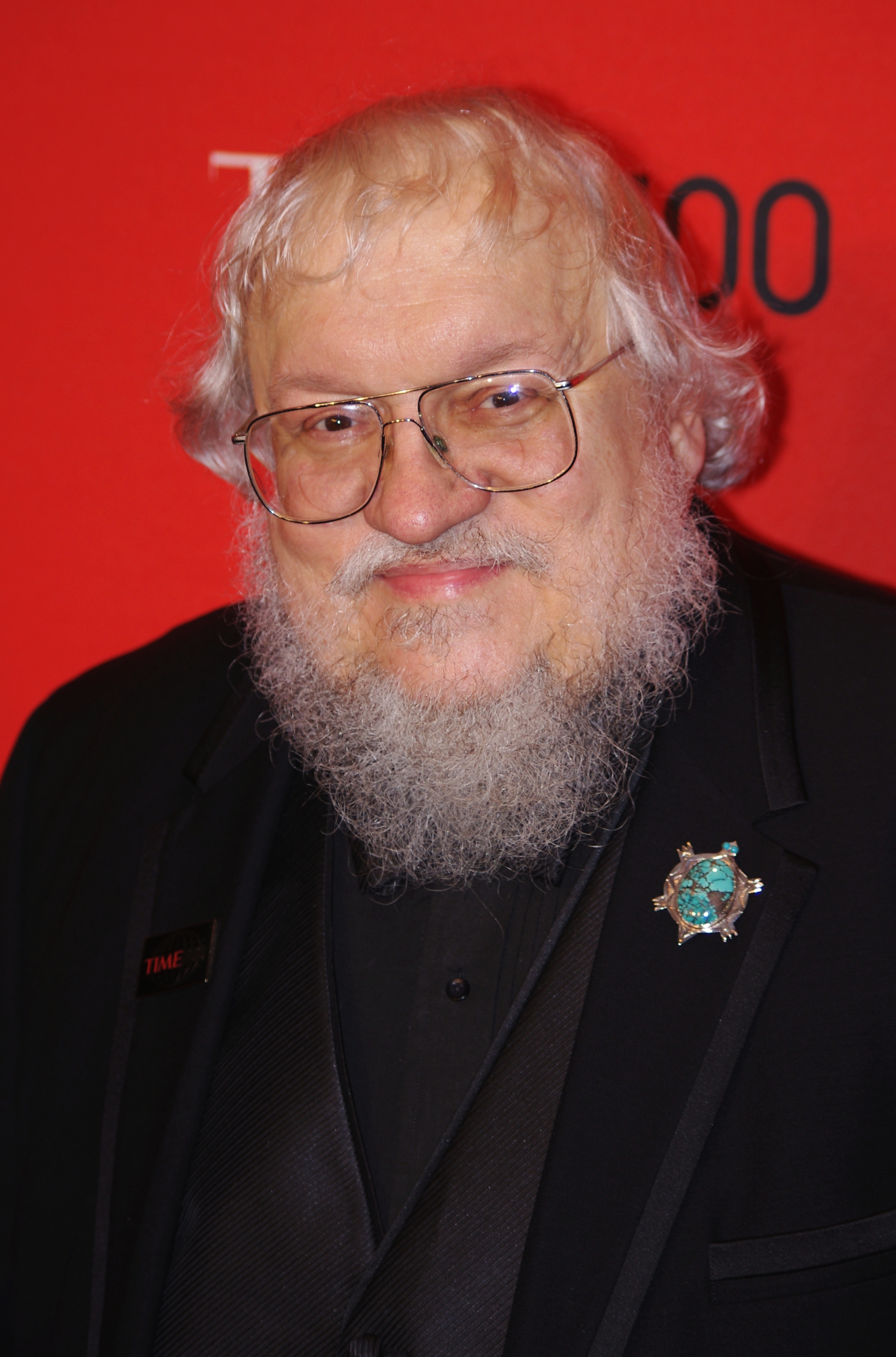
George_R_R_Martin_2011_Shankbone

Pictured: GRRM, escaped from his writing box

Speaking of success, another issue affecting the books is its serialization on HBO. I have yet to watch the show. I’m sure it’s amazing, but something in me is forcing me to finish the books, all of them, before starting in on the show. This may no longer be possible. The show is now halfway through the third of five books, and there is so much fluff in books four and five that the showrunners could conceivably fit it all into one season. Assuming HBO sticks to a yearly production schedule, that gives GRRM one year to write book six and one year to finish it up with book seven. His total output for the past 15years is two books, so unless something drastically changes, there is every possibility I will be watching instead of reading the conclusion to this story.

I do not want to be forced to another medium to find out what happens in the books I love. There is nothing wrong with the show, but it is not the same thing as the books. Not having watched much of it, I can’t speak to specific differences, but it’s clear that there cannot be nearly as much detail to the world – in order to make something watchable, you have to cut it down significantly. The size, the texture, and the depth of the books is part of what makes it for me. The backstories, the tiny defeats and victories for every single character, the flashbacks, the red herrings and true clues packed into the pages of A Song of Ice and Fire are flying through my head right now, and there is no way they fly as thick and fast in the HBO version.

Another strangeness created by the success of the show, because TV popularity is orders of magnitude above book popularity, is that there are new legions of addicts who do not want to be spoiled. A huge event happens at the end of season three of the show (which I did watch on YouTube, because holy shit), and everyone was understandably concerned about spoilers, but that same event happened in a book published while Bill Clinton was still president. If you really care about spoilers and desperately want to know what happens next, read the damned books.

Neil Gaiman famously responded to a fan question about GRRM’s writing pace with “GRRM is not your bitch.” Good response, absolutely true, but a little bit simplistic. When you write something so great that you have a significant percentage of the human population wishing that you would just sit in a box typing for 18 hours a day, there are consequences. One consequence is that you become famous and fabulously wealthy, afforded the freedom to engage in whatever projects you like. Another is that the fervor of fans that catapulted you to the top can quickly turn to anger if they feel you are not fulfilling your obligations to them. It is ridiculous that people wanted Martin to stop watching football so he could write. It is terrible that fans are more concerned about their series concluding than his life ending (although at this point, I’m mildly concerned that my death will come before book seven is published). Even still, George has an obligation to his fans. Edit more judiciously, tie plots together more tightly, and return to the transcendence of A Storm of Swords. I desperately want to see the North remember, and I want to see it in print.

Andrew Findlay has strong opinions about things (mostly literature) and will share them with you loudly and confidently.

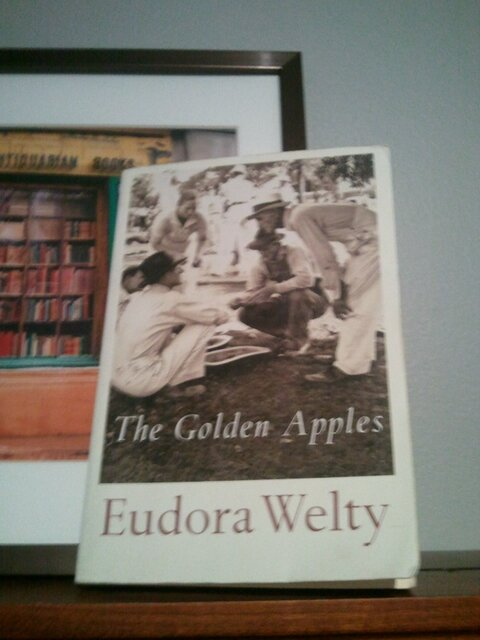
Eudora Welty’s The Golden Apples and How to Write the Way People Actually Talk

Andrew Findlay

The Golden Apples is a collection of interwoven short stories about a town called Morgana, Mississippi. It explores the people, places and values of the town. It is very similar in structure to The Dubliners, except instead of Dublin it’s focused on Mississippi. Mississippi is a weird place. Like New Jersey, it has very specific associations in the national consciousness. Like New Jersey is supposedly hideous, marred by endless highways, and filled with people who only care about gym, tan, and laundry, Mississippi is supposedly just farmland, devoid of culture, and filled with fat racists. The problem with national preconceptions about different regions is that they are held mostly by people who have never been within 300 miles of those regions.

New Jersey

This is New Jersey.

That is to say – they might be based in part on fact, but the resulting ideas have usually been extrapolated beyond all semblance of reality. Mississippi definitely has problems. One prime example is that in 2009 (2009!) students at a Charleston, MS high school had their first integrated prom. Yea, sure, that’s messed up, but that doesn’t mean the entire state is full of ignorant people. The artistic contributions of Mississippians to American letters are staggering. You have the old, dead greats like Faulkner, Richard Wright, and Tennessee Williams. You have bestselling authors like John Grisham. You have current show-stoppers like Donna Tartt. Eudora Welty was a Mississippi author, and she was the equal, or close to it, of Faulkner. One of the things that made her so great was her command of language.

Her skill with language is two-fold. First off, Katherine Anne Porter once said that Welty had “an ear sharp, shrewd, and true as a tuning fork.” Her dialogue captures exactly how people actually say things, which is one of the first talents to disappear from the output of an author as they slide from first to second-rate. To give an example, this is what one character says in response to a question asking why she spent so long at her sister’s:

“I was comin’ back. Sister’s place a place once you get to it — hard time gettin’ out.”

This communicates the dropped g, the dropped “to be” verb that indicates casual Southern-accented conversation, but more importantly what happens towards the end of the sentence reflects what people actually sound like when they speak – the pause, the abandonment of the old syntax, the start of a new sentence, not grammatically correct, as a new and better way to say what you’re saying occurs to you mid-sentence. Another example, pulled from a group of people talking about a daughter’s behavior:

“Daughter wouldn’t run off and leave her, she’s old and crippled.”

“Left once, will again.”

“That fellow Mabry’s been taking out his gun and leaving Virgie a bag o’ quail every other day. Anybody can see him go by the back door.”

What stands out here is the “Left once, will again.” Completely wrong sentence. Everything is implied, nothing is clear. This is never what people would say in an official paper or newspaper article. Thing is, it’s exactly what people say in conversation to save time. In the context of the conversation, the referents are absolutely clear. Many high-level writers have trouble writing dialogue in a way that does not reflect the correct language drilled into them in grade school. Welty has no such difficulty.

She also just uses language really well. Her diction is not absurdly recherché, but it is dense and powerful. She packs a lot of meaning into collections of simple words, which is more impressive than sending your poor reader to the dictionary endlessly. Following is an excerpt from one of the stories in which Miss Eckhart, the old emotionless piano teacher, surprises her pupils when she plays.

Coming from Miss Eckhart, the music made all the pupils uneasy, almost alarmed; something had burst out unwanted, exciting, from the wrong person’s life. This was some brilliant thing too splendid for Miss Eckhart, piercing and striking the air around her the way a Christmas firework might almost jump out of the hand that was, each year, inexperienced anew.

In simple and clear language, Welty deeply explores the issues of childhood innocence, of the depths of human emotion, and of the discomfort we feel when confronted with the unexpected. This depth-through-simplicity is a feat she pulls off repeatedly throughout the book.

Here she is, looking out the window and thinking words that are probably already better put-together than anything you’ve ever put on paper.

The Golden Apples is a strange book. It does not have a strong message like 1984 about the dangers of totalitarianism or Catch-22 about the absurdities of war. Its themes revolve around the importance of family, identity, and community and the intersection among them, but instead of making a clear declaration about them, Welty is content with exploring them profoundly. Each story moves forward in time, so the reader sees the progression of different important characters as the town and the families within it grow and change. The main impression this book leaves upon completion is density – all the themes, motifs, and characters in the different stories have been exhaustively explored using a minimum of words – meaning is coiled and pressed heavily into each syllable.

Due to how tightly-packed it is with significance, it is not at all a beach read, but it is one of the most important books I’ve ever read. It is a meditation on life, emotion, struggle, and resolution. It does not have the answers, only the exploration. It’s a tough climb, but it’s worth it.

Andrew Findlay has strong opinions about things (mostly literature) and will share them with you loudly and confidently.

Images: Myscenicdrives.com, Brainpickings.org

Life After the Star Wars Expanded Universe: N.K. Jemisin’s The Broken Kingdoms

Andrew Findlay

In Life After the Star Wars Expanded Universe, we take a look at science fiction and fantasy, why they’re great, and what they say about where our species has been and where it’s going.

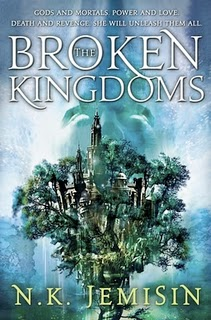
The Broken Kingdoms is book two of The Inheritance Trilogy. The main premise of this book series is that the inhabitants of this world coexist with and even enslave their gods. There are three main “big G” Gods: Nahadoth, god of the night, Itempas, god of the day, and Yeine, goddess of twilight and the dawn. Any offspring from these three Gods are called godlings, and while not as powerful as their forebears, they have some impressive abilities. Without getting into specifics, I can tell you these Gods have disagreements and war sometimes. During the first book, Nahadoth is actually enslaved by humanity because Itempas chained him as punishment. The humans who had control of him, the Arameri, quickly became the undisputed rulers of the world, because any society that stood against them quickly fell to the overwhelming power of their pet God. The Arameri live in the palace pictured on the book cover – Sky, a castle in a tree. Shadow is the city that has grown under the tree, so called because the massive branches shade most of the city.

The author, N.K. Jemisin, is a relatively new author – book one of this series is her first novel that really exploded. I appreciate how prolific she is: The first book in the trilogy was published in 2010 and the third was published in 2011. That is a whole world, a full story, complete and entire, in less than a couple of years. That is refreshing as hell in the world of The Wheel of Time and A Song of Ice and Fire, the former of which took twenty-three years to complete, and the latter of which has been going for eighteen years and is nowhere near finished.

Praise this woman – she actually publishes fantasy regularly. It’s impressive.

The story she creates in The Broken Kingdoms focuses on the upheaval and changes in a city newly filled with godlings. For 2,000 years, godlings were not allowed in the human realm, but events in the first book ease that restriction, and now they participate in human society. The action of the book starts with the murder of one of their number, and suspense begins high and fast – who killed an immortal, and how did they do it?

The main character through whose perceptions the reader experiences the search for the murderer is Oree Shoth, a member of a marginalized race, the Maroneh. In the distant past, the rich and powerful island that was her people’s ancestral home was sunk beneath the waves by the fury of Nahadoth, the Arameri’s enslaved God. They were given space to settle in Arameri lands but have never really recovered. What’s special about Oree? Well, for one thing she’s blind, but not really.

The not really part is that she is magic – for some reason, she can “see” anything magical. In the enchantment-doused city of Shadow, this means she can get around easily by the glow of magic everywhere, and godlings she can see perfectly clearly, as they are beings of pure magic. Her magical ability also allows her to use paint and artistic representations to open doors to other places. Equipped with normal and godling friends and her abilities, she finds herself embroiled in the conflict bubbling at the center of this murder conspiracy.

Without discussing key events of the book, I want to talk about what is good and bad about this book. The best thing about this book is the mythos – Jemisin spends a significant amount of time explaining the origin of the world. First, there was Maelstrom, massive, incomprehensible, chaotic, feared by god and man alike. Maelstrom produced Nahadoth, god of the night, then Itempas, god of the day. They were brothers and more than brothers, and loved each other deeply. A few millennia later, Enefa, goddess of twilight, dawn, and life appears. Through her, procreation and the genesis of human life become possible. Later, there is a massive conflict among the Three that creates many of the problems explored in this book. The magic system is also interesting. All magic in this world originates in the gods, but in a world where Gods and godlings regularly had relationships with humans, many humans have a little godsblood in them and can channel a bit of magic. There is a competing form of magic wherein ungifted humans, through extreme study and materials manipulation, can use sigils, inscriptions, and artifacts to tap magical potential. Finally, the book has high readability. It’s a fast read because Jemisin follows a nicely balanced intrigue/payoff rhythm wherein suspense and lack of knowledge is set up, satisfied, and replaced by even more extensive intrigue in rapid oscillations, holding final satisfaction off until the last page of the book.

On the bad side, the characters seem a little light. Almost no one other than Oree is fleshed out at all, and even Oree herself is not an extremely complex character. The same lack of complexity affects the plot. It’s just event, event, event, TWIST, keep reading! It’s well put-together, but it’s built like a carpenter building a chair, not an architect building a cathedral. Also, the world surrounding the story is not very well explored. This could be because the books are comparatively short. I wasn’t sure whether to include this feature as a good thing or a bad thing, because Jemisin sketches out a massive world brimming with history by using a minimum of key explanations and events. This strategy can leave the world feeling a little bit hollow and flimsy, but it’s a blessed change from Robert Jordan’s strategy of describing every fold in every garment and the delicate silverwork on the side of every teapot.

You should read this. Some of the story elements are a bit weak, but it is strong on everything I look for in a fantasy: interesting premise for a new world, satisfying exploration of the mythology of that world, and a respectably put-together and exciting plot. Also, you should reward this author for actually finishing her book series instead of stringing people along for decades.

Andrew Findlay has strong opinions about things (mostly literature) and will share them with you loudly and confidently.

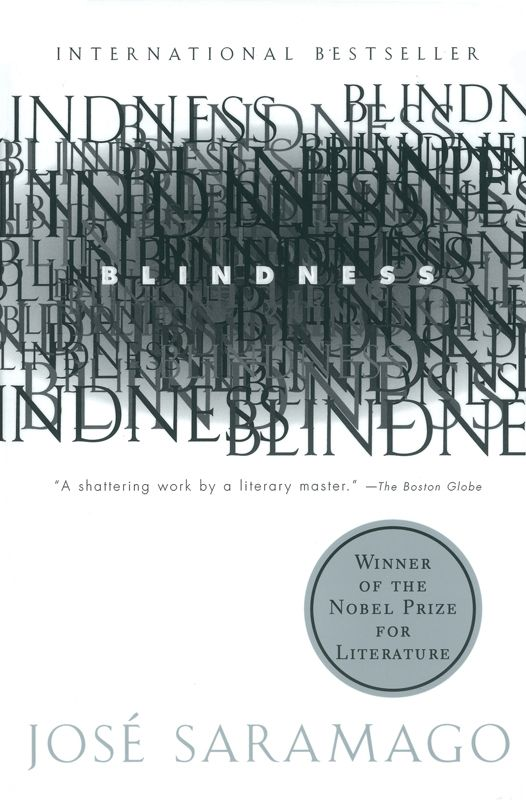
Life After the Star Wars Expanded Universe: Jose Saramago’s Blindness

Andrew Findlay

In Life After the Star Wars Expanded Universe, we take a look at science fiction and fantasy, why they’re great, and what they say about where our species has been and where it’s going.

Blindness is a novel like Infinite Jest in that it has strong science-fictional traits, but many would throw out terms like counterfactual or speculative instead of going whole-hog and calling it SF. I’ll just say the main premise of the book and let you decide for yourself: In an unnamed city in an unnamed country, people are going about their lives as normal until suddenly, out of nowhere, people start going blind. There seems to be no contagion, no reasonable epidemiology to explain why this is occurring. Some people go blind, some do not. The blindness is not a lack of sight, but a complete whitewashing of your vision – all the stricken can see, all the time, is a wall of white.

The greatest SF explores what happens to society in the face of great change, and that’s exactly what Blindness is going for. Saramago takes away one tiny little thing – sight – and it completely upends the world. The first man to go blind does so at a stoplight, so when it turns green he does not move and pisses a bunch of people off. When those around him understand that he’s been struck blind, they get less angry and one even offers to drive him home. In an action that foreshadows the societal breakdown to come, this shitty samaritan then steals his car. He is the second person to go blind. The government’s response to a seeming disease that they can neither control nor understand is to freak out and force everyone affected to into an old asylum that they have repurposed to house them. A large portion of the book takes place in this asylum, and it is there that Saramago explores in depth what happens to people when they are pushed to the edge.

This seems like a rational response to people going blind.

The main characters of the novel, as much as there are main characters, are the doctor and his wife. The doctor, hilariously, is an ophthalmologist. His wife is inexplicably not affected by the disease – she pretends to be blind so as not to lose her husband to the asylum. In the first group of asylum inhabitants, this pair serves as the voice of reason and tamps down the group anxiety to manageable and sane levels. They build a tenuous society within those asylum walls, which are patrolled by soldiers who will shoot them if they attempt to leave. Nothing lasts, and everything is subject to strain and decay, so however much those first inhabitants can work together, their way of life is shattered as the epidemic builds up to full steam and the asylum is flooded with the newly blind. In the beginning, soldiers would send them food, now there is not enough. In the beginning, the inhabitants would share and work together, now gangs are forming and fighting with each other for food and, horrifyingly, women. It used to be possible to maintain some cleanliness, but with the facilities overflowing with people, the latrines overflow with waste. Blind, imprisoned, and with all agency taken from him by the authorities, the doctor keeps a stiff upper lip, but his breaking point is trying to use the bathroom:

The stench choked him. He had the impression of having stepped on some soft pulp, the excrement of someone who had missed the hole of the latrine or who had decided to relieve himself without any consideration for others. He tried to imagine what the place must look like, for him it was all white, luminous, resplendent, he had no way of knowing whether the walls and ground were white and he came to the absurd conclusion that the light and whiteness there were giving off the awful stench. We shall go mad with horror, he thought. Then he tried to clean himself but there was no paper. He ran his hand over the wall behind him, where he expected to find the rolls of toilet paper or nails, where in the absence of anything better, any old scraps of paper had been stuck up. Nothing. He felt unhappy, disconsolate, more unfortunate than he could bear, crushed there, protecting his trousers which were brushing against that disgusting floor, blind, blind, blind, and, unable to control himself, he began to weep quietly.

There’s a lot going on in this excerpt. First off, it communicates the horror and squalor of their physical situation: this character just identified shit by his sense of touch. He’s stuck in a bathroom where no one can ever hit the target because no one can see it. His sight is gone, but his smell is not, and his surroundings assault it powerfully. Secondly, it highlights how difficult and degrading the simplest tasks can become when we lose one simple thing. Sure, of course blind people cannot drive, but the frightening thing about this novel is that all these newly blind people who have not had time to adjust to their condition struggle even with wiping themselves. Thirdly, it explores the spiritual effect this lack of ability has on people. In this excerpt, we have the doctor – married, successful, in the business of confidently helping others – sitting in a shit-stained bathroom unable to take care of his most basic physical needs. His lack of control in the physical world leads directly to his loss of emotional control, which results in him weeping quietly in a bathroom.

When this is one your main nemeses in life, you are in a bad spiritual place.

This helplessness and despair eventually spreads to most of the city. The guards start falling prey to the blindness epidemic, and, in the absence of soldiers or any overarching social order, the inmates wander out of the asylum and stumble through their transformed city. Blindness demonstrates intensely and convincingly exactly how little it would take for our society to crumble. Everyone is familiar with the idea of the world ending due to violent illness, resource scarcity, or nuclear war. It does not even take that much – the world will end if filled with a bunch of perfectly healthy people who have lost the ability to see. Evolutionarily, this makes sense. Sight is humanity’s primary sense. In the way way back, it, along with bipedalism, gave us an advantage in our primal environment: we could stand taller and see farther than other animals on the plain. We no longer need to hunt for and run from other animals, but the primacy of sight still exists. Think about it: When cops are searching for a fugitive, they don’t put his scent on the APB, they put his image. Movies and television, two of the most popular forms of mass entertainment, require sight to fully enjoy. Reading is, has been, and for the foreseeable future will be the main method of information transfer in our society. Without sight, you would not be able to understand this article. When sight disappears, a big part of how we adapt to and interact with the world disappears with it.

Science fiction is an exploration of humanity in extremity. It imagines a different world and explores how we deal with it. How does a man condemned to perpetual loneliness in Moon deal? How does a man who has come unstuck in time and exposed to all the psychological awkwardness of that state in Slaughterhouse-Five deal? How do the handful of survivors of a world-wrapping biopocalypse in MaddAddam deal? Saramago crafts a beautiful and concise exploration of humanity in extremity by changing one tiny aspect of our current world. It’s not even in the realm of SF that people go blind – that happens daily. The only change Saramago makes is that it happens inexplicably, and it happens to everyone. He pulls at one small string, and the entire fabric of human society unravels. It is important to keep in mind how fragile and impermanent our way of life is, and how little it would take to completely wreck it.

Andrew Findlay has strong opinions about things (mostly literature) and will share them with you loudly and confidently.

Image sources: Wiki, Amazon