TV

How is The Walking Dead like Dave Matthews Band?

dave matthews band performs 220210

Scott Phillips

I like to think of The Walking Dead as the modern television version of the Dave Matthews Band. Remember how in the late 90s and early 2000s seemingly everyone liked Dave Matthews Band because it was safe to do so?

You could get asked by any adult, co-worker, or kid if you liked the Dave Matthews Band and if you said, “yes,” 95 percent of society would accept that answer while only five percent would call you out on your bullshit.

Most people “sorta” liked Dave Matthews Band, but just wanted to fit in and give the answer easiest in doing so, so I feel like they became a bigger thing than they should have been. I can’t tell you how many kids I went to high school with who were so pumped to see “Dave” in concert yet NEVER speak about that band anymore. Not ever.

I feel the same way with The Walking Dead.

(Writer’s Note: This article — and subsequent thoughts — are strictly about The Walking Dead television show and not the graphic novels, or correlations to the novels or any other weird shit like that. I watch television, so that is what I’m strictly writing about here.)

It’s the most watched basic cable television show in history and I don’t know anyone that truly enjoys the show. Everyone sorta likes The Walking Dead; just like DMB. It can be amusing sometimes. The action-driven scenes involving zombies are decent enough.

But Rick is the same mindless character the last three seasons and his son Carl needs to die. Or maybe the producers saw that Carl couldn’t even play dead as a zombie and believed they would be best served keeping him alive and alternating episodes where he isn’t in the plotline. The kid that plays Carl is so bad that he makes the kid that played A.J. Soprano look like Tom Hanks. Michonne is finally getting a back story now of all times? And the new characters: Why should anyone care about them and their fate?

Do you ever go into each week begging for the next episode of TWD? The next episode is just always sort of there. I don’t know anyone that would list The Walking Dead as their favorite show on television. If they do, they’ve probably taken every Buzzfeed quiz about which television character they are or which deli meat they would be.

I just don’t understand how this show about zombies — with minimal character development and really mediocre acting — is the top-rated cable television show of all time. This show regularly has five-to-six times the audience of Breaking Bad and Mad Men (!!!!!!!!!!!!, !!!!!!!!!!!!!) yet, I couldn’t name a soul that would say The Walking Dead is better than those shows.

Is America really filled with this many people that are iffy on entertainment options? Talking Dead, a show ABOUT a show, gets ratings this season that are nearly even with Breaking Bad‘s final season. That’s fucking insane… Do these people not know True Detective exists? Do this many people not get HBO?

Not to insult DMB or The Walking Dead as the worst thing ever; that’s not my intent with that comparison. Both are perfectly good forms of their respective entertainment with things they do well (Dave: live shows, Carter Beauford and percussion implementation with the band; TWD: good at cliffhangers and battle scenes, it’s diverse?), I’m just at a loss to see how both became so universally popular other than having mass appeal.

The Walking Dead: Working Despite Itself

amctwd

Mike Hannemann

WARNING – Full spoilers for the entire series so far for The Walking Dead are in the article below. Read at your own risk (or lack thereof, if you don’t give a damn). Oh, there’s also a pretty easy joke about Lost that may or may not ruin that so… use caution if you haven’t seen a show that ended in 2010, I guess.

The Walking Dead is back and has a few episodes under its belt for the final half of its fourth season. This is a peculiar show for someone who follows around a lot of pop culture for two reasons. The people I know who love quality television (and will debate it endlessly) watch every episode… and hate it. On the other side of the coin, the people I know who watch things like Duck Dynasty or Pawn Stars watch every episode… and love it. This is a very odd thing in 2014.

What is it about this show that has both sides of the spectrum coming back? What is drawing in people who lambaste it yet discuss it in length the next day and simultaneously those who will just post “OMG, Walking Dead!! So great!!” on Facebook every Sunday night? As someone well-versed in this particular undead universe, I’d like to try to figure this out.

Before the show aired its very first episode, I read the first 70 or so comics. The show is based on a graphic novel by Robert Kirkman, and he is involved in the show, so I figured I’d give the source material a whirl. When the first episode aired, I knew many of the characters already since they came from the books. I had my favorites and my least favorites. Ones I reviled and was looking forward to their on-screen demises. But… a lot of it just didn’t happen the same way. I can’t blame the creators, they needed to differentiate themselves from the source material so they could tell their own stories. “Ok,” I thought, “more time with these characters, I guess.” But then I realized something.

I don’t actually like any of these people. Why the hell don’t I like any of these people?

It’s because the show can’t recover from the shadow of its greatest and biggest character. Its break-out star. What made the show a ratings smash. I’m referring to the actual, physical, nightmarish world the characters live in. The world is a more important character than any person you ever see on screen. A show’s world is always a big part of the storytelling. Pawnee, Indiana is its own background character on Parks and Recreation. The Simpsons have a reliable backup every week: the town of Springfield. Hell, even a show with such brilliant characters as Breaking Bad gains a little bit of charm from the fact that it’s set in Albuquerque, NM. The Walking Dead turned this television trope on its head by making the setting the star attraction. Everyone else is just there as backup. The closest comparison is Lost, but that show had the narrative framework that included 20 minutes of flashbacks per episode and the possibility that “everything is magic all the time.”

This criticism applies to every instance the show slows down. When it stops for smaller character beats or long pointless monologues so you can learn how one survivor feels about religion, on the back of everyone’s mind is when we’re going to get back to the world falling apart. It’s not as much fun to watch people farming when you know just on the horizon is something horrifying. And because of this, when horrible things DO happen, (first major spoiler: things only sometimes happen) while it’s viscerally enjoyable, there’s no real emotional stake to it.

No one knew this was going to be a smash hit. It’s why the opening episode starts the same way the comics do. There’s an introduction to the sheriff for a few pages. Sheriff gets shot. Sheriff wakes up from a coma months later to find that the world has gone to hell and there’s no one really left. Why would you care, though? This is just some dude who it looks like woke up in a horror movie halfway through the second act. The show tries, desperately, to make you feel for these people on a deep level but it’s nearly impossible to because there’s no room for solid foundation. In a show about the world in ruins and only a handful of survivors, people actually can make the criticism “Well, nothing happened in THAT episode.”

I can only imagine how amazing this show could have built itself into if it had started with a slow burn. A first season of 12 episodes where we meet these characters, spread throughout Georgia, with occasional scenes of the world starting to go to shit. Give these characters something that’s worth caring about before pulling back the curtain to reveal the star of the show. Care about two characters’ marriage for a different reason than “Hey! They’re married! And marriage is supposed to be great, right?” Or, hell, care about a kid’s actions outside of other than “LOOK AT THE BOY ON THE SCREEN!”

It’s harsh criticism, but it’s true. The show’s writers do their best with the materials they have. Occasionally, there are times when you do care about the people on screen. But it’s not often enough to really drive the show anywhere. And, to be fair, most of the people who are watching this show aren’t asking for much more. They want to see a screwdriver to a zombie’s head and call it a day. They can get by with a character nicknaming a newborn “Lil’ Asskicker” because that isn’t important to them. And, maybe, a show like this doesn’t need to have compelling character arcs. But if you try to shoehorn them into the REAL reason everyone is watching, you’re just going come across as hacky. You’re working from a disadvantage, but at least acknowledge this and try to tell a fun story.

I’m fine, The Walking Dead, with you occasionally taking a breather from incessant mayhem to give characters room to grow. But you are a show about gross-out scares and the end of the world. It’s OK to not be better than that.

Image source: AMC

Tough Questions: What Do you Keep Recommending that No One Will Believe is Good?

question-mark

Every Monday we ask everyone who hangs out around here to answer a tough question. This week:

What Do You Keep Recommending that No One Will Believe is Good?

Rules are simple: what do you find yourself telling every person you come across to check out that no one will listen to you about? What would totally be someone’s favorite show/book/movie/Chinese food menu item that’s being overlooked?

Mike Hannemann

The thing I love that I find myself never able to convince anyone is good is the tacos at Burger King. I normally hate the guy that goes to a Mexican restaurant and orders a burger but these are LEGIT. They cost $1.19 for two and yet no one takes the chance despite my urging. They’re fried, filled with a meat-like substance, a half piece of Kraft american cheese, and a slice of lettuce, all topped with a weird taco sauce. I can’t explain why they’re amazing. I can’t explain how an airplane flies, either. I just know two things: a plane can fly and these tacos are good.

Alex Marino

I swear if you’re still using that shitty shower head that was there when you moved in you need to get rid of that shit right now. Get on Amazon and order yourself one of these. Yes, it’s expensive. Yes, it’s completely worth it. You’ve probably spent $100 on some shitty sweater you wear once every few weeks. Why not spend that on something you do every day? Instead of a shower just being that thing you do before you go to work, you actually enjoy it. You’re fucking WELCOME.

Alex Russell

The funniest thing you don’t listen to is My Brother, My Brother and Me. It’s a podcast on the Maximum Fun podcast network that’s hosted by three brothers. They answer questions from Yahoo! Answers and from people who email them their pressing questions. Want to know what to do if you think you’re in love with a goose? Need to learn to box but refuse to learn how to block? Unsure if shoplifting is really illegal? You need to listen to the brothers. I’ve suggested this to every single person I’ve met that likes comedy in the last two years. “You need to listen to this podcast” is tantamount to asking someone for both of their kidneys, but seriously check out the sampler

Austin Duck

Poetry.

Andrew Findlay

I have been asking my coworkers to watch Breaking Bad for a year and a half. To my knowledge, only one has taken me up on the offer. This is frustrating. The worst part is that a guy I work closely with kept recommending The Wire to me, and I kept recommending Breaking Bad to him. We would have arguments over which was better without us having seen an episode of the show we were putting in second place. I have since watched all 60 episodes of The Wire, and he has not watched the pilot of Breaking Bad. I’m sure everyone believes it’s good, but a disheartening number of people don’t believe it’s good enough to actually sit down and watch.

Brent Hopkins

The thing that I always recommend to other people that no one seems to think is good is a series called The Mistborn Trilogy by Brandon Sanderson. This is a fantasy series that keeps you engaged from start to finish and has enough twists and turns to keep you in the dark until the final few pages. There is plenty of action, romance, and mystery in these books and it was one of the best things I read over the last year. I am not necessarily huge into fantasy but I found myself reading until I passed out with my Nook on my chest. I have quite a few friends I think would love it when they started it but they always come up with other things they need to do. READ THIS SERIES, SERIOUSLY!

Jonathan May

Two words: Big Love. That Bill Paxton love-bonanza had its crazy ups and downs. Even Chloë Sevigny described the fourth season (of five) as a telenovela. But fuck if I didn’t cry consistently during the last episode. This show, as Stefon from Saturday Night Live would say, has everything: polygamy, Jeanne Tripplehorn, home goods superstores, Memphian Ginnifer Goodwin, Indian casinos, conversations with God, running for State office, and polygamy (you have to say it at least twice). But no one, besides me and my friend Kyle, seems to have given this gem the time of day. It’s only five seasons, people. I get that polygamy and Mormonism are “sensitive” topics, but the character arcs you experience are incredible. I was blown away by how the women ended up. Utterly blown away. So watch it.

Why We Watch Community

120509021715-community-therapy-story-top

Jonathan May

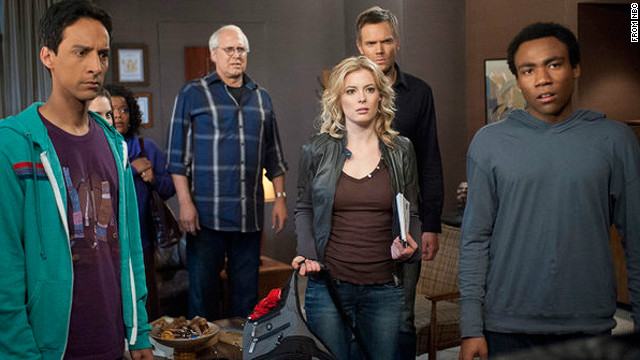
Community is one of those shows you inhabit in your dreams. I’ve gone to bed a night or two, only to end up being a part of the wacky, lovable study group’s japes. What I think brings me, and others, to this place most often is the show’s use of linguistic repetitions. The reinforcement of each character’s linguistic neuroses and their collective verbal neuroses add to the believability of the show (one of the grandest attempts of television). Think of the many utterances of “Doi!” or the Dean’s multitudinous and eponymous puns. Think of the many insults belted back at Leonard, the group’s old-ass, background naysayer. Troy and Abed’s many shared phrases. Abed, for whom everything is meta, even subtly acknowledges the level and power of repetition in the show every time he says, “Cool. Cool cool cool.”

To state and restate is the show’s power, like a sonnet unfolding over 25 minutes. The core of the show resembles that of a sonnet as well; the lines build on each other, according to the “rhyme scheme” (thematic topic) of the episode. Everything ends in a final couplet: lines of moral epiphany normally delivered by Jeff, our not-always-so-humble protagonist. Sonnets, among other strict metrical forms, work out of repetition of sounds; so too does a show like Community. Using individual phrases as units of expression (read: “feet”), the show leads to a moral ending, accreting from the different lines of our seven main characters a Gestalt. For a show built around an inherent timetable (community college degree completion) and structure (“#sixseasonsandamovie”), there’s a whole lot of circling, repetition, and discursiveness. What does this say about us, about students, about the modern college experience? That we too, in our headlong course for straightforwardness and completion, fail miserably? That we cannot escape the velocity of our own repetitions?

Maybe that’s not a bad thing. We, like the show, refine ourselves through repeating stories from our lives that define us; with each utterance, we either fall further into parody or resolve ourselves further in unity of character. The show does a great job of taking this chance each episode, using familiar phrases and tropes in an attempt to always be further resolved, rather than further caricatured. As the show moves into its fifth season, with Dan Harmon again at the helm, we’ll see, with the loss of Pierce and Troy, if the show can sustain itself with its remaining familiars. We’ll see if it can circle back around to a further incarnation.

Image source: CNN

Space Dandy Needs Women: Anime’s Feminism Problem

Dandy6-620x

Alex Russell

When I first talked about Space Dandy a month and a half ago, I praised the animation and commented on how odd it was to see the New York Times commenting on it. I mentioned that it really needed to learn how to balance the absurd humor of parody and the interesting nature of a universe worth exploring. It’s now seven episodes in, and so now I feel more comfortable evaluating what Space Dandy is rather than what it could be.

The show is broadcast in the United States and Japan on the same day, which allows for the US broadcast to proclaim that you’re watching the “world premiere” of every episode. It’s definitely a unique show in that regard, and the narrative elements of the show prove why they took that risk on this show.

A traditional anime series is 26 episodes long per season, with a lot of shows only getting that one season. Since not every story merits a 13-hour uninterrupted telling, one of the big tropes of anime is the “filler” episode. You meet everyone for 11 episodes and then everyone goes to the beach, or rides a train, or visits a friend in a far-away land. It’s either that or a recap show (imagine if every single sitcom had a clip show, whether they had the history to pull clips or not) and the “filler” episode is just an accepted part of the genre.

There’s no “filler” on Space Dandy, because every episode is equally unimportant. On a normal show those episodes can help explain characters by taking them away from a grinding story and forcing them to develop without advancing the plot. Space Dandy is absolutely not interested in growth, so no need to worry about getting too deep in the story to examine everyone. Everything is one plot and nothing carries over from episode to episode enough to bother with characters.

Or does it? The most compelling part of the show is the loose continuity. In one episode they surf away through space on lava coming from an exploding world. The next episode opens on a throwaway line about surfing, and then they’re done discussing it. It leads instantly into a Wacky Racers parody. It is forgotten, because it doesn’t matter.

It is easy to use this decreased emphasis on character to explain the problem with what Space Dandy is not: a reasoned discussion of the role of sex and gender in anime. Space Dandy is built to make fun of every single thing traditional anime does — right down to the hapless bad guy that doesn’t even seem to be trying very hard to catch the good guy — but it handles women so poorly that it’s tough to tell if it’s failing at the joke or legitimately doing a bad job with the topic.

There is an aggressive dedication to parody in this show. The lava-surf-riding episode ends with a nonsensical song about what happens after the end of forever. It’s impossible not to see this as a send-up of some of the more fantastical elements of animation. They nail this so hard that anyone who recognizes the joke will love it. Why can’t they also spoof anime’s gender problems that well without adding to them?

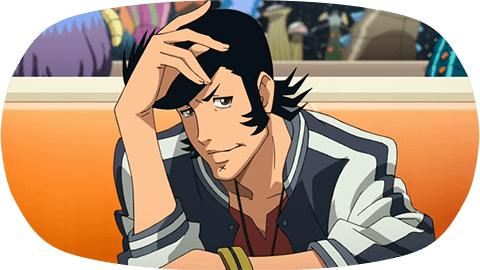
Space Dandy the show is about Space Dandy the character hunting aliens down to register them in order to make money. His crew is a genderless robot (voiced by a female, but the gender never matters in the show) and a cat whose gender is established but never really matters. Lest I be labelled as looking for a problem here, let’s look at the only thing that happens in every single episode of Space Dandy: he tries to find the closest Hooters-clone restaurant.

200px-Honey_portal

Honey, essentially the only female on the show, is in every restaurant. After 3.5 hours of the show she still does not have any real character elements; she’s mostly played as a pleasant-but-simple person who likes that Space Dandy keeps coming to the restaurant. Her outfit is absurd. She’s a waitress at outer space Hooters. Use your imagination, not your Google.

The argument here is if it is “joking” with the ultra-masculine pompadoured-Dandy and his approach to women. At a certain point, does it matter? Sure, naming the restaurant “Boobies” shows that you’re trying to be a little sly with the attitude towards it, but if you keep going back to it what does it matter what the intent is?

Other than Honey, who has absolutely no character to speak of, the only time the show has dealt with gender at all is in the episode “A Merry Companion is a Wagon in Space, Baby.” Dandy meets an alien that he can make a buck off, but the little girl has the power to turn someone into a stuffed doll once a day. The plot of the episode works as a “journey” while the two have to learn to get along on the way, but the slow development of the little girl as a character that matters feels glacial. She finally earns Dandy’s respect as a peer, but it is entirely dashed when it comes out that she just wants to grow up and “hang out” with Dandy. After working so hard to develop a character — a rare attempt for the show — they finally decide she is only valuable as she relates to the male protagonist.

dandy

Space Dandy the show is rarely about anything other than the absurdity of Space Dandy the guy and how much he wants to find some women, but that lens is no excuse for the way this show excludes half of the world. The creators of Grand Theft Auto 5 went on the record saying that their game features three playable male characters and no female characters because “the concept of being masculine was so central to this story.” People didn’t buy that and people shouldn’t buy this. Anime has plenty of powerful women, but it’s largely a space occupied only by women defined as sexual objects. If Space Dandy wants to mock the genre, it would honestly have to get even more absurd to handle the topic this way. As is, it comes off a lot like GTA 5: part of the thing that it’s supposedly making fun of.

There’s a lot to like about the animation and narrative risk to Space Dandy, but the world is hollow because it’s half empty. It’s a phenomenal show because of what it lampoons and the success with which it does so, but it’s hard to imagine this show couldn’t take down the sacred cow of anime: the limited role of women. Hopefully, it will. It might want to start with itself.

Image source: Space Dandy wiki

On Hate-Watching Girls

girls_ep9_shoshana_g_mp_576

Jonathan May

I must admit that I love to hate-watch shows. I don’t apologize for it. Many people love to hate things all of the time: other people, their Facebook pages, movies everyone loves, Republicans. So I claim Girls as my love-to-hate show. Besides the obviousness of it, that these are girls you are supposed to not-like, the show offers little in terms of episode-to-episode flow, the most appalling examples of which fall in the most recent and unfolding season (Adam’s sister, anyone?). For the first two seasons, I also held the show to be a comedy, which it fails at disastrously. The only funny moments involve Shoshanna, a character rendered tangential by her lack of “worldliness”—a quality which Lena Dunham and her ilk hold highest.

The problem with this is that these girls, apart from Jessa (sometimes), live out their petty dramas in the TV-bubble of New York City. Unlike Sex and the City, however, this works against the girls, casting them as Jenny-come-lately poseurs in a city that Carrie and crew embraced full and well years ago. This is more than just a problem of looking at two groups of women in completely different points in their lives/careers; as a result of hipster influx into Brooklyn (among myriad other U.S. locales), these girls don’t even recognize their status as interlopers, which is the root cause of their unhappiness. Marnie spends a lot of time alone; she has no friends because she has chosen to move to a city where sacrifice could mean something greater, but often doesn’t. Hannah never escapes her insular world made up of Adam and the occasional friend and the writing she is literally never doing. Each of the Girls revolves in a world populated by just a few.

Now, back to the hate-watching. I hate-watch Girls not only because I can and am free to, but also because I hate-read a few hundred romance novels when I worked at a used bookstore over the course of nine years. Girls’ formula is unfortunately so formulaic as to be laughable; it follows the exact arc of most good romances, which is lucky because the show fails as a drama and a comedy. So, why is everyone, myself included, obsessed with this new brand of romance? What does it offer? Well, I hate-but-don’t-hate to burst your bubble, but the show offers nothing besides pure romantic entertainment. There are no higher messages or coded morals; there are no expressions of the Zeitgeist or proclamations of culture. We have ripped tank tops and party dresses; we have unanswered texts. What we have is romance, and all proper romances end in marriage. So I guess we’ll see if Girls fails in that regard as well.

Image source: Grantland

“Dumb Starbucks” is Part of Something Bigger and You Really Shouldn’t Be Missing It

Alex Russell

On Friday, the new twitter account @dumbstarbucks announced the dawning of a new business. Dumb Starbucks is open and is very real.

Maybe you saw a post about it and maybe you didn’t. Even if you’ve read up on it, though, there’s just not that much to know about Dumb Starbucks. It’s a supposed art exhibit (that’s their argument, they are an artistic parody of Starbucks, so they can use the name) that sells coffee as art. They stuck the word “dumb” in front of everything about the most famous coffee chain in the world, from their business name to their specific drink sizes (get a Dumb Venti, etc) and opened to the world.

The video above was released today, from the “owner.” That’s comedian Nathan Fielder, who is most likely best known for his series of Twitter pranks. He asked people to text their parents and significant others incendiary comments like “I haven’t been fully honest with you” just to see the response. He’s fascinated by what we all are: how bad can it get? Everyone who has ever thought about pushing someone down the stairs but held off because you’re not supposed to act like that can appreciate Nathan Fielder. There’s a lot to love about doing what you’re not supposed to do.

It’s funny to read about someone telling their significant other something terrible because it is funny to think of how our own friends would react. How would your mom handle getting a text from you that asked about buying drugs? How would your girlfriend respond to a text that appears to precede bad news about your relationship? You can imagine — but you won’t test it because you are presumably not a monster.

Some people are monsters.

Nathan Fielder is the star of Comedy Central’s very strange and very beautiful Nathan For You. There’s a ton of it on Comedy Central’s site, I highly suggest you check some out. The show ran for one eight-episode season last year during a very strong season of new shows for a network that is relatively infamous now for throwing pilot after pilot out and then forsaking them all. They picked up another season of Nathan For You that is set to air this year at some point.

The show is about Nathan agreeing to help small businesses with aggressive new strategies. He demands that a pizza place offer a free pizza if they don’t meet their delivery goal, but then the pizza is the size of a quarter. He inspires an ice cream place to create a disgusting flavor to get people in the door. In one truly inspired episode, he creates a rebate for gasoline that is so impossible to redeem that it ends up being a hike and sleepover in the mountains with lunatics.

The joy of Nathan For You is in the moment that you realize everything has escalated beyond what you thought could be possible. How intense can the process for redeeming a gas rebate be? It involves impossible riddles and your own spirit journey. How could it? Really, how could it?

This is clearly — on some level, though surely not entirely — the best possible ad for Nathan For You. There will be more reveals and Starbucks will sue them to death and this will end up being all about getting you to watch season two of a weird show that you might not know about. It’s a pretty great joke by itself, but if it gets you to at least click on Comedy Central’s site and watch a few Nathan For You bits, then it’s even better.

Nathan For You will return to Comedy Central Summer 2014.

Chozen: Spiritual Successor to Eastbound and Down?

"Chozen"

Scott Phillips

After three episodes, I still have no idea how to feel about FX’s new animated series Chozen.

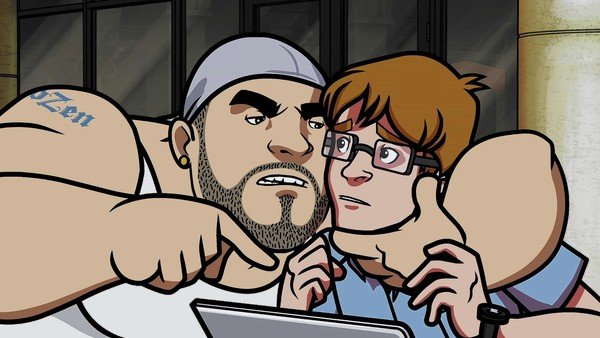
A Monday night FX comedy that airs following Archer, Chozen is a unique blend of cartoon comedy and hip-hop with some humor about Chozen being gay thrown in for good measure (more on that in a minute).

That’s right: Chozen is a gay, white, cartoon gangsta rapper.

That lead character — and show itself — should make for something unique, but as the mixture of staffs indicates in the trailer, this show is a lot like Eastbound and Down meets Archer.

Before you Archer fans get upset, the animation is what I’m comparing but the Eastbound and Down comparisons stand through three episodes of Chozen.

Chozen is a less likable and less realistic — it is a cartoon — version of Kenny Powers during the first three episodes. Bobby Moynihan does great voice work but Chozen’s desire to make it to the top as quickly as possible while doing drugs and chasing sex is very much like the journey of Kenny Powers.

But there are some subtle differences.

For one, Chozen is gay and his preference is men rather than Kenny womanizing while pursing his former girlfriend. Chozen’s sexual preference is not forced or used for frequent cheap pops — much like how sex can be overused for both heterosexual and homosexual characters for cheap laughs in comedic situations. While Chozen’s sexual preference is mentioned and Chozen frequently pursues sex, this character tendency doesn’t feel forced and it feels as though Chozen’s desire for sex prevents him from attaining his goals of rap superstardom.

People do stupid things for sex and Chozen is no exception. Chozen being gay was played up quite a bit in the trailer,  but it doesn’t feel like that big of a part of Chozen. Chozen is — thankfully — more about revenge over a rap rival than it is about the sexuality of a white rapper and that is why Chozen has potential as a show. The storyline for revenge is feasible and Chozen’s character traits of enjoying drugs and sex sometimes prevent Chozen from achieving those goals. Pretty simple formula…

…which is why I’m still scratching my head about this show, because the main plot line and hip-hop elements of the show have been very up-and-down.

As a lifelong fan of hip-hop, I appreciate many of the jokes and, of course, rap songs that go on in Chozen but I just can’t get over how awful Chozen’s rival, Phantasm, is.

Once, or twice, during each episode Moynihan and the”Chozen crew will conjure up a fake rap song that Chozen will fantasize about while doing something else. The results of these songs are often fantastic. They’re humorous, catchy and have so many subtle one-liners and jokes in many of the songs that poke fun at hip-hop culture and other things.

When Chozen raps “Murder, Sex” in the pilot it makes fun of every hip-hop cliche in both video and song form while also adding in the element of hard-bodied dudes in bear-heads grinding up on Chozen. The whole song and video is absurd and it’s hard not to enjoy if you understand some of the ridiculous pitfalls of modern hip-hop culture.

http://www.youtube.com/watch?v=ywQsrHyI_DM

So we have Chozen — free after spending 10 years in jail — and he’s instantly making catchy rap songs in pursuit of his rival Phantasm — who framed Chozen and put him in jail after previously being in the same rap crew.

Phantasm is now one of the biggest rap stars in the world. He’s got videos, security teams, and a pet jaguar, and everything about Phantasm pisses me off.

Voiced by Wu-Tang Clan legend Method Man, Chozen takes Meth’s trademark gravel voice and makes it sound so much worse. It sounds like a charisma-less Method Man did some PCP and had a tracheotomy before he did Phantasm’s voice work. It’s fucking miserable.

So, not only do we have an awful voiceover job at work when it comes to Phantasm, but Phantasm as a character just isn’t very realistic. As an audience, many of which are likely keen on hip-hop, we’re supposed to believe that a mediocre rapper named “Phantasm” is going to become one of the world’s biggest stars?

Many musical acts make it to the top without a lot of talent, but never with a name as awful as “Phantasm” in a genre as judgmental as hip-hop. Image and street cred are EVERYTHING in hip-hop and Phantasm doesn’t look, sound, or act like a major rap star. In the first face-to-face moment featuring Phantasm and Chozen in episode 3, Phantasm reveals that other people write his tracks and how he struggles to be creative in the studio.

Again, maybe this is being used to make it seem like Chozen has a chance at glory, but it makes Phantasm look like a cheap prop that will be good for nothing once Chozen and his friends pass him by.

It undermines Chozen and his journey to top Phantasm if everyone in the audience thinks Phantasm is whack to begin with.

This, again, draws back to Kenny Powers and his journey on Eastbound and Down. Kenny had rivals on “Eastbound and Down” but the main battle that Kenny fought was always a battle of inner demons in his quest to make it to the top. While some of Kenny’s rivals came and went during the journey, the trip to the top was always the ultimate payoff.

With how Phantasm is being set up the early part of this season, it wouldn’t surprise me if Chozen’s journey — and story arc — follows much of the same path as Kenny Powers’.

There are plenty of other fictional cartoon rappers that Chozen can go against as a rival character in the future, but this show will likely always center on Chozen doing whatever it takes to make it out of his sister’s living room and onto the covers of magazines.

While I’m not buying Phantasm as a rival and the sophomoric humor can be up-and-down, Chozen has a chance to be a decent comedy if it sticks to its formula and lets Chozen — as a character — breathe and be creative. Moynihan has a good grasp on the Chozen character already and there are a lot of different and fun ways the writers can go with how to take Chozen.

Let’s just hope the Chozen staff keeps the formula simple and lets the journey to the top guide Chozen along his path.

Chozen can be seen on FX’s website and Monday nights alongside Archer.

Image source: LA Times

Rick and Morty: Midseason Review

Mike Hannemann

It’s got to be hard pitching a show to Adult Swim. The network is famous for giving shows a chance that couldn’t have possibly gained an audience (Google Saul of the Mole Men some time when you have five minutes to kill and want to waste precious brain cells). So, in theory, if you can get enough momentum behind an idea and some clout, there’s a chance you can get it on there. However, Adult Swim original shows are also forever associated with things like Aqua Teen Hunger Force: stupid, pointless shows that get more laughs out of randomness than pathos.

Sure, there are exceptions. The Venture Brothers is a front runner of mixing absurdity and character depth to mine laughs. I have a feeling that when Dan Harmon (of Community) pitched his current 22-minute long cartoon, Rick and Morty, he was well aware of that.

Rick and Morty has aired six episodes so far, so we’re at midseason now. Before I jump into whether or not this is working, here’s a quick synopsis: the titular characters are an alcoholic scientist (Rick) and his pubescent grandson (Morty). It’s essentially Back to the Future if Doc Brown did cocaine, Marty was a constantly-wound ball of nerves, and the universe was about to explode every second. A wealth of storylines from previous sci-fi ventures are mined, including the “shrinking down to go into someone’s body to stop a virus” just to name one example. There’s a handful of supporting characters coming from their family: Chris Parnell plays the part of Morty’s father in a role that seems to have been written for him simply because they saw an episode of Archer. That’s pretty much all you need to know.

The show is clearly cynical, which most “adult” cartoons are. The kind characters get beaten within an inch of their life and the bastards seem to get away with everything. Morty, in the role of put-upon reluctant voice of reason, is thrown into situations by his grandfather that are sociopathic. Constantly on the verge of death, the show reaches for humor in seeing this kid go through some extremely rough situations where his victory is “well, he didn’t die.” Rick, on the other hand, is an alcoholic. He does whatever serves his current purposes (be it money or revenge) and usually gets away with it all. There’s no hug at the end and no moment of warmth. It looks, on its surface, to be just another tick on Adult Swim’s soon-to-be-cancelled list…

…except for the fact that the creators clearly respect their medium. As a 22-minute show, Rick and Morty is allowed to be a little loose with time. There’s time for establishing shots, grand epic sets, and whatever action sequences need to take place. This isn’t thrown together last-minute flash animation. The visuals have a retro feel to them. They look like the action scenes from the cartoons you remember watching as a kid. Clarification is needed here: it doesn’t look like something from the early 1990s that you’d pull up on YouTube. They look like how you remember they did. For a minute you forget the monster on the screen is actually a gigantic mutant strain of gonorrhea. It’s just plain fun.

Adult Swim is broadcasting this show on Mondays, which is uncommon for their new programming. It’s also airing at an earlier time slot – in between reruns of Family Guy and American Dad! It’s early enough to give the show a chance to reach audiences that are used to just binging their usual reruns. And while you can say what you will about both of those options, animation has always been something they’ve excelled at. It’s almost like Adult Swim is saying “Ok, Fox, we know you can do this. So can we.”

All of this wouldn’t matter much if the characters haven’t slowly been able to grow, as well. Much like the best comedies, the heart shows through just infrequently enough to catch you off guard and feel earned. There’s never going to be a sitcom-esque wrap up where everyone grows and learns. But in the midst of escaping from a virtual AI simulation on an alien spaceship, there may be a brief moment where the kid and his grandfather have a makeshift snowball fight (in this case, I replace “crystals an alcoholic wants to sell for booze money” with “snowball”). It isn’t much to drive a show, but it’s enough to keep the viewer engaged in the story. It’s the most real element of a show that makes it a point to go as far away from that description as possible.

All in all? This is something to have on your radar. Rick and Morty could become something much more than what it is now. There are flaws, of course. The jokes are often visual and for shock value (everything you expect from Adult Swim, honestly). The weaker characters remain weak and one-note. The premise could easily get overdone if not handled in a creative way. I wouldn’t say the cards are stacked against Rick and Morty working. They’re evenly doled out on either side.

Right now, it isn’t must-watch television… but in a few years, I could see people binging on three seasons in a Memorial Day weekend on Netflix because their friends told them to check it out. I hope to be one of those annoying friends.

Recommended Viewing: If you want to give this show a try, check out episode five: “M. Night Shyam-Aliens!” You don’t need to watch the show in sequential order and this one nails the elements I mentioned above.

Rick and Morty airs at 9:30 p.m. CST on Adult Swim.

Image source: Adult Swim

Infinite Entertainment: Postmodern Maximalism and the Serial Television of Today

Austin Duck

Pages want to be filled” –Stanley Plumly

Lately (and by lately I mean over the past five years or so), I’ve become transfixed by two things: postmodern maximalist literature (read: big fucking books written after 1970) and serial television. I would actually go so far as to argue that they produce the same effect across two different mediums, that great serial television and long, long novels employ the same techniques toward the same effect, but in different mediums. And they both completely obsess us. They drive us day after day to watch hours of Netflix, to lug around huge tomes like Infinite Jest or 2666 or The Luminaries or Seiobo There Below on the subway while looking like assholes, to have us struggling and stuttering when we’re asked things like “doesn’t that seem like a waste of time,” because really, no, it doesn’t, but it’s not easy to say why I can justify watching 30 hours of TV in a weekend or spending a month reading a novel, but I know it’s vital. I know it is.

Yes, both require time, considerable time, hours and hours of our lives invested in both plots and characters, but also in the cities of their settings, the minutiae of daily lives, and the large-scale, totalizing cultural patterns that exist in the narrative’s “eye.” (Sorry, I don’t know how to talk about both the scope of a novel and a TV show simultaneously in a non-pretentious way… it is, after all, an ‘eye/I’ that we’re watching all this though… Okay, my head’s out of my ass now). And, ultimately, as simple as it seems, that is what unites these two mediums; they take a lot of time, and give themselves the space to be simultaneously obsessed by individuated lives while archetypalizing (is that a word?) those thousands of individual patterns to make a larger statement about the “eye’s” culture(s).

For too long, people have tried and tried to equate film and novel, and it just doesn’t work. Novels, in general, are too complex. I’ll assume that you all read in high school and acknowledge that Baz Luhrmann’s The Great Gatsby was a colossal pile of crap. Yes, you can hack out the basic plot of a novel for a movie, and yes, you can create period sets and costumes and just really evoke the shit out of culture of the text, but you’ll never get it. And you’ll never get it for this reason: film, like poetry, can rarely (if ever) accommodate more than a handful of characters. Think about it.

Poems can rarely handle more than one character and, while exceptions do exist, primarily revolve around a single “I” speaking the text. Everything included, then, is meant to weigh on the I, to create empathy with the I so that you, the reader, can experience the revelation as the “I.” While I know better than to make totalizing statements about “what poems do,” I’ll say that, majority of the time, in English language poetry from the mid 18th century to now, the object has been to create empathy with a speaking I (“Dead white-guy poetry,” I think they call it). As I’m sure you already know, movies are, by and large, the same. Rarely can a film tell the story of more than one person, unless the other parties involved are directly linked to and involved in the action of the primary character, the hero (think any of the Ocean’s movies, for example). In film, the hero’s narrative controls the landscape of other characters, creating a singular story.

This is where those train-wreck movies like Love Actually and Valentine’s Day fail; they create too many narratives that become, in a way, abstract. They fail because they take on the architecture of a maximalist novel (or of serialized television), but they don’t have the space to become stories; instead, they watch as hypothetical, as constructed; we feel their intentions because we are having the same single-sentence synopsis (“You will find the love you deserve on Valentine’s Day”) reiterated 10-12 times over the course of 100 minutes. Sure, these movies are great cash-grabs, packing the screen-time with more celebrities than I can even pretend to know (I’m more of a TV guy, remember?) but they have always failed and will always because there’s no texture, no space, no way to allow these characters to transition from an undergraduate thesis statement to living, breathing characters.

Postmodern maximalism, on the other hand, is all-space all the time; it comes with a commitment of its own. Its investment lies not in telling a quick, punchy story; you will literally never read a book over 600 pages and think “wow, that went by fast,” and this will never happen for a reason: one cannot sustain that kind of attention or argument (because, honestly, all art is argument) on plot alone. Instead, these works (just like serial television) rely on small details of characters, what they eat for breakfast, what kind of drugs they take, a complete filmography documenting the life’s work of their auteur father, etc. They rely on multiple compelling plots coming to the surface, creating mirrors of one another to make a single, more complex point (the “eye’s culture” as I pretentiously claimed before) without actually saying it aloud. Think about it this way: maximalist literature and serial television work less to “tell a good story” than they do to build a kind of collage, you know the kind, where they use a bunch of little pictures to make a big picture. That’s what this kind of art does; it’s meta.

But so the fuck what, right? What do you care? Postmodern pastiche and cultural meta-analysis belong in one place (and that’s up the asses of bearded white guys with thick plastic glasses, amiright?) Well, yes, you are, in a way. But think about it my way (says the bearded white guy with thick plastic glasses): these serial TV shows are drawing us to our Netflix queues (do they still call them that?) day after day for these binges. I don’t think a day goes by when I don’t hear someone talking about Girls, The Wire, Mad Men, or Breaking Bad and there’s a reason for that. I don’t know what it is, but I think this is my forum for guessing, and I’ll take a shot. We’re fucking tired of the simplicity of narrative transmission. That doesn’t mean the old way is bad (or that postmodernism is better than anything else, because jesus shit, it’s really not); it simply means that, for most of us consuming this stuff, we’ve grown up in a “multicultural, multilingual, linguistically and epistemologically decentered” world. We live in a world of relativism where there is no Truth, no God, only small, subjective truths and gods. And maximalism represents that complexity.

We don’t have a hero because there are no heroes; instead, we have a foreboding structural presence (whether it is economics, bureaucracy, neo-liberal capitalism, or the entertainment) that drives all of our poor stories to play out in one way or another while we, as silly as we are, try being human despite it all.

Image credit: The Guardian