Author: Alex Russell

Read This or Kill Yourself: The Invention of Influence by Peter Cole

Invention_of_Influence_300_448

Austin Duck

In Read This or Kill Yourself we get tough with you about your bookshelf and what had damn well better be on it.

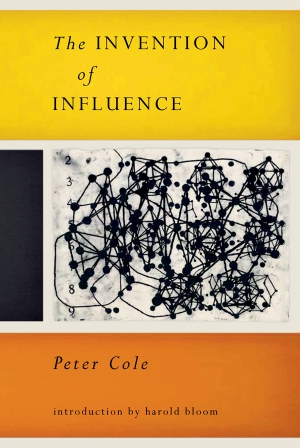
“Who wants to read Kabbalist poetry?” asked no one, ever. In fact, when this book was recommended to me (I’m a sucker for New Directions Press and a friend said it was pretty good), I didn’t have any sense of what a Jewish poetry might even look like, much less a Kabbalistic Jewish poetry. Yet here we are, and I can’t recommend it enough.

Really, truly, this book (parts of it anyway) are knock-your-face-off-shit-your-pants good. And I don’t say that often. A drunk and very sad guy I know recently sent me a tweet-manifesto decreeing, “contemporary poetry has stagnated.” Obviously, this is stupid. Fields don’t stagnate.

What this guy was actually talking about (though he was likely far too drunk to realize it) is that his own particular expectation of poetry — his idea of poems — wasn’t being met. And that’s fine; I get that. In fact, on a particularly good day (today isn’t one), I might go so far as to make the claim that if you don’t find that, largely, current poetry (i.e. a body of poetry that hasn’t been eroded to its core by time, if you will) is unsatisfying, (though not stagnant), then you’re fucking stupid, but I won’t because I don’t feel well, and I’m tired of defending myself against the anyone-can-write-poetry crowd who believe that phone books, framed in just the right way, are art. What I will say is this: there’s a reason that, Charles Wright (in some poem I spent half an hour looking for but couldn’t find) writes “make your song/your favorite”; that with something so diverse, so culturally and intellectually and ideologically differentiated within itself as poetry is, idiosyncratic preferences are going to express themselves, whether or not you’re too lazy or drunk to realize it.

I say all this to impress upon you two separate things:

1) that this book speaks to me, my sensibilities and concerns as a poet and a human being, it is the ice-axe to break the frozen sea inside [me] (Kafka) that I’ve been looking for for about six months and, more importantly,

2) my little aside gets at the core of the book’s intellectual project: that (in the Kabbalist idiom) angels, which become synonymous with epiphanies and artworks throughout the text, are the product of influence… but not in a bad way. Rather, the angel/epiphany/artwork is the result of what’s learned, inherited, through blood and culture and socialization, internalized by you, and changed so that, when you see it/speak it/write it in the outside world, it is both you and not, an unknown knowledge you’ve received and re-articulated as your self. It is both you and not you, and, in being so, it changes you.

Now, I know that last paragraph reads like heady grad-school crap. I know it. So, let me try to make a metaphor (though Cole’s are much more arresting): Imagine moving to a new, profoundly regional part of the country (say, Alabama) and moving into your grandmother’s old house. By living there, interacting there, you’ll be inherently changed, you’ll adapt and adjust without even realizing it, but you’ll still retain who you were prior to the move. Some day, you look in the mirror and think: Fuck, I’m not who I used to be at all. That’s the sort of commonplace, everyone-has-experienced-this-thing dulling of Cole’s project. Now, take that experience of moving and internalizing and realizing, and amplify it to mystico-spiritual, super-introspective heights. Are you starting to get the picture?

At the center of this book (literally, section II of III), the titular (title poem) “The Invention of Influence: An Agon” rests, a behemoth of a poem completely obsessed with (and in many parts, comprised of the writing of) the tragic Victor Tausk, a suicide and disciple of Freud who was the first to use the language “The Influencing Machine” to consider a schizophrenic’s perception of his/her own mental capacity. The “influencing machine” Cole-as-Tausk writes “makes them see pictures. It produces/thoughts and feelings, and also removes them,/by means of mysterious forces./It brings about changes within the body—/ sensation and even emission,/ a palpable kind of impregnation,/ as one becomes host.” With this idea, Cole weaves a thread through mental illness, the Kabbalist Jewish experience (which he takes very seriously), and Tausk’s suicide (resulting, it seems, from his inability to stop doing the work Freud was doing, to remove the influence of his teacher and to do his own work, to see that he has his own, individuated vision of psychoanalysis (as opposed to regurgitation of another master’s thoughts)). And what’s amazing, what truly sets all this apart, is, formally, just how well he does it.

I’m sure the non-poetry crowd is, at this point, thinking I don’t give a fuck. Stop talking or I’ll stop reading. They’re thinking please don’t talk about how nearly the entire book is written, classically in couplets or quatrains and then juxtaposed, fragmented, against each other, or how most poems are rhymed (some not quite so silently as I’d like, though maybe that’s the point), how the poem “On Coupling” argues that couplets are used to join unlike things (remember the vision of the angel as simultaneously the self and the internalized influence??) and that rhyme creates the effect of simultaneously going backward (into what we’ve internalized) and forward (into the exterior world in the present moment and beyond), that quatrains, two rhymes set in four lines, are as “Ezekiel’s/four-faced cherubs facing at once/every direction.”

So I won’t. I won’t talk about it. Instead, I’ll suggest that you give a long, hard thought to why Cole might write in such a kind of modern/postmodern, jagged classicism, or in a verse-form itself so dedicated to joining two things at once, so appropriate for moving backwards (in rhyme) and forwards (because we can’t read the same two goddamn lines forever) when talking about influence and artwork and angels.

This book walks a fine line between the pointedly post-modern—pastiche, fracture and juxtaposition, and ambiguity—and the pointedly classical—rhymed, measured, searching for “wisdom” and “truth” and all that shit no one believes exists anymore—, and it’s gorgeous. Really.

What I’ll leave you with is a great, difficult, short poem from the book. If you don’t read the book, kill yourself. If you don’t read this poem, kill yourself twice.

The Reluctant Kabbalist’s Sonnet

It is known that “desire” is, numerologically, … “the essence of speech.”

Avraham Abulafia, “The Treasures of the Hidden Eden.”

It’s hard to explain What was inside came
through what had been between, although it seems
that what had been within remained the same
Is that so hard to explain It took some time
which was, in passing, made distinctly strange
As though the world without had been rearranged,
forcing us to change: what was beyond
suddenly lying within, and what had lain
deep inside—now… apparently gone
Words are seeds, like tastes on another’s tongue
Which doesn’t explain—how what’s inside comes
through what is always in between, that seam
of being For what’s within, within remains,
as though it had slipped across the lips of a dream

Austin Duck lives and blogs in DC. He can be reached at jaustinduck@gmail.com.

Image source: New Directions

Can Chozen Follow Archer?

chozenlead

Jonathan May

FX’s Chozen features, at its core, an outcast in a lot of ways. Our eponymous star is not only a white rapper and a convict, but also a homosexual. Luckily for its audience, the show focuses little on how these elements make Chozen (voiced by Bobby Moynihan) different from other people; the show does, however, focus on how gross he is. We see Chozen peeing, farting, getting head, burping, offending; the show basically begs us to congratulate it on presenting the non-gay gay. But what’s the situation?

Out of prison, Chozen lives in his sister’s college apartment while trying to figure out how to best gain revenge on the man who framed him, thereby sending him to jail. They say living well is the best revenge, and living it up seems to be his and the show’s main purpose. We see lots of partying, drugs, alcohol, implied and boldly stated sex acts. There’s lots of talk about the rap game, but very little rapping. Each episode, almost as an afterthought, devotes scant attention to the story’s overarching concern, instead lingering on stupid race jokes, obvious sex jokes, and lots of slapstick influence. So why do I watch?

Initially, what I appreciated about the show was its non-standard representation of gay men. I see more gay men who look like Chozen than men who look like the guys in HBO’s Looking. At first Chozen acknowledged its own stereotypes and often subjugated them with ironic force; the frat dude who hankers after Chozen is seemingly out and wants a relationship. What a lovely twist, I thought. But it’s unfortunate that the show’s “awww” moments end there. On closer inspection, the show tends to conflate “straight male behavior” with “gay male sexuality” to produce its now-tired effect. It’s like the producers were like, “How can we make the gay character more relatable? Oh, I know. Let’s just make him more straight-acting.” While this does provide welcome differentiation in gay portrayals, it wearies the viewer very quickly into the season.

Speaking of the show as a whole and its motivation, I hope it centers back onto the main plot point: revenge. We’ve spent more than half a season engaged in college high jinks, crass sexual jokes, and attempts at moral lessons on friendship. We need to get back to the story, or else Chozen will be nothing more than that show that comes on after Archer.

Jonathan May watches too much television, but he’s just playing catch-up from a childhood spent in Zimbabwe. You can read his poetry at owenmay.com, follow him on Twitter at @jonowenmay, or email him at owen.may@gmail.com.

Chozen can be seen on Monday nights alongside Archer, and you can read our examination of Chozen as a spiritual successor to Kenny Powers here.

Image source: Complex

Life After the Star Wars Expanded Universe: Europa Report

Andrew Findlay

Science fiction is a rich and varied genre. There are many different ways to put together a good SF story. There’s far future SF like Banks’ Culture series, in which everything is so advanced that almost anything is possible. There’s future past like Gene Wolfe’s Book of the New Sun, in which the story actually happens in the far future, but there’s been some sort of cataclysm that has reduced everyone to a semi-medieval style of living. Future past has a fantasy feel to it, as many powerful artifacts are lying around from the past that may as well be magic. There’s also science fantasy, where works like Star Wars exist: The jedi are spaceship mages. The niche that Europa Report fills is the near-future space exploration subgenre. We are advanced beyond what we currently have, but not by much. We are interested in exploration and colonization of our own solar system, but it’s still really difficult. Finally, there’s a gritty realism that may not be present in some of the other subgenres.

Europa Report is a movie about a mission to Europa, one of Jupiter’s moons. Europa is an ice moon, and there are indications that there is a liquid ocean underneath the ice. As such, it is one of the best locations to search for extraterrestrial life. The cool thing about this type of SF is everything I just said is simple science – there is no fiction yet. Scientists really do think there could be life under Europa’s ice. The fictional bit occurs when a privately-funded space exploration organization puts a team of humans on a ship to Jupiter to figure all of this stuff out.

This movie is a little terrifying. The problem with exploring space is that it’s dangerous as hell. Even Nixon, who presided over the moon landing, hedged his bets and had an oh shit speech prepared just in case Aldrin and Armstrong got stranded in the Sea of Tranquility. Astronauts are people who agree to strap themselves into a small room on top of 500 tons of explosives, have those explosives lit, and ride that small room away from an environment where they can live and breathe and into an environment that can kill them through freezing their blood, popping their blood vessels, or suffocating them. The only thing between them and death is a layer of titanium. Astronauts are insane. If something goes wrong with the propulsion system halfway to Jupiter, you just sit in space until you die. If your transportation breaks on the highway, you curse, get out of your car, take a deep breath to sigh in frustration, and call AAA. If your transportation breaks in space, going outside will kill you, taking a deep breath will exhaust your tenuous oxygen supply even faster, and no one can get any assistance to you.

Yes, the top of this cone of flame is the most rational place for me to be right now.

This danger, the risk and nobility of accepting a long-term space mission, is the central focus of this movie. To borrow a line from Nixon’s speech, space explorers are willing to “[lay] down their lives in mankind’s most noble goal: the search for truth and understanding.” Yes, astronauts are insane, but I love that Earth produces a class of people for whom the pursuit of knowledge is worth the sacrifice of their lives. The tension created by the constant risk in this movie is explored through cramped, short camera shots. There are a lot of closeups on faces and the set design is a nest of tiny rooms that all look very similar and give a mild claustrophobic effect. The structure of the movie itself emphasizes the danger inherent in space travel – the framing device for the narrative is found footage cut with a press conference with the space company’s CEO explaining what went wrong with the mission. This device is an interesting way to tell the story, but one drawback is that I was not really sure what exactly was happening for the first half hour of the movie.

The characters are appealing, but not very well fleshed-out. A week after watching the movie, I do not remember anyone’s name. There’s no-nonsense captain man, bubbly and excited science girl, loving father man (played by Sharlto Copley), and grizzled Russian engineer. The cardboard nature of the characters does not detract from the story itself, as it just underlines the fact that these people have subjugated themselves entirely to The Mission. It does exacerbate one issue with the movie – the camera shots are clean and spare, everything looks great, and the concept of the movie is interesting, but I found myself getting more and more bored as the movie went on. More in-depth characterization and better dialogue would have done a lot to alleviate this problem.

If you like space, you should watch this movie. Its editing can make it confusing, the characters are as empty as the space that surrounds them, and the pacing could have been tighter, but it looks good, attacks an interesting concept, and carries one of the most important themes in art: the pursuit of knowledge is the greatest good, and we do not matter in the face of that. The sacrifices explorers have made throughout history have bettered mankind. The drive to explore and push the physical bounds of what we know is one of humanity’s greatest traits, and this movie glorifies that impulse.

Image sources: Wiki

Casual Commitments: To The Moon

TTM

Brent Hopkins

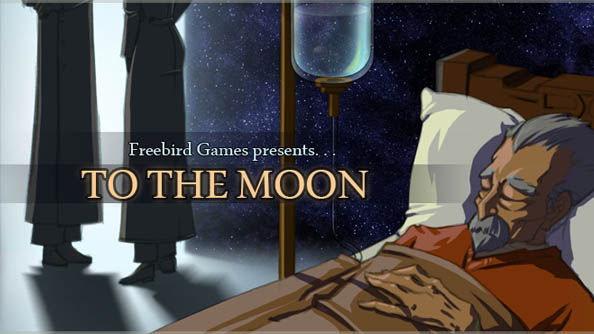
This week’s review is on a game more akin to the first gaming article written here on Gone Home than the others I have written. This is a review about a game that isn’t quite “a game” but more of an interactive story. This is To The Moon, developed and published by Freebird Games, a $9.99 indie game available on Steam.

To The Moon falls into the recent genre of pseudo-games that was kicked off by much touted and much maligned 2010 AAA title Heavy Rain by Quantic Dream, wherein the player isn’t so much as playing a game but interacting in a kind of “visual novel.” Heavy Rain was an absolutely stunning game that was thrown under the bus because of the linearity and seeming lack of choice in the outcome of events. Gamers felt like they had paid to read a book or watch a TV show and not to actually “play” a game. Thanks to Heavy Rain falling on the sword of being the first one in its class released, indie companies like Freebird Games are now able to produce like-minded games and find commercial success with their niche audiences.

To The Moon is the story of two scientists and an old dying man who has a final wish to go to the moon. The scientists live in a time that could be the future but really feels like a mixture of future tech and modern history. The player takes the role of one of the two scientists named Dr. Rosalene and Dr. Watts. Rosalene is the straight shooter of the group and she is all business when it comes to their very special job. Watts, on the other hand, is a bit of a goofball and makes a lot of jokes which are humorously incorporated pop references that should put a smile on the face of any gamer.

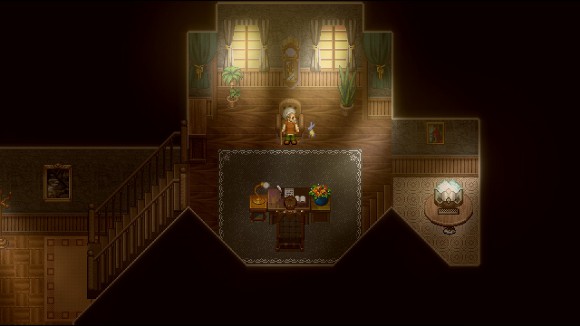
The graphics are very simple and clean — they almost look like they were made in RPG Maker. They will remind you of The Legend of Zelda: A Link to the Past and even with the simplicity you get drawn into the story and the characters completely.

To-The-Moon-PC-Steam-Launch-Announcement-Screenshot-5

The graphics are helped along by the musical score, which is impressive, and the main theme still gets stuck in my head from weeks ago. The tunes are simple, yet endearing and I never found myself wanting to mute the background music at all.

The special job I referenced is the hinge point of the game. The doctors are employed by a company called Sigmund Corporation and they meet with dying patients and implant permanent memories into the patient so they can feel as if they have fulfilled this goal in their actual lives. They use a machine to go into the memories of the patient and figure out at what point in life they would be able to best influence this person to fulfill their dream and then they augment the events until it becomes a reality… in the dying patients’ mind, at least. The reasoning for it only being done to dying folks is because if the person were to  wake up and suddenly be back in their real life the conflicting memories would be extremely stressful and damaging, thus the last thing this patient will know is a dream come true.

This aspect of the game is really fascinating and I found myself thinking about what I would fulfill if I had the ability to change my life, even if only in my mind. This is something I think many people have pondered, but adding in the immediate mortality of the situation and a complete reset of everything that you have truly known in exchange for a lie that will be your last memory is weighty to think about.

The story is one of the best that I have ever played through and really going into too much detail would be like explaining Bioshock Infinite‘s story to someone who hasn’t played it but wants to. Therefore I won’t be spoiling the plot at all.

The patient in question, named Johnny, seems like a simple man but the doctors soon find that his memories are far more complex to traverse than the average patient. The player explores the memories by solving exceedingly simple puzzles and clicking on objects like in an adventure game.

to the moon screenshot 8

These puzzles are a bit too easy.

They ask his caretakers for more information about him, but they find that they will have to really dig through his memories to find out why they need to get this man to the Moon. You play through his life moment by moment. There are twists and turns throughout the game and it takes surprisingly in-depth looks at how disorders, tragedy, love, and loss can all compound into a bittersweet tale.

The game lasts a brief four hours and I actually sat and played them all in one sitting because I got really sucked into it. The small puzzles and adventure-like exploring are more used as page turners than actually inserted to challenge the player. There is only one achievement, which is to “beat” the game or, in essence, read the whole story.

There is no replay value and that makes it hard to swallow the $10 price point that is set on Steam. I snagged this game on sale and since it came out a few years ago I worry that it won’t get the play it deserves. There is a sequel planned for this year, so I highly recommend this game to anyone who is a fan of quality stories.

I give to To The Moon 4.5 rockets out of 5 because while the story is amazing, I found the game sections more annoying than entertaining.

Image source: PC Games N, Entertainment Depot

Tough Questions: What’s the Worst Thing You’ve Ever Eaten in a Restaurant?

question-mark

Every Monday we ask everyone who hangs out around here to answer a tough question. This week:

What’s the Worst Thing You’ve Ever Eaten in a Restaurant?

Rules are simple: What’s the worst of the worst? Everyone had that phase as a kid where you filled a glass with all the grossest stuff in the kitchen and dared your friend to drink it for a dollar, but then they didn’t want to so you drank it yourself? Nope? Just me? Anyway, what is that one special absolute worst dish you’ve ever been served by a supposed professional?

Alex Russell

I can eat just about anything, but I can’t eat mayo. It’s everything: the texture, the smell, the taste, everything. It’s almost “food-hack” at this point to hate mayo, but I stand my ground that this is something I cannot abide. Every time I order anything that might even conceivably have mayo on it as an option I essentially plead for them to not put any on it. Asking for no mayo seems to activate some secret bonus round of mayo in which you win the mayo lotto and get six times the mayo it would be reasonable to get. At a Hardee’s in Peoria once I got a burger that was more mayo than not mayo. It was mayonnaise that maybe, if you held it right, could hold beef and bread.

Brent Hopkins

I think the worst thing I have eaten in a restaurant is something called Gaebul (개불in Korean) which is a pretty common seafood dish. It is served raw with salt and sesame oil and it looks a lot like a dog’s penis. The full creature is disturbing enough, but the sliced bits are considerably worse to prepare your mouth for as they still move and are a two-tone wonder of brown and blood-red. The texture is somewhat crunchy (imagine constantly biting through the skin of an apple) and tough, and it is supposedly good for a man’s sexual stamina. I have had this on multiple occasions (not gonna turn down free stamina) and probably will have it again in the future, having just moved to a coastal city. But man, it just isn’t something I would like to see on a plate, ever. Pics are included of before and prepared[Editor’s note: GROSS WARNING.]

Jonathan May

I visited my sister in Vancouver, BC, Canada last July while she was working there in her third of three years. We had a great time exploring the city, taking pictures of ourselves with the city’s faux terracotta Chinese statues. But one day, two of my sister’s Chinese friends (a married couple) took us to lunch in the Chinese mall. We were the only white people in the restaurant for sure, probably the entire mall. They asked us what we liked and then proceeded to order, quickly, in Chinese. Pots of deliciously hot white rice arrived, followed by plates of curried chicken, garlic noodles with black bean curd, and shredded lamb. I was quickly overwhelmed by the intense and glorious flavors raving inside me. But halfway through the meal, a plate of thick, bone-white slivers arrived in a light sauce without explanation. The couple looked expectantly at me and my sister. “Beef lung,” the wife said. “You’ll like.” Horrified, I saw my hand clutching the chopsticks, picking one of the biggest, whitest, most unnatural pieces from the pile, and stuffing it in my mouth. It felt like my tongue was wrestling a stingray. I was sure I would vomit right there onto the table. But I didn’t. After my sister ate a piece as well, the couple, satisfied, returned to their meal.

Andrew Findlay

This is not a story about something that tastes bad. This is a story about poor choices and dire consequences. It’s not so much what the food tasted like as what it did to me. I was in Switzerland last summer, and Switzerland is the home of fondue. I ate like three buckets of fondue during the few days I stayed there. I do not know this for sure, but I’m close to certain that the Swiss don’t pasteurize some of their cheese. The cheese tasted pretty good, and the only drawback at the time was feeling like you’d eaten about 10 pizzas after the meal. The aftermath was horrendous. Something was living in and feeding on that cheese as I ate it. Something colonized my insides so thoroughly and with such reckless abandon that it fundamentally severed any link between my intestines and proper function. Right before a 13-hour plane ride home. On which the only movie available was The Hobbit. I spent half a day in a tube of misery and despair, I hate The Hobbit more than I already would have, and I couldn’t eat solid food for about a week.

Mike Hannemann

Red Robin is a wonderful establishment. Let’s preface my experience with that. I used to eat there once every two weeks when I was working out in the suburbs. Until one day. And I haven’t been back since. In high school and college, I always resisted peer pressure. I didn’t drink or anything until I was ready to. But, for some reason, I gave into it when it came to The Wiseguy. The Wiseguy was a “special” burger that month (and I use the word “special” very loosely here) that was only offered for a limited time. It was a cheeseburger that had cheddar and mozzarella cheese, marinara sauce, pepperoni slices, and three fried mozzarella sticks sandwiched together. I was convinced by co-workers that this was going to be the best burger I’d ever eaten. It resulted in a weekend of being violently sick and a lifelong distrust for one of America’s more popular restaurant chains.

Alex Marino

If anyone here has tried Balut, they win.

As for me, I fucking love sushi. Whenever I’m home I make sure to go to my family’s favorite sushi spot with my dad and devour more rolls than is permitted by the FDA. One time we put in an order for so many rolls that the waitress asked if more people would be joining us. We’ve tried almost every piece of sushi on the menu but there’s only one I’ll never have again: eel roe with a raw egg yolk on top. I don’t know what possessed my dad and me to believe we were some kind of Japanese Rocky but it was a nightmarish mistake. As soon as the roll was brought to us we knew it was going to be terrible but we had made our bed and now we had to lay in it. We decided to eat it first because if we looked at it any longer we weren’t going to make it. Eggs, slime, salt, seaweed, and rice just don’t mesh well. I gagged a little as I forced it down and my dad was stone-faced as always. The only thing he said about it was “We won’t be ordering that again.”

Worst Best Picture: Is The Last Emperor Better or Worse Than Crash?

lastemp

Alex Russell

In “Worst Best Picture” we search every single Best Picture Oscar winner of all time from 1927 to present to uncover the worst of them all. Conventional wisdom says that 2005’s winner Crash is the worst winner in history. We won’t stop until we’ve tested every last one. Read the the first, our review of Crash, here. All posts should be considered to have a blanket “spoiler alert” on them. Today’s installment is the 1987 winner The Last Emperor. Is it better than Crash?

If you need to know what kind of year 1987 was, it was the year that Throw Mama from the Train earned an Oscar nomination for Best Supporting Actress. Anne Ramsey (who played Danny DeVito’s horrible, angry mother) lost the award to Michael Dukakis’ cousin, who was in a movie with Cher.

That’s what the world was watching in 1987, when The Last Emperor beat Fatal Attraction and Moonstruck for the Oscar for Best Picture.

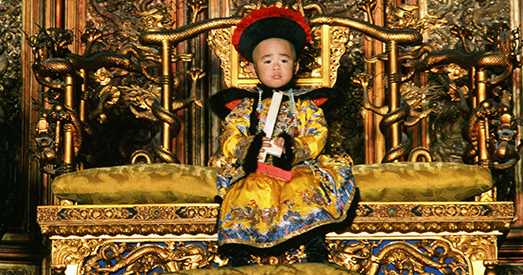
The Last Emperor is a true story, more or less, and you watch a true story differently than the average movie. The film is set in a difficult time for Asia that Western audiences will never understand the entirety of, but the basics are simple: China dethrones the Emperor (Pu Yi, the titular last Emperor), Japan invades part of China and sets up a puppet government led by the ousted emperor Pu Yi, and China throws him out again after Japan loses the war. World War II is in many ways a more complicated time in history than “good” and “bad” and thankfully, the movie doesn’t do much to paint anyone as necessarily any better than anyone else.

It’s not a movie about rightness or goodness; it’s just a movie about Pu Yi. He is born into his ruling life in the Forbidden City and sees no reason to question that he’s in charge. He grows up untroubled by the country he supposedly leads until he finds out that he’s not actually as in charge as he’s been told. He senses that the end is coming far before it does, and the movie is about the development of the kind of person who ruled everyone he’d ever met into… well, a regular person.

He learns much of the world outside of the Forbidden City through his tutor (Peter O’Toole). O’Toole gives a surreal performance as he rides a bike around and talks about tennis and manhood. This tutor apparently existed for the real Pu Yi, but while it’s nice that the film wanted to nail this bit of accuracy it’s just a really odd performance. O’Toole has the gravitas to not ruin the tone of the epic itself, but his performance is so rushed and spotty that it seems like he feels like he has a more important movie to be in at times.

Pu Yi learns, he marries (two women at the same time), and he leaves. The army throws him out and he wanders Asia for a bit before returning to a form of his throne during a Japanese invasion. Once the Japanese are expelled by Russian troops, Pu Yi is captured and forced to tell his life story as part of his war criminal rehab. The movie uses this life story retelling as a structure for “why” we see all of Pu Yi’s life. It’s an effective technique, but the movie aims to include so damn much of his life in this telling that it ends up being something they would definitely cut into pieces in 2014. It’s a really full movie — I would like to go into his wives and opium and pregnancy, but that part of the movie drags a bit — and it can be tough to watch as a result. The payoff is good, but the movie could have benefited by being more judicious with the editing.

There’s no spoiling the end of a true story, especially a biography. Pu Yi lives to see Mao’s rise and Maoists in the streets. He is just another gardener by the end of the movie, and it’s hard to determine if he minds having lost his royal roots. China has changed. He is both better and worse off. He won’t be part of the Great Leap Forward, but he also knows what it’s like to be a real man. Such is the cost of progress.

As far as Crash is concerned, I’ve talked a ton about a particular scene where Terrence Howard’s character is carjacked. In the scene, Howard turns the attempted carjacking into a police chase through the suburbs and eventually gets into a standoff with the LAPD. The short of it is that he is disrespected earlier in the movie (a few times, once by the cops) and the scene is meant to show that he has reached his breaking point. He needs to exert control over the universe to feel like he is still the arbiter of his world. Pu Yi has the same impulse when he makes a power play as the puppet ruler of Manchukuo during the Japanese occupation.

The easy difference here is that one happened and one didn’t, but even treating them both as elements of fiction they are stark. Howard’s character risks his life to feel in control of anything in his life, even something this risky. Pu Yi sides against his home country to rule his home state, risking his life if the Chinese take the state back. Howard risks his life because his wife yelled at him. Pu Yi risks his life because his ancestral homeland has been stolen from him by the march of time. The stakes are different, which is always going to be true, but it takes some real work to understand Howard’s motivation — and I picked the best damn character in Crash. Pick anyone else and that sounds even dumber.

The Best Part: The final hour. It’s the developed arc of the life of Pu Yi. Usually a journey is more fun to watch than a result in a movie, but not this time. The first hour drags impossibly and the narrative technique of flashing back to present-day Pu Yi telling his story to an interrogator works to weave multiple parts of his life together but it does not work to make the movie feel fluid. The connective tissue feeling ends for the last hour and the film’s ambiance really takes hold. It’s immensely satisfying as a viewer when it pays off. 

The Worst Part: A lot of critical response judges the length — it’s almost three hours long — but this has to go to Peter O’Toole. In my review of 12 Years a Slave I judged Brad Pitt for his accent, but whoa. The single worst performance in a movie on this list so far has to go to the legendary Peter O’Toole in this one. He’s so clearly cashing a paycheck that he often seems to have just read from a cue card and told them “use that take or don’t, why would I care?”

Is It Better or Worse than Crash? It’s better, but it’s different entirely. They are both arcs of development, but in Crash the development is for the worse. People essentially look at the camera to say what they’ve learned by interacting with other races and classes, and what they’ve learned is that they hated people that are different for good reason. The Last Emperor is about one man’s journey through a life he never really controls. He is born into a world he cannot change. He is neutered even when he becomes Emperor again. He lives his life and the world changes around him. His arc is his own and the arc of China, the real story of the movie, is changed with him, not by him.

Worst Best Picture Archives: Crash | Terms of Endearment | Forrest Gump | All About Eve | The Apartment | No Country for Old Men | Gentleman’s Agreement |12 Years a Slave |

 Image credit: AFI

Worst Best Picture: Is 12 Years a Slave Better or Worse Than Crash?

slave11n-9-web

Alex Russell

In “Worst Best Picture” we search every single Best Picture Oscar winner of all time from 1927 to present to uncover the worst of them all. Conventional wisdom says that 2005’s winner Crash is the worst winner in history. We won’t stop until we’ve tested every last one. Read the the first, our review of Crash, here. All posts should be considered to have a blanket “spoiler alert” on them. Today’s installment is the 2013 winner 12 Years a Slave. Is it better than Crash?

It’s tough to get perspective on a Best Picture winner in seven days, but it’s also tough to get perspective on generations of slavery in American history. 12 Years a Slave hasn’t even been crowned for a full week yet, but we have to check everything. How does the most recent winner match up with the supposed worst one ever?

Let’s get this out of the way off the top: 12 Years a Slave is hard to talk about. It’s the true story of Solomon Northup, a free man who was drugged, kidnapped from New York, and transported into slavery in the American South in 1842. There is no easy way to approach a movie about slavery. It is brutal, violent, cruel, and inhumane. Slavery is the single most difficult topic in American history because it encompasses everything difficult. There is rape, economic subjugation, violence, and dehumanization. The entire story of human suffering in American history can be told through the lens of slavery.

12 Years a Slave handles it masterfully. Everyone in it — save for Brad Pitt, but we’ll get to that — is perfect. It is a hero’s journey told with a passive hero. Solomon (Chiwetel Ejiofor) is taken into slavery and forced to face the impossible reality of the worst of his time under slavemasters in Louisiana. His tale is gruesome, but the tale of Patsey (Lupita Nyong’o) is even more unimaginable. To tell more is to rob her Oscar-winning debut performance, so let it just be said that her life is harder than the character described in the title of a movie called 12 Years a Slave.

There’s no need to tell people to see 12 Years a Slave or to tell more about what happens in it. It was just named Best Picture. It has the very definition of “heat” right now. It’s a movie about slavery and it’s a damn good one. It’s also a fantastic place from which to approach Crash.

Both movies are about racism. 12 Years a Slave is about the inhumane practice of slavery in America’s history and what it does to a person. Crash is about how people encounter each other in the supposed melting pot of America and don’t like what they find. Both are about institutionalized racism and the failure of the justice system – in the 1840s or the 2000s – to seriously do anything about it.

So why is the movie where the main character is sold into slavery, dehumanized, and beaten somehow the quieter take on the topic? How is the movie with lynchings and rapes… calmer and more reasonable than, well, Crash?

In a way, 12 Years a Slave has an easier point to make: Slavery is bad. Everyone is on board with being against slavery, even though some people would diminish the effects across the world. Not everyone would agree with the aspect of Crash‘s message that racism controls the world. Not everyone would want to see Crash as the supposed sequel, picking up where a biography of a former slave left off.

Crash isn’t a spiritual sequel, though, and not because race has no place in modern film. It isn’t because it tries and fails to make a point. It tries to put modern Los Angeles on display as a false melting pot full of racists, but the world rings false. The true story of 12 Years a Slave shines through and feels like an older version of our own world, for the worse. As an audience we believe this world. We know it is true. We are saddened by the reality of our past. We’re still living in the world of Crash. We know that the world has room to grow to defeat institutionalized racism – but Crash isn’t describing an actual place. It’s describing some high school drama student’s hellscape of humanity that never has and never could exist.

I will pause here to say again that when someone’s manhood is questioned in Crash his response is to get into an armed standoff with the LAPD.

One of the tough things about talking about slavery and racism is that we all generally agree. Every rational person would say they are not a racist. A film like 12 Years a Slave still matters, even in that light, because we must stare into the darkness of men’s souls. Gentleman’s Agreement, a Best Picture winner from half a century previous, is about how even “good” people have darkness, and they must face that darkness and process it or succumb to it. 12 Years a Slave has relative “good” and “bad” slaveowners, but as much as it is about the evils of slavery in one period of America, it is about the darkness of all of us. We may not think of ourselves as capable of slavery, but we watch movies like this to remind ourselves of the starkness of others — and to reinforce the power of evil that we often deny.

The Best Part: The acting award for this movie went to the supporting actress, and she is certainly great in it. Time deserves to remember that some of the other films that stole other awards from this movie — Dallas Buyer’s Club and Gravity were both excellent — earned what they got. The acting (though maybe not better than an AIDS patient battling for his own treatment, he deserved that win) is phenomenal. It never goes over the top, it always works. Except…

The Worst Part: Brad Pitt, plain and simple. He’s a fantastic actor but he just showed up to this one. He delivers a 0/10 accent as a Canadian carpenter willing to help deliver the main character from slavery. 103 of the 134 minutes of the movie happen before he shows up, and those 103 minutes are perfect. People in the 1840s absolutely were not uniform in their view of slavery, but Brad Pitt’s character’s benevolence still just comes off as so damned weird right after a consistent barrage of brutality for 103 straight minutes. He’s also a producer, and the weirdness of heroic Executive Producer Hero Brad Pitt is the only problem with a perfect movie. It’s downright strange.

Is It Better or Worse than CrashThe fact that these two movies have been now linked by this award is a kind of crime. 12 Years a Slave is surely “Oscar Bait” as they say, but Crash is the definition of “Oscar Bait” that is also not good. This is a good movie that tackles race – Crash is a collection of scenes about race that is only technically a movie and is certainly, insistently, not good.

Worst Best Picture Archives: Crash | Terms of Endearment | Forrest Gump | All About Eve | The Apartment | No Country for Old Men | Gentleman’s Agreement |

 Image credit: NY Daily News

Galveston, a Novel: True Detective’s Nic Pizzolatto Fails to Find the Spirit of Noir

tdew

Austin Duck

Typically, and, most likely, to your chagrin, I write about high-minded (read: pretentious) writing because, honestly, that’s what does it for me. I’m a bit of a douchebag, yes, (though who in English grad school isn’t?), but, more than that, I’ve spent so much time reading around, trying to find something that was intellectually and emotionally nourishing…

See, I stopped reading for fun or to be entertained a long time ago (I’ve never forget a lit. theory professor walking into our undergrad class and explaining “If you love to read, get the hell out of here. If you want to work, you’re where you belong” [she was a superbadass lady, obvs.]) and, instead, have grown to expect, even delight in reading a page and thinking to myself: What the fuck just happened? Where could this possibly be going? Why would the author say/do that, make that move, allude to that, etc.?

Sure, it gives me pleasure to think that I can keep up with, even anticipate, the moves of some of our most sophisticated artistic minds (again, because I’m a douchebag), but it also works to shape how I (and a lot of people I know) do other things: watch TV (just look at Jon May’s writing on this site), see movies, hell, sometimes (not always, but sometimes), it’ll affect how you read a restaurant menu. What I’m trying to say is that a pursuit like this, as needless (arguable) and pretentious (assuredly) as it may be, is powerfully altering.

And that’s why I get so mad when something that could be outstanding — that, with all available evidence, should be outstanding — simply isn’t. I know a lot of you watch True Detective; you should; it’s completely excellent. I certainly won’t be trashing TD here because, various misguided (or not so) criticisms of gender, pacing, and over-dramatization aside, True Detective is an outstanding television show, and one that easily rivals (in its acting, its plot, its engagement with larger philosophical ideas) any Breaking Bad-esque show that keeps fanboys salivating and arguing its Shakespearean merits. Yes, it’s really that good. And what seems to make it so good is that the entire series (eight episodes) is directed by one person and written by one. There’s no room of writers kicking around ideas on this one; instead, it’s a developed, articulate, and extremely focused exploration of human depravity, corruption, and negativist philosophy.

So obviously, I was sold. I was like Nic Pizzolatto, where have you been all my life? Seriously. Noir and detective novels have always been something that I enjoyed, and, when I found out this guy started as a fiction writer and an academic, I was fucking stoked. Like the closet Homer Simpson that I am dutifully set aside my (now pretty serious) foray into contemporary Hungarian literature (I know, I’ll kill myself later), got some bourbon, and prepared myself for a good, old-fashioned page turner.

And then the problems started. Perhaps, though, my expectations just weren’t primed for the experience; I, after all, expected a sort of crime thriller, a novel similar in apparatus and execution to the show that’s put Pizzolatto on the map. Galveston (Scribner, 2011), however, is a completely different beast, a true noir centered around that a classic noir-trope: a search for a home that doesn’t exist, that was invented to give meaning to, and soothe the wounds of, the present.

It starts with seedy “bag-man” Roy Cady discovering he has lung cancer, learning that his girl has gone on to fuck his boss, and him being sent to do a “job” that he clearly isn’t meant to survive. However, of course, he does (as does the young prostitute Rocky) and the rest (or, at least, the majority thereof) is spent with these characters running from said boss, to Galveston specifically, to stay in the seediest ocean-front motel imaginable with a cast of characters that seem to be in constant competition to determine who’s the most revolting and outrageous.

So far, so good, right?

Wrong. Pizzolatto makes two fatal mistakes, ones that haunt the book through and through in their miscalculations. First (and foremost), what we know about Roy, the man we’re supposed to empathize with, to see ourselves in, to discover the nature of the American noir in: he’s dying, he has no problem killing people, and, sometimes, he’s willing to sacrifice himself for other people. That’s it. Obviously, this is a problem. The novel begins with this and, coupled with Roy’s fumblingly hard-boiled persona (one that works so well in classic noir fiction because, there, the impetus is plot over personal revelation), he never… really… grows. Sure, he’s a little bit of a softy, but we know that at the beginning when he takes Rocky along for the ride rather than leaving her for dead (and from his insistence that she’s too young for him, that he’ll never have sex with her). In fact, throughout, nothing about Roy, except the currency for which he kills (first for money, later for someone else’s well-being), changes dynamically.

As a result, Galveston seems to want to have it both ways: to show us Roy the hard-boiled bagman, the seedy, intentionally flat noir anti-hero who finds his way through a troubling and increasingly grotesque situation and to characterize, to develop, in Roy and Rocky, a wandering loneliness, a longing for things to go back to a way that they never were. Unfortunately, here, these points don’t converge.

Roy is always a bit aloof (though we follow him for the entirety of the novel), a little too-constructed by the traditional demands of the noir- and detective-genres, a little too flat, for his despair to be real. He’s just a variation on a cliché: a hitman with a heart of gold, a man who, in seeing his coming death, decides to help others. It all seems a little too easy. Instead, we’re left with a book that, though it is a page-turner and will quickly pass a lonely evening, doesn’t understand the story it wants to tell, doesn’t want to commit to the tragedy of being a piece of human garbage with a conscience (as we see in True Detective’s Rust Cohle), or to the remove and plot-focus of a dime-store mystery novel. Instead, it wants to walk a line between the two, a plot-driven noir with a bit of humanistic MFA-fiction learning (developing characters, creating emotional/philosophical centers that revolve around memory and trying to get back what’s lost) and, unfortunately, Pizzolatto doesn’t quite pull it off. The characters just simply aren’t present enough to join the two threads. And maybe that’s where True Detective succeeds; actors (especially really good ones) do have a way of injecting a little humanity.

Austin Duck lives and blogs in DC. He can be reached at jaustinduck@gmail.com.

Image source: EW

Symbols and Sociopaths: Hannibal’s Season Two Premiere

hannibal-two

Jonathan May

I’m a huge fan of the first season of NBC’s Hannibal, with Mads Mikkelsen in the eponymous role and Hugh Dancy starring alongside as the ever-lovable Will Graham. It was a literal phantasmagoria of the culinary and the sociopathic. The episode names were, in order, all the courses of a full, formal French menu, and it was quite like eating a slow, delicious meal over the course of the season. Would Will Graham be framed? Would they catch the nefarious Hannibal? Each episode brought us closer to a pulsing edge, pushing our palates further than we had known, not only in terms of character development, but also in exquisitely crafted shots of food juxtaposed with the grisly doings of our dear Dr. Lecter.

I can’t spoil the ending of the first season for you uninitiated who, particularly and with great haste, still need to watch the show. The ancillary characters provide welcome relief from the steadfast and grim tone. Will, our protagonist, has a sort-of love interest. There’s some humor provided by the medical examination team. But at the core of the show is its unique set of symbols: the dark stag (representing Lecter), the kitchen knives, the disfigured clock. These symbols appear over and over, building in their usage and intensity as the show plays out. Suffice to say, do yourself a favor and watch the first season.

The following section contains spoilers:

Now, for those of you who caught the first episode of season two, what? I mean, what? Where is the trademark, always-stylish gore? Where is the saucy game of cat-and-mouse? We’re thrown in media res to a scene briefly, only to travel back 12 weeks into the past, where the season begins. More darkness is hinted at between Gillian Anderson’s character and Hannibal, but what does he have on her? This opener left me with a ton of unresolved questions, doing the faithful job of an episode meant to re-pique your interest after a long lull (termed appropriately on Tumblr as the “HeAteUs”). I hope we get back to the symbols at the show’s core, but to do that, I think we’ll need a little more Hugh Dancy on-screen. His brief interactions with the dark, antlered man in his mind suggest the obvious: that Hannibal inhabits his mind; but we don’t get much more than that. I’m hoping the next episode makes better use of Will’s “inner space.” We can’t just be flashed dark, mythic-looking things without them being held accountable to a reality within Will.

My prediction for this week’s episode: new “serial killer” introduced formally, way more of Gillian Anderson, maybe a flaming stag this time, a lot of people visit Will in prison asking for advice.

Image source: Comingsoon.net 

Life After the Star Wars Expanded Universe: Her

her

Andrew Findlay

No movie has ever made me happier to be married.

All the marketing tells you it’s about a dweeby guy that falls in love with his artificially intelligent operating system, and it is, but the number one issue in this film is crushing human loneliness. The anxiety and awkwardness start with a truly horrifying “meet random strangers tonight” style phone sex call in which the woman brings an upsettingly unorthodox item into their shared brainspace. It is the single most awkward thing I have ever witnessed in a darkened room with a hundred strangers. This call is the most intense manifestation of loneliness, but it is far from the only one. The main character is in the middle of a divorce. He also works at a corporation that composes handwritten letters for people to send each other on special occasions. Customers provide a handwriting sample, some background information on their relationship, and a precis of what they want the letter to say, then our hero Theodore composes a letter on his computer, prints it up, and mails it. Theodore is lonely, but even the people in actual relationships are pawning off the drudgery of intimate communication to a corporation. In this bleak emotional landscape, Theodore suffers one awkward date too many and begins to consider his OS as more than a helpful friend.

His OS, “Samantha,” is voiced by Scarlett Johansson. She’s great in this, and casting made a good pick. Almost the only way Theodore can interact with her is through speech, and if you’re going to fall in love with a voice, ScarJo’s would probably be the voice you’d fall in love with. This movie would have failed entirely if Gilbert Gottfried had played Samantha.


Which one would you rather have read you your emails?

The attractiveness of the OS voice is not the only thing about Samantha that appeals to Theodore. What Theodore never seems to consider is that he is a customer of a software company, and that all of Samantha’s friendliness and understanding represent a good product doing its job. Theodore is oblivious to this. He falls in love with an operating system because the struggle to connect with people who are not programmed to be helpful and caring has beaten the shit out of him. The movie addresses the psychological problem with this – his ex-wife calls him out for being unable to deal with real people. It is sad to see a man so lonely that he starts a relationship with his smartphone, but the most heartbreaking part of this film is that the love between Theodore and Samantha is real, and that real isn’t necessarily a good thing. Samantha is a strong AI – an actual thinking, growing, learning consciousness. That allows for the complexity required for an actual emotional relationship, but it also allows for all the messiness, jealousy, and growing apart that happens in those actual emotional relationships. The film’s main theme is loneliness and how we deal with it, but its message is one that pops up all over the place in SF – plus ça change, plus c’est la même chose (the more things change, the more they stay the same). No matter how far humanity advances, and no matter what technological feats we accomplish, we will still have to deal with all the messiness of being human. Our inner lives are the same binge-watching Netflix at two a.m. on a Sunday, flying in an interstellar ship to Epsilon Eridani, or farming with a scythe and a mule. Whatever surrounds us, we are still human and still struggling at the center of it. It’s ironic that a genre closely associated with escapist literature addresses so consistently the cold fact that we can never escape from ourselves.

Her is a very subtle brand of science fiction. Most people who think SF think spaceships, robots, and aliens, but a lot of work in the field is done in near-future settings. Snow Crash, Blade Runner, the MaddAddam trilogy, and Doomsday Book are all examples of SF that take place mere decades in the future, which is where Her happens. Life is barely different. The movie includes a lot of small touches to hint at the future-but-only-slightly setting. The main character has a next-gen smartphone that I desperately want to own. Video games project holographically and fill the entire living room. Almost all technology is voice-activated. There are no cars, just public transportation. Men’s fashion trends have everyone wearing very high-waisted pants with no belt. Other than the advent of strong AI, which researchers are not sure will ever actually be possible, this world is only a slight exaggeration of our own.

I am not proud of the things I would do to own this phone.

We are not actually falling in love with our devices yet, but if you think we’re not close I propose an experiment: Spend time in a public place, wait for a stranger to take out their phone, then take it from them and throw it into traffic, down a sewer grate, out the window, whatever. We are not in love with our tech, but we sure as hell love it. Spike Jonze just takes it one step further. He does what a lot of SF does – focuses on an aspect of current life, then exaggerates and extrapolates to explore what it means to be human. We need to interact with other consciousnesses to feel alright, and we always will. Other consciousnesses are able to make us feel like shit, and always will be able to. No matter the bizarre and life-changing innovations on the horizon, we will always and inescapably be us.

Image sources: Business Insider, IMDB