In our rarely-running kinda-series Should You See It? we talk about movies that just came out (or have “Rowdy” Roddy Piper in them). You can figure out the rest of the premise from the title of the series. That’s right: we talk recipes. Should you see Hell Comes to Frogtown?
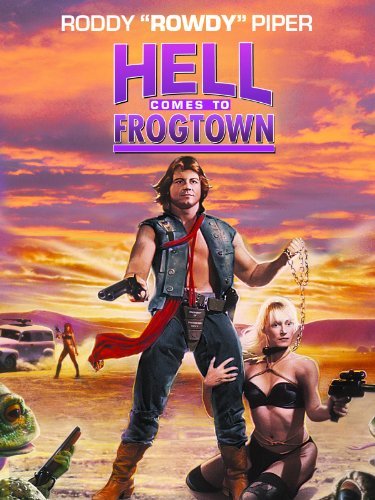
Hell Comes to Frogtown is a 1988 movie about the last man on earth. Or maybe the last sexually active man on earth. Or at the very least, the last sexually desirable man on earth, given that what you find desirable is a fat Mark Wahlberg lookalike with a glans penis haircut. Piecing together what the movie is about is a pointless task. Most of the lines are mumbled and I had been drinking. But from what Wikipedia can tell me, it’s the story of a group of female scientists who kidnap a man named Sam Hell, put him in an explosive chastity belt, and use him to rescue some prostitutes from Frogtown (more on Frogtown in a bit). The movie is to Mad Max as Krull is to Star Wars. It’s one of those beautifully bad 80s clones that’s lovable for its earnestness (i.e. it’s sincere like The Room rather than purposefully campy like Sharknado).
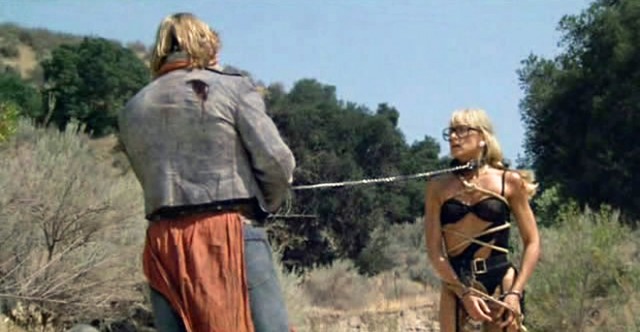
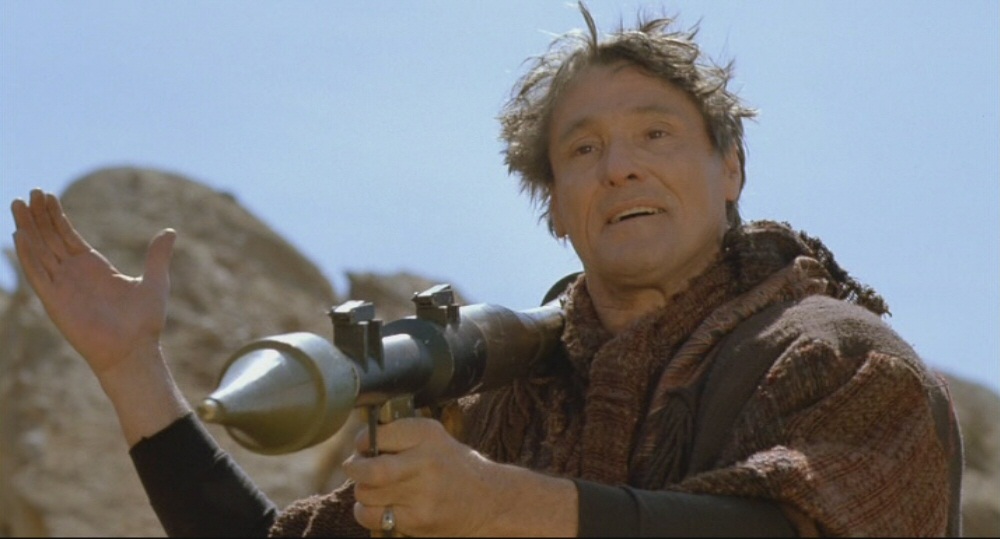
One reason to watch Hell Comes to Frogtown is that it’s like a time capsule for what was considered funny in 1988. Rape, for instance. Lots of rape and misogyny. You’re not going to believe me but the following still is from a scene that’s meant to be funny.
Oh, I get it! She’s like a slave but for sex! Zing!
I’m not saying that people don’t still make rape jokes, but how about this: in another scene, our heroes catch a female savage, give her a libido-boosting shot, and then Sam Hell rapes her. But, you know, in what is supposedly a “light-hearted way.” So light-hearted that the next morning the two are seen cuddling. Then the savage hugs and thanks Sam and we never see her again. She’s a plot device in the worst possible sense: she has no function in the movie other than as that which is sexually liberated (against her will). (Editor’s note: uhhh… whoa.)
All this happens before the heroes even make it to Frogtown. What is Frogtown? Frogtown is where the frogs live. Because of an Apocalyptic Scenario, frogs are now human-sized, speak English, and sometimes have three penises. The scenes in Frogtown are so sexually frustrated no one would be surprised if the writers all have frog fetishes.
No, please don’t. You’re so far out of my league.
There are details I could go into, but that would be a one-way ticket to Spoilertown. And trust me, you want to visit Frogtown firsthand.
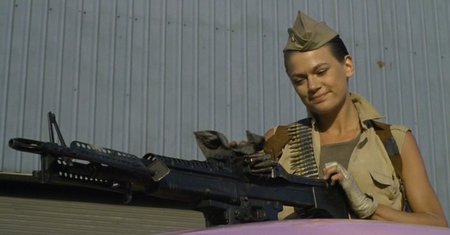
The plot holes in Hell Comes to Frogtown are Mexican sinkhole-sized. Why does Sam Hell need to go with them to Frogtown to save the women when they have this girl who just sits in the car and polishes her guns?
Why do characters inexplicably change outfits from one scene to the next?
Why would the scientists strap Sam in an explosive chastity belt when his dick is the only thing of importance to them?
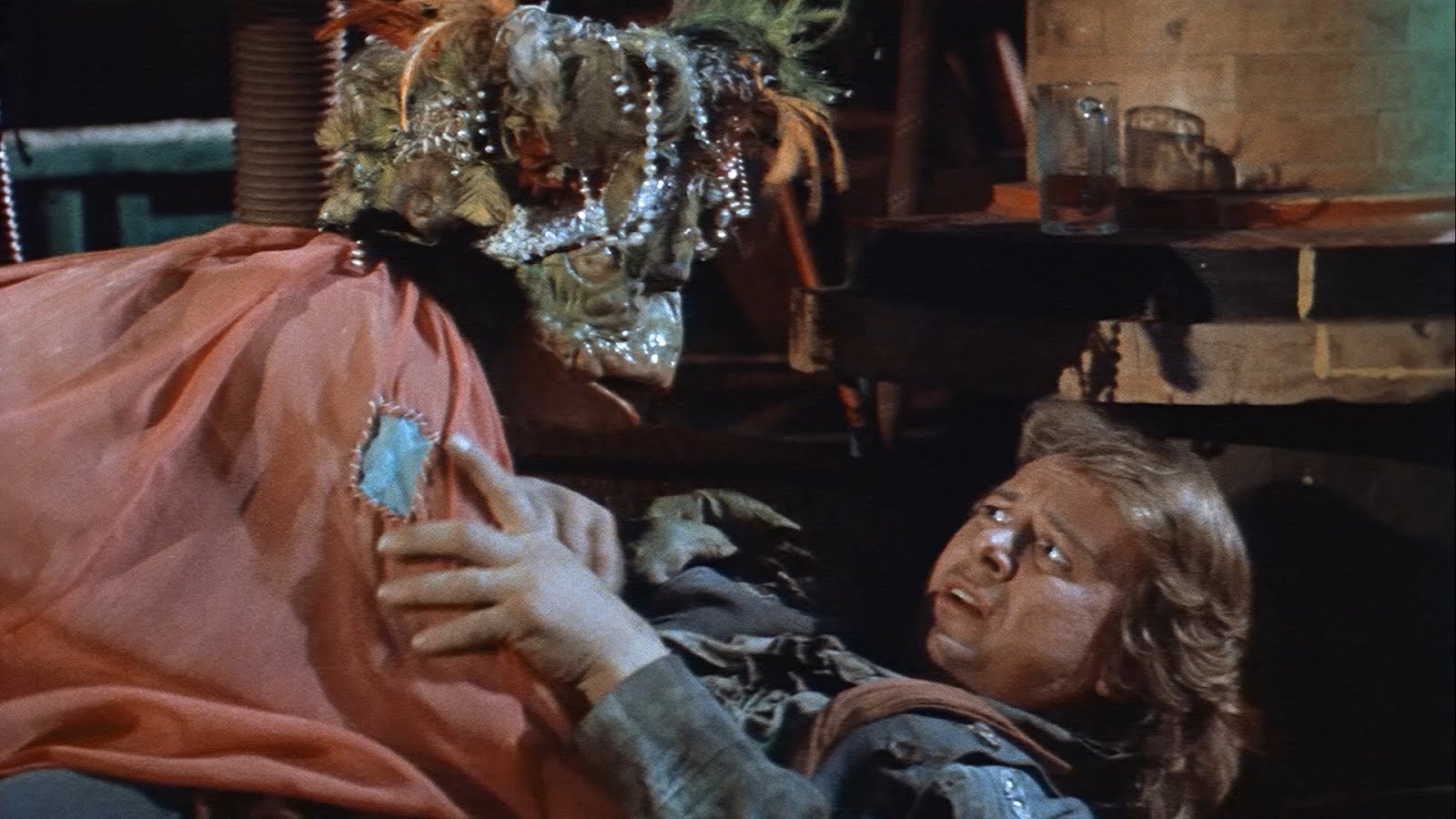
And who the fuck is this guy?
God?
Should You See It?
Of all the reasons to watch Hell Comes to Frogtown, it’s the simplest reason that’s the most convincing. That’s this: in the late 80s a movie called Hell Comes to (Motherfucking) Frogtown was released, and for some reason you haven’t seen it.
Watch it on Hulu Plus or stream it on Amazon for $2.99.
In our rarely-running kinda-series Should You See It? we talk about movies that just came out. You can figure out the rest of the premise from the title of the series. That’s right: We talk recipes. Should you see Hercules?
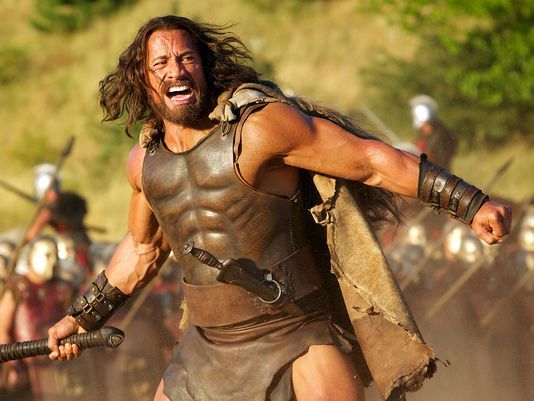
Last week I had the opportunity to watch Brett Ratner’s take on the tale of Hercules. This film stars Dwayne Johnson, a.k.a. “The Rock” from wrestling fame, as the eponymous Hercules.
I, like many others, have grown to genuinely like Dwayne Johnson as a celebrity. There are so many things he could be — rude, egotistical, abusive — yet he has managed to break the mold for super-juiced up athletes and has this genuinely endearing air around him.
He is constantly doing stuff like this. His life is a perpetual Old Spice commercial.
Now, I could write an entire article about why Dwayne Johnson is awesome but I will leave you all to Ask Jeeves that question. This is about the movie Hercules and there honestly isn’t much good to say about it. Ratner decides to eschew the various trials of Hercules (a.k.a. the interesting stuff) to instead focus on how a super strong (but entirely mortal) Hercules deals with being known as a demigod.
We meet his team of super talented warriors that help him take on the various trials he is known for. His group is an Amazon archer-woman, a rogue who throws daggers, a battle mage who can see the future, a mute berserker, and Hercules as a heavily armored “tank” of sorts. We see that the trials are all just tricks set up by various evil people that have entirely rational solutions. We learn that Hercules becomes about as popular as the Emperor he is receiving patronage from due to these accomplishments and then he is suddenly outcast after a tragic night involving his family (spoiler alert: they dead y’all).
The plot focuses on Hercules doing one last job as a mercenary to help pay for his self exile to atone for his sins. This does not go as planned and an insidious plot is uncovered that requires Hercules to effectively unwin a war he just won. This is all incredibly stupid and never takes the viewer off guard. It truly feels like a poorly written tween version of 300, except with none of the cool supernatural stuff.
Dwayne Johnson honestly does well in the role, and he is one of the few celebrities I could imagine playing Hercules. The main problem I ran into is that the man playing Hercules is honestly more Herculean than the character he is portraying. If the entire film was just about him going to the gym, listing the food he eats on his cheat days, and making Vine movies I would have enjoyed this film more. The supporting cast is completely superfluous and you will not care about any of them in any way, shape, or form. This holds true for the villains as well, who are just dicks for the sake of being dicks.
Should You See It?
There is absolutely no reason to see this film. It is a bad film, and it falls into that category of movies that just don’t have enough heart to be memorable. I wasn’t angry that I paid money to see it like I have been with other films, I just instantly forgot about it when I left the theater.
This summer has chosen dance as its musical medium, given the ubiquity of dance tracks and structures. I was fortunate enough to see The xx play at the New Daisy Theater in downtown Memphis earlier this year, and man, what a rush of beauty and polyphony! Of the two bandmates, Jamie xx works more independently than his cohort. Spinning at clubs and events all over the world appears to imbue his solo music with worldly energy, perhaps drawing from travels during their tour. Whatever the case, this track (put out June 2014) captures not only the evolution of The xx’s sound toward the steel drum and fluid dance movements, but also manages to incorporate samples in a natural and progressive manner. The song is essentially a love paean to the UK’s multistoried dance history and club scene; Jamie keeps it his own by leaving moments of “silence” throughout, allowing the ever-present steel drum to serve as the cool, collected backdrop to the additional layered beats and sound bites. “We were under one roof raving, laughing and joking” stands out as the eponymous line and also serves to bring a gestalt to the theme of the song: that music can make a community. Certainly the song evokes a Caribbean beach of the mind, underscoring the UK’s continual evolution in music as influenced by its broad Commonwealth reach, and by doing so, it allows us to appreciate the larger issues of transcendence the song itself describes. By pulling audio clips from club/scene kids and others, we get two kinds of primary exuberance: that of the firsthand account, and that of own our enjoyment (positing of course you enjoy quieter dance music with steel drums). This is definitely a track I’d like to hear quietly on the beach at night, with cold tequila in a glass.
Jonathan May watches too much television, but he’s just playing catch-up from a childhood spent in Zimbabwe. You can read his poetry at owenmay.com, follow him on Twitter at @jonowenmay, or email him at owen.may@gmail.com
In What I Did With My Summer Vacation we explore shows you should catch up on during TV’s slowest season. This week: 24’s triumphant return to television and when a half-season is just right.
When 24 was cancelled back in 2008, well, the word “cancelled” actually meant something. Thanks to digital streaming services and Kickstarter, now nothing is truly final on the TV landscape, which is great when shows like Arrested Development meet their end too soon, but it can be a little alarming when shows like 24 end. It could come back, and who knows what it would be like.
On paper, renewing 24 for another season six years after it left the airwaves seems like a huge mistake. It seems like something that Fox devised to cash in on a once-beloved show to rake in some ratings and advertising revenue when other networks were burning off remaining episodes of the nonsense that didn’t make the cut this year. It’s a no brainer. Put Kiefer Sutherland on screen, let him yell and blow things up for an hour, and it’ll pull in an audience. So when I found out one of my once-favorite shows was coming back I was… cautious, at best, in my expectations.
Anyone who has seen the show knows the dip in quality the final seasons had. The show had run out of ideas. The gimmick, 24 hours of real time drama, had been exhausted. Hell, it had been exhausted as early as season one when the now-expected cliches were used for the first time. But Sutherland’s acting and some genuinely smart storylines kept the show going. And going. And going (cue clock ticking sound here). Then, in 2014, 24 finally realized that it didn’t need to be a gimmick. It could just be itself.
And that’s what happened this summer.
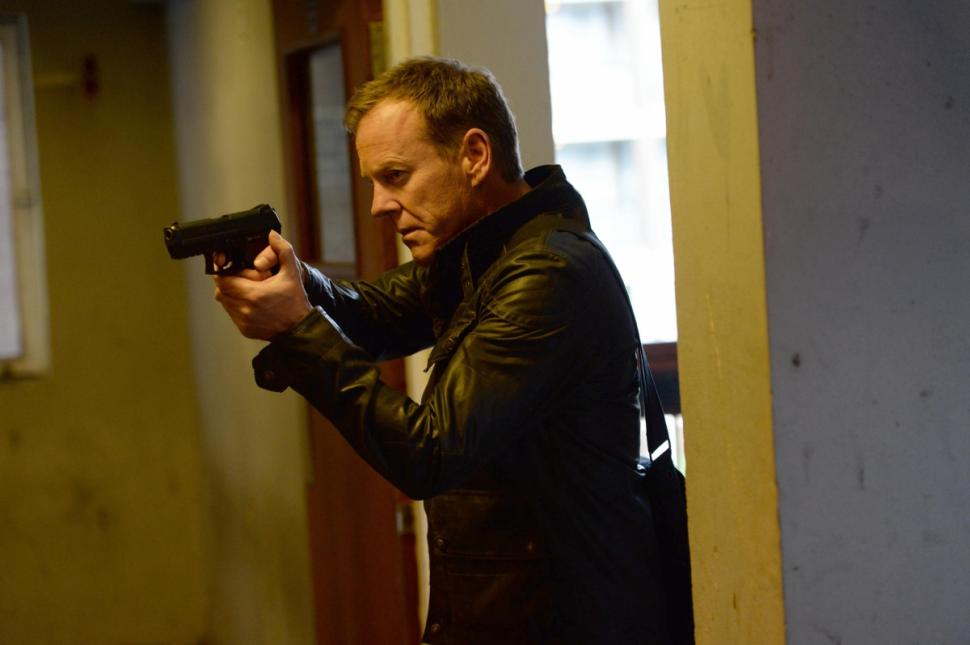
It almost seems like a coming of age story, for a show’s legacy. The writers decided to throw the 24-hour real time aspect to the curb. The season was 12 episodes, and the focus wasn’t “OK, how can we make this one long day that keeps the clock ticking?” it was “Alright. What do people love about this show that has nothing to do with the clock? Yeah, let’s go with that.” The show decided to invest its time in the most beloved aspects: Jack Bauer being an unrelenting badass, Mary Lynn Rajskub’s fan-favorite character Chloe O’Brian hacking every conceivable piece of technology known to man, and a sense of escalation that didn’t need to be calmed back down every five hours to figure out what the hell to do from here.
Not to belabor my point on viewing the show’s lifespan in the sense of yours or mine, but 24is finally done living in its high school years. It has its own identity now that has nothing to do with the number 24 other than that’s… just what people called it. It isn’t beholden to what it used to be. It held on to the best part of its past and it grew up, got a job and a 401k, and finally started using that treadmill that’s been gathering dust for years (but kept that beat up sofa it loved).
“Hey man, why do they call you 24?”
“Long story, doesn’t really matter anymore. They called me that in college, the name just kind of stuck.”
You can watch 24 on Amazon Instant Video or Fox’s website. It may or may not get another season/mini-series/movie/animated cartoon.
Every week Colton Royle discusses the newest episode of HBO’s new show about a new kind of rapture, The Leftovers. You can also read our review of the book the show is based on.
Spoilers for Tired Feet
This show is constantly going to push you to wonder if it is worth your time. I don’t mean that in some grocery store aisle kind of way where you have some leftover (haha) cash and you can’t decide between Snickers and 3 Musketeers. What I mean is that the show in and of itself (yeah, I’m using that well-worn phrase) relies on you to provide its interpretation. Let me explain.
It’s not like we weren’t aware of how much the show brings up classic examples of religion only to shoot it down. Matt Jamison’s explanation getting trampled on by Kevin is just another example, but now they seem to trample on their own created religions. Wayne’s Asian franchises brings up the awkward chain of people in history that have claimed to be related to divinity, yet just like the factory scene from a couple episodes back, the one where they put together babies only to have one used as the baby Jesus, all of it is produced in assembly line ways. Wayne’s total awareness and Tom Garvey’s lack of awareness has us all awash with religious insecurity and bullet holes next to our twiddling thumbs.
Great metaphors and symbols for our modern times, right? Except that The Leftovers as a show has been created with little subtlety or regard for tone. Take the first scene in which we hear the all-male chorus chime in during the Guilty Remnant protest while Kevin gives up and turns away from pursuing his father. The easy question to ask is, “How did his father even escape?” but the real question is, “What is the purpose of the music and slowed footage?” The final shot of the three main women in the cult looking at Kevin had me baffled with what I was supposed to take away from that moment. Are we sad that he lost his father? Are we confident that Kevin is crazy and these ladies know it? Is all of it futile? The show never reveals its cards, expects you to play, but doesn’t even bother to explain the rules.
But hey, Nora and Kevin DID IT and boy was that great.
But let’s start to wrap this series up: this show is bad. Christine’s solo water birth notwithstanding, it’s going to take some incredible work to bring all of this back together. Who exactly is receiving the “solace” and who has the “tired feet?” Is it okay to realize only now the extent of Kevin’s medicinal addictions? Is it okay to show Jill a note that we don’t get to see, and then use it as dramatic collateral for a moment with a 1972 issue of National Geographic?
We’re all working too hard. Let’s use something simple. Liv Tyler comes in all hot and bothered by Nora and Kevin’s sexcapade, and she’s writing to Laurie that the dirty deed is being done, and Laurie writes back, “so?” And that is like EXACTLY how I feel. If the wife (ex-wife) doesn’t care, I sure as hell will not care. And she’s known him for years, and I’ve known him for like, what, seven weeks?
And all the while the show is encouraging you to build thematic structures of your own, and yea that’s a cool concept for middle school kids playing Minecraft, but it isn’t very inspiring here.
Colton Royle is a reader of mostly American fiction and non-fiction. He is currently teaching in Fort Worth, Texas.
In Life After the Star Wars Expanded Universe, we take a look at science fiction and fantasy, why they’re great, and what they say about where our species has been and where it’s going.
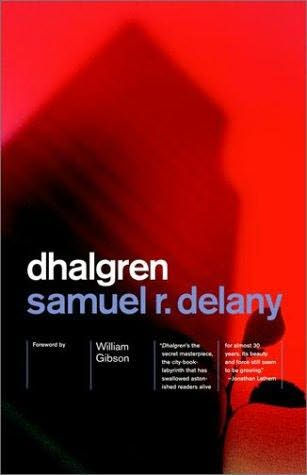
Dhalgren is a 1975 novel by Samuel R. Delany, arguably his most successful critically and most likely his most successful commercially, with over one million copies sold. It took me a while, even devouring SF like I do, to find Delany. This is a shame, as the man really knows his way around a sentence. He’s also fucking insane, or at least wrote a fucking insane novel. To give you an idea of the strangeness inherent in the book, one of the very first events is a guy (the main character) walking down a highway, seeing a naked woman running across a field, going to her, having sex with her, then later approaching her in a meadow as she metamorphoses into a tree. Freaked out by this, he sprints back out to the highway to hitch a ride and talks with a long-haul trucker about artichokes. The trucker drops him off at his destination, Bellona, and it does not get less strange.
Yup.
Bellona is a midwestern U.S. city that has undergone a vague cataclysm. No one really understands what happened, but a lot of the city burned down, and a lot of people moved away. What’s left is an anarchic-in-the-bad-way-unless-you-are-kind-of-an-asshole type social structure where people are just trying to get by and don’t really understand the place in which they live, but are powerfully drawn to it. Weird things keep happening. Our amnesic protagonist, who ends up taking the name Kidd, sleeps on a rooftop a few blocks away from the river the first night, then wakes up and cannot see the river. He enters a building by one door and leaves by the same door, only it exits in a different place. The city is constantly encased in a roiling dome of ash, smoke, and cloud. The one time this really clears away, there are two moons in the sky. The place is just weird, and the evocation of this strangeness is what this novel does best: it is huge on atmosphere. Reading it, you are as wandering and confused as the main character. The grimness and foreboding of the place flows underneath every word, like dark water through the sewers underneath a city. Also, strangeness never stops.
Bellona is kind of like this, with less sunlight.
Our fearless protagonist finds a notebook in the city, one in which all the right-hand pages are filled in as someone’s journal. Paper is at a premium, so he uses the left-hand pages to write poems as he moves through the city, but he also glances at what has been written, and these pages sometimes reveal a written version of thoughts Kidd has already had. For example, one of the narrator’s thoughts (assumed to be the internal thoughts of Kidd, but who knows) is him reflecting upon his amnesia:
It is not that I have no past. Rather, it continually fragments on the terrible and vivid ephemera of now.
First off, look at that writing. Secondly, when he starts reading the journal, he finds this written in it:
It is not that I have no future. Rather it continually fragments on the insubstantial and indistinct ephemera of now.
He is amnesic, so he knows even less than the reader if he is the original writer of the journal, and other than tenuous speculation, there is nothing to indicate a final answer. This novel builds mystery and leaves it there, strong and swirling in mist. William Gibson referred to the novel as “a riddle that was never meant to be solved.” Good, because I am nowhere close. (While we’re talking about SF author reactions to Dhalgren, Philip K. Dick called it trash, and Harlan Ellison threw it across the room, never to return, at page 361. I am on page 349. Because it is so weird, it is very divisive in the community – some think it is incomprehensible pap, others think it is the best thing science fiction has ever done).
While we’re quoting, below is the first dozen or so lines of the book, to give you an idea if the style is something that appeals to you or not:
to wound the autumnal city.
So howled out for the world to give him a name.
The in-dark answered with wind.
All you know I know: careening astronauts and bank clerks glancing at the clock before lunch; actresses cowling at light-ringed mirrors and freight elevator operators grinding a thumbful of grease on a steel handle; student riots; know that dark women in bodegas shook their heads last week because in six months prices have risen outlandishly; how coffee tastes after you’ve held it in your mouth, cold, a whole minute.
So, I quit. Well, not really. This book is too much of a landmark, and there is way too much exciting stuff going on in it for me never to finish. It is really good, I just need some time. In the words of Led Zeppelin, “I can’t quit you babe, so I’m gonna put you down for a while.”
There’s a reason 73% of American high-school males go through a Led Zeppelin phase. Led Zeppelin is fucking great.
The problem is not that it’s a bad book. It is amazing. The problem is, it’s fudge. Fudge is good. Fudge is an impressive and rewarding concoction. Eating fudge is better than eating, say, a ham sandwich. But if you eat nothing but fudge, it becomes hard to chew, sensorially overwhelming, and the culprit behind severe digestive problems. I need to eat a few ham sandwiches before returning to my 879-page platter of fudge. Delany crafted a highly experimental novel with a lot of innovative features, but digestibility was not one of his goals.
The worst/best dinner you’ll ever have.
Quitting a book is the sovereign right of any reader. As I get older, I do it more and more. As a youth, it always seemed like it was my failure if I put down a book. This attitude had me finishing a lot of really terrible, highly acclaimed stuff. Now, it’s clearer that it is more the author’s failure than mine. If the author is not delivering, you owe them nothing, and buckling to the social pressure of what a “good” book is and reading it even when you don’t like it gives you misery you don’t need and wastes time you don’t have. I love reading the Big Books, the ones in The Canon, and it’s fine to have social opinion be one of the determining factors of whether you finish a book, but it cannot serve as the sole support of a bad book (Obligatory: The Corrections was super terrible. “I am a well-educated, white, heterosexual, cisgender male, my life is so hard, won’t you follow me as I explain my psychological hangups? Also, I’m a giant asshole and made all my problems for myself.”). So my hatred of The Corrections is sloshing over the rim of parenthetical address. In it, the main character’s life is messed up because, as a tenure-track professor, he had sex with one of his students and got fired. He broke the rules and regulations of his workplace and got canned. He’s super bitter about it, but what the hell did he expect? Can you imagine reading Crime and Punishment if, instead of going through the psychological anguish of nihilism versus meaning, despair versus hope, and anxiety versus acceptance, all Raskolnikov did was bitch about how that dumb old lady he murdered ruined his life and how unfair it all was? That’s The Corrections.
Okay, back on track. Yes, I am taking a break, but Dhalgren is amazing. Hopefully, I will read the remaining 530 pages, and there will be a companion piece up here in a few months titled “On Finishing Samuel R. Delany’s Dhalgren,” but there doesn’t have to be. Read good books, don’t read bad ones, regardless of the opinions of others. When people read books based solely on reputation, bad writers profit and good readers suffer.
Andrew Findlay has strong opinions about things (mostly literature) and will share them with you loudly and confidently. You can email him at afindlay.recess@gmail.com.
In Major Issues, we look at one newly-released comic book each week. Now updated Mondays.
Gardner Mounce
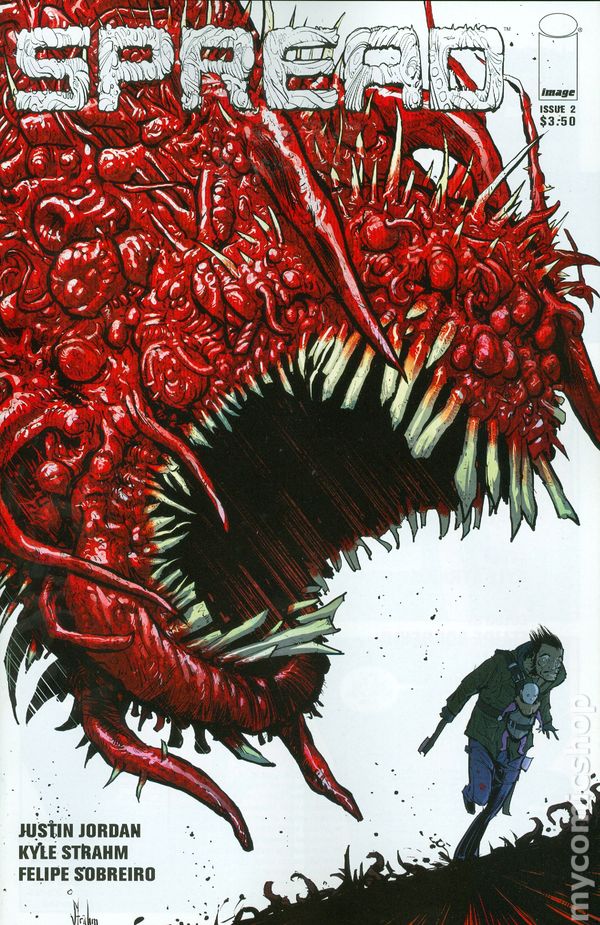
Spread #2 Written by Justin Jordan Art by Kyle Strahm Published by Image Comics 7/6/2014
The post-apocalyptic story seeped into the cultural consciousness at the end of the nineteenth century with Mary Shelley’s novel The Last Man, and has been retold in countless incarnations since. We’ve our plague-pocalypses, zombie-pocalypses, pocalypse-pocalypses (this hasn’t been done yet?), all serving to sate our need to punish ourselves in fiction for how great of a job we’re doing fucking everything up. In such an over-saturated apocalypse narrative market, what must a new narrative do to stand apart and be successful?
Not much, apparently. Spread’s first issue sold out its first two printings and is heading into its third, and the second issue sold out immediately. So what’s it about? How does it stand apart? Combining elements of John Carpenter’s The Thing, Cormac McCarthy’s The Road, and the baby-as-narrator device from Saga, Spread is an amalgam of things guaranteed to work. In a world ravaged by parasitic organisms capable of banding together into larger mega-organisms, a man named No must protect the world’s only hope: a baby actually named Hope, whose tears have the power to dissolve the parasites’ bodies. I’m not suggesting that Spread is bad. It’s actually a lot of fun. It combines the right elements of visceral art, disgusting monsters, creepy characters, and heady pacing. But if you’re looking for a fresh take on post-apocalyptic stories, look elsewhere.
The story is strong and has been diligently introducing the right elements. In this issue, writer Justin Jordan introduces some new characters. First we meet Ravello, the Fabio-esque leader of a group of bandits. Unlike the other scarred, dirty characters of this world, Ravello is an unscathed Adonis–the visual antithesis to issue 1’s creepy thin man who has the power to spawn additional parasites. Then we meet the series’ first mega-parasite (pictured on the issue’s cover). And finally, baby Hope’s mother Molly, a totally capable mother who is in no way balls-out crazy. Though the story elements are strong and balanced, the story’s chief flaw is in taking itself too seriously. It rides too many familiar elements to not be self-aware and poke fun at its own premise.
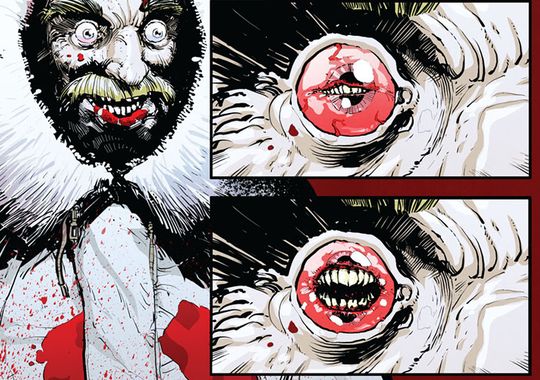
The art is bloody and visceral, and probably the series’ best element. Artist Kyle Strahm can handle anything Jordan throws his way, including parasites exploding from eyeballs and multi-mouthed worms. If there’s anything in this series that can be said to be funny, it’s in the gratuitous use of violence. It’s funny in the exploitative way of John Carpenter and Quentin Tarantino movies.
The old parasite chewing through the eyeball bit. Too funny.
Should You Get It?
For post-apocalypse junkies only. You won’t find anything necessarily fresh in its pages, but if you need to feel that psychic catharsis by seeing humanity punished for all its mistakes, you could do worse than Spread.
Gardner Mounce is a writer, speaker, listener, husband, wife, truck driver, detective, liar. When asked to describe himself in three words, Gardner Mounce says: humble, humble, God-sent. You can find him at gardnermounce.tumblr.com or email him at gmounce611@gmail.com
Every week we ask everyone who hangs out around here to answer a tough question. This week:
What’s the worst date you’ve ever been on?
Rules are simple: so, like, what do you do for fun? Dating is extremely stressful, because it requires exactly the right blend of being honest about yourself and shielding a near-stranger from the horrible truth of who you are. Dating is exciting because it’s full of possibility, but one of those possibilities is that it will go really, really badly. What’s your worst experience?
Alex Russell
There have been a few, but nothing will ever dethrone the very first one. I was 13 and painfully shy, but I met a girl at a friend’s party and we hit it off. I don’t know how much one can “hit it off” at 13, but it at least went well enough that she wanted to see me again. She invited me to her friend’s party the next week and told me it was a “fancy dress-up party.” I showed up in loafers and a suit coat, and everyone else was ready for what was clearly a swimming event. I never figured out if she made an honest mistake or if she was just evil. As some kind of gesture to show I was a good sport, I jumped in and swam in my 13-year-old “nice clothes” anyway. An auspicious start.
Jonathan May
I’ve been on a ton of horrible dates. But one time really takes the cake. I was seeing this guy who wasn’t really my type, but he was really into me, so I thought, “What the heck? Okay.” He wanted to take me to a movie, which is my least favorite kind of date because you don’t actually talk to the other person at all. Well, I wanted to see Tree of Life, which (trust me) is not a date film. Halfway through the film, as Jessica Chastain’s character hovers mid-air, I started to cry because I was struck by the movie’s poetic beauty. It was at this exact moment that he tried to hold my hand. I can’t describe how little I wanted anyone to touch me right then and there in the dark theater, with a billion emotions roiling within me. That was the camel’s straw. Afterward, I begged off going for dinner due to a headache, which I didn’t even have to fabricate at that point. Ugh, the worst.
Brent Hopkins
The worst date I went on was with a Korean lady who started off by informing me that she always wanted to go out with a black dude but that I wasn’t that black in skin color and actions. I guess she saw me as training wheels to the “real” thing or something. I tried to explain that his was not something that was okay to say, which led me down this road of trying to figure out what type of backhanded offensive things I could say to her to get her to understand. So, yeah, I had a date that was entirely based on racism and stereotyping and it was, the suck, as they say.
Andrew Findlay
I met my wife when I was 18, so the only bad dates I’ve ever been on were bad teenager dates, where neither of you know what to do or what you want, and both of you are just super awkward for basically all the time you spend together. It was ten years ago though man, so I don’t know.
Gardner Mounce
The weirdest date I’ve ever been on happened when I was in 8th grade and was dating a girl I’ll call C. C and I were at her house one night watching a movie. C decided it’d be fun to get in her hot tub out back. We did. After a little while, her mom, who we both thought was upstairs sleeping, came out with a camera and asked if she could take a picture of us kissing. Ladies and gentlemen, I have never felt more uncomfortable. I wish I could say I declined, but I didn’t. I rest uneasy knowing that her mom probably still looks at that thing.
Colton Royle
I once went on a date with a woman who advocated for a fascist educational system. “Maybe some people with lower IQ’s should be taught what to think.” We report. You decide.
Every week Colton Royle discusses the newest episode of HBO’s new show about a new kind of rapture, The Leftovers. You can also read our review of the book the show is based on.
Spoilers and such.
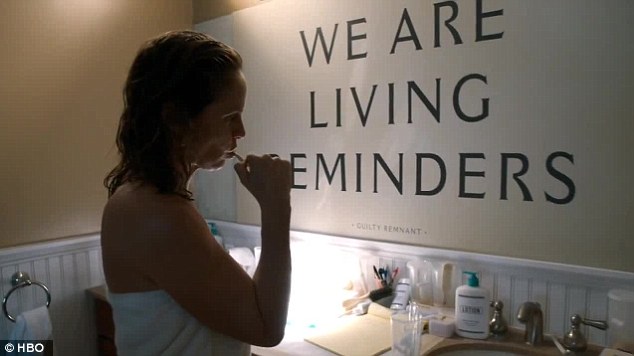
We get to see another possibly religious event collide with a secular result in this episode of The Leftovers, an episode with Nora kissing dead doppelgangers and stopping conspiracy theorists from taking her name and Wayne sucking the grief out of her AND Nora wanting to be shot in the chest with a gun while wearing a bulletproof vest AND seeing Kevin at the exact same time in court for the exact same reason, a divorce, AND featuring a question on the departed insurance form that gets a 100% response of “yes” until she is cured by Wayne.
All this roundabout summary is to say that The Leftovers is using a pretty big hammer all the time. Would Nora really kiss a constructed cadaver? Oh, she’s on a drug that’s “going to be FDA approved by October.” Many of the characters’ actions, like Jill’s Nerf fire arrow event and Kevin’s dog shooting, seem to be based on the words, “F#$% it.” If you were to really ask me to find the difference between Jill and Kevin, I would say apathy vs. depression. If you were to really ask me to find the difference between Nora and Kevin, I couldn’t tell you. Yet they create shamwow moments and claim it is character, and that’s textbook hitting the carnival hammer really hard. Kevin yells at dry cleaners. Jill steals Jesus. Preacher beats stealer. If The Leftovers wanted to satirize conventional plot, they can’t have this many signature moments and claim it is still coincidence. At some point, we know it’s a show, fellas.
And this review ends up being even more incoherent than the show. Remember when Nora held a dead grenade in her hands? Remember what was written on it? I sure as hell don’t. The sense of value when it comes to scenes is so frayed (what is more relevant, Wayne’s “I don’t give a shit comment,” or her healing Nora?). If it all matters it becomes paranoia. If none of it matters it’s irrelevant. “So, hey man, what’s your story?”
If it is a show attempting to explain modern living in this way, I think it’s going to ultimately fail. You can’t pull the rug out from somebody who wasn’t standing on it to begin with. And if you split the fan base into categories, are you really achieving anything different from Lost? I’m not looking for answers here, I mean I named my series Postmodern Rapture because I’m that guy. But what about questions? “If they get you to ask the wrong questions, they don’t have to worry about the answers.”
And oh my God Nora and Kevin, just do it already. Put a couple intense scenes around their moments and it feels like Kevin should be pulling Nora’s hair in a game of tag at recess. Kevin says, “I’m a mess” and we’re all nodding our heads, but all for different reasons. I thought of “a hot mess express,” in case you were wondering.
But like, woah man, Wayne “heals” Nora into buying the right groceries, and she replaces the paper towels. It’s a great image, the towel stuff, but it kind of gets lost in the gray. Small tool-like style choices get marred by some “major” plot developments. Nora was compelling when she tipped the coffee cup and broke it because at least it was a small detail that had much larger ramifications, not to mention mystery. Here we have some pretty incredible events (spiritual healing, identity theft, WANTING TO GET SHOT IN THE CHEST WITH LOUD MUSIC ON) that are yes, mysterious, but ultimately boring.
You want to see fun suburban mayhem? Give it a shot.
Colton Royle is a reader of mostly American fiction and non-fiction. He is currently teaching in Fort Worth, Texas.
In “Worst Best Picture” we search every single Best Picture Oscar winner of all time from 1927 to present to uncover the worst of them all. Conventional wisdom says that 2005’s winner Crash is the worst winner in history. We won’t stop until we’ve tested every last one. Read the the first, our review of Crash, here. Posts will be relatively spoiler free, but there may be some details revealed. Today’s installment is the 1946 winner The Best Years of Our Lives. Is it better than Crash?
The Best Years of Our Lives is the best movie on this list that you’ve never heard of. It’s loads better than Crash. This could be the shortest one yet, but I’m going to try to convince you to go watch a movie from 1946.
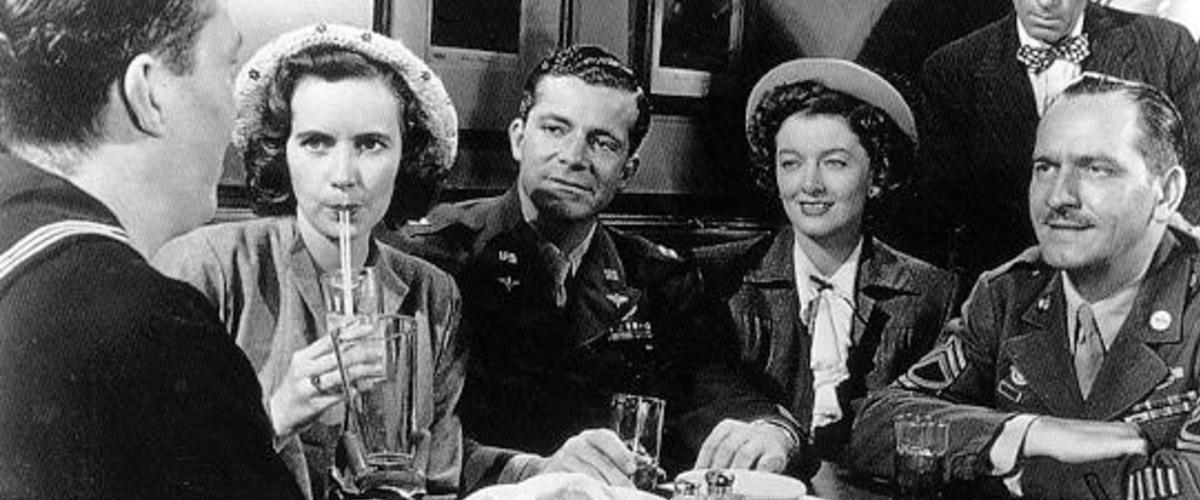
The film is about three men returning to Smalltown, USA after World War II. They have a hard time readjusting to civilian life: Fred can’t get a job good enough to impress his wife, Al can’t seem to return to his job at the bank, and Homer has much, much bigger problems than both of them.
Homer is played by Harold Russell, and it’s important to note that Russell received two Oscars for his portrayal. Russell, like his character Homer, lost both hands in World War II. The result is a captivating performance that would be played now through special effects. The choice to have an actor who actually knew the experience and could be shown as he really was — as war really was — is the cornerstone of the film.
Homer returns to his girlfriend and they must confront his new life with hooks for hands. I don’t want to rob Homer’s storyline of any surprise, but it’s beautiful right up to the big reveal and his choice about how to engage his world after such a big change.
Al and Fred have parallel storylines that both involve love and work. They represent the difficult job market post-war, even for veterans, and the struggle of returning to a relationship as a different person. War changes everything, but The Best Years of Our Lives is interested in a part too often unexplored: the life at home.
You should see it to focus on the struggles involved and the timelessness of this cycle: America goes to war, America sends Americans, Americans come home from war, America doesn’t know what to do with the war or the Americans. We’re a country obsessed with the idea of war, but we’re not always one that knows what to do with everything that goes into that. We already weren’t in 1946, and you should see this movie just to be shocked by how relevant it all feels.
The Best Part: This has to go to Harold Russell. His character is compelling beyond the hooks for hands detail, but it’s obviously the most interesting detail in the movie. You really have to see it.
The Worst Part: Everyone in the movie, right down to the bar owner at the bar where they all drink, gets a full backstory… except for Fred’s wife Marie. She’s young and impulsive and thus has no time for her husband’s difficulties in finding a job. I suppose the message is “some people are just awful, even to good people” but that’s hardly a message worth focusing on. Some depth to make her complicated rather than just evil for evil’s sake would be nice.
Is It Better or Worse than Crash? It’s not spoiling anything to say that our heroes do have one run-in with a guy who challenges their “heroics” and says they fought in a meaningless war. That’s a standard scene for any war movie, but it’s surreal to see it done with regards to World War II. It’s hard to imagine a time when anyone could tell a World War II vet to their face that Hitler wasn’t really all that dangerous, and it’s stranger still to watch it happen. The timelessness of the situation, though — that bravery is often a challenged concept — is what keeps the movie fresh 60+ years later. Crash is not fresh now, and it’s at least in color.




 Reading at Recess