Tough Questions: What’s the Longest You’ve Ever Stayed Up in a Row and Why?

question-mark

Every week we ask everyone who hangs out around here to answer a tough question. This week:

What’s the longest you’ve ever stayed up in a row and why?

Rules are simple: go to sleep. Well, don’t, actually. You remember that episode of The Adventures of Pete & Pete where the kids tried to stay up so long that they went back in time? This is basically the same thing, really. Most people have pulled one all-nighter, but have you pulled two in a row? Or more? Are you dead right now because you’ve been up for two weeks?

Alex Russell

I used to go two or three days without sleep in a row all the time. I hated sleep as a teenager; I used to be worried I was missing something cool whenever I went to sleep. I now know that an infomercial for a hot plate doesn’t count as “something cool” but that kind of wisdom comes with time. My longest stretch was in grad school when I went more than three full nights without sleep. I had to finish a particularly complicated project and I hadn’t had time to read everything I wanted to before starting it. The final night involved a four pack of Red Bull, a box of off-brand NoDoz from the gas station, and a crying jag on a staircase at 7 a.m. when I couldn’t figure out what a book about nationalism and farming was trying to say. All-nighters for education are really stupid, and I’ve forgotten almost everything about that final night other than how manic I was.

Jonathan May

I, like most Americans since the advent of Netflix, am prone to binge-watching TV shows online. Reality competition shows like Project Runway and America’s Next Top Model are my jam, and I’ve seen every episode of both. But I was recently (like two weeks ago) introduced to So You Think You Can Dance, which falls safely in line with my main TV binge interests. I’m on day three of no sleep as I compose this. I’ve watched more people laugh and cry and dance in the past few days than probably the rest of my life combined. Needless to say, I feel really weird, both physically and emotionally. Also, I’ve become almost uncannily able to predict the winner once they announce the top 20 dancers. I have one episode left, and I’ll definitely watch it as soon as I get home. As was often said in our high school, “You can sleep when you’re dead.”

Brent Hopkins

The longest I have stayed up in one sitting was around 60 hours and that was due to traveling. I was flying from Korea to Hawaii to visit my cousins and had two insanely long layovers in China and Japan. I couldn’t sleep on the flights because the seats were so tiny and by the time I arrived in Hawaii it was 9 a.m. and there was no way I could sleep then. I kinda went through a daze of delirium but my sleep schedule was on point once I woke up the next day.

Andrew Findlay

I have never missed more than one full night’s sleep. I had one prepared about the time I stayed up all night at a friend’s bachelor party. He broke his arm, and I had to drive his car home for him hungover on no sleep, but most of the time when I miss sleep, the word “party” is not involved, so I selected something more representative. I intake media at an alarming rate. School let out in late June, and I have already used that time to read five novels. With video games, I actually play fairly rarely. I can go weeks without turning on my console, but that is because when I do, the game consumes me. This is not a problem often, as the majority of games clock in around 15-20 hours, which translates to just one to two days where all my waking moments are spent playing. But Skyrim, oh Skyrim. It does not end. Ever. The first weekend I got it, I started playing on Friday, stayed up all night, brewed coffee continuously, and did not shut down the machine until late on Saturday. By that time, I had entered an altered state of consciousness. At one point, I had to go buy eye drops because my corneas were sticky from being constantly open. Not my proudest moment, but there it is.

Gardner Mounce

I can’t function without sleep. I never saw pulling an all-nighter in college as a rite of passage like some people do, and I’ve never stayed up for more than one night. I hate the idea of not sleeping at the end of the day. I stayed up all night at a birthday party and was the one who kept suggesting that we all go to sleep. And I stayed up all night for my bachelor party, and probably was the one who ended up suggesting that we all go to sleep.


Worst Best Picture: Is Chicago Better or Worse Than Crash?

chicago

Alex Russell

In “Worst Best Picture” we search every single Best Picture Oscar winner of all time from 1927 to present to uncover the worst of them all. Conventional wisdom says that 2005’s winner Crash is the worst winner in history. We won’t stop until we’ve tested every last one. Read the the first, our review of Crash, here. Posts will be relatively spoiler free, but there may be some details revealed. Today’s installment is the 2002 winner Chicago. Is it better than Crash?

When I mention this project to people they always have the same general response. People always mention the movie they think is the worst Oscar winner ever. Usually it’s Crash. Sometimes it’s not.

When someone says a different movie, I desperately want to see it. I don’t have a plan for if something is worse than Crash, but I want to have to figure that out. I want one of the other 85 movies between Wings and 12 Years a Slave to be so bad that I have to retitle this whole damn thing. So far, through roughly a third of them, nothing has really approached it.

The closest so far is probably The Artist. I don’t have a great case to make there, I just thought it was obsessed with the wrong parts of itself. I thought it was somehow both indulgent and uninteresting. I didn’t love Shakespeare in Love, either, but neither movie was so odious that I could justify hate like I have hate for Crash.

All of this is to say that people told me that Chicago had a chance to dethrone the king of the list. When I heard that, I got excited. I wanted to see a musical that had a shot at being worse than the sledgehammer-gentle message of Crash that “everyone is bad, forever.”

There are a handful of musicals that have won Best Picture over the years. They’re mostly iconic films like My Fair Lady and West Side Story. Some of them are oddities like Gigiwhich BuzzFeed called the worst Best Picture winner of all time in their listGigi is strange, to be sure, but it’s not terrible. It’s actually pretty fun, which is what I assume people mostly want out of a musical.

Chicago is also supposed to be fun, and I was definitely surprised to find that I really enjoyed it. The songs are catchy and the dancing is flashy and it has Taye Diggs. Are you going to tell me you hate Taye Diggs?

The thing is, I don’t really have a lot to say about Chicago, because I went in with some weird expectations. I expected a movie that was “big” and “loud” in obnoxious ways, but I got something charming and refreshing. Chicago “worked” on me. There’s no love story to get in the way and there’s no real development, but it’s fun. It’s a bunch of songs and visuals that combine to form something mostly worth looking at. I think that’s all a musical is supposed to be, right?

The Best Part: A lot of the reviews for Chicago talk about the dancing being largely smoke and mirrors. I’m not a sharp enough dance critic (let no one tell you otherwise!) to know, but it seemed pretty great to me. I do not generally like movies like Chicago, but the “Cell Block Tango” performance was pretty excellent.

The Worst Part: I’m not in love with the ending. I don’t think it’s really a spoiler to say how a musical ends, but it just feels really haphazardly tied up. You can’t fault this version for how the actual story of Chicago ends, but “the smooth guy is smooth, the putz is a putz, and everyone else is whatever” isn’t exactly dynamic.

Is It Better or Worse than CrashI’ve recently decided I need to go back and rewatch Crash, because I’m running out of extremely specific complaints about my subject matter. Both movies have a cynical view of the world, but again, Chicago has more subtlety about its cynicism despite having a scene where a guy controls characters with strings. Crash deserves to be raked over the coals for a lot of faults, but none more than how obvious it is.

Worst Best Picture Archives: Crash | Terms of Endearment | Forrest Gump | All About Eve | The Apartment | No Country for Old Men | Gentleman’s Agreement |12 Years a SlaveThe Last Emperor | The Silence of the Lambs | The Artist | A Man for All Seasons | Platoon | The Lord of the Rings: The Return of the King | The King’s Speech | Rain Man | The Departed | The Bridge on the River Kwai | Marty | Gigi | It Happened One Night | Driving Miss Daisy | Shakespeare in Love | Wings | Midnight Cowboy | Rocky | Gone with the Wind|

Alex Russell lives in Chicago and is set in his ways. Disagree with him about anything at readingatrecess@gmail.com or on Twitter at @alexbad.

Song of the Summer? Tove Lo’s Stay High (Habits Remix)

Tove_Lo_Habits

Jonathan May

Tove Lo – “Stay High (Habits Remix)”
Universal

In my quest to find the ultimate 2014 summer song, I’d finally hit rock bottom, breaking down and asking my high school students for the answers. They found this curious displacement of roles hilarious, further cementing that though I’m “the cool teacher,” this doesn’t save me from being hopelessly out of touch. Their pitiable glances produced a somber list of just three songs. I’d already reviewed “Fancy” by Iggy Azalea. And after rejecting the horror that is the band 5 Seconds of Summer, I launched into the final song on the list: “Stay High” by Tove Lo. I was touched the tragic fragility of the song and video, and I believe they work seamlessly as expressions of one another, twined around the main idea: that people escape, through almost any means necessary, the pain of a broken heart. The video chooses mainly alcohol as the visual metaphor to approximate the lyrical content; of course, any substance could have stood in here. The camera follows, closely and in front, the gorgeous young Swede as a stand-in for any loveburnt soul; combined with lyrics like “can’t go home alone again/need someone to numb the pain” and “try all the time/to keep you off my mind,” an obsessive quality takes hold. The video makes use of time distortion to accentuate the endless feeling that being heartbroken gives, the cycles of destructive routine that appear to give order. While the lyrics aren’t terribly complex, they achieve the stark beauty of truth, and that is their strength. The sonic makeup of the song isn’t incredibly varied either, yet its insistence on returning to the same loops and beats hearkens to the thematic idea that we circle obsessively around our own idea of love. And sometimes it becomes impossible to escape. While this song isn’t one to jam at the poolside, its hypnotic qualities lend it that summer-night dance feel, something to slink to as the humid night draws dark over the moon.

Jonathan May watches too much television, but he’s just playing catch-up from a childhood spent in Zimbabwe. You can read his poetry at owenmay.com, follow him on Twitter at @jonowenmay, or email him at owen.may@gmail.com

Postmodern Rapture – The Leftovers Episode Three – Two Boats and a Helicopter

article-2654110-1EA2AAB600000578-391_634x356

Colton Royle

Every week Colton Royle discusses the newest episode of HBO’s new show about a new kind of rapture, The Leftovers. You can also read our review of the book the show is based on.

Many spoilers ahead.

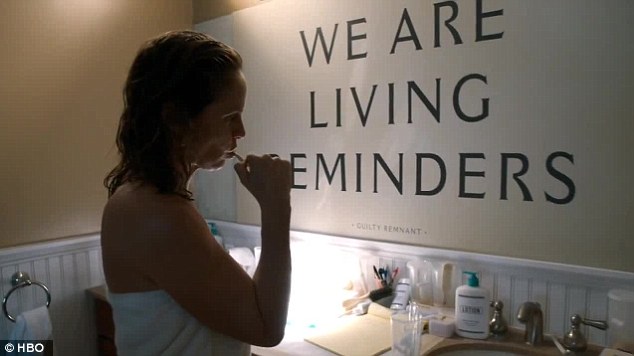
The Leftovers stares religion in the face with the new episode focusing entirely on Matt Jamison, Mapleton’s minister, as he pushes the line between madness and divine power that arises as a theme once again. Where the previous two episodes have felt frayed at the edges and had us viewers grabbing for a metaphorical bucket dropping into a well, here was an episode that felt tight, feverish, and much more indicative thematically.

Matt Jamison preaching to a near empty church was an interesting and unexpected turn when you consider how much emphasis is placed on the rapture in Christian doctrine, and this brings up a theme of the episode which to me was ambiguity in suffering. I mean here is a guy who lost his congregation and now he’s gonna lose his church, and he can’t get the money from his sister and he eventually does get the money but he almost gets mugged and THEN he gets hit with a rock and misses the deadline and his wife is…I mean WTF, I don’t even know if I have a heart left after all these emotional stab wounds straight to it.

Three arrivals of the pigeons in key locations and colors for a massive gambling success only to have him miss the deadline to buy his church back by three days establishes the point Nora (his sister!?) makes that even with all the “good news,” or even divine help, does it make the situation of life, life in the modern world, any better? To me, The Leftovers is starting to make some massive questions very concrete in this episode, and even the varied tones in which they depicted Matt, from beautiful and serene during the baptism scene, to his eventual nightmare in the hospital and his jagged anger in chiaroscuro lighting, leads us to question each of these characters in multiple settings. It’s not simply binary; it’s not just this and that, but rather a polyphony of reactions.

All this I say, yet when the Guilty Remnants buy Matt’s church, it builds a rage in Jamison that is building all through Mapleton that is very much an “us and them” story. Will it turn violent for the cult? Tethered to all this melancholy and hysteria is this building desire from the citizens for all of post-departed life to mean something more, and with that comes “responsibility” and “retribution” and “redemption” and a bunch of other five dollar words to say that these people want it to matter. So while The Leftovers builds ambiguity and uncertainty, it also meddles with characters who are trying to push against it. Case in point, when asked “what denomination?” in reference to casino chips and Matt (the minister) replies, “does it matter?” we start nodding and going, “okay now I get it.”

This is interesting. It’s interesting to me because at the heart of it is storytelling in general and what television takes for granted in particular and the friction between plot development and real life coming to a head could lead to some super interesting and way too academic analyses (see previous 507 words).

But really this episode was gripping and really hurt and had some more reveals (“Roy, you deserve this” –K.G.) that will make you butt-bump up and down on the couch and clap. You want to see other people (not just us) try and make sense of life in erratic and strange ways? Follow follow follow follow…

Colton Royle is a reader of mostly American fiction and non-fiction. He is currently teaching in Fort Worth, Texas.

What I Did With My Summer Vacation: Fargo

allison-tolman-fargo-tv

Alex Russell

In What I Did With My Summer Vacation we explore shows you should catch up on during TV’s slowest season. This week: Fargo, morality, and lots and lots of snow.

I mean, you watched Fargo, right?

Something I’ve become fascinated with lately is “missing” culture. I haven’t seen True Detective yet, and I have to add the yet there as quickly as I can whenever I say that. Of course I’m going to watch True Detective. How could I not, with how people talk about it?

That’s what happens with shows now. People either watch the “not optional” ones or they spend time at parties telling people that they’re “a few seasons behind.” The entire premise of this series — to get you to hopefully watch a show you should catch up on — requires that you be some sort of mythical beast that doesn’t already have a few lifetimes of TV ahead of you.

Let’s assume you have the time, but you need to be persuaded to spend it with Fargo. You saw the movie at least, right? OK. Well, start there, I guess?

Fargo the show exists in the same world as Fargo the movie, but that’s essentially all you need to know. The show is interested in some of the same themes — what we deserve, especially — but it’s refreshingly its own thing. There are a handful of Coen brothers homages peppered through the season, but they are more affirming than they are distracting. They exist to bring up questions about the bigger universe of both Fargo the show and Fargo the movie. They’re meant as little easter eggs more than big “oh, that guy!” moments.

It feels too slight to just say that it’s not just a cousin to the movie, but it’s an important starting place when discussing the show. I came in skeptical; Fargo is one of my favorite movies. I wasn’t disappointed. The show looks poised to pick up just about every miniseries Emmy available, too, so people have bought into this world.

I’m not going to rundown the plot of the first season. Since the first season is self-contained (supposedly, but some members of the cast broke out so much that I wouldn’t be surprised if that gets reconsidered) this story is “over.” These people, such as they are now, are done in the world of Fargo. This is a completely closed story, and you don’t get too many of those.

Fargo is a hard show to not spoil. I don’t want to give any details here because I want you to go watch this damn thing, but it’s a show that is not uncomfortable taking risks. I’ll say that. Any show where your cast doesn’t even have to last the season — much less the episode — is a show with just an unbelievable amount of suspense. It’s not all blood and death, but man, sometimes it sure is. There’s just something about the contrast of blood and snow. It’s a really striking show, even when there’s nothing too bonkers happening.

I think you should watch Fargo. It’s not that long and you already know the world, somewhat. You don’t know Billy Bob Thornton in it, though. You might wanna check that out, no matter what else you have on your plate.

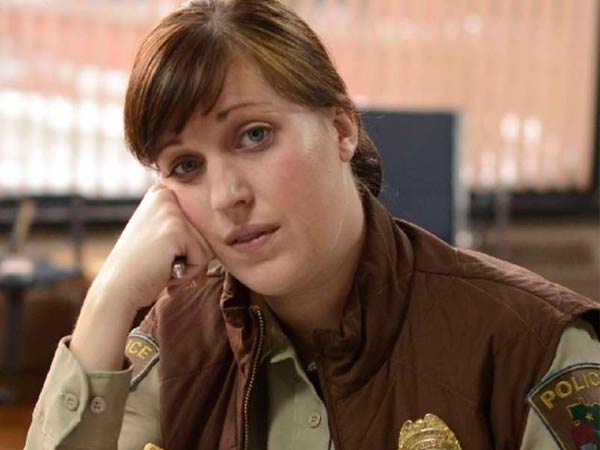
You can watch Fargo’s first season on FX’s website or on Hulu. You can also read our previous piece about Molly, the cop who subverts the trope of the evil hero in modern TV.

Alex Russell lives in Chicago and is set in his ways. Disagree with him about anything at readingatrecess@gmail.com or on Twitter at @alexbad.

Life After the Star Wars Expanded Universe: Philip K. Dick’s The Three Stigmata of Palmer Eldritch

TheThreeStigmataOfPalmerEldritch(1stEd)

Andrew Findlay

In Life After the Star Wars Expanded Universe, we take a look at science fiction and fantasy, why they’re great, and what they say about where our species has been and where it’s going.

Editor’s note: an earlier version of this article mentioned that Philip K. Dick took a lot of LSD and wrote solely genre fiction. They’re both only partially true, and the article has been updated as a result.

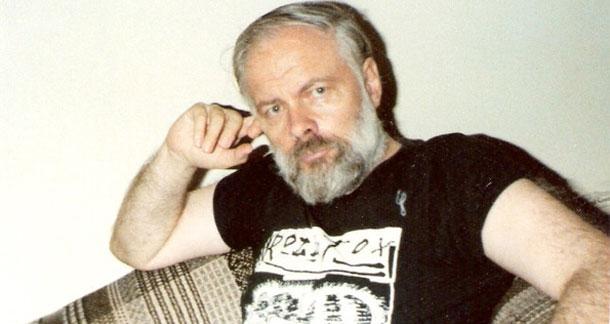
Philip K. Dick is the ultimate psychedelic writer. His explorations of the mutability of reality and the fragility of the human psyche are vivid, incisive, and hallucinogenic. Roberto Bolaño described him as “a kind of Kafka steeped in LSD and rage.” However much altered states influenced his writing, PKD did not actually do that much LSD – it gave him unpleasant experiences. Yup, he was just your run-of-the-mill, square, SoCal writer, ingesting massive quantities of amphetamines as he wrote feverishly, and as he wrote this book, he hadn’t even tried LSD for the first time. As I explain the concept of this book, it is very important to remember that Dick had not yet ingested lysergic acid. He was this crazy beforehand. I’m assuming every single novel PKD ever wrote deals with the nature of reality, its uncertainty and unknowability. I can definitely declare that each one I’ve read by him has always had someone losing their goddamn mind. In this 1965 novel, Dick explores the ramifications of self-medication when the medicine you use is powerful enough to make the universe drunk.

This book starts out in the far future, with many of the trappings of futuristic societies. Due to climate change, it is now too hot to be safely outside, and people have to wear special AC suits to prevent combusting while walking to work. The rich and powerful of the world vacation in Antarctica, which is nice and balmy. Most of the moons and planets of the solar system are colonized, but not happily. The UN runs the world, and in order to preserve humanity from the crumbling, condemned planet Earth, they instituted a draft for emigration. A certain percentage of Earthlings have to be induced to go to space colonies. They have to be induced because colonization sucks. On Mars, there’s nothing to do but tend your dying farm and hang out in your subterranean bunker. Well, that and taking powerful psychoactive drugs. Most of the action of the novel centers around the use of Can-D, a “translation” drug. Can-D is useless without Perky Pat Layouts, a company that makes miniature versions of all the stuff that can be found on Earth (this company also illicitly manufactures the drug). Think Polly Pocket, but extremely realistic.

Sol454_Marte_spirit

Your new backyard, colonist!

It is so realistic because Can-D “translates” its users into the world of the layout. Therefore, if you take Can-D, some type of fungal hallucinogen, while sitting in front of a layout with a beach and a convertible, you get to spend a set amount of time living the life of either Pat, the woman, or Walt, her boyfriend, as they enjoy a seaside holiday. For some reason, the hallucination is dependent upon the layout – if you want to take a beach vacation, you better buy miniaturized beach towels and sun umbrellas. A feature that further complicates this already strange experience is that there are only two possible surrogates for the drug-user’s consciousness: either mini-Pat or mini-Walt. Women become Pat, and men become Walt. This means that if three male/female couples trip together in front of the same layout, all three women will be in Pat, and all three men will be in Walt, directing each as one member of a group conscious. Supremely weird, but honestly, if you were exiled to a barren sandscape where, if you’re lucky and terraforming is advanced enough, you might be able to go outside, wouldn’t you indulge in powerful psychotropics? Everyone in this book does, and that is the most plausible part of it – the human reaction to complete loss and mental stultification is to take stimulation wherever it can be found.

The conflict in the book starts when Palmer Eldritch, a kind of insane, spacefaring Richard Branson, returns from a ten-year voyage to Proxima Centauri with another fungus – Chew-Z. He begins marketing it immediately, and the Perky Pat people react with professional terror, because Chew-Z is a reality-altering drug that requires no layout, which means it is perfectly poised to put them out of business. Chew-Z is similar to Can-D in that it creates an alternate mode of existence for whoever takes it. However, it is much more powerful than Can-D. It can translate you into whichever existence you most want to be in – it is chewable wish-fulfillment. The problem is that, whatever new universe you make for yourself, Palmer Eldritch is there, and he exerts some type of control over your personal reality. If that sounds creepy, wait till you hear what his stigmata are: giant metal teeth, robotic eyes, and a metal arm. These are the three indicating marks you see on the people in your hallucination if Eldritch is taking control of them. Worst. Trip. Ever.

super-01

If I could hallucinate my very own universe, it would be the one in which the Nic Cage Superman movie happened.

A lot of the framework of this novel is pretty generic SF – spaceships that move fast and zip between planets, strange genetic therapies, and space colonization, but the social analysis and the ontological questions raised by drug use in this book make it interesting. First off, it is absolutely believable that the disaffected and depressed legions of press-ganged colonists would escape their bleak existence through whatever means necessary. The implications of their method of escape is also terrifying – if this creates a vivid surrogate reality, how do you tell when the high is over? Do you ever get out? Is this reality any less real than the one you experienced pre-dosing? Does it matter if it is or isn’t? These questions are hammered home again and again, and their lack of resolution strengthens the sense of loss and uncertainty and creepiness that permeate the book.

philip-k-dick-primer

I love this man.

Philip K. Dick is fast carving out a very special place in my brain. I went on an expedition through his work after rewatching Blade Runner a couple of weeks ago. I have moved through three of his novels in the past couple of weeks, and each one is extraordinary. He went through a lot of his life very poor because, despite his prodigious output, he had trouble making money because critics relegated him to the genre fiction backwater. His catalog is overwhelmingly genre fiction, undoubtedly and unapologetically. What is important though is that this man always, always swung for the fences. It’s like he couldn’t help it. The characters might be lopsided, the plot might have pacing issues, and the setting might be overly lurid or unbalanced, but every one of his novels ends with you questioning existence, reality, and your conception of yourself. I have been a committed atheist for half my life, and one of his books had me (briefly) seriously considering the benefits of Gnostic Christianity. His writing is that powerful – while other books might explore what the problem is, his has you worrying over what “what” even signifies. I will take a sloppy book that asks what existence is any day over a perfectly-balanced artifact of a book that explores the problems of one neurotic family whose daddy didn’t give out enough love (I will never stop hating you, The Corrections).

Andrew Findlay has strong opinions about things (mostly literature) and will share them with you loudly and confidently. You can email him at afindlay.recess@gmail.com.

Images: Lit Reactor and IGN

Postmodern Rapture – The Leftovers Episode Two – Penguin One, Us Zero

article-2678245-1F5677FC00000578-381_634x789

Colton Royle

Every Tuesday Colton Royle discusses the newest episode of HBO’s new show about a new kind of rapture, The Leftovers. Since two episodes have already aired, we covered episode one on Friday and here is episode two. You can also read our review of the book the show is based on.

To repeat, massive spoilers ahead.

I cannot believe I’m saying this: there are too many guns. Already in episode two a SWAT team is getting sent into Wayne’s establishment to rob so many Asian girls it’s comical. This action that happens way too soon gets multiplied by Tom “saving” Christine by killing with a gunshot to the neck. Yes, I’m enjoying the parallels to his father, Kevin’s, shooting of the dogs last episode, and yes, we’re debating whether the identities created so far are because of the massive departed, or whether the personality was something there all along, but it’s too much too fast. The violence left the rest of the episode in a fog.

More questions of identity: Kevin Garvey’s mental disturbances mimic the continued parallel to the supernatural plot developments of Stephen King’s The Stand and Under the Dome, and we’re unaware if it is truly madness or divine intervention, which is so 15th Century. It has that Lost feel to it that makes me want to bite down on live electrical wire.

The quick edits to the dog shooting during the therapy session were too quick and not subtle and loud and just…etc.

Kevin’s “Investigation of the Missing Bagels,” felt like a Blue’s Clues episode, but this combined with questioning the shooter’s existence to his father’s schizophrenia was layered extremely well, and featured that adult paranoia that seems to be building in Mapleton.

Yet Jill observing Nora purposely break the coffee mug to get out of paying for her breakfast was easily the most engaging moment in the episode. Is she using her tragic story for profit? Is she simply playing around with suburban niceties? This coincides with her role in “departed insurance” which is literally profit made on the disappearance three years ago.

Jill is at a crossroads, and is the last Garvey to commit to any kind of altered behavior post-disappearance. Playing detective with both the dead dog last episode and Nora this episode has her seeing all the avenues. Again: so much identity.

Meg Abbott swinging an axe is one of those odd totally-a-cult procedures that gets remarked on by Laurie Garvey as “not a cult,” and this is a problem. It’s a problem when handwriting is with blue ink on little white notepads that make us feel like we’re teaching the sixth grade because we’re squinting at the screen. It’s a problem when dialogue moves fast and handwriting and reading don’t. There are some major complexities with the Guilty Remnants that are going to be missed or incorrectly assumed or told without elegance.

Tom’s repeated yelling from underwater last episode to above water this episode was an excellent progression of the suffering that Wayne says he wants, “without salvation,” and perhaps Tom assumes in some way that he is already damned.

Will Kevin uncover the truth about his supposedly “sent” friend? Will Jill and Aimee steal more stale gummy bears? Is Christine really everything? Will Liv Tyler build a log cabin? We’ll let Wayne decide.

Colton Royle is a reader of mostly American fiction and non-fiction. He is currently teaching in Fort Worth, Texas.

Image: The Daily Mail

Tough Questions: What’s the Best Thing You’ve Seen this Year?

question-mark

Every week we ask everyone who hangs out around here to answer a tough question. This week:

What’s the best thing you’ve seen this year?

Rules are simple: what have we, like, gotta see, man? No, really, what have we gotta see? It’s the middle of the year and nearly everything worthwhile is on hiatus. Wonder if anyone here is writing about that? Is that the first meta-plug in the intro paragraph? Why are you reading this, still? Go find out what you’re missing! What’s the best stuff from your first half of 2014?

Alex Russell

“So Did the Fat Lady” is the episode of Louie that’s nominated for an Emmy, but I’m sticking with the entire “Elevator” saga. I’m Louie‘s biggest fan, and I’m honestly a little surprised every time I realize it competes for Emmy awards as a “comedy.” I guess it is, but the “Elevator” arc from this season is everything the show is supposed to be. There were a ton of thinkpieces written about how it’s not funny anymore, but if you’re watching Louie to laugh then you’re missing the point. It’s all about watching a woman try to explain “hairdryer” to someone with no shared language between them. DAMN this season of Louie was good, y’all.

Jonathan May

IMG_1472

I’d have to say the Clyfford Still Museum in Denver, Colorado. Clyfford Still was one of the leading American Abtract-Expressionist painters. The Museum houses 94% of the artist’s output, and he stipulated in his will that all of his work should be sealed off from the public (upon his death) until a museum devoted solely to it was built. The Museum opened just a few years ago, so I was lucky to be able to return to Denver to see it this year. Not only is the building itself absolutely gorgeous (concrete and steel), the paintings hang beautifully in chronological order, with many more in careful storage. I’d never been able to see his paintings in the flesh, so to walk through rooms and rooms of them was just heaven.

IMG_1476

Brent Hopkins

I would say the best thing I have seen this year would have to be Kyoto, Osaka, and Kobe in Japan. I’ve always been intrigued by Japan as a long time video game and anime fan, and finally had a chance to go visit. (I wrote about the arcade culture there way back when.) You always hear about Tokyo, but the other cities are so vibrant and lively that they shouldn’t be taken for granted either. Kyoto in particular had me feeling like I had lived there forever or could live there forever. Just a breathtaking place with amazing people.

Gardner Mounce

The best thing I’ve seen so far this year is the trailer for Boyhood, the new Richard Linklater film. I’m a huge Linklater fan, having seen all of the Before… movies a dozen times. I was smiling ear-to-ear when I saw that trailer. It looks like it’s going to be like the Before…movies but three hours long and with all the cringiness of puberty. That’s my kind of entertainment.

Colton Royle

Can we just talk about how incredible The Lego Movie really was? I mean here is a movie about a kid’s toy that was somehow also about globalization, free movement of capital, and the possibility for a post-nation state while also adding in a little Marxist criticism for the low income workers?

In all seriousness, the movie is really funny. Each cliché is tweaked just out of reach for comedy. Consider the foreshadowing of Emmit’s fall into the human world (spoilers, but it’s been enough time) with items like the “Blade of Exact Zero” and the enlightened flashes that included a cat poster. Consider how Morgan Freeman’s character Vitruvius thinks that a prophecy is true because it rhymes. And the first five minutes of the film in Bricksburg is the most satirical animated wonder since Shrek. While it definitely shows as not a movie for children, it is philosophical and quirky in a way that had me doing jumping jacks.

Andrew Findlay

The best thing I have seen all year is The Sopranos. I have been on a quest to catch up on all of the universally acclaimed television shows from the last couple decades, and The Sopranos has impressed me the most by far. Mad Men is dripping with style, The Wire is sprawling, complex, and incisive, and Breaking Bad is absurdly exciting to watch, but none quite hit the slow and workmanlike layering of a fully realized network of people. The Sopranos is a show about generational psychosis, the American dream, and family (both the kind you see at Thanksgiving and the kind you order to hijack a semi of fine Italian suits for you). All the shows I listed are amazing, but they are all missing something intangible that The Sopranos has, and I expect it to remain for some time in my top five cultural experiences.

Postmodern Rapture – The Leftovers Series Premiere

article-2654110-1EA2AAB600000578-391_634x356

Every Tuesday Colton Royle discusses the newest episode of HBO’s new show about a new kind of rapture, The Leftovers. Since two episodes have already aired, episode one is covered today, episode two will be covered on Monday, and we’ll be caught up by Tuesday. You can also read our review of the book the show is based on.

Colton Royle

We all remember the 1990s and Kirk Cameron, but it’s a new decade, and The Leftovers, an HBO series based on the novel of the same name by Tom Perotta, hopes to avoid any religious dogma while presenting moral aspirations of its very own. The story mostly follows the Garvey family in the suburban and affluent Mapleton, and it has been three years after a rapture-like disappearance of two percent of the world population by unknown causes. “Gary fuckin’ Busey,” a bartender says before turning the volume down, an almost overused reminder in the first episode that there was no motivation or criteria. Mapleton remembers October 14 as “Hero’s Day” and holds a parade to honor the ones that have gone. It is a world of letters with no signatures, and little to no hope of anything near redemption.

The following contains spoilers.

And yet, even with Kevin Garney, police officer and existential night runner, as he punches a photograph of his wife on the wall, even with the students burying a dog and lamenting, “I’m sorry you had to go through this,” and the stale parallels in that, the story is already heading towards some Stephen King style good vs. evil conflict a la The Stand and Under the Dome. Not one but three cults have emerged from the mess of disappearances, each with their own reasoning for the event. The Garney family itself is as fractured as the town, with the father coping with his own wife, in a twist, not as one of those vanished, but a member of the silent-and-chain-smoking-and-traveling-in-pairs Guilty Remnants. Kevin’s son Tom attempts a relationship with a young Asian woman who is under the watchful eye of Wayne, a leader for the second cult, as he holds his eyes open just a little too wide and intimidates with knife moves. And the daughter, who floats in anti-paranoia for as long as possible, gets high on-campus and elbows girls in field hockey.

I myself am stumped by my reactions: do I want a supernatural show to commit to a linear progression of understanding? Because I seem also to enjoy, only slightly, the sheer noise of responses, the entropy of anger. Even the parallel structure with Kevin Garney and his run-in with the dog killer, from hatred for killing animals, to his changeover to shooting the dogs with a gun of his own, the symbolism oversaturated, at least was somewhat intriguing. They showed a lot and told a little, which is a good start, but it will face difficulties in tone and therefore audience if it is continued. “They’re not our dogs anymore,” the hunter says, and while that is true for the town of Mapleton, so far, it is also a question in the air for the entire show. Who will The Leftovers belong to?

Colton Royle is a reader of mostly American fiction and non-fiction. He is currently teaching in Fort Worth, Texas.

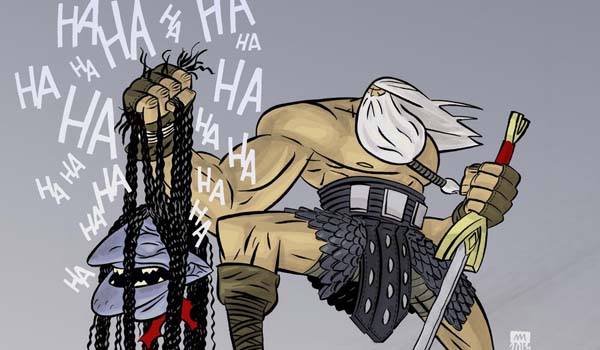
Major Issues: Head Lopper #1 and What We Talk About When We Talk About Lopping Heads

Screen_20Shot_202013-05-16_20at_201.40.08_20PM_original.png

In Major Issues, we look at one newly released comic book each week. Updated Fridays.

Gardner Mounce

Head Lopper: Issue 1
Written and Illustrated by Andrew Maclean
Colors by Mike Spicer
Self-Published
Release: 7/9/14

Comic books are stuffed with “Badasses.” These are characters so “Awesome” they encroach upon the “Mythic.” These are the characters who, in the first scene, catch a flying fist to the astonishment of a gathered crowd. These are the characters who lie sleepless on motel mattresses, hardly aware of the lusty nude figures curled against them. These are the characters who barely keep cigarettes tucked into mouth corners. Whose silhouettes can be seen in a screen of smoke. Who don’t have pasts until issue four (The Past Issue), when it’s revealed that everyone they’ve ever met died in a car accident. These are the characters who have clipped, masculine conversations with clipped, masculine men of any race. Who command presence. Who walk unafraid down the middle of dark echoey streets. Who splash water on their faces. Who reveal weapons just long enough for their assailants to say, “Oh, shit.” Who stand in a circle of assailants, allowing the tension to build with the knuckle-cracking and the jeering. Who then attack every assailant with every limb all at once, and somehow even use the assailants’ limbs against them. Who then stand in the epicenter of all that violence and hurt and look off somewhere else, to some new fight, to some new arena in which they can prove themselves again.

The badass myth speaks to a desire that (some/most/all) men have to be validated for physical strength and cool detachment. Something that most comic book readers are not known for, if you can even believe that. The desire runs deep. That means that the badass myth, however played out it is, will be here as long as men reading comic books are. The flip side is that so will parodies (thank god).

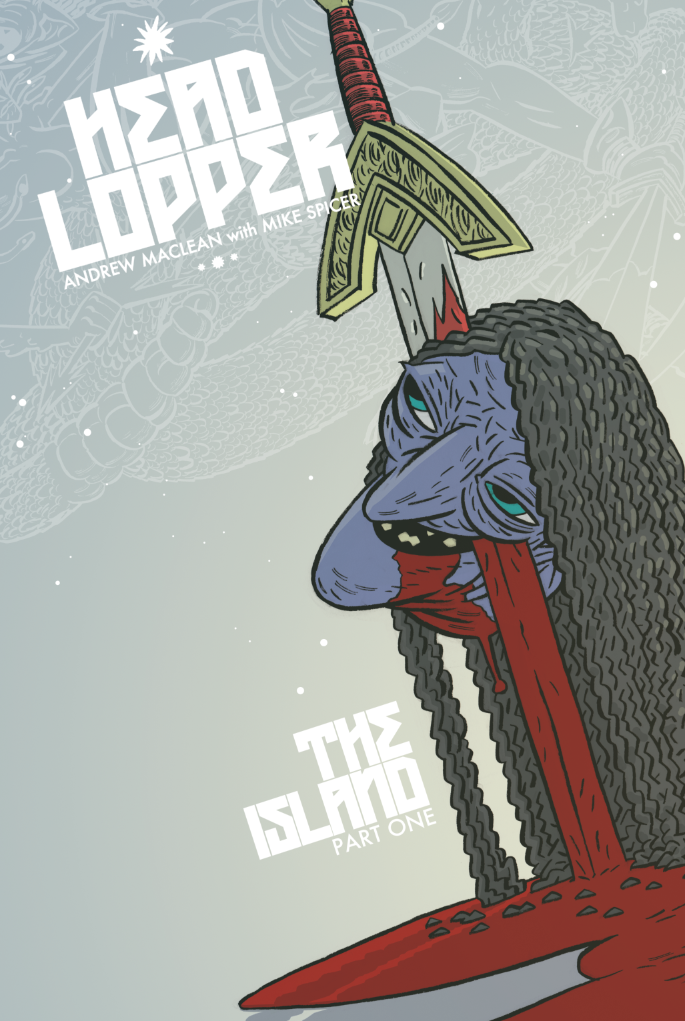
Head Lopper is one such parody. This self-described tongue-in-cheek “sword and monsters” comic is the story of a nomadic warrior, Norgal, and his unlikely companion, the severed head of Agatha the Blue Witch, who arrive on the Isle of Barra to slay a sea serpent. The promise of this series is lots of cartoon violence that toys with (and hopefully subverts) badass tropes and Nordic mythology.

Most of the tongue-in-cheekiness is carried by the art and dialogue and not the narration. There is hardly any narration, which is a good thing, since narration would have slowed down all the fun to be had lopping heads. A steady narrator would have also invited unnecessary backstory to a two-dimensional archetypal character who needs none. The Head Lopper is the Head Lopper is the Head Lopper. Who is the Head Lopper? The One Who Lops Heads. Anything more would run counter-purpose to the comic’s hack-and-slash readability. The story translates well visually, and the only major flaw in the writing in this issue is the dialogue. It never establishes a steady tone and see-saws between unpracticed “medieval speak” (people tend to say “indeed”) and the tongue-in-cheek modern dialogue that better suits it.

The art is simple, clean, and colorful. Maclean delivers wonderfully cinematic aspect-to-aspect panels that either establish setting and mood or cleverly show the passage of time and the silence between one head lopping and the next. Spicer’s colors really make this thing stand apart. He establishes a cool blue-green-gray-purple world and then tactfully splashes hot oranges and torrents of red to ratchet up the action. Characters are drawn in a simplified way, suggesting their archetypal, mythical roots–these are the symbols of masculinity.

Hopefully, in future issues, Maclean will make more use of his source material and give us something even more fun and subversive. Though there’s no guarantee, because as Maclean says, this is a sword and monsters comic–nothing more. True, it’s badass mythology, and played out, but what sets Head Lopper apart from the literally thousands of other comics of the brawn genre is that it doesn’t take itself too seriously. There are a thousand writers of badass stories out there, but very few who allow themselves to have a little fun with it.

header.jpg

Should you get it?

I wouldn’t recommend this comic to someone new to the art form. This is more for seasoned comic book fans who want a nice break from all the up-their-own-asses badassery. Plus, it never hurts to support a talented self-published writer/artist. Get Issue 1 at the publisher’s site or from digital comic stores like Comixology for $1.99.

Gardner Mounce is a writer, speaker, listener, husband, wife, truck driver, detective, liar. When asked to describe himself in three words, Gardner Mounce says: humble, humble, God-sent. You can find him at gardnermounce.tumblr.com or email him at gmounce611@gmail.com