image comics

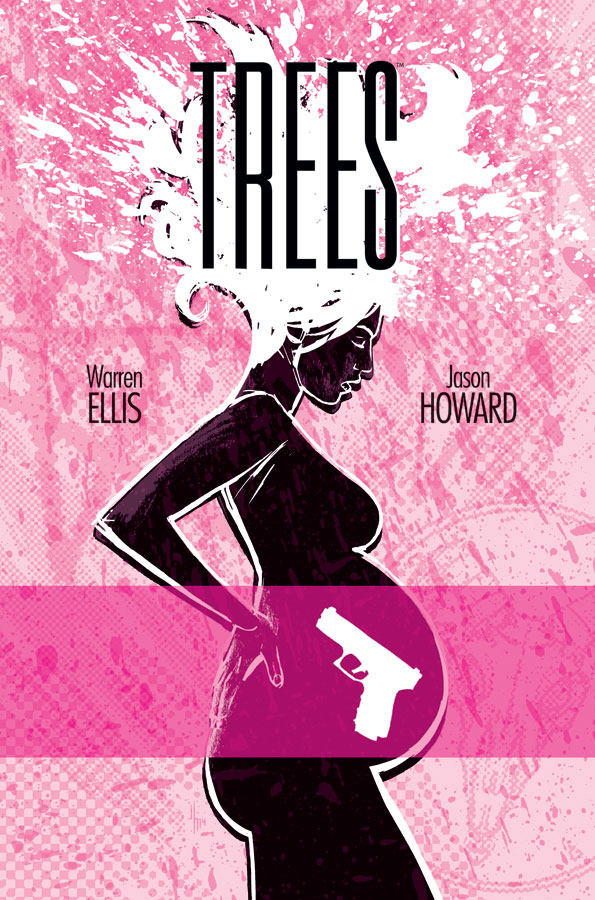
Major Issues: Trees #3

8665.jpg

In Major Issues, we look at one newly released comic book each week. Updated Fridays.

Gardner Mounce

Trees #3
Written by Warren Ellis
Art by Jason Howard
Published by Image Comics
Published: 7/24/14

As pop culture would have it, there are two ways that aliens are going to invade. There’s the Invasion of the Body Snatchers/Men in Black type where one day we find out that the aliens have been living right under our noses for years. And there’s the Independence Day/The Hitchhiker’s Guide to the Galaxy type where the aliens just announce that they’re here and in a few seconds we’ll all be dead. The first thing we notice is that Will Smith has saved us from both types. The second thing we notice is that, in both scenarios, the aliens are accessible antagonists—they’re here among us for us to interact with or fight or whatever, or they’re above us in spaceships for us to throw rocks at. But imagine if an alien race left some undeniable symbol of their presence and utter superiority, and then just left us to scratch our heads about it.

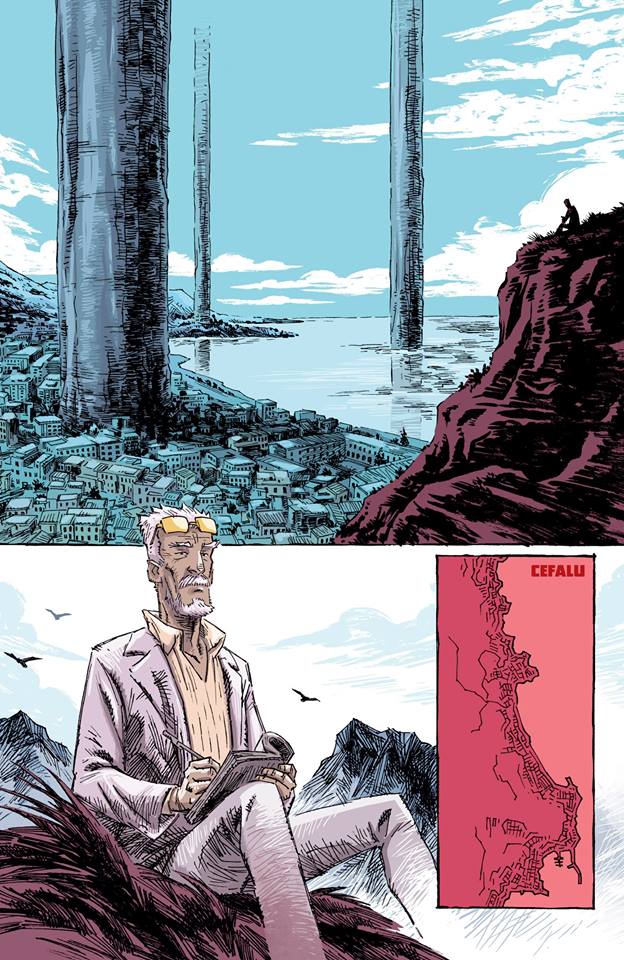
In Warren Ellis and Jason Howard’s Trees, an alien race has punctured the globe with monumental, sky-scraping towers (which humanity has dubbed “trees”)—and then vanished, like, your move, humans, and haven’t returned or made contact for over a decade. Less us-versus-them-story and more human drama, Trees tracks a number of story lines that span the globe, from an ex-professor in Cefalu and the fascist’s girlfriend who stalks him to scientists in Antarctica studying a mysterious black bloom growing at the base of a “tree.”

Ellis handles it all with incredible subtlety. A lesser writer would have written swathes of heavy-handed narration, but after some necessary exposition in the first issue Ellis constructs the world scene-by-scene with zero narration at all. A narrator-less story gives the sense that the reader knows just as much as the characters do about the trees—hardly anything. It also stresses the importance of the present moment: the world has halted since the trees arrived; they are ever-present, in nearly every scene; timeless and unchanging; dominating the landscape and laying waste to our sense of importance and human scale of time. Subtle also is Ellis’ dialogue. It’s been ten years since the trees arrived, so it’s only natural that people aren’t having exposition-heavy conversations about them. People are solving small problems on their own small stages, leaving the reader to synthesize bits of information to form the larger picture. The dialogue is smart, clipped, and avoids pandering.

Jason Howard is one of those imminently readable artists whose art is so functional that it’s almost invisible. It takes a keen eye to discern his moves. He uses the same types of panels over and over, and, taken together, the pages form a rhythm. There are the borderless panels that suggest timelessness, the bordered action panels that break the borderless panels up, and the white-backgrounded panels that strip the world down to action, reaction, and emotion. The borderless panels often establish expansive spaces like arctic vistas, sterile cafeterias, and “tree”-dotted Italian landscapes. These ground us in the sense of timelessness that the “trees” have imposed. These borderless panels are the arena on which the story takes place, and the places to which we always return: huge silent spaces punctuated by human action. Much rides on Howard’s colors, which he uses to establish mood. From cool conciliatory blues to altercation-accompanying yellows and pinks, his art is about subtlety.

Alien invasion stories are generally heavy on action and light on mystery. And we usually know the invaders’ intentions by the end of act one, which gives us plenty of time for preparing for fighting, fighting, and high-fiving over the fighting that just occurred. Trees stands apart because, first of all, there are no roles for Will Smith to play in the movie adaptation, and second of all, we don’t have any idea why the aliens dropped these “trees” down on us. To study us? To suck the life from our planet? To mess with us? The whole fun is that not knowing makes us feel out-of-the-loop and insignificant, and that fear of our insignificance spurs us. Fun, right?
tree-2.jpg

Should You Get it?

Absolutely. As a writer, Ellis is confident as hell, and treats his readers with respect. These first three issues have been slim on action and heavy on establishing world, character, and conflict. He will not spoon feed, he will not pander. This is a serious comic for serious readers, and as with almost any Ellis comic, will most likely have tremendous payoff. Though, I will say, this comic might be more satisfying in trade paperback form where you can read a lot in one sitting.

Gardner Mounce is a writer, speaker, listener, husband, wife, truck driver, detective, liar. When asked to describe himself in three words, Gardner Mounce says: humble, humble, God-sent. You can find him at gardnermounce.tumblr.com or email him at gmounce611@gmail.com 
Major Issues: Saga #20 and Binge Watching vs. Actually Doing Something

image

In Major Issues, we look at one newly released comic book each week. Updated Fridays.

Gardner Mounce

Saga #20
Written by Brian K Vaughan

Art by Fiona Staples
Published by Image Comics
Release: 6/25/2014

Saga is not a comic for the faint of heart. It’s irreverent, crude, and pairs attraction with repulsion like a sociopathic sommelier. For example, this very NSFW picture of a naked woman with a spider vagina. Awesome! Saga is a mixed bag. It sometimes hits with you an ethical quandary, and sometimes hits you with arachnid genitals. Just like in life.

If you know nothing about the comic, it’s the story of Alana and Marko, citizens of the planet Landfall and its moon Wreath, respectively. Landfall and Wreath are at war, but since the destruction of one would mess up the other’s orbit, the war has been outsourced. It’s Star Wars meets Romeo and Juliet with a whole lot of Vonnegutian humor.

Of the many things Issue 20 deals with (drugs, dance lessons, …) it spends some of its time with Alana at her job at the Circuit (a television station, of sorts). She gets into a conversation with a coworker about what capital-g Good, if any, they’re doing as actors of the Circuit. The coworker says none; they’re drug-dealers, and the Circuit is the opiate for the masses. Alana counters by saying that as a kid she watched a Circuit show that irrevocably changed her views on poverty. But, her coworker counters, “What did you do? Join a nonprofit organization? Volunteer at a soup kitchen? Or did you lock yourself in a tiny room, shut the blinds and mainline every transmission like a junkie?”

This is a great question for our binge-watching culture, and the type of thing Saga is wont to ask. I’ll state it in another way: Is a story considered a failure if the audience doesn’t internalize the unique perspective and act on it?

It reminds me of a similar question brought up in Fahrenheit 451. In that book, the scholar-in-secret, Faber, argues that there are three things a healthy culture requires to avoid ossification: art with texture, leisure time to reflect upon that art, and the ability to act on the lessons learned from it. In our culture, I think that we do plenty of the first two, but do we allow ourselves to act on the implications of the art we engage with?

Allow me to completely derail this Saga train and talk a little about Orange is the New Black (no spoilers) because it’s a good example. Can we watch OitNB and shirk the onus to reform the prison system? Well, people do. But is this right? Are we avoiding the third step of Faber’s advice in Fahrenheit 451 and putting our society at risk of ossification? The best answer I can give is that social reform is a (possible) positive byproduct of good story, but not story’s objective.

The first thing stories do, as David Mamet says, is to order the universe into a comprehensible form. A story is working if your first inclination once an episode ends is to watch another one. That means you’re invested in its characters, in its world. It is ordering the universe into an exciting and comprehensible form and giving you some new perspective or understanding of it. And so a writer’s objective shouldn’t be “Well, I’m going to teach them all something,” but “I’m going to drop them into the world of story and show them (in an interesting way) a little of what it’s like to be these particular human beings.” If a story’s success was based on its ability to teach something, then we could reduce stories to preaching and pamphleteering. Our stories would all come to resemble The Pilgrim’s Progress. And, of course, stories are so much more than this. Great stores are like a black box we get dropped into. Once we get to the other side, we should be changed in some way. Maybe we don’t have a new answer, but we have a new perspective. In the case of OitNB, we see that the prison system is a dehumanizing system. It is not something the writers force on us like a sermon, but a condition of the characters’ lives. It is a necessary and unavoidable element of telling the story honestly.

But once we have that new perspective, is it wrong to not act on it? Are we watchers of OitNB immoral for locking ourselves in a dark room and binge-watching instead of working for prison reform?

Maybe you know more about the problem than I do, and maybe it’s not as bad as it seems, but based on what I know, I feel like I should do something. Am I going to go start a nonprofit? Rally in the streets? Honestly, no. But I will vote differently, and I will speak up in conversation. After all, maybe that’s the best way to effect social change–through stories, not through argumentative means, by showing how human lives are affected by the dehumanizing systems we have created, and creating empathy for them.

443816

Should you get it?

(Saga, not Orange is the New Black)

Yes. Though Saga has its weaknesses (almost all of the characters’ voices sound the same) it’s one of my favorite ongoing series. It’s smart, consistently hilarious, filled with bizarre environs and ridiculous characters, and very punk rock. It also raises great questions (see above article). You can get the trade paperback of the first six issues on Amazon or at your local comic book shop for $9.99.

Gardner Mounce is a writer, speaker, listener, husband, wife, truck driver, detective, liar. When asked to describe himself in three words, Gardner Mounce says: humble, humble, God-sent. You can find him at gardnermounce.tumblr.com or email him at gmounce611@gmail.com 
Comic Review: The Wicked + The Divine: Issue 1

thewicked1

Gardner Mounce 

The Wicked + The Divine: Issue 1
Written by Kieron Gillen
Art by Jamie McKelvie
Published by Image Comics
Release: 6/18/2014

There are few things as pathetic for adults to engage in as the cult of personality. As a teenager, it’s expected–encouraged, even–to hang posters of pop stars and athletes on your wall. They are your heroes. They inhabit that nebulous world of fame that promises fulfillment and power, etc. But when you grow up, you pull back the veil and it turns out Justin Bieber is a turd and… Creed? (Yes, I had an actual Creed poster on my wall when I was in fifth grade. It’s my life. I wasn’t living it for you.) Image Comics’ latest release The Wicked + The Divine (heretoforth known as WD) finds that balance between idolizing these figures and understanding them to be human, but then tips it. Because in WD, the pop stars are actual gods.

In this world, 12 deities incarnate every 90 years as humans in order to live two years on Earth. Why? I’m not sure yet. But in 2014, they’re pop stars. Roll with it. Let’s touch on which gods we’re talking about, first of all. Is this going to be about a hip Jesus MCing a rap battle between Yah Boi Yahweh and Allah $? No. In the first issue we meet Ananke (Ancient Greek), Susanoo (Shinto), Amaterasu (Shinto), Sakhmet (Egyptian), and Lucifer. Try to guess which of those I didn’t have to Google. So, kudos to writer Kieron Gillen for exploring mythologies not often found in pop culture. Though the reader goes into the story knowing the gods are legitimate, Gillen doesn’t give the reader a god’s eye view. After an explosive introduction, we follow Laura, a 17-year-old fangirl of the gods (i.e. the teenage perspective in that balance I mentioned earlier). But, wisely, Gillen packs the deck with adult skeptics. A reporter accuses Amaterasu and the other gods of being “kids posturing with a Wikipedia summary’s understanding of myth,” and, more hilariously, accuses Amaterasu of being “a provincial girl who doesn’t understand how cosplaying a Shinto god is problematic at best and offensive at worst.”

thewicked2

Throughout, the dialogue crackles with similar wit and character. But that isn’t the only aspect of the writing that’s on point. The scenes build and explode with heady pacing and smooth transitions. And, suggesting a great trust between writer and artist not often found in comics, Gillen never weighs down the art with unnecessary narration. It should be a major pet peeve of every comic reader when a panel that shows a man running from a bomb also has that man yelling, “I am RUNNING from a BOMB!”

The art matches the writing in quality. Whether or not you’ve read another McKelvie comic, you know intuitively that his art is practiced. The panels are arranged poetically, correctly, becoming denser or larger with the beats of action. Likewise, colorist Matt Wilson endows the panels with a versatile color palette capable of portraying violence, beauty, and fame. In this first issue, the really standout feature of the art is the character design. It is my suspicion that each character has a real-world analogue that may or may not have deeper significance. Amaterasu looks like the lead singer of Paramore going through a hippie stage. Sakhmet looks similar to Rihanna. And Lucifer (Luci, in this case) looks just like Pink.

thewicked3

Lucifer, everyone.

The promise this first issue shows isn’t in the premise or story, which is, in my opinion, sort of like American Gods (which I really didn’t like) but in how the story is told. Gillen and McKelvie are master storytellers, and the evidence is borne out in the details.

Should you get it?

Yes, most definitely. This is an exciting new release, written with intelligence and wit.

Gardner Mounce is a writer, speaker, listener, husband, wife, truck driver, detective, liar. When asked to describe himself in three words, Gardner Mounce says: humble, humble, God-sent.