star wars

Life After the Star Wars Expanded Universe: Patrick Rothfuss’ The Wise Man’s Fear

Andrew Findlay

In Life After the Star Wars Expanded Universe, we take a look at science fiction and fantasy, why they’re great, and what they say about where our species has been and where it’s going.

Warning: While I wouldn’t really call anything I discuss a big spoiler, absolute purists may want to tread lightly. I discuss some general plot points.

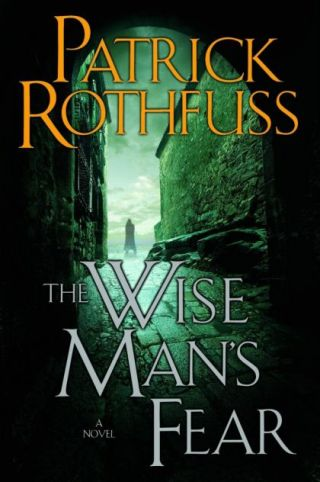
The Wise Man’s Fear has generated a lot of excitement in fantasy circles in recent years. Book Two of The Kingkiller Chronicles, it continues the story of Kvothe, master wizard, musician, and warrior. The framing device for The Kingkiller Chronicles is that Kvothe, the titular kingkiller, has gone into hiding as an unassuming innkeeper in a nowhere town. He has taken the name Kote and spends his time pressing apples for cider and cooking mutton for guests. A chronicler happens upon the inn, recognizes him, and asks to take down his story. Kvothe obliges, and the story starts. It’s an appealing bildungsroman, underdog-against-all-odds type of tale. At the time that Kote/Kvothe is telling his story, he has achieved legendary fame, accomplished a ridiculous amount even by the standards of heroic fantasy, and then retired. When I say “accomplished a ridiculous amount,” maybe I would best make my point by quoting the beginning of his account of his life:

“I have stolen princesses back from sleeping barrow kings. I burned down the town of Trebon. I have spent the night with Felurian and left with both my sanity and my life. I was expelled from the University at a younger age than most people are allowed in. I tread paths by moonlight that others fear to speak of during day. I have talked to gods, loved women, and written songs that make the minstrels weep. You may have heard of me.”
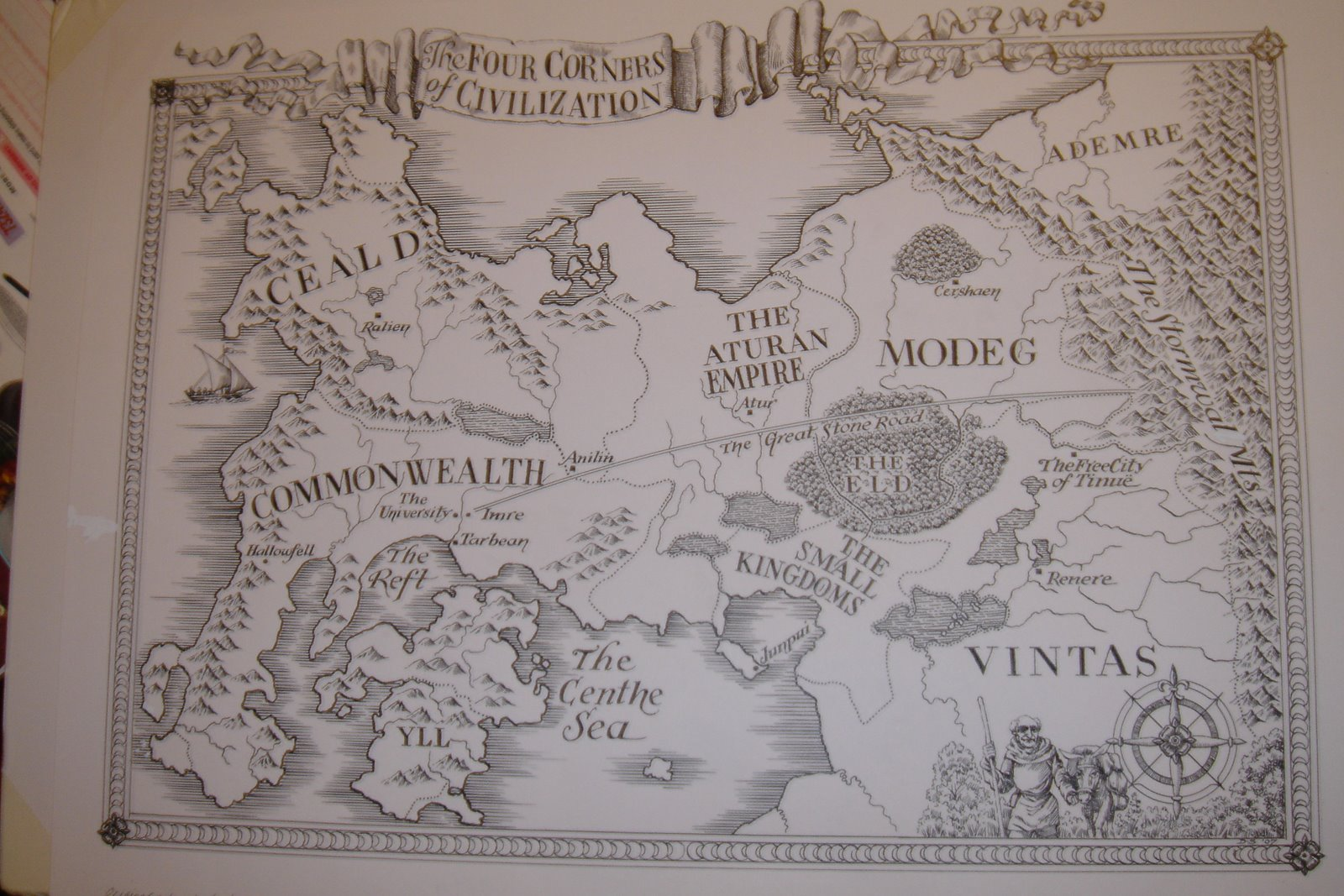
Also, here’s a map. I don’t think you’re allowed to write fantasy without a map.

Kvothe was a big problem for me for a very long time because Rothfuss would hammer down the “Kvothe is so cool!” nail relentlessly throughout the entire first book. The strongest criticism against the character is that he’s a definite Mary Sue. He’s an underdog because he’s a poor orphan, but he is anything but poor talent-wise. He breezes past his magic school entrance exams, grows extremely powerful in magecraft, and is a master musician. The problems Kvothe confronts in the first book seem contrived. Oh, he’s really poor? That must really suck when you’re the most powerful young magician in the entire freaking world. After finishing the first book in the series, I did not come back to it for years, as I’d read in a blurb somewhere that he meets Felurian, an ancient sex goddess who either kills men or drives them insane with her vulvic talents. He escapes, because it turns out that he is so naturally good at sex that he impresses a five-thousand-year-old GODDESS OF SEX with his skills. As a virgin. This was a breaking point for me, as Rothfuss seemed to be building a character like you used to build characters when you were sub-10 and playing superheroes: OK, he’s as strong as Hulk, as fast as Flash, also he can breathe underwater and shoot fire from his hands. And he can shoot ice like Subzero, too. The Penny Arcade guys love this series, but even they take Rothfuss to task for this:
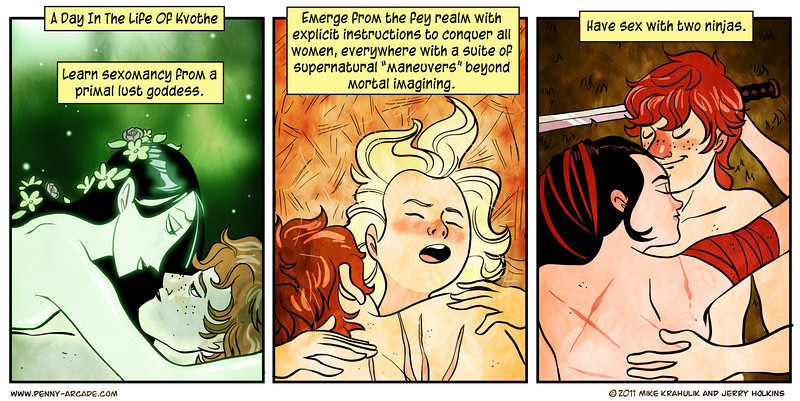
With all that being said, the Mary Sueness is improving. In The Wise Man’s Fear, he’s still way too good at everything, but at least he has some believable flaws. His ego is causing serious problems for him, he is struggling in some of his classes, and there are many things he does not know. Even his meeting with the sex goddess Felurian went down differently than the blurb made me think – he didn’t sex her so good that she fell in love with him. He was almost killed but fought with pure will and magic until he achieved victory. He still learns sexomancy from a lust fairy, but the problem was not his talent, it was that he was extremely talented at just about anything he tried. Him besting Felurian is fine, because he did it with unbelievably impressive magic, and being unbelievably impressive at one thing is fine as long as it’s not all the things. His character is easier to swallow in The Wise Man’s Fear because he faces more real struggles and he’s not just the absolute best at everything. Well, not every single thing. The Mary Sue problem still exists, it’s just no longer unforgivable. The thing is though, as an American reader, I can’t help but think of Superman. He is the most famous comic book character in the world for a reason, and one could argue that he’s way too talented – barring exposure to an extremely rare radioactive element, he’s unstoppable. The Kvothe of The Name of the Wind is insufferable, whereas the Kvothe of The Wise Man’s Fear is merely stuck within a Superman complex – over the top, but not story-breaking.
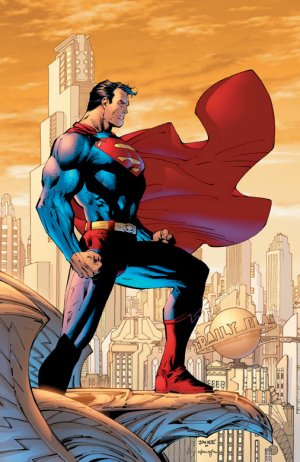
Fuck plot armor. I’m explicitly unkillable!

The strength of The Kingkiller Chronicles lies in its reverence for the art of storytelling. The framing device for the whole book is the protagonist telling a story about himself. Within that story, there are a lot of common, insignificant myths that do a lot to increase the texture and weight of the world. There are stories about religion. Travelers pass the time around campfires in telling each other tales. These range from rumors and gossip passed along on the road to old creation stories. In addition, the main quest of the series is Kvothe’s desire to find a group of seven immortal demons. Most people think these seven, the Chandrian, are just a silly children’s tale, but that’s because these monsters have spent the last few millennia obliterating any trace of themselves from the stories of men. Kvothe’s father begins researching them, and they show up and murder Kvothe’s entire family. Kvothe’s main motivation throughout the books is to gain enough knowledge and power to find and kill the beings who made him an orphan. His search for knowledge explores the beautiful patchwork nature of human storytelling – he manages to find a piece here, a sliver there, but all the stories are slightly different, the names added to or worn away by time, minimized or aggrandized by whichever culture acted as the story’s steward from the time it was created to the time Kvothe found it. Why did the Chandrian work so hard to make these stories so few and far between? It has something to do with the magic system of the book – knowing the true names of these creatures would give Kvothe some measure of power over them.

Pictured: The most powerful weapon in the fight against evil

One of the standout features of The Kingkiller Chronicles is its compelling magic system. Magic systems are important. They define the way mages can influence the world around them, which is a major concern of most fantasy. Rothfuss’ is inventive and intricate. The author includes many detailed, rule-bound systems and schools of magic, but all of these different techniques are children playing with matches compared to the roaring conflagration of Naming. Naming as a form of magic used to be widespread, but now only a handful of extremely talented people can manage it (Kvothe is, of course, among them). Naming consists of being able to intuitively know and call the true name of different things – wind, fire, rock, even blood or bone, even people. If a Namer calls something by its true name, he or she can control it. This is much more powerful than the other forms of magic. A Namer can break a hole through a thick stone wall by speaking to it. He can kill by calling the name of the wind and sucking the breath out of the lungs of his enemy. Naming, the true and accurate use of the perfect word at the perfect moment, is the most powerful form of magic in this world. This, along with the lovingly crafted myths that permeate this narrative, emphasizes the importance and power of writers and writing. The right words can kill an enemy, burn down a forest, or break through a wall. This focus of The Kingkiller Chronicles will appeal deeply to lovers of words and stories.

Wearing one of these is a really, really bad idea in this world.

Ironically, for all of its care and focus on the nature and power of stories, The Wise Man’s Fear has taken a lot of flack for its own storytelling. One of the main complaints is that, although it’s book two of three in The Kingkiller Chronicles, there is yet to be a kingkilling. Many are concerned with the pacing of the story – with only one book left, how will Kvothe kill a king, find his parents’ murderers, and bring the story he’s telling up to the present day? Another major criticism of The Wise Man’s Fear is that it seems like a mass of stitched-together short stories about Kvothe instead of a cohesive novel. Kvothe at school, Kvothe hunting bandits in the forest, Kvothe in the Fae realm, Kvothe with the desert swordsmen, et cetera. I see the point of this complaint, but I don’t care because all of these stitched-together stories are entertaining and well-written. Rothfuss has a gift for vivid, clear, and immediate writing, and he’s very good at describing knuckle-whitening fight scenes. Honestly, as a fantasy writer, if you can describe a duel involving magic, swordplay, or both with energy and deftness, you can be forgiven for a host of other niggling complaints.

In conclusion, the book is flawed but well worth a read. I’m a strong believer in the phrase “don’t let perfect be the enemy of good,” and just because this novel is not perfection does not mean it’s not enjoyable. Sure, the main character is Mary Sueish. Sure, this book consisted of what felt like a bunch of sidequests. Here’s the thing though – the character is driven and compelling through the sheer force of his skill. The sidequests are engrossing and fun standing by themselves. Also, the pure power of the narrative is a roaring river – hard to resist. I read this book for hours at a time. Finally, the languorous love affair with tales of any and all kinds that Rothfuss builds into the book, along with the idea of writer as Namer and words as power, serves to forge this series into a paean to the strength and gift of human communication and storytelling, which is a worthwhile accomplishment.

Andrew Findlay has strong opinions about things (mostly literature) and will share them with you loudly and confidently.

Image sources: Wiki, Penny-Arcade, and io9
Life After the Star Wars Expanded Universe: Europa Report

Andrew Findlay

Science fiction is a rich and varied genre. There are many different ways to put together a good SF story. There’s far future SF like Banks’ Culture series, in which everything is so advanced that almost anything is possible. There’s future past like Gene Wolfe’s Book of the New Sun, in which the story actually happens in the far future, but there’s been some sort of cataclysm that has reduced everyone to a semi-medieval style of living. Future past has a fantasy feel to it, as many powerful artifacts are lying around from the past that may as well be magic. There’s also science fantasy, where works like Star Wars exist: The jedi are spaceship mages. The niche that Europa Report fills is the near-future space exploration subgenre. We are advanced beyond what we currently have, but not by much. We are interested in exploration and colonization of our own solar system, but it’s still really difficult. Finally, there’s a gritty realism that may not be present in some of the other subgenres.

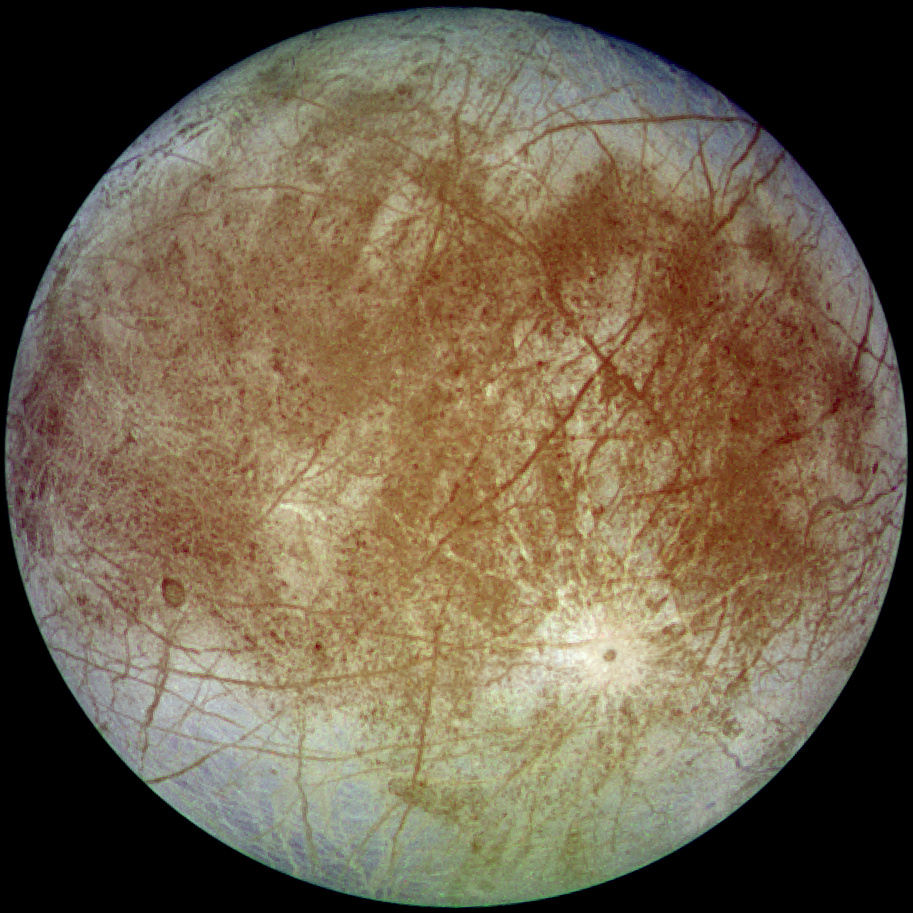
Europa Report is a movie about a mission to Europa, one of Jupiter’s moons. Europa is an ice moon, and there are indications that there is a liquid ocean underneath the ice. As such, it is one of the best locations to search for extraterrestrial life. The cool thing about this type of SF is everything I just said is simple science – there is no fiction yet. Scientists really do think there could be life under Europa’s ice. The fictional bit occurs when a privately-funded space exploration organization puts a team of humans on a ship to Jupiter to figure all of this stuff out.

This movie is a little terrifying. The problem with exploring space is that it’s dangerous as hell. Even Nixon, who presided over the moon landing, hedged his bets and had an oh shit speech prepared just in case Aldrin and Armstrong got stranded in the Sea of Tranquility. Astronauts are people who agree to strap themselves into a small room on top of 500 tons of explosives, have those explosives lit, and ride that small room away from an environment where they can live and breathe and into an environment that can kill them through freezing their blood, popping their blood vessels, or suffocating them. The only thing between them and death is a layer of titanium. Astronauts are insane. If something goes wrong with the propulsion system halfway to Jupiter, you just sit in space until you die. If your transportation breaks on the highway, you curse, get out of your car, take a deep breath to sigh in frustration, and call AAA. If your transportation breaks in space, going outside will kill you, taking a deep breath will exhaust your tenuous oxygen supply even faster, and no one can get any assistance to you.

Yes, the top of this cone of flame is the most rational place for me to be right now.

This danger, the risk and nobility of accepting a long-term space mission, is the central focus of this movie. To borrow a line from Nixon’s speech, space explorers are willing to “[lay] down their lives in mankind’s most noble goal: the search for truth and understanding.” Yes, astronauts are insane, but I love that Earth produces a class of people for whom the pursuit of knowledge is worth the sacrifice of their lives. The tension created by the constant risk in this movie is explored through cramped, short camera shots. There are a lot of closeups on faces and the set design is a nest of tiny rooms that all look very similar and give a mild claustrophobic effect. The structure of the movie itself emphasizes the danger inherent in space travel – the framing device for the narrative is found footage cut with a press conference with the space company’s CEO explaining what went wrong with the mission. This device is an interesting way to tell the story, but one drawback is that I was not really sure what exactly was happening for the first half hour of the movie.

The characters are appealing, but not very well fleshed-out. A week after watching the movie, I do not remember anyone’s name. There’s no-nonsense captain man, bubbly and excited science girl, loving father man (played by Sharlto Copley), and grizzled Russian engineer. The cardboard nature of the characters does not detract from the story itself, as it just underlines the fact that these people have subjugated themselves entirely to The Mission. It does exacerbate one issue with the movie – the camera shots are clean and spare, everything looks great, and the concept of the movie is interesting, but I found myself getting more and more bored as the movie went on. More in-depth characterization and better dialogue would have done a lot to alleviate this problem.

If you like space, you should watch this movie. Its editing can make it confusing, the characters are as empty as the space that surrounds them, and the pacing could have been tighter, but it looks good, attacks an interesting concept, and carries one of the most important themes in art: the pursuit of knowledge is the greatest good, and we do not matter in the face of that. The sacrifices explorers have made throughout history have bettered mankind. The drive to explore and push the physical bounds of what we know is one of humanity’s greatest traits, and this movie glorifies that impulse.

Image sources: Wiki

Life After the Star Wars Expanded Universe: Neil Gaiman’s American Gods

png;base647a670ee3cff69c24

Andrew Findlay

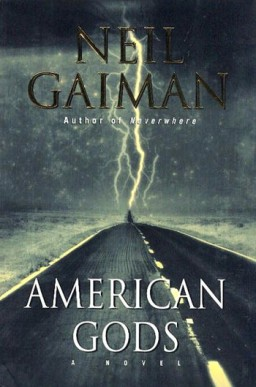
Neil Gaiman has been a darling of fantasy fiction for years. His profile is huge and unassailable – multiple awards, multiple movie adaptations – this is a writer who goes on late night talk shows and people watch those shows specifically to see him. Any two or three of his works are enough to qualify him as a game-changing writer. If you have not read Sandman, go do that right now. It is the best thing he’s ever written, and one of the best 15 things written in the last 50 years. I can’t get into it right now because the story is massively complex and free-roaming, but do yourself a favor and check it out. Today’s book, American Gods, won the Hugo, Nebula, and Locus awards. To give an idea of how big a deal that is, only 10 books have ever done that, and two of them were written by Isaac Asimov and Arthur C. Clarke, respectively.

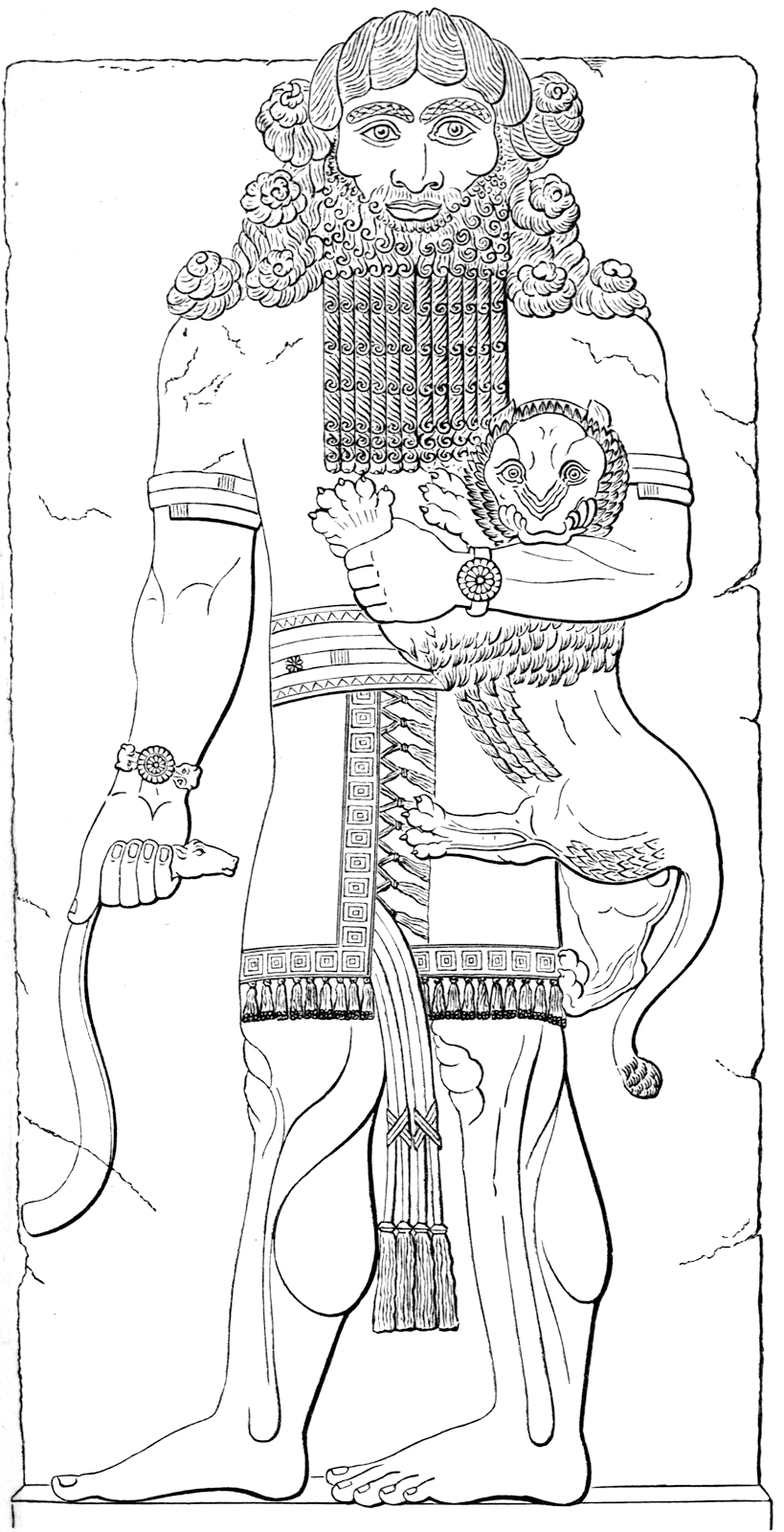
American Gods is fantasy, which is a really important genre as it’s the first there ever was. Think about it: In Gilgamesh the main character is the son of a goddess, befriends a wild man, slays an ogre, rejects the advances of the goddess of sex, and slays the skybull she sends to destroy him in revenge. In The Odyssey, the main character blinds an ogre, pisses off a sea god, and is assisted by and given gear by a war goddess. Any number of old stories contain fantastic elements: humans made of clay, humans made of thrown rocks, world-wrapping floods, and so on. These early stories are special, as they all attempt to explain humanity, its place in the world, and how they both came about. There is no whiny asshole running around with daddy issues (I’m looking at you, The Corrections). At the dawn of human cultural life, all of the stories were concerned with how we got here and what we should do about it. Of course, people back then had no fucking clue and just made shit up. The results were amazing. Modern fantasy stems from either that initial efflorescence or from all the stuff J.R.R. Tolkien single-handedly standardized. American Gods is the former. It goes old and deep for its mythology.

I am the oldest character in all of literature, and my beard rings are amazing.

Some people hate American Gods, and those people are wrong. There is plenty to hate, but a lot more to love. The first big hit is that the main character’s name is Shadow, which is usually not a good sign quality-wise. In general, the characters are there to advance the plot and to do cool things. There’s depth there, but not a lot. Shadow is a pretty simple guy who is set up a little maladroitly as a big strong silent type, but with hidden feelings. At the start of the novel, he finishes a three-year bid in prison. Later in the novel, he remembers being a kid and crying while reading Gravity’s Rainbow in a hospital while his mother died of cancer. Jarring mismatches like that rub you wrong and don’t deserve to be forgiven, but there is just so much good to go with the bad. Most of the good comes from the premise in the title itself.

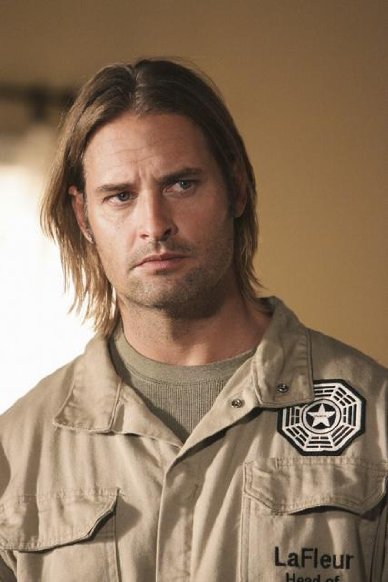
What exactly are American gods? The premise that makes the book is that gods are generated by human thought and belief. For example, Odin (who is a main character), first popped up in America when Vikings visited the Americas, got into conflict, and slew a native in a ritualistic way. The power of their belief created him. Then they left, and Odin spent the next few centuries kicking around the continental US as “Mr. Wednesday” (Wednesday = Wōdnesdæg or Odin’s Day). This method of god creation is upliftingly anthropocentric – our belief is not just their payment or due, but the key to their existence. Unfortunately for the gods, lack of faith leads to lack of food. Without constant, strong belief, they weaken and, if they can find no substitute, they die. The substitutes available normally consist of some type of human interaction tangentially related to their godhead. For example, the half-djinn Queen of Sheba, Bilquis, achieved fame and drew belief as a great seducer. In American Gods, she is working as a prostitute and drawing her power and sustenance from that. An American incarnation of Anubis, the Egyptian death god, runs a funeral home and draws his power and sustenance from that. The hardscrabble landscape of American belief has transmogrified Mr. Wednesday, an incarnation of the Norse god of war, wisdom, and poetry, into a confidence man. There is definitely a precedent for Odin as a type of trickster god, and his godhood being shaped and reflected by American culture emphasizes and feeds this aspect of him. He gains strength and survives through bamboozlement. For example, he needs money, so he finds an ATM, dresses up like a security guard, handcuffs a briefcase to his hand, and marks the ATM as out of order. When anyone comes up to make a deposit, he apologizes, takes their money, and painstakingly writes them a receipt. He then walks away with a ton of money. He not only gets cash this way, but also acquires the “worship” necessary for his continued existence. The problems associated with lack of spiritual nourishment create the central conflict of the book.

I’m going to need a little bit more than that to survive, Ron.

Old gods are scattered across all of America. All of the immigrants who ever came here, and all of their beliefs, created sub-pantheons filled with strangely reduced gods. Old cultures come over with their old beliefs, then slowly buy in to the new ones. Up to the time of the book, these gods have only had to deal with their transformation and weakening due to the acculturation of their worshipers, but problems arise when they enter into direct competition with the new gods, avatars of tech, finance, and the like. As Americans worship these things with more fervor, so do their respective avatars gain power, to the direct detriment and weakening of the old gods. Once created, gods have staying power, but if they are completely cut off, they will simply fade into nothing. This is an undesirable outcome, so the main plot of the book deals with the old gods’ actions to preserve themselves in the face of the onslaught of the modern world.

Yes, the plot is linear and simple. Yes, the characters could have a little more depth. Yes, the protagonist’s name is Shadow Moon. Do any of those things make this a bad book? I mean, yes, they would, if there wasn’t more to it. American Gods is an exploration of American belief, American places, and the American psyche. Neil Gaiman is an Englishman who settled in Minnesota, and this is his love letter to his adopted country. The whole presents a mythic America, one where the salt of the Earth is the center of the nation and where roadside attractions are the most sacred and powerful locations in the country. The climax of the novel takes place in the holiest spot in the United States – Rock City, just outside Chattanooga, TN. The swindler habits of a major character – Mr. Wednesday – dovetail with the venerable American tradition of getting one over on people not as clever as yourself, from Tom Sawyer getting people to paint a fence all the way down to a more modern Sawyer.

Son of a bitch.

Ultimately, this novel’s passion for Americana and its in-depth commentary on the nature and power of human belief far outweigh any niggling concerns with naming or plot pacing. Much like taking a road trip (which occupies most of the plot), you might go to some less-than-ideal places, but you will still have an amazing time there because of the idea of the road trip. The idea of this novel transcends any flaws that mar its execution. I believe it is a great novel, and as Neil Gaiman himself writes in the novel:

People believe…[i]t’s what people do. They believe.

And then they will not take responsibility for their beliefs; they conjure things,

and do not trust the conjurations. People populate the darkness; with ghosts,

with gods, with electrons, with tales. People imagine, and people believe: and

it is that belief, that rock-solid belief, that makes things happen.

It is not a perfect novel, but any book containing the above quote has my vote. It is not flawless, but much like the nation it enshrines, the monumental good overwhelms the (admittedly) searing bad.

Image sources: IMDB, Wiki

Life After the Star Wars Expanded Universe: Ursula K. Le Guin’s The Dispossessed

Andrew Findlay

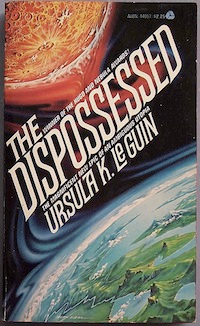
The Dispossessed is a perfect novel. It is great not just because of plot, characterization, or prose, but because Ursula K. Le Guin structured it in a way that makes it almost an architectural marvel. The general plot is fairly basic – in the Tau Ceti system, there is a binary planet – a system in which two planets orbit each other. The original world, Urras, lush, green, and rich, is at the mercy of a massive revolution led by a woman named Odo. To defuse the situation, the government makes a deal with these Odonians to send them to Anarres, the other world. The revolutionaries take the deal, even though Anarres is basically a planetary desert. The story opens a couple of centuries later, when a famous Anarresti physicist, Shevek, is invited to Urras to help work on a mathematical equation which would enable faster-than-light travel. He heads to Urras on a journey that will finally unite his people and make life better for everyone, the end. Except Le Guin puts it together in a way that makes it so much more complicated and rewarding.

Science fiction is a spectacular vehicle for social critique, as it can either propose worlds and social constructs that have never existed and show how much better they are than what we have, or mirror and exaggerate the systems we currently live by in order to scrutinize the problems inherent in them. The Dispossessed accomplishes the latter. The binary planetary system does more than separate an Earth-standard planet from a worldwide desert, it separates a world of capitalists from a world of anarcho-syndicalists. Shevek, the protagonist, comes from Anarres, the anarchist moon. He is raised in a society where there is no such thing as wages, where if someone needs something they just go and pick it up at the village dispensary, where room and board is free and people can do or not do mostly what they want, except for work necessary to support society (farming, sewage treatment, construction) that all members do in short rotations. This society stands in sharp contrast with that of Urras, which is propertarian, patriarchal, and filled with nationalist conflict. It is a stand-in for 1970s Earth, complete with a world-dominant continent-wide capitalist country (A-Io) and a nation with a massively centralized and authoritarian government resulting from a workers’ revolution (Thu). A lesser author would have used the moon dichotomy to demonstrate how evil and backwards the Earth stand-in is. Le Guin is not a lesser author. Her exploration of the contrast between the two worlds is complex and subtle for two reasons. One is that the anarchist from Anarres who visits Urras, Shevek, is not the righteous voice of morality, come to indict a degenerate culture. While some parts of Urrasti society do disturb him, he mostly just does not understand it. When he is shown into his private quarters on Urras, they are so big he assumes he is to share it with three or four other people. His mind is blown by the amount of water wasted when he flushes the toilet. When he asks his scientist companions on Urras why there are no women scientists, they answer with a lot of claptrap about differences between the genders, the purity of women, and the intellectual superiority of men. In one of my favorite tongue-in-cheek exchanges in all of literature, Shevek explains how things are on Anarres:

“You Odonians let women study science?” Oiie inquired.

“Well, there are many in the sciences, yes.” [Shevek responds]

“Not many, I hope.”

“Well, about half.”

This simple exchange highlights the absolute gulf of understanding between the two societies – Shevek cannot see why you would waste half of the human race, while his companions are horrified at anything that challenges male primacy.

Go fuck yourself, Urras. Love, Mme Curie.

The second reason the story is subtle and complex is that, although people try to be equal above all on Anarres, and people try to extend their own power and make money above all on Urras, Le Guin does not set up an all good/all bad dynamic. When Shevek first sees the open, green fields of Urras, he is taken aback by how beautiful everything is. When he sees their workers, he is surprised at the ingenuity, drive and desire that they exhibit – to him, any work done simply for money is inherently debasing and demoralizing, so he cannot reconcile the quality and effectiveness of Urrasti work with what he has been taught his entire life. On the other side of things, the completely egalitarian society of Anarres is not without flaw. It becomes clear as the story progresses that there is something not quite right. Power has a tendency to cohere, thicken, and spread. While nearly everything on Anarres is decentralized, no society can work without some type of organizing force. This force on Anarres, the PDC, is responsible for inventory, personnel, and communication worldwide. It started out as just a coordinating body, but its members have won themselves a type of personal power. For example, if a scientist wants to publish a paper that the PDC does not agree with, it will not get published. Someone of whom they disapprove might have trouble finding a job that matches his or her skill set. A math teacher could end up being assigned to dig ditches every single work rotation instead of receiving a teaching post. Anarres is still held up as a “better” society, as some true atrocities are committed on Urras, but the flaws in the “good” example and the beauty in the “bad” example serve to show that nothing is ever perfect, and nothing is ever all one thing or the other. The answer is just never that simple.

Unless the question is “Is Hoobastank a good band?”

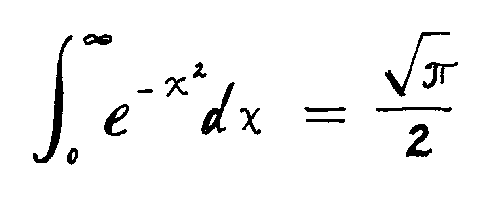
Most well-known science fiction is a normal story that simply happens to take place in a universe where technology is extremely advanced. Star Wars: A New Hope could easily have taken place in a much less advanced society with just a few plot changes. Some Star Trek episodes deal specifically with problems that come from advanced technology, but many are simple shoot-em-ups where the cowboys have absurdly complex toys. What is glorious about The Dispossessed as a science fiction novel is that science is at its core. The entire motivation for the Urrasti to receive Shevek on their planet is because he is the most brilliant physicist of the century. He is on the cusp of working out the General Temporal Theory, which would enable instantaneous travel over interstellar distances. Propertarians that they are, the Urrasti invite Shevek to their world so that they can own the completed equation. What exactly does the equation accomplish?

The General Temporal Theory, if completed, would unite two seemingly contradictory theories of time. In the novel, sequency physicists believe time occurs linearly, in discrete bits, one right after the other. Simultaneity physicists believe everything is happening all at the same time. There is stiff disagreement between the two camps, but Shevek, the brilliant scientist, believes the theories can be unified. If everything is happening all at the same time, and the sequence of step-by-step time that we perceive can be linked to simultaneity, then there is no obstacle to having a ship wink out of existence in one time and place and wink back into existence wherever its captain wants to take her, as everything is happening at the same time anyway. This represents a huge source of power and profit to the Urrasti scientists.

We are gonna monetize the shit out of this.

This equation does more than just drive the main action of the book. The entire structure and thematic development of the novel mirror it. Thematically, the book addresses problems created by false division and limns the benefits of unity. Capitalism and anarchism, Urras and Anarres, the self and the group: all of these things suffer from being pulled apart and considered absolute opposites. Structurally, the book jumps backwards and forwards in time, with the odd chapters starting with Shevek’s arrival on Urras, and the even chapters starting with his childhood on Anarres. The even chapters trace his childhood, adolescence, and adulthood on Anarres, and the odd chapters cover his adventures on Urras. The chapters saw back and forth until the last even chapter is Shevek and his wife discussing a possible trip to Urras, and the last odd chapter is Shevek returning home from Urras. The chapter design itself leads to unity between the sequency and simultaneity of time.

Le Guin pulls so much off with this book. She crafts a novel that shows all the true subtlety and real problems of moral governance. She organizes it so that science is not just its setting, but its main driving force, absolutely essential to the plot and theme of the book itself. The science fiction here is not laser guns and biological horrors, but clear, cold math alongside a profound exploration of the impact of that math on the societal underpinnings of two civilizations. Le Guin refuses easy divisions and classifications, she refuses simple morals, and she refuses easy answers. It is something for which all science fiction writers, and all writers in general, should strive.

Life After the Star Wars Expanded Universe: M.T. Anderson’s Feed

Andrew Findlay

I read a buttload. I track it, and last year alone I completed 37 books. So far this year, I am halfway through Blue Mars, Blood Meridian, and Les Jours Etranges de Nostradamus and have finished Green Mars, The Reivers, and Feed. That last book is the one I want to talk about today. It is a young adult science fiction book, which is a double-whammy of literary marginalization. The same style of thought that leads serious readers away from science fiction also has them skip YA fiction. It’s a shame, not only because YA is vital to the vibrancy and growth of our literary culture, but because it is worthwhile in its own right.

I mention how much I now read by way of comparison. When I was young, I did not enjoy reading. Why sit around and look at pages when there’s so much other shit to do? My discovery of Goosebumps changed everything. Young Adult fiction builds generations of readers. 10-year-olds probably can’t be interested in Cormac McCarthy, much like you probably can’t step outside and run a marathon right now. It takes practice. Progress happens in increments and the process has a beginning and an end. The path that leads to successful completion and enjoyment of Infinite Jest starts with The Berenstain Bears. I discovered Goosebumps when I was 10, and I now have a heroin-level addiction to reading.

Who needs reasons when you’ve got books?

If you never read any Goosebumps, I question whether you are a normal human with a childhood or if you sprang full-formed from a cultivation vat. By fifth grade, I’d moved on to my first semi-adult book, Tyrant’s Test, book three of the Blackfleet Crisis series in the Star Wars Expanded Universe. At the time, I didn’t really understand the problem of starting with the third one. Anyway, I read it, and there were a lot of words I had simply never seen before. One of my clearest reading-related memories is running across a new word and asking my dad what “ad-juh-kent” meant. He responded that “adjacent” meant “next to.” That was the first of many exchanges that made me an etymological nut, to the extent that I can tell you that “buttload” is not in the same class as “fuckload” or “metric shit-ton,” but actually represents 126 imperial gallons of liquid, as that was the size of a “butt,” something used to store wine. YA fiction entices and cultivates new generations of readers, without which American literary culture would be in worse decline than it already is, but that’s not all it does. The best YA fiction does some heavy philosophical lifting in the formation of young minds. One of the best examples of this is The Giver, which teaches middle-school age kids that nothing can be perfect without a price. That is a huge concept. If you are not familiar with The Giver, again, you are probably a clone.

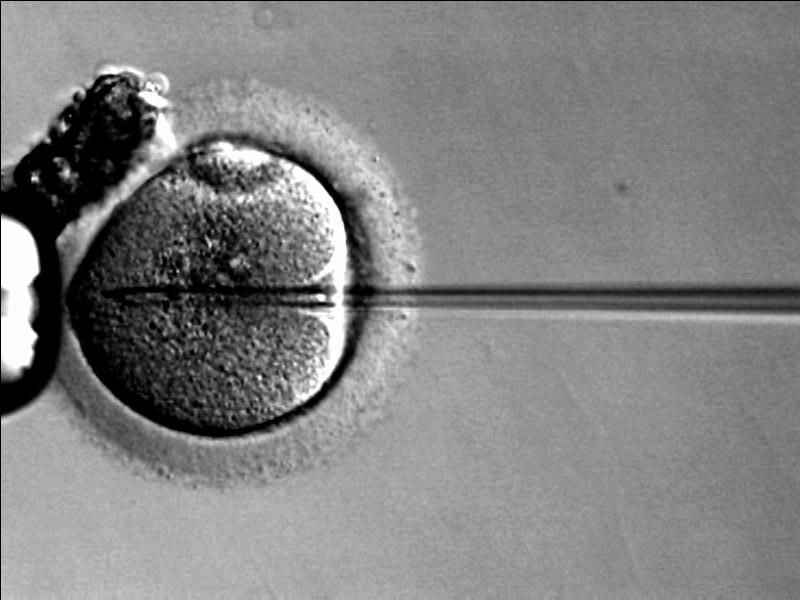
    It’s a boy!

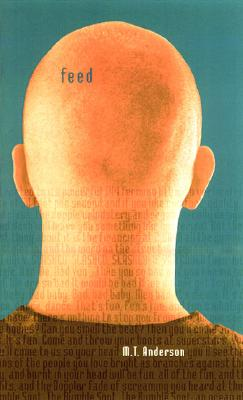
Feed, like The Giver, attacks big issues in bites digestible by young minds. The title of the book comes from its main concept – about three-fourths of citizens have “feeds,” which are like Google Glass but implanted directly into the brain and entwined with the limbic system. Corporations can advertise directly to people with banner ads that scroll  across feed users’ field of vision. Think of how annoying pop-up ads are, and then imagine them being inside of your brain. Data mining is prevalent, with corporations using purchase history and even biological information to target their advertisements. In one particularly surreal scene, a character is in a life-threatening situation, and because she is sweating, Feednet shows her an advertisement for deodorant. There are a lot of dystopic elements to this book, one being that most people live in environment bubbles because the actual outdoors is mostly too toxic to survive in. However, the main focus of the book is the effect of the feed on society. It is the creation and the sustainer of an overwhelmingly lazy culture of consumption. People with feeds are capable of buying anything they want at any time and having it flown to them. People with feeds can look up any piece of information they want at any time, leading to a general decline in critical thinking, memory formation, and language. The decline of language and thought instigated by the Feed is clear throughout the book. One example of character speech: “It was meg big big loud. There was everything there.” This type of dialogue really turned me off of the book for the first few chapters, but you get used to it, and besides it’s just another symptom of the social decline set off by misuse of technology, so it actually serves to strengthen the themes of the book.

The vanguard of civilization’s downfall. Also, it makes you look like an asshole.

The unifying plot is very simple. Boy and girl meet, boy and girl kind of like each other, things go wrong, things end badly. The complexity of the story comes from the setting and from character interactions with the feed. The simplicity of the plot merges with the complexity of the social milieu of the story to create an artifact science fiction is very good at manufacturing: the intellectual beach read. Sentence wizards are great, but it takes a special kind of person to read nothing but DFW, Joyce, and Faulkner. In science fiction, there is an emphasis on clear and direct speech, plot, and characterization. Sure, there are still books like Dhalgren (the Ulysses of science fiction. I only got 200 pages into it because I took it to an actual beach, which was not the best decision ever), but Hemingway-clarity is a feature of most science fiction. The text itself represents very little challenge, yet the ideas discussed therein are intriguing and nourishing. This alchemical melding of simplicity and complexity trigger a lung-gom-pa style of reading in which, unimpeded by overwrought sentences and spurred on by intellectual interest, a reader can consume vast amounts of text in a short amount of time. In this state, reading is exhilaration. This feature makes Feed is a great entry into the constellation of young adult literature. If we want to build a strong reading culture, we need authors who put out literature that can stimulate and exhilarate young minds. Feed is the gateway drug that creates the addicts that would do anything for just one more hit of The Brothers Karamazov.

Image credits: Wiki and IMDB.