TV

The Pete Holmes Show is Canceled and Why I’m Not Quitting

tbs-features-pete-holmes-705x405_110420130454

Alex Russell

The Pete Holmes Show got 80 episodes on TBS. Per a very personal post from Pete Holmes himself, the variety/comedy/interview/sketch/whatever show is now over and will air its final episodes within the next month.

The comedy nerd world has been both insanely good and insanely bad to Pete. He’s one of the biggest comedians that your parents probably don’t also know, but he’s also the target of a metric ton of hate by way of his sometimes-infuriating-but-always-interesting podcast You Made it Weird and his career as a baby that sold insurance on television. If all you know about Pete Holmes is that he has a podcast where he sometimes talks about astral projection and healthy juicing for upwards of two (or three) hours a week and that he sold insurance on TV, sure, why did they give that guy a show is a reasonable question.

But he’s also one of the ten funniest people in the world right now, and that’s not something I say lightly. He’s a better standup than he is anything else, and 80 episodes of The Pete Holmes Show showed that he’s a pretty damn good “anything else.”

Every episode wasn’t always my favorite — though part of the joy of Pete Holmes is his persona that he sometimes calls “fun dad,” so he’s in on the joke that he’s sometimes just so much — but I watched every single episode because I was so in awe. Pete Holmes got to do sketches based on in-jokes and interview segments where he clearly ignored publicists. He got to make what “The Pete Holmes Show” without the italics would be if he had his say. He made his show.

This week we passed 10,000 total hits on Reading at Recess. This week we hit 175 unique posts from nine different people. Despite what I’d call “success,” I still almost gave up.

I started Reading at Recess earlier this year to have an outlet to write about culture. I figured that the world didn’t necessarily need another recap of Louie or an ode to Walter White. That said, I think there’s space for what we write about Louie and our thoughts about Walter White’s opposite on Fargo. I think there’s room for an Obama campaign worker’s review of Mitt as oddly humanizing. I think there’s room for covering things everyone else is talking about, like How I Met Your Mother‘s weird ending and Archer‘s lull of a season and why half of the audience of Girls seems to be watching for strange reasons.

At the end of the day, this is just a blog. It’s just a place that I hope you spend five minutes of your website time every weekday. But if it’s more than that, it’s somewhere you might learn something about feminism and parody in anime, or art design’s influence on gameplay in video games, or about data’s influence on politics.

What it hasn’t been is consistent. We’re all over the place. We’re a shotgun, not a sniper rifle. When you watch The Pete Holmes Show, you’re looking at what Pete wanted you to see. When you’re here, you’re kinda seeing something that’s far too unfocused.

We’re taking Thursday and Friday off to regroup. When you come back on Monday — and I do hope you come back on Monday — you’ll see something that looks a lot like what you’re used to, but better, more consistent, and more focused. You’ll see our real show, because it’s what we wanted to show you from the get-go.

Want to write for us? We’re accepting contributors! Reach out through our submit page.

Alex Russell lives in Chicago and is set in his ways. Disagree with him about anything at readingatrecess@gmail.com or on Twitter at @alexbad.

Image: TBS
Life Lessons from Episodes of Louie: “Elevator (Part 4)” and “Elevator (Part 5)”

louie-3

Alex Russell

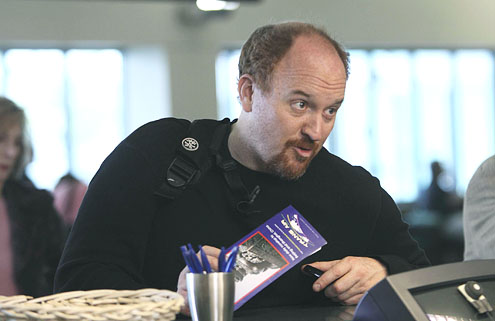
Louis C.K.’s critically acclaimed show Louie’s fourth season runs as two episodes every Monday night. Rather than just answering the question of “are these episodes good,” (because the answer is always yes) we’ll talk about the big lessons imparted in each episode. This week: Louie looks at his love life and does not like what he sees; Louie deals with Mentos.

Episode 7: “Elevator (Part 4)”

It’s very difficult to separate “Elevator” into episodes. Louie has always been compared to film in a stylistic sense — it’s much more like film than television — but only now is the structure of the show an actual damn movie. “Elevator” concludes next week, but we already know enough to work with it now.

Louie owns up to the fact that he isn’t really doing anything productive with his love life, and that’s a hard thing to admit. We’ve all had to admit to a drunk friend that we’re in a relationship that’s well past the expiration date, but Louie’s got the opposite problem: He can’t actually date Amia, because she’s going back to Hungary soon. He can’t start a relationship.

Louie is a “dark” show. When I’ve met people that aren’t into it, the most common complaint is that it isn’t funny. There’s nothing funny about Louie’s plight with Amia, or with his struggles to stay cordial with his ex-wife so that his kids will be happy, or his general life in the world of the show. The laughs are there, but that can’t be why you show up.

During a flashback, Louie deals with one night on a trip where he and his then-wife stay in a hotel room. It is the most realistic portrayal of a long relationship I’ve seen in months, and it’s that realism that makes the show feel cinematic. It’s not an episode of television that happens in a hotel room; it’s a look into people that have to leave that hotel room and go back to life later. I don’t want to spoil it, but the lesson is the same one any good Eagle Scout knows: Be prepared.

Episode 8: “Elevator (Part 5)

It’s hard to say how the fifth part is without the sixth, but the problem in it for Louie could exist outside of any continuity. Louie has to deal with what his relationship with Amia means if it doesn’t mean sex.

The best part about this whole story is that Louie loves Amia as an ideal. He loves someone who seems nice and fun and happy, but he just doesn’t really know that much about her. This kind of love story makes my eyes roll in most situations because there’s nothing worse than someone in love with the idea of love. You want someone to love specifics, not just “the essence of Sarah.” No one’s essence alone will get you to year two.

It works in Louie because it helps Louie understand that he’s not actually furthering himself. He’s just spending time with someone that feels like a partner, not a partner. This same story would be a happy one in a rom-com. It’s more than a little sad here because it reinforces the idea that everyone is a person first, and if you love them as an ideal then you’re just not actually in love with anyone who really exists. You’re not being honest with them or yourself.

Louie‘s love story will conclude next week and with that episode will be a larger lesson. Today’s, though, is a healthy part of a grown-up diet: Love someone for who they are, because all of that other shit will fade in two months.

Alex Russell lives in Chicago and is set in his ways. Disagree with him about anything at readingatrecess@gmail.com or on Twitter at @alexbad.

Symbols and Sociopaths: Hannibal Season 2, Episode 12

Hannibal, episode 12

Jonathan May

Spoiler alert, as always.

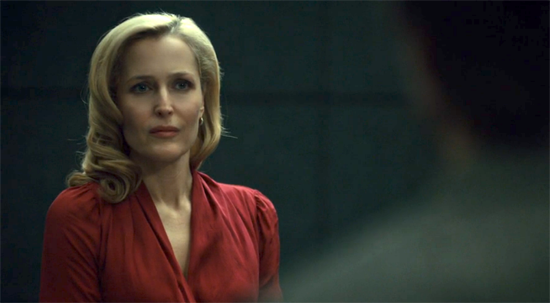
This episode was the kick in the pants that this season needed heading into the finale. What made this episode so big and bold? Gillian Anderson. She rocked her role as Dr. Bedelia Du Maurier, revealing everything in the suggestions and silences. Her ghostly, incantatory tone as she spoke there in the interrogation room gave me chills. And finally clarity was added, showing us what Jack and Will have been up to this whole time. Bedelia was fated to return as soon as she uttered her belief of Will’s innocence to him in the asylum. By bringing in someone who hasn’t been sullied by the lacklusterness of the past six or seven episodes, we, and the show’s characters, are able to take a step back and reevaluate the madness into which we’ve been drawn. Jack and Will are trying to bait Hannibal? Seriously? Though it’s easily their worst conceived plan, it does give great excuse for Will’s obsequious fanboy attitude toward Hannibal these past few weeks. What had bordered on the homoerotic now can be easily enough explained as an attempt at intimacy. And intimate we get.

Bedelia states that Hannibal can be made prey to his own aesthetic whimsy, a clever choice of words on her part, given how Hannibal views his victims. Ultimately this could be a critique of the aesthete, that echelon of society outside of financial worry, wherein one has time and means to enact one’s fantasies. How this will become a trap for Hannibal isn’t immediately apparent, but I predict they will have to dispense with this advice if they actually want to catch the bastard.

The scene where Hannibal convinces Mason Verger, by way of amyl nitrate, to scrape off his own face is wholly incredible; I was literally disgusted by the wet noises and the voice thinning out. Without the veiling of chiaroscurist darkness, this certainly wouldn’t have been able to air on network television. But this scene showed off what the production of this show can really do. And the episode as a whole was well shot; we had lots of close-ups of faces and people seen through the negative spaces left by others. These kinds of choices really make us examine everyone in a new light, which is perfect as we head into the final episode for this season.

So, what’s going down tonight? We know, via the first episode, that Jack and Hannibal will have their showdown. The catalyst for this could be anything, but I think it will have to do with Alana, who’s been strangely absent. Hopefully we’re over this whole Mason and Margot business. Now that NBC has bought a third season, we know this charade must continue. But if we’re left tonight with some horrible impossibility or vagueness, I might not be tuning in next time around.

Jonathan May watches too much television, but he’s just playing catch-up from a childhood spent in Zimbabwe. You can read his poetry at owenmay.com, follow him on Twitter at @jonowenmay, or email him at owen.may@gmail.com.

Hannibal airs Friday nights on NBC. You can read our pieces about previous episodes here.

Image: NBC

Life Lessons from Episodes of Louie: “Elevator (Part 2)” and “Elevator (Part 3)”

louie-3

Alex Russell

Louis C.K.’s critically acclaimed show Louie’s fourth season runs as two episodes every Monday night. Rather than just answering the question of “are these episodes good,” (because the answer is always yes) we’ll talk about the big lessons imparted in each episode. This week: Louie takes a woman to two stores on a date and has to decide if his daughter needs to go to private school.

Episode 4: “Elevator (Part 2)”

“Elevator” is a six-part episode, soeven at two episodes a week there’s much more to tell. Louie is in love with a woman he can’t really communicate with, though that leads to some outstanding pantomime in a drug store as the two try to exchange the idea of “hair dryer” back and forth.

Louie being in love with a woman who doesn’t speak English has some pretty obvious connections to his inability to communicate with women in general, and this wouldn’t be Louie if it stopped there. It’s not just that they can’t communicate, it’s that Louie the charactacter throws himself into something so fully that he turns down Pamela, the “love of his life” character on the show, when she comes back from Barcelona. Is Pamela back for Louie? Does Louie turn her down because he resents that she left, because he loves this new woman, or a little of both? This might be stand up for yourself when people act like assholes but with Louie, the flipside of that oft-given advice might be more important by the time this tale is told.

Episode 5: “Elevator (Part 3)

These two are also about Louie’s troublesome daughter Jane. Jane’s in trouble at school, but she’s acting out because she doesn’t buy into the established authority of the world. Louis C.K.’s comedy is a lot of things, but it’s definitely about the supposed “rules” that society needs to keep working. Things go poorly because people take too many cookies or they drive like assholes or they don’t leave their rental car at the counter. These rules, and our decisions to follow them, keep the whole damn puzzle together.

If that premise is Louis C.K.’s worldview, his jokes are about how we love to not play by those rules. Breaking down jokes is tough and mostly pointless, but the serious realities of Louie work the same way. Jane doesn’t like that she set up rules with a friend about time on a thing at the playground and the friend didn’t follow them. Jane’s not mean, Jane’s just frustrated that the world wasn’t fair when she was.

The episode is about love and how we fall in it, and our kids and how we want them to have better lives, and our lot in life and how we choose to view it. Louie runs into his doctor and a three-legged dog in the lobby of his building, and that scene doesn’t deserve me spoiling it. It does reinforce a beautiful lesson, though, and that’s that you can smash anything with a bat that you want, but you’ll always be your responses to the things you cannot change.

Alex Russell lives in Chicago and is set in his ways. Disagree with him about anything at readingatrecess@gmail.com or on Twitter at @alexbad.

Bad Men Doing Bad Things: How Fargo’s Molly Solverson is the Anti-Walter White

allison-tolman-fargo-tv

Mike Hannemann

(Note: This article, outside of character names, contains no spoilers for the show Fargo. There’s a minor one about Dexter, but you probably weren’t going to watch that anyway.)

Before I jump into the point I want to make, I’d like to walk you through my thought process of getting there. I sat down to watch the series finale of Dexter, hoping to find some angle to discuss about jumping into a series-ending episode after not watching the three seasons prior. About halfway through, it dawned on me that the end-game scenario most fans were rooting for was for two serial killers to get out of the country. These people literally hacked their victims into bits and the audience was rooting for them to escape? Something’s wrong here.

It’s not news that television audiences are enamored with the genre “Bad Men Doing Bad Things.” We have Dexter, Mad Men, Breaking Bad…the list goes on and on. What makes these stories work is that, despite their reprehensible actions, the actors portraying the leading men bring enough to the roles where it doesn’t feel wrong to root for Don Draper as he cheats on (another) wife or to hope that Walter White becomes the drug kingpin he aspires to be. For as perfect as those shows are (I’m not including you on this list, you know what you did, Dexter) they have one glaring flaw: For the most part, the female roles are pushed aside due to the intrigue of the Bad Man Doing Bad Things.

Take Breaking Bad for example. I fully admit that it’s my favorite show of all time. However, the fan base was furious at the lead female character because she…wanted a drug dealer away from her kids? The only imperfection on this show was its fans. How could you honestly judge someone for wanting to be out of a bad situation? All of her actions were natural, ones any normal person would have, but because she was in the way of the hook of the show the fan outcry was overly negative and completely unjustified.

But…then there’s Fargo, a show very loosely tied to the movie of the same name, but it also falls into the aforementioned genre. There are some very bad men and they are doing some very bad things. It could easily be another show where the performance of the leading villain (in this case, Billy Bob Thornton’s character Malvo) is the hook. Seeing the next step of his plan, and the gruesome trail of death that lies in his wake, is gripping. It’s addictive. It isn’t why I come back to it week after week, though.

Fargo breaks the mold by finally introducing a strong female character that overcomes the appeal of the bad man doing bad things. Allison Tolman (a name I’d never heard before) plays Molly Solverson, one of the only characters thus far to be the moral compass of the show. When I watch, I don’t care what the villains are up to. I want to know more about Molly’s story. I want her to win. She’s a wonderfully written, fully realized character. She overcomes the hook of the show, the black comedy and murder, as a shining beacon of justice and morality.

I sincerely hope television writers take notice. The female role doesn’t need to be the put-upon wife or just used as a plot device to make the protagonist’s story more complicated. Molly surely does this on Fargo but it’s not done in a way to make the villains have to change their plans. Her story is the more important one. You sympathize with her more than whatever the stereotypical “cool” characters are doing (and, granted, they do some pretty interesting things in their own right). She’s a roadblock, and damn right she is.

This isn’t to say other female characters on television aren’t well written – that’s not the implication. There are amazing performances, but in the eyes of the masses they get overlooked. Don Draper is a household name (even my parents know who he is), even though I would argue that Peggy Olsen should be, too. I hope this is finally turning the corner on televised dramas. Bad men will still be doing bad things, but more empowered women will be a part of the story and not just a plot device to be overlooked by the immorality if the leading man. In comedy, the male performances often unjustly overshadow the female ones. Sitcom characters Liz Lemon and Leslie Knope were able to overcome this and change TV comedy. If people pay enough attention, I have a feeling Molly Solverson is going to do the same for drama.

Something, I may add, that is long overdue.

Image: Philly.com

Symbols and Sociopaths: Hannibal Season 2, Episode 11

Jonathan May

Spoiler alert, as always.

With two episodes left and the reappearance of Freddie Lounds at large, the question on everyone’s mind is, what’s going on between Will and Hannibal? Is Will playing Hannibal, or playing everyone else on his behalf? Is Dr. Bloom next on Hannibal’s menu, and is that what it will take for Jack to finally wake up? This week, I present the tweets each character would have sent during the action of episode 11.

@Will_Graham: A certain someone was in my dream again last night J

@Will_Graham: Wtf? I have to eat a songbird whole?

@FBI_Jack: Does anyone else think Will and Hannibal are….closer than normal?

@Mason_Pigmaster: I said I only want Tanqueray. Wtf do I pay these people for?

@Alana_Bloom: Hey guys, just running over to Will’s. Someone call me in like an hour.

@Hannibal: If I have to listen to this piggishness further, I might have to whip up a nice Paupiettes de porc later… @Will_Graham will I see you there?

@Will_Graham: I’ll bring the wine.

@Hannibal: You know I like to pick the wine L

@Freddie_Lounds: And then I said to her, How was my funeral, bitch?

Hannibal, episode 11

Jonathan May watches too much television, but he’s just playing catch-up from a childhood spent in Zimbabwe. You can read his poetry at owenmay.com, follow him on Twitter at @jonowenmay, or email him at owen.may@gmail.com.

Hannibal airs Friday nights on NBC. You can read our pieces about previous episodes here.

Image: NBC

Life Lessons from Episodes of Louie: “So Did the Fat Lady” and “Elevator (Part 1)”

louie-3

Alex Russell

Louis C.K.’s critically acclaimed show Louie’s fourth season runs as two episodes every Monday night. Rather than just answering the question of “are these episodes good,” (because the answer is always yes) we’ll talk about the big lessons imparted in each episode. This week: Louie reluctantly goes on a date and almost loses his daughter.

Episode 3: “So Did the Fat Lady”

No one has perspective immediately. Right after watching a particular episode of a particular show, it feels more important. That one episode isn’t just 22 minutes of entertainment, it’s your Monday. It’s the time you sat in one specific chair and felt one specific way because someone who made something made you pay attention.

The third episode of Louie will get mentioned a ton this year as one of the best episodes of the show, and that makes it tough to digest fully just a few hours after its debut. In it, Louie presents the story of how he’s worn down into a date by a compelling woman at a comedy club that doesn’t fit the standard “expected weight” of a woman on television. It’s not an overdrawn morality play about how weight shouldn’t matter. It’s a story about how weight does matter (even when it shouldn’t), but how we treat people in life matters a heullva lot more.

Everyone will draw the obvious from it: It’s about being kind but still being realistic. It’s about how we think of ourselves as good people even though we sometimes click the “no thanks” button when Walgreens asks for money for breast cancer research. It’s about why we think of ourselves as honest even though we go without mentioning faults to our friends. It’s the story of the faults we all have that we don’t even always consider faults.

The episode will be a smash hit (as much as a Louie episode can be) because a 30-something woman talking about body issues in a real way is great television. It will stick with me because one of the secondary lessons is that it’s important to be a good person, whatever that means to you.

Episode 4: “Elevator (Part 1)

The second episode is a big step down in the “cultural issues” department, but it comes out of the gate with a ton of energy just the same. Louie tells his girls to repeat the “rules of the subway” as they get on the subway. Chekhov taught us that means that the subway rules are going to be broken, and sure enough…

…but the episode’s not really about losing the girls. It’s about Louie finding a woman stuck in an elevator and trying to help in a situation where he doesn’t have any real answers. There will assuredly be more in next week’s second part of this episode that explains how the subway scene relates to the scared woman in the stalled elevator, but right now we need to leave this one somewhat unfinished. It’s a great episode and it has something really sweet to say about language and shared experiences, though it isn’t a finished story yet. Both stories in it have the same lesson so far, though: Don’t bother running away from anything that can catch you.

Alex Russell lives in Chicago and is set in his ways. Disagree with him about anything at readingatrecess@gmail.com or on Twitter at @alexbad.

Symbols and Sociopaths: Hannibal Season 2, Episode 10

hannibal, episode 10

Jonathan May

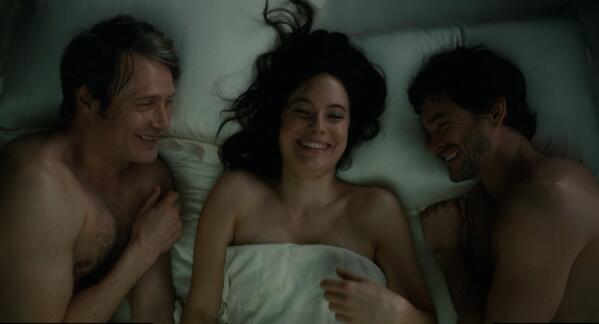
We always open inside Will’s head lately, and this episode was no different. (Here’s hoping we’re not Roseanned at the end!) He conflates his slaying of last week’s serial killer in a dream of also killing Hannibal, which ties in with the incredibly slow David Lynchian conflated sex scene wherein Dr. Bloom is “had” by Hannibal literally and Will projectively. The use of conflation in this episode is important because Will and Hannibal are finally merging. Before they do fully, however, we will be prone to their flirting (serial killer-style) with one another in front of Jack and Dr. Bloom and everyone else. I didn’t expect Will’s transformation to be so obsequious in regard to Hannibal, but if we take the whole sex scene a step further, then Will, by projecting that he has sex with Dr. Bloom through Margot, is able to “have sex” with Hannibal through that projection. I know, I know, I’ve been reading too much Harold Bloom. In any case, the episode ends with both Will’s and Hannibal’s faces conflated into one another, like some kind of ghoulish Chuck Close painting. If the effect is to heighten the “merging” aspect of these two, the production is laying it on a bit thick.

So, Will gets to (presumably) kill Freddie Lounds, ending the life of yet another part of the closed circle. But Margot and her sinister, pig-obsessed brother are uncovering the dark of the wings and heading for the limelight as we speak. As old ancillary characters die, so must new ancillary characters live. Will murdering Freddie didn’t bother me; she already had figured out, as Alana is coming around to now, what the game is. And tonight, it should come around to Jack, prompting (perhaps) the showdown with Hannibal that began the season. But I think we have to deal yet with further piggishness before we can get down to the bones. Other prediction for tonight: The whole Will and Margot (though I wouldn’t rule out Alana and Hannibal) pregnancy thing is another emotional red herring. Don’t let’s add another complication, Story Gods! This isn’t Passions.

My favorite moment of the episode: when Will is eating (presumably) a part of Freddie, that look on his face—transcendence.

Jonathan May watches too much television, but he’s just playing catch-up from a childhood spent in Zimbabwe. You can read his poetry at owenmay.com, follow him on Twitter at @jonowenmay, or email him at owen.may@gmail.com.

Hannibal airs Friday nights on NBC. You can read our pieces about previous episodes here.

Image: NBC

You Need to Watch Black Mirror: “The National Anthem” Episode Review

black-mirror

Jonathan May

Promise: I will not give away the ending. You must watch this show. Watch it immediately after reading this.

It’s been a long time since television has posed such an interesting question as this episode poses. Is the decency of one man worth more or less than the life of one other person? Such a fragile and horrifying situation. I found myself aghast at the cost of fame, wherein your personhood, known to all, is your own worst enemy. In this case, the British Prime Minister must have sex with a pig on live television or else the kidnapped Princess will be executed. The use of YouTube by the kidnappers (I’m not giving the end away, I promise) to facilitate a public interest reminded me, in a way, of the scene between the prisoners and citizens of Gotham in The Dark Knight. You bring the public into the situation, and that’s where the stake of fame comes in. It would be interesting to posit the same premise, but with an “ordinary citizen” at the center, instead of a Prime Minister. Would the greater public be just as interested in watching an everyday Joe have sex with a pig to secure the release of a princess? I’m not so sure, but then again, I’ve never wanted an office of power, where you become the target for statements thrust into the public sphere.

As far as this being a commentary on art, all I will say, without divulging the end, is that this episode conflates “Art” with “Statements.” For something to be artistic, it should be beautiful (a bold statement, but one I’ll stand by any day), and while the idea might be beautiful in a cold, intellectual way, the expression of the idea is far from beauty, focusing instead on art always being a performance, which I thought we had moved beyond.

But for the love of yourself, if you want to watch the most gripping thing produced for television in the past five years, seek out Channel 4’s Black Mirror, the first episode “The National Anthem.”

Jonathan May watches too much television, but he’s just playing catch-up from a childhood spent in Zimbabwe. You can read his poetry at owenmay.com, follow him on Twitter at @jonowenmay, or email him at owen.may@gmail.com


Life Lessons from Episodes of Louie: “Back” and “Model”

louie-3

Alex Russell

Louis C.K.’s critically acclaimed show Louie’s fourth season runs as two episodes every Monday night. Rather than just answering the question of “are these episodes good,” (because the answer is always yes) we’ll talk about the big lessons imparted in each episode. This week: Louie’s back hurts and he has to open for Jerry Seinfeld.

Welcome to this! Maybe it’ll work and maybe it won’t. That sentence had to come up in the pitch for Louie, so it’s as good of a place to start as any. I love Louie very deeply. I even loved Louis C.K.’s tonally similar movie. Louie is always going to mean different things to different people, but to me it means hope for the hopeless. The “world” of Louie is brutal and mean, but it is not without victory. After an extremely long hiatus, Louis C.K. had to come out swinging to remind people what both the world of Louie and the character of “Louie” are like. The first two episodes definitely do that.

Episode 1: “Back”

“Back” opens with the best joke structure possible: Big gets bigger. Louie wakes up in New York City to the sound of garbage men. Of course, they break into his house to jump on his bed and dump trash on him. His life literally gets worse from the moment he wakes up. It’s a fitting start to an episode that’s mostly about how hard it is to get older.

Louie always features stand up bits that weave the vignettes together; the one about hating a 31-year-old for complaining about aging will hit too close to home for a lot of people. Louie’s back goes out and a gruff doctor, an unfazed sexshop worker, and Todd Barry don’t have any time or interest in consoling him.

It’s tempting to label this “you have to take care of yourself,” but the doctor is insistent that everyone’s back hurts most of the time. The back pain is obvious both as a symbol for and the result of aging, so the first episode of the season is closer to the first line from the Serenity Prayer:

God, grant me the serenity to accept the things I cannot change,
The courage to change the things I can,
And wisdom to know the difference.

Episode 2: “Model

Anyone with a passing knowledge of Louie or a working sense of dread will see the first twist in “Model” coming. Louie has to open for Jerry Seinfeld at a benefit. He doesn’t get enough detail and thus ends up in a T-shirt at a black-tie affair full of millionaires. The first 10 minutes is every bit as agonizing as you’d expect, but it’s when the episode turns to the model herself that it socks you in the gut.

There’s some good stuff that I don’t want to spoil, but it is enough to say that this episode would have consequences for the characters on another show. The “continuity” of Louie is always up in the air — outside of two extended relationships on the show, not much carries over — but it will be interesting to see if the show cares about the big blow it deals its main character in “Model.”

Probably not, and that’s more than fine. What’s more interesting is the lesson itself, revealed in the scene with the credits: It’s never all bad.

Alex Russell lives in Chicago and is set in his ways. Disagree with him about anything at readingatrecess@gmail.com or on Twitter at @alexbad.