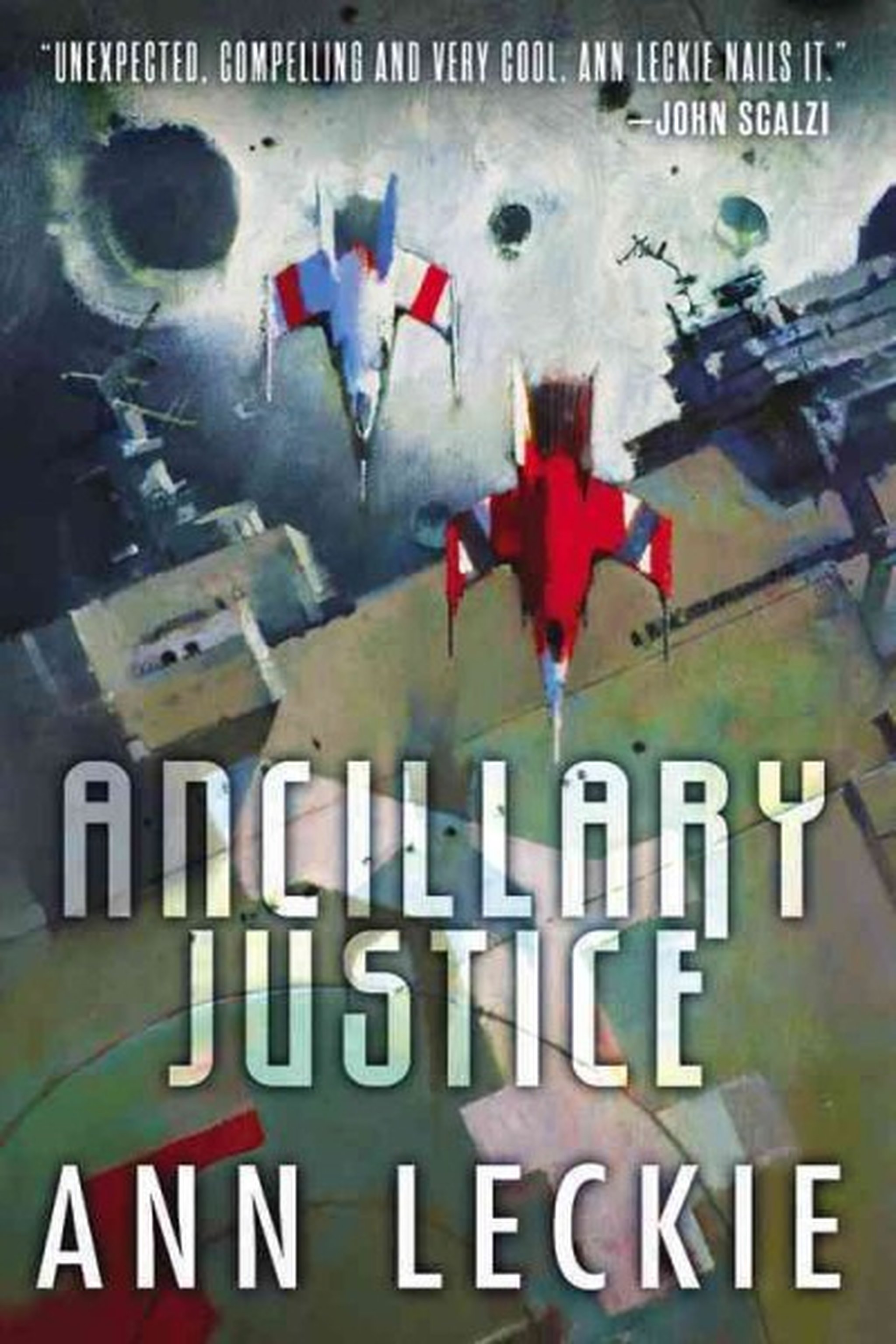
Life After the Star Wars Expanded Universe: Ann Leckie’s Ancillary Justice

image credit: NPR

image credit: NPR

Andrew Findlay

In Life After the Star Wars Expanded Universe, we take a look at science fiction and fantasy, why they’re great, and what they say about where our species has been and where it’s going. 

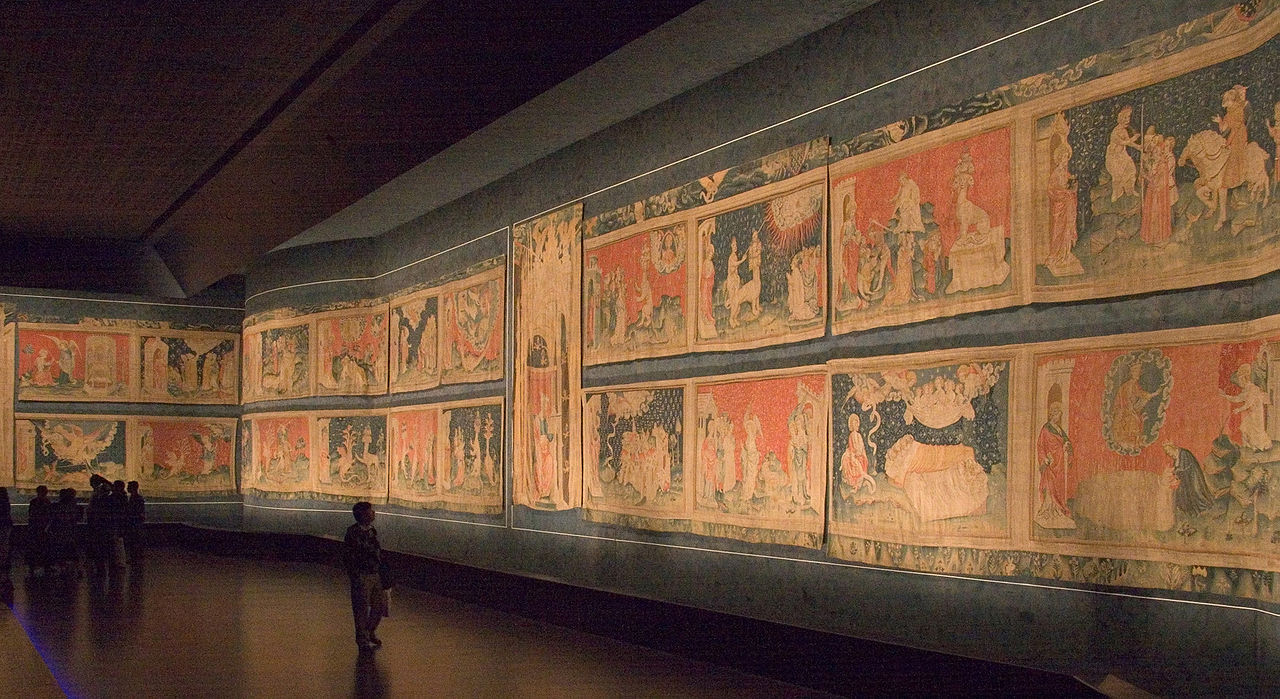
Normally, this feature has me rooting around in the dust heap of the 70s, 80s, 90s, and aughties to find something to review. I write here based on what I’ve finished reading in the past month or so, and since there is a lot more written in the past 50 years than the past one, more often than not there are a couple decades between publication of the book and the posting of the article on it. I’m excited to say that today, I bring you Ancillary Justice, published less than a year ago. I ran across it a little while ago, but the title seemed like something that would have David Caruso de-sunglassing on the cover, so I passed it by. It won the Hugo on August 17th, and the Hugo, Arthur C. Clarke, Locus, and Nebula awards are all telling me I made a mistake. Any single one of those awards is enough to get me trust a book, and this one got all four of them. Another tidbit – at the Hugos, the entire Wheel of Time series was also on the shortlist. This beat out the Wheel of Time – not one of the books, all of them. On the one hand, that’s not surprising – I tried to read them. The first one was not that bad, but I had to put it down halfway through the second one, asking myself how many words were really necessary to describe the tapestries hanging on the chill stone of the castle hallways through which our protagonist was running for his life. Still, even if Wheel of Time is kind of bad, it occupies a gigantic cultural niche, and the power the entire series should hold over Hugo voters is impressive, but Ancillary Justice beat it, stupid name and all.
1280px-Tapisserie_de_l'apocalypse

image source: wiki

Yes Robert, it’s beautiful. Isn’t the world in peril or something?

First off, in the context of the book, the name is not that stupid. The premise of the book is as follows: a galactic empire called the Radch is a vast and expanding power, and it conquers through the use of ships and ancillaries. Ancillaries are ex-humans, drawn from the conquered populace, who are heavily modified and slaved to the ship AI, becoming appendages of the ship itself. It is effective (AI brain running targeting, hunting, thinking), it is cheap (feed them water and the minimum, no-frills nutrition, freeze them in the ship hold when they are not in use), and it is good propaganda (they are terrifying in much the same way zombies are – “that could be us” – and the enemies of the Radch call them corpse soldiers). There is a lot more going on in the plot, but to avoid spoiling it for you, I’ll just say that one of the ships, The Justice of Toren, is destroyed, and only a single ancillary escapes. Since she basically is the ship, albeit heavily reduced, she launches on a mission of vengeance (hence Ancillary Justice, slow clap).

Fairly basic plot, so what makes this such a darling of all the most famous SF awards? First off, the entire concept of ancillaries is really cool (and horrifying). The book chapters alternate between the vengeance-mission present and the pre-Toren destruction past, so we get to see the main character function as a distinct entity and as an ancillary. As an ancillary, there are 20 of her, all connected to and by the ship. A single ship possesses thousands (possibly millions) of ancillaries stored in its holds, but the active ones seem to be organized into action groups of 20. The author does a good job of recreating what it would feel like to be a 20-bodied hyperconsciousness, jumping back and forth among all the tasks (guard, administrator, detective, etc.) this group is performing simultaneously, all of them with a constant awareness in the backs of their minds of being in orbit overhead. All ancillaries are heavily modified, each implanted with advanced communications and optic suites, forcefield generators, and other technical goodies. They have, while connected, access to all the processing power and judgment of a ship AI – they are the AI. This creates an interesting problem for the main character when she is left alone – she constantly compares herself to “what [she] was,” that is, compares her existence in one tiny meatbrain to her much more powerful existence as a linked and devastating machine of war.

One thing that makes ancillaries so compelling is their believability. Sure, it seems completely out there right now, but this is the far-future. Let’s think about progress in terms of mere decades and centuries. 1914, one hundred years ago, was the first time anyone successfully completed an indirect blood transfusion, meaning that before that, for a transfusion to work, the donor had to be strapped in the hospital bed next to the recipient. Over the past century, we have developed the ability to transplant hearts, kidneys, eyes, and other organs, and in March of this year, scientists reported that they could use a blood sample from any human to create stem cells. We went, in 100 years, from just barely being able to move blood from one person to another to being able to use blood cells to regenerate any type of damaged cell in the human body. The terrifying thing is, we’re getting faster – just think of where technology was even in 2004 versus now.

The most advanced piece of consumer communications technology available in 2004.

In February, a man received a prosthetic hand that gave a sense of touch. Right now, I have a friend pursuing a biomedical engineering Ph.D, and his main job in the lab is studying monkeys who are hooked up to mechanical arms which they control with their neuronal impulses. Right now, we have man-made hands that transmit directly to nerves and mechanical arms that monkeys can control with their minds. Where will we be in 100 years? 500? 2000? Now, there is the problem of AI, which, like expedient interstellar travel, is kind of a holy grail for science. Accepting AI, it becomes completely feasible that machines and humans could be linked, and that the machine could be programmed as the dominant partner in the relationship. The possibilities are terrifying.

This is a little bit scary to watch. How much damage could that arm do?

Another point of interest in the book is that Radch society makes no real distinction between genders. Every Radch character uses “she” as the third person singular, and this creates a sense of ambiguity that emulates the ambiguity of gender in the Radch itself. It is an interesting choice, and it requires you to form your own opinions about the gender of the characters, which, in Radch society, doesn’t really matter anyway.

There are some weak points in the book. First off, the characters are a little bit flat. They are not unforgivably thin, but they could be more fleshed-out and believable. One of the main characters goes from a disloyal waste of space to an effective and dedicated companion through the mediation of one key event, and the switch was too fast for plausibility. The main character is simple, which could be forgiven due to her being the amputated consciousness of a machine, but the other characters are even less complex. They are by no means inadequate, but by comparison, I’m reading Light in August right now, in which each character has about three pages describing their life story before they actually do anything. The plotting could also be tighter. The book rides on a well put-together mystery plot which drives the reader forward, but it drags in some places, gets lost in exposition or description here and there.

Up to this point, Ann Leckie has built her career on writing and editing short stories. This is her first novel, and it is a great one. In an article of around 1400 words, I dedicate just 158 to weak points in the book. There is a lot more good here than bad. It explores the concept of identity and loss through the ancillary and the contradictions and problems inherent in empire through the history of the Radch. There are some issues, but they tumble away insignificantly in the face of the gale-force imagination with which Leckie infuses her work.

Andrew Findlay has strong opinions about things (mostly literature) and will share them with you loudly and confidently. You can email him at afindlay.recess@gmail.com.

Major Issues: Supreme: Blue Rose #2

STK647497.jpg

In Major Issues, we look at one newly-released comic book each week. Now updated Mondays.

Gardner Mounce

Supreme Blue Rose #2
Written by Warren Ellis
Art by Tula Lotay
Published by Image Comics
Published: 8/20/2014

Issue #2 of Supreme: Blue Rose opens on a scene that can be described as both artfully crafted and expositionally convoluted. It withholds exactly the information that would contextualize it–who are these characters and what is their purpose in the story? And, really, that’s exactly how Supreme: Blue Rose itself can be summed up so far. Warren Ellis reveals layers of the story like a magician overturning cards, but it’s two issues in and we’re just seeing the beginnings of the trick. Who knows how long it will be until he unveils what he’s up to.

The story so far: Darius Dax, a wealthy investigator of “blue rose cases”–rare events that do not typically occur in nature–hires Diane Dane, an out of work journalist, to investigate a strange event in upper New York state for an exorbitant rate. Dax plans to sell his findings to “actors” or “entities that act upon the geopolitical sphere” for even more money.

Before getting back to Diana Dane’s story in this issue, we wade through additional new subplots. Like artist Tula Lotay’s multimedia approach, there are layers upon layers of subplots. In the opening scene, an enigmatic woman leads an aged writer up a spiral staircase to [heaven?]. Following this is another installment of Professor Night, a TV show Diana Dane watches that is stuffed with non sequiturs and high-minded pronouncements. Its dark imagery is a reflection of the psyche of the Manhattan of the Supreme universe: violent and paranoid and cowed. It’s possibly an unconscious parallel version of the events of the story proper, like Tales of the Black Freighter was for Watchmen. Finally, there’s a scene in which a [mathematician] solves an equation that puts her in contact with an intelligent source from somewhere in deep spacetime.

When we catch up with Diana Dane, she’s grabbing a limo ride with a representative of Darius Dax, code name Twilight Girl Marvel. Twilight Girl Marvel explains to Diana that her position as a limo driver is a temporary reprieve from her true job as a “versioner”–someone who tests alternate versions of history and their would-have-been effects. We’re just getting back to some semblance of linear, understandable plot when suddenly Diana falls into a dream state in which she envisions an alternate history in which a North African scientific empire pioneered Mars.

Supreme-Blue-Rose-002-021.jpg

Should You Get it?

Supreme: Blue Rose is one of those puzzle-piecer stories for fans of Memento or Donnie Darko or Primer where every single frame will probably have multiple meanings. It’s for those with an allergy to exposition dumps and patronizing narrators. It’s for “smart” readers. In comic form, a story like this can be frustrating. Can you imagine watching two or three scenes of Memento at a time with a month between each installment? On the other hand, maybe it’s just convoluted for the sake of convolution. The question is: how much do you trust Warren Ellis?

Gardner Mounce is a writer, speaker, listener, husband, wife, truck driver, detective, liar. When asked to describe himself in three words, Gardner Mounce says: humble, humble, God-sent. You can find him at gardnermounce.tumblr.com or email him at gmounce611@gmail.com 

Tough Questions: What Did You Love as a Teenager That You Can’t Stand Now?

question-mark

Every week we ask everyone who hangs out around here to answer a tough question. This week:

What did you love as a teenager that you can’t stand now?

Rules are simple: what have you grown out of, or at the very least what do you think you’ve grown out of? Everyone is at their dumbest when they’re a teenager, and that’s never clearer than when you consider what you liked as a teen. When you were brooding, moody, and SMARTER THAN ANYONE, what were you, like, into?

Alex Russell

I want you to hit me as hard as you can. I was just leaving my teenage years when Facebook became what it is today, but with Facebook’s boom in the mid 2000s we all learned about the most common things people we knew liked. The answers for “favorite movies” on Facebook were eerily consistent: The Big Lebowski, Boondock Saints, and Fight Club. I’m not going to lie to you, I saw Fight Club about ten times as a teenager. I read the book. I considered the deeper implications of the philosophy of Tyler Durden on my life. The Big Lebowski is a pretty good movie and Boondock Saints is a pretty bad movie, but Fight Club alone represents the terrible nature of a teenager best. What better movie is there to sum up the angst and rage of a teen than a movie about pushing the reset button to wake people up, man!? There’s also The Matrix, I guess, but Fight Club is especially horrible because (myself included) people seemed to latch on to the supposed message. I lived in the suburbs and sometimes drove past one version of a fast food place to go to another version of the same shitty restaurant. I was not bringing down the system. Clean it up, kids that like Fight Club too much.

Jonathan May

Myself mostly. No, all jokes aside, I used to really love coffee, so much so that I worked at three different coffee shops over the course of ten years, from high school up to grad school. I drank the stuff several times a day, and, when I was on the clock, you better believe that black liquid cocaine rushed freely and sweetly through me. That day I quit working at a coffee shop, though, was the day I gave up coffee. It was like flipping off a switch inside me; I just never craved it from that day forward. Also the smell still makes me think of bitchy people.

Andrew Findlay

Admitting that I ever loved something worthy of hatred would be admitting that I ever made bad choices. I only make good choices, ab aeterno.

Gardner Mounce

I started writing and reading poetry more seriously during my senior year of high school. It was my first foray into contemporary poetry, and pretty soon I came across Billy Collins. My poetry education up to that point had been strictly assigned by English teachers, so compared to Shelley and Dickinson, Collins was off-the-cuff, and spoke with honesty and wit. He was so accessible. The reason I don’t read him anymore isn’t because he’s too accessible or because I think he’s a hack. I think Collins writes honestly and from the heart. I believe that. But he is so boring, in terms of both content and sound. Reading his poems out loud will put you to sleep. And the best of them are like diet drink poems. I think his next collection should be called Epiphany Lite.

Worst Best Picture: Is Casablanca Better or Worse Than Crash?

casablanca

Alex Russell

In “Worst Best Picture” we search every single Best Picture Oscar winner of all time from 1927 to present to uncover the worst of them all. Conventional wisdom says that 2005’s winner Crash is the worst winner in history. We won’t stop until we’ve tested every last one. Read the the first, our review of Crash, here. Posts will be relatively spoiler free, but there may be some details revealed. Today’s installment is the 1943 winner Casablanca. Is it better than Crash?

I’m not going to lie, it’s difficult to find something new to say about Casablanca. Fresh off The Godfather, I have to find something new to tell people about one of the other consensus picks for greatest movie of all time (G.M.O.A.T., which is not a great acronym). I think it’s this: Casablanca is one of the rare things in life that is as good as you hope it is.

We constantly expect disappointment from the supposed canon now. Just yesterday someone was telling me about a guy who wouldn’t watch Citizen Kane because he didn’t expect it to live up to the hype. I still haven’t read any of the (stop it) Game of Thrones (I know) books yet (note the yet, I said yet, you don’t have to tell me to) and I’m skeptical that they could possibly be as good as people say. None of us will take “this show is hilarious” as enough reason to watch something. We just tell people “oh, I’m sure, I’ll check it out” and then we continue with whatever we were going to watch anyway.

Is that so wrong? Do we need to be broadening ourselves on recommendations of the people we surround ourselves with or the cultural arbiters of our world? Casablanca exists as a monument to the argument that we do. The beautiful lines are still beautiful, 70 years later. The performances are incredible; Humphrey Bogart’s Rick has become one of American film’s most enduring characters, even though he didn’t win Best Actor for it that year. The love feels like love actually feels: complicated, painful, and overwhelming. Casablanca is a romantic movie and a war movie and it’s never one at the detriment of the other. It defies you to pick one of those to describe it.

I think that’s what comes through the most: it’s so many things. For the uninitiated, it’s the story of a brief period of time in Rick’s Cafe Americain, a bar/casino/nightclub/etc in Morocco in the early 40s. Rick doesn’t want to deal with the war, he just wants to drink and quip one liners to his patrons. His life of rolling his eyes at everyone’s silly “war” is broken up when his ex Ilsa shows up with her new beau Victor. It’s more complicated than all that (because it always is) but the movie depends on this triangle. It also depends on the war, but Casablanca is such a great war movie precisely because the war is never the biggest thing in any one scene. It’s not about combat, it’s about the realities of war outside the battlefield. Just how The Best Years of Our Lives is a war movie with no real war going on, Casablanca is a war movie that happens entirely in tensions between people. Oh, and a really loud version of “La Marseillaise.”

Gushing about one of the greatest triumphs in film history is a bad use of time. Let me say this, and we’ll move on to Crash: you’ve got to watch it. Just the same as I’ve got to find out about this throne and the wall and the debts and all that, you’ve got to fill in your cultural blanks. If one is Casablanca, you should start there.

The Best Part: This has to be the piano scene. Ilsa wants to hear “her song” “As Time Goes By” but Rick has banned it from his club because it pains him. We’ve all got that song. The melancholy of hurting yourself with music that’s so deeply connected to an old, beautiful time is an extremely specific emotion, but even though “As Time Goes By” is intensely dated by itself, the scene is timeless.

The Worst Part: Paul Henreid was supposedly worried that his portrayal of Victor Laszlo would typecast him as being “a stiff.” It’s a necessary character for the movie, of course, but you can definitely see where he was coming from. He’s the Scottie Pippen of the greatest movie of all time: a guy who only looks worse because he’s right next to Bogie’s Jordan.

Is It Better or Worse than Crash? I wrote this question and I’m offended by it. Casablanca is perfect in a lot of ways, but matched up against Crash you start to notice why subtlety is so important. Casablanca is about a tense time in a tense country, but it never feels forced. As you watch it you are aware of the political realities of the characters (like when the police look the other way for most things, but can’t ignore internationally important incidents) without people reading explanations into the camera. The meaning in Casablanca is there for you to find. Crash is a lesser movie in every way, but it’s specifically lesser in that it is so terrible about telling rather than showing. Casablanca hopes you’re smart enough to find everything in it; Crash thinks too little of you to even hide anything worth finding.

Worst Best Picture Archives: Crash | Terms of Endearment | Forrest Gump | All About Eve | The Apartment | No Country for Old Men | Gentleman’s Agreement |12 Years a SlaveThe Last Emperor | The Silence of the Lambs | The Artist | A Man for All Seasons | Platoon | The Lord of the Rings: The Return of the King | The King’s Speech | Rain Man | The Departed | The Bridge on the River Kwai | Marty | Gigi | It Happened One Night | Driving Miss Daisy | Shakespeare in Love | Wings | Midnight Cowboy | Rocky | Gone with the Wind| Chicago | Gladiator | Cavalcade | The Greatest Show on Earth | You Can’t Take It With You | The Best Years of Our Lives | The Godfather | Casablanca

Alex Russell lives in Chicago and is set in his ways. Disagree with him about anything at readingatrecess@gmail.com or on Twitter at @alexbad.

Image: rogerebert.com

Song of the Summer? Meghan Trainor – “All About That Bass”

“All About That Bass” by Meghan Trainor

Jonathan May

Attempts at social consciousness aside, “All About That Bass” by Meghan Trainor ultimately fails as a continuation of the female, vocal-centered pop tradition. Its cardinal sin is that of being boring in a genre that demands newness within strict boundaries and digestible parameters. What the listener instead is subjected to over the course of the unending three minutes and ten seconds is nothing more than a grotesque and laden pastiche of female pop vocalists from the 1950s and 60s. Go ahead and call me Killjoy; upon first listen, the song has everything you might want from it, given the first verse and lead-in to the chorus: punchy vocals, a “message” of sorts, nods to 50s and 60s swing pop, and a classic, predictable beat structure. But every subsequent listen goaded me further into believing that the song, lyrically, merely trades one set of priorities and objectifications for another, still reveling in a world of the vain concern for one’s looks as the metaphor by which to find/reclaim self-assurance and gratification. As always, the woman is posited only in relationship to how she’s perceived by others, specifically men; her body is always on display and needs to be explained to the outside world. The video only further entrenches us in a plastic, heteronormative world, with modest knee-length, go-go style dresses in all manner of pastels, pink walls, sweater vests, and girls playing with dolls. If the video subjugated these clichés instead of merely presenting them for their cartoonish visual aesthetics, perhaps it might imbue the song with some ironic winking eye. Instead paraded before us is a facile Old Navy commercial “celebrating” curvature. By all means, I don’t believe all songs must be completely self-aware, but for a song to take such a bold claim and hard line through its lyrics means that it wants to be taken, perhaps, for more than just another pop construction. In a larger sense, the song could easily, by removing just a few lines, parody the church of the body which we all attend or at least not be Janus-faced in its own logic about women. Though it’s catchy the first time or two, this track is certainly not the summer jam for which I, or anyone else, is looking; one would think a celebration song would somehow feel more fun for everyone.

Jonathan May watches too much television, but he’s just playing catch-up from a childhood spent in Zimbabwe. You can read his poetry at owenmay.com, follow him on Twitter at @jonowenmay, or email him at owen.may@gmail.com

Postmodern Rapture – The Leftovers Episode Eight – Cairo

the leftovers episode 8

Colton Royle

Every week Colton Royle discusses the newest episode of HBO’s new show about a new kind of rapture, The Leftovers. You can also read our review of the book the show is based on.

I want you to understand: spoilers.

Where do I start?

So if irony is the case where the viewer knows more than the characters, what is the opposite of that called? I’ll start there, because if once was bad enough, Kevin’s lapse of memory is awfully convenient for set pieces. But hey, the guardian angel character knows what happened right? Just in case the viewer is confused?

It’s like that moment when Jill and Aimee argue over whether Aimee had sex with Jill’s dad, and a whole bunch of sarcasm is used, and you still end up not knowing whether it actually happened. Even the twins afterward have a hard time proving or disproving it.

So here’s the problem: just because you use gaps in memory and divine coincidence and sarcasm to fill the cracks of plot with glue does not mean that anything is intact.

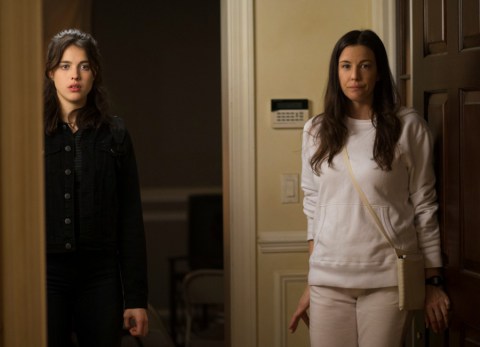
How about Liv Tyler? That opening shot with her beating the living tar out of Matt Jamison and her cussing the living daylights out of our ears was probably the nicest part of the episode. That was after the toneless introduction of Kevin and Patti arranging a table and room respectively. Great directorial transitions between the two, excellent lighting, beautiful music, and nothing to show for it. Sure you could claim some kind of parallels, but in hindsight it seems to be some bookend to her death in Kevin’s arms.

Yes, I’m aware also of the parallels between the knife in both Jill’s and Kevin’s hands, but I just care so little. It’s episode eight and Jill is still playing detective. I could say that Jill began the classic adulthood stage of paranoia, in which we all fit the massive amounts of information from Wikipedia into little stories we call our lives. I could say that, whether through divine assistance, or through radical will, Patti was not going to leave that cabin. I could say that perhaps Aimee has some serious family issues like Nora, considering we haven’t seen any of her family and we haven’t seen her leave Kevin and Jill’s house, and she got all shaky and hurt whenever Jill pushed her about “moving on.” But I’m not, because I am tired.

I definitely think this show is for somebody, like that somebody who watched Synecdoche, New York five times in a row and drooled on a clipboard. At least in this episode there were some interesting visual displays: zooming in on both Jill and Kevin’s faces, for example. But I am way too tired of being tugged around by plot. The plot is heavy and the characters are light and they all bow down to the mighty conflict. It’s like that aggressive coworker that explains their whole predicament only to push you verbally to say, “Okay, I’ll help you.”

I think The Leftovers is trying to create an overarching and powerful plot, while at the same time building the story on sand in order to prove that plots are futile, and I think they failed. It’s not like they didn’t work their asses off, it’s just that they didn’t commit to either. You’ve got Nora’s run-in with Wayne, Tommy’s highway stop with the bodies in which the view is “just like his dream.” Kevin’s father is telling him that his “services are needed.”

Yet Gladys gets murdered and we’re told that Patti and the gang killed her. And you realize that any dramatic emotion you had over Gladys was kind of bullshit, and you wonder why you bothered picking up the show in the first place. Or maybe that was their whole point?

Colton Royle is a reader of mostly American fiction and non-fiction. He is currently teaching in Fort Worth, Texas.

Major Issues: Shutter #5

Shutter05_Cover.jpg

In Major Issues, we look at one newly-released comic book each week. Now updated Mondays.

Gardner Mounce

Shutter #5
Written by Joe Keatinge
Art by Leila del Duca, Owen Gieni
Published by Image Comics
Published: 8/13/2014

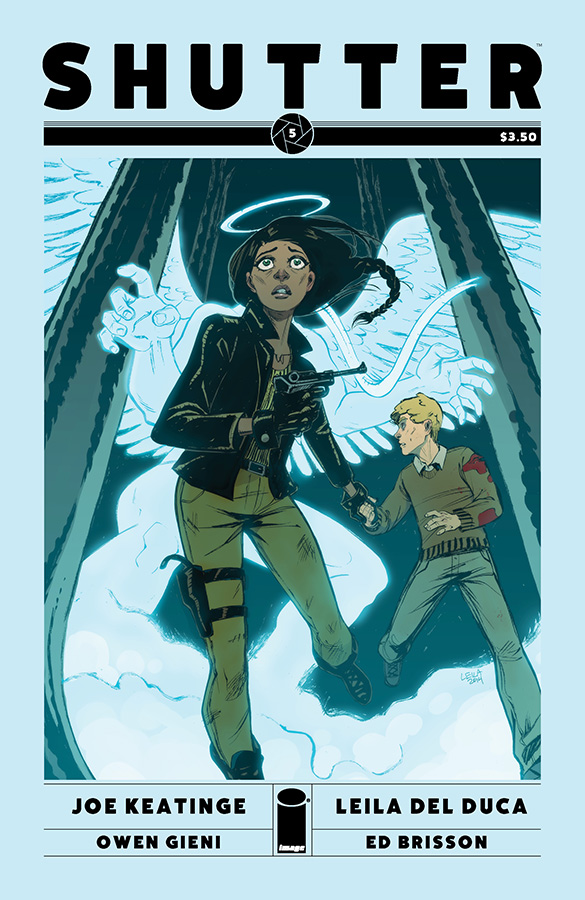
In its first five issues, Shutter has suffered from being married to its influences. Critics and readers have accused it of sharing too many similarities with Saga. There are too many analogues not to. Saga’s Lying Cat is Shutter’s Alarm Cat. Saga’s Alana is Shutter’s Kate Kristopher. Saga’s no-holds-barred world building with its television-headed technocrats and armless spiderwomen is reflected in Shutter’s ghost assassins, living-dead butlers, and cat mafias.

However, Shutter differs from Saga in a few important ways. First, Shutter is a family drama rather than a planet-hopping space opera. Sure, Shutter’s Kate Kristopher is an explorer, but our story begins after Kate’s last adventure with her father, when her father died tragically. It is the story of a grounded explorer, crippled by depression. Second, Saga’s narrator couches the story from a safe distance in the future where she can speak on the events with humor and forgiveness. Shutter has no narrator, no guiding voice to contextualize Kate’s struggle or assure the reader that, at some future time, all this will work out.

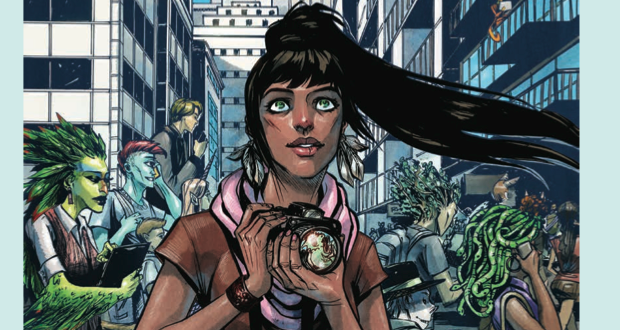
Comics are too often guilty of stripping female characters of both clothes and realistic personalities. Most women in comics are attractive, as if comic creators fear that unattractive female characters will be unpalatable to male readers–which is bullshit and insulting to both genders. Kate Kristopher is three-dimensional and independent, but, like the comic itself, is drawn too heavily from influences. She is a mixture of equal parts Hawkeye’s Kate Bishop and Saga’s Alana. She shares Kate Bishop’s off-beat humor and quirky vernacular, and Alana’s strength of character and knack of flying off the handle.

The first unique characterizing moment for Kate Kristopher happens at the end of issue 5 (no spoilers). It’s a game-changer, and comes so far out of left field that it makes you wonder how writer Joe Keatinge will handle the inevitable fallout. This is his chance to transform Kate from an amalgam of influences into a deeply flawed and unique person. But, if he fails, it will all have been for shock value.

SHUTTER-FEATURE.png

Should You Get It?

If you haven’t started Shutter yet, wait until the trade paperback of the first six issues hits stands. Due to the giant cliffhanger at the end of issue 5, issue 6 will show us if Keatinge has the chops to take the story in a fresh direction.

Gardner Mounce is a writer, speaker, listener, husband, wife, truck driver, detective, liar. When asked to describe himself in three words, Gardner Mounce says: humble, humble, God-sent. You can find him at gardnermounce.tumblr.com or email him at gmounce611@gmail.com 

Life After the Star Wars Expanded Universe: Deus Ex: Human Revolution

 Deus Ex: Human Revolution

Andrew Findlay

In Life After the Star Wars Expanded Universe, we take a look at science fiction and fantasy, why they’re great, and what they say about where our species has been and where it’s going. 

Deus Ex: Human Revolution is a cyberpunk action RPG developed by Eidos Montreal in 2011. Stylistically, cyberpunk is a mashup of film noir (alienated loner protagonist, detective structure, grim outlook) and near-future science fiction. Neuromancer is the most famous work in the genre, and Snow Crash, Blade Runner, and to a certain extent The Matrix are other examples. The setting of most cyberpunk is the point at which corporations and technology begin overwhelming the more traditional structures of power with mixed (but mostly negative) results. In Human Revolution, the technology that is approaching a world-altering paradigm shift is cybernetic augmentation – the ability for a person with a lost arm, a scarred retina, or a faulty heart to get a fully-functional robotic replacement. It opens with Adam Jensen, the protagonist, fulfilling his role as head of security for Sarif Industries, the CEO of which is about to hold a press conference about a huge scientific breakthrough. While Jensen is moving through the labs, they are invaded by a souped-up merc team (the dark side of augmentation is that there are endless military applications, and these guys are armed to their cybernetic teeth). The scientists working on the project are all killed (including Jensen’s ex-girlfriend), and Jensen himself is physically destroyed. Sarif saves him by having him undergo extensive cybernetic surgery, replacing most of his body with mechanical parts, turning him into a kind of cyberpunk Darth Vader, more machine than man. With basically his entire body turned into a weapon, he launches on his quest for answers and revenge.

Here’s the E3 trailer for the game.

The gameplay as he moves through this quest is extremely satisfying and versatile. Your arsenal is a combination of military-grade cybernetic augmentations along with more standard pistols, assault rifles, and grenades. There are multiple paths throughout every level, multiple choices for how to deal with enemies, and really cool tech to use to accomplish those things. There seems to be a bias in the game for you to move through it peaceably, as you get more XP for knocking people out instead of shooting them in the head. Other than this slight benefit to being kind, the moral choices in this game are mostly left up to you. There is none of the ridiculous starkness of choice from the early morality-based RPG craze (in which you could choose to give a beggar all of your money or murder him for his shoes, no middle ground). This deepens the main-character-as-cipher effect that helps the player become the protagonist. With no in-game judgment attached to your actions, Jensen’s decisions are your decisions. I chose to go through more peacefully than not, knocking out innocent bystanders but slaughtering anyone I found to be involved with the attack on Sarif Industries (they killed my ex and left me for dead, after all).

The augmentations you choose have a lot to do with how you play the game, and many interact with each other. For example, if you invest heavily in cloaking, you can just sprint invisibly through a room. If you invest in hacking, you can find a computer and shut down the internal surveillance system. If you invest in hacking and the arm strength upgrades (which by itself allows you to kill people by throwing refrigerators at them), you can hack a turret to make it friendly and then just carry it through the level (this is a game-breaking combo). If you upgrade your sight to be able to see through walls and upgrade your arms to be able to punch through them, it enables you to time your strike so it takes out multiple people. The customization and slow strengthening of Jensen due to unlocking more and more augmentations is extremely pleasurable – is he an invisible ghost, is he an unstoppable, neck-snapping colossus, or is he somewhere in between? The absurd level of strength your character has by the end of the game (playing on normal difficulty) ties into the thematic concerns of the game – augmentation allows one solitary man to become a terror to both powerful governments and nation-spanning multi-billion dollar corporations.

This leads into why this game is here and not elsewhere on the site. It engages deeply with the moral quandaries and personal concerns involved with human advancement. Jensen himself is a little flat, as you are meant to fill him in with your own thoughts and preconceptions, but he moves in a world of people with frighteningly powerful opinions: his boss, Sarif, who thinks augmentation is the next step in human evolution, terrorists, who think augmentation is an abomination, and government officials, who are terrified of this new human potential that can make controlling a population all but impossible. Jensen himself, as one of the most heavily modified humans in existence, stands at the center of all these ambitions and concerns. He single-handedly justifies governmental concerns – if you play the game right, he is unkillable and undetectable. The conversations Jensen has with people, the actions he takes, and the ultimate outcome of the game (much of which is up to player decisions) all heavily involve the age-old SF trope of the benefits and drawbacks of human progress. It is an expertly developed theme planted right in the middle of a satisfying gaming experience, and if you own a console and like cyberpunk, you need to play it.

Andrew Findlay has strong opinions about things (mostly literature) and will share them with you loudly and confidently. You can email him at afindlay.recess@gmail.com.
Worst Best Picture: Is The Godfather Better or Worse Than Crash?

godfather_2467471b

Alex Russell

In “Worst Best Picture” we search every single Best Picture Oscar winner of all time from 1927 to present to uncover the worst of them all. Conventional wisdom says that 2005’s winner Crash is the worst winner in history. We won’t stop until we’ve tested every last one. Read the the first, our review of Crash, here. Posts will be relatively spoiler free, but there may be some details revealed. Today’s installment is the 1972 winner The Godfather. Is it better than Crash?

Have you ever met someone who hated The Beatles? You meet those people every now and again, and it’s always a strange experience. Personally, I have to rationalize it by saying that they must just be rebelling against something that they’ve always been told to like. They must be responding to a world that says “this is the stuff we all like” by not liking it.

They’re wrong, of course, in the same way that anyone would be wrong if they hated The Godfather. If you ask anyone to make a list of the best American movies of the last 50 years, you can judge them harshly if they exclude The Godfather. Its place in the canon is secure.

It also holds up. It’s amazing even in 2014, mostly because the performances all play up to the source material. Everyone is complicated, which matters. Al Pacino shows how a man’s principles can be broken by extreme circumstances, and by the time he’s shooting a police chief with a gun stashed in a restaurant bathroom, you already believe his transformation from a simple son not looking for trouble into Michael Corleone. James Caan’s Sonny is the breathing example of “when all you have is a hammer, everything looks like a nail.” In The Godfather‘s world, where everyone has to constantly reaffirm their manhood, Sonny figures throwing a guy around in the street is as good a way as any to do so. It’s the contrast between Michael and Sonny that’s so fascinating, because that’s the contrast of human experience.

Is it better to be strong or to appear strong? At certain points of The Godfather, they’re both valuable. One of the many messages of the movie, though, is that you have to know which is more valuable in the moment. If you’re capable of both and of knowing which you should be in that situation, well, then you might be able to jump the line, even if you’re just some college kid. And to boot, Sonny is there to remind us that anger gets you what anger always gets you.

It is impressive that The Godfather still feels massive in 2014. It has the same electricity about it that Gone with the Wind and Casablanca do. You know you’re watching something special, even among a list of solely “special” movies. There are a million things going on in it that I haven’t touched on here, but this doesn’t exist as a full exploration of one of the greatest films of all time. This exists to wonder how it compares to Crash, which I’ll get into below. This also exists as a call to action. If you’re one of those people that hasn’t seen it, go shell out the three bucks and watch it online. If you have seen it, go watch it again. If you’re already watching it while you’re reading this, well, you should at least pay closer attention.

The Best Part: The ending montage is fantastic and iconic, but I’m going to go even simpler: Brando. My favorite Brando is still Stanley Kowalski from A Streetcar Named Desire, but Don Corleone is just about everything. He’s controlled rage, he’s measured response, he’s tough-but-fair counseling. He’s the heart of the movie, even as he’s confined to his sickbed. The sequel is all Pacino’s movie, but this one is all Brando.

The Worst Part: I’m going to save the discussion of gender for the sequel, which also won Best Picture, because it will make more sense there. For The Godfather itself, it’s hard to pick a “worst part. I suppose I’ll go with the scenes in Italy. It’s an important part of the plot, but it’s never been my favorite to watch when I watch The Godfather. Fine, you don’t like that, you tell me what the “worst” part of arguably the greatest Best Picture winner ever is, you’re so smart?

Is It Better or Worse than CrashI’ve been doing a lot of thinking about Crash lately. As I get close to the halfway point, I’ve started to wonder if Crash deserves a rewatch. I’m going to give it one — reluctantly, angrily, with a heavy heart — and I’m going to try to not compare it to the dozens of incredible movies listed below. In this brief moment, however, I have to compare Crash to The Godfather. I suppose they both offer looks at worlds that aren’t enviable. The Godfather doesn’t offer a positive view of masculinity or the mob and Crash doesn’t offer a positive view of… Earth. The Godfather is about Michael’s decision to opt out of a violent life and then the external forces that compel him. I could just type “Marlon Brando” 45 times here, but I’d rather make the case that The Godfather is hopeful, because Michael gets so close. Crash offers only a brief hope at escape, and it essentially closes all of those doors on its characters. Michael nearly escapes with Diane Keaton. Isn’t that basically what we all want?

Worst Best Picture Archives: Crash | Terms of Endearment | Forrest Gump | All About Eve | The Apartment | No Country for Old Men | Gentleman’s Agreement |12 Years a SlaveThe Last Emperor | The Silence of the Lambs | The Artist | A Man for All Seasons | Platoon | The Lord of the Rings: The Return of the King | The King’s Speech | Rain Man | The Departed | The Bridge on the River Kwai | Marty | Gigi | It Happened One Night | Driving Miss Daisy | Shakespeare in Love | Wings | Midnight Cowboy | Rocky | Gone with the Wind| Chicago | Gladiator | Cavalcade | The Greatest Show on Earth | You Can’t Take It With You | The Best Years of Our Lives | The Godfather

Alex Russell lives in Chicago and is set in his ways. Disagree with him about anything at readingatrecess@gmail.com or on Twitter at @alexbad.

Tough Questions: What Are You Superstitious About?

question-mark

Every week we ask everyone who hangs out around here to answer a tough question. This week:

What are you superstitious about?

Rules are simple: what are you really, truly, weird about? The dictionary offers that a superstition is “not based on reason or knowledge,” which makes the dictionary sound like a bit of an asshole. These are real fears that you need to develop. How have you lived this long without these? How can you just STAND THERE with all this fear in the world?

Alex Russell

I’m a checker — I’ll go back home to make sure that my alarm is off, even if I’m almost all the way to work. That’s the most debilitating of my quirks, but my biggest superstition has to be a belief in lucky items. I drink out of the same coffee cup every day at work, I use the same water glass every day at home, I carry the same few “lucky” trinkets in my wallet. I cannot break these cycles because what if those are all the reasons that you and I can still get up every single day?! I’m saving lives.

Jonathan May

I’m an incredibly superstitious person by nature. I don’t walk under ladders. I throw spilled salt over my shoulder. I have lucky underwear. But the thing I’m probably most superstitious about is my birthday. I take great pains to avoid any kind of unpleasantry on that day, even going so far as (at one point) having a friend kick out a group of interlopers from my party. The day itself is very ordered, a high mark of superstition. I get up and make bacon, then sit down to write a birthday haiku. Afterward I see my family before throwing myself full-on into party preparation. Hosting a party decidedly invites unpleasantries into one’s life, so I’m basically all but falling apart by the time the whole thing goes down. I think if a black cat crossed my path on my birthday, I would physically recoil and break down in nerves.

Andrew Findlay

I’m not so much superstitious about anything as I am anxious about everything.

Gardner Mounce

We form superstitions towards things we’re scared of or ignorant to, and I ain’t scared of nothing. Once, while walking through the woods at night without a flashlight, I got tangled in a giant spider web. Except the spider was actually a jawless eight-legged man with eyes like pale eggsacs who tortured his victims by describing how much more their high school peers have accomplished than them. You know what I did? Fell asleep. All that to say, I ain’t scared of nothing. However, I am scared of spiders. I have this superstition where if I haven’t seen a spider for a good amount of time, like a week, I’m convinced that the spiders know this and will promptly dispatch their most terrifying member to my bedroom window. The worst part is that they always do.

Colton Royle

I’ve been taking a lot of certification tests this summer to be able to teach new subjects. I was told around senior year of college that blueberries were the best food to eat before a test, and now I start eating an entire collection of blueberries two days before the test. Catchphrases like “brain food,” others like “antioxidants,” and even some like “belly fat burner,” get me mentally turned on. On my Princeton Review book for the GRE I put a dedication on the front page to Violet Beauregarde.