comic books

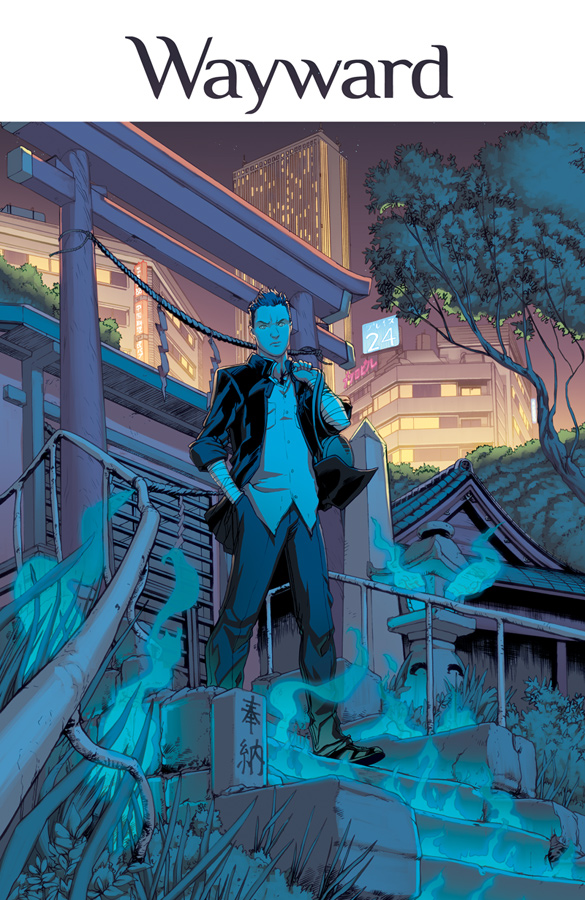
Major Issues: Wayward #1

Wayward02A-585x900-web.jpg

In Major Issues, we look at one newly-released comic book each week. Updated Mondays.

Gardner Mounce

Wayward #1
Written by Jim Zub
Art by Steve Cummings
Colors by John Rauch and Jim Zub
Letters by Marshall Dillon
Published by Image Comics 8/27/14

My high school English teacher taught me that it’s bad form to begin an essay with a quote, and that’s why I’m saving it for sentence two. Someone once said that anyone can write a first act. It’s fun and easy to come up with a group of characters and establish a conflict; it’s in act two where things get tricky. Even so, a first act can be told poorly. Wayward’s problem is that it sets up its pieces so quickly that it doesn’t seem to enjoy its own premise.

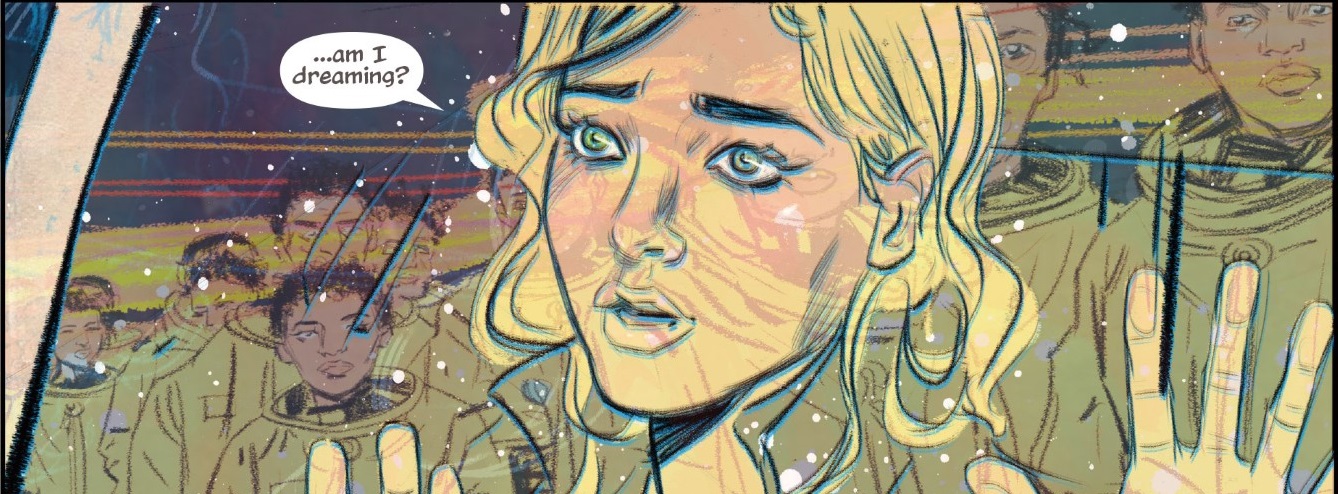
Issue one falls into the trap of trying too quickly to get to the action. It assumes readers don’t have patience for the setup and are rolling their eyes until someone draws a sword. Protagonist Rori Lane, an Irish-Japanese high school student, lands in Japan to start a new life with her mom. For some reason, her mom doesn’t pick her up from the airport, which conveniently allows Rori to discover her new superpower–the ability to see her literal future path displayed for her in a red line (exactly like Donnie Darko’s ability to see his future path in a blue line). She catches up with her mom over dinner and explores Japan a little. Three men in an alleyway accost her. She’s saved by a ninja girl. They fight them off. The guys end up being turtle monsters, she discovers she can jump buildings for some reason, etc, etc.

This would be too much for one issue anyways, but writer Jim Zub dumps additional exposition on us in gobs of narration. Comics are a combination of words and pictures, but I’d argue that they’re a visual medium first. I hold them to Alfred Hitchcock’s standard that, like film, if they are played “silently” (without narration) the story should still work. It’s the cliche: show don’t tell. Narration should never do the work that the visual element could do. Most of the narration in Wayward could have been relayed to the reader visually, but oftentimes the narration just parrots what the comic is already showing. For instance, in one scene Rori struggles to take an afternoon nap, but is unable to do so due to jet lag. There are three frames. In frame one, Rori is lying down, staring at the ceiling. The narrator says, “I wonder if my brain will stop whirling long enough to take a nap.” The second frame is the same shot, to show that time has passed. The third frame shows Rori sitting up, indicating that, no, her brain won’t stop whirling long enough for her to take a nap. The reader understands this and needs no further indication, but Zub provides two additional layers of narration. First, Rori says, “Nope!” Second, the narrator says, “I guess it’s time to go exploring!”, which is an unnecessary line since the next panel shows Rori exploring. Zub commits this crime of over explaining constantly in issue one. The overall effect is that it reads like a rough draft, like Zub is still in the process of learning what his characters want and hasn’t yet found a way to tell the story in an interesting visual way.

Artist Steve Cummings and colorist John Rauch created this comic for a niche audience: the anime-ers. Skin is translucent. Hair is green or blue. Everyone’s dressed like they’re in attendance at Anime Expo. I’m not an anime or manga fan, so the art doesn’t feel like an homage to a Japanese style so much as it feels derivative of it. However, Cummings’s perspectives are noteworthy. Wide shots distort like wide angle lenses, giving the effect that the comic is filmed. It gives issue one a slick cinematic feel that definitely catches the eye. Now, if only Zub would trust him enough to take that camera eye and show us Japan and Rori Lane’s knotty relationship to her parents rather than tell us about it.

Should You Get It?

No. Unless manga is an obsession for you, and you’ve read all the manga, and you need anything that looks like manga or anime right now.

Gardner Mounce is a writer, speaker, listener, husband, wife, truck driver, detective, liar. When asked to describe himself in three words, Gardner Mounce says: humble, humble, God-sent. You can find him at gardnermounce.tumblr.com or email him at gmounce611@gmail.com 

Major Issues: Supreme: Blue Rose #2

STK647497.jpg

In Major Issues, we look at one newly-released comic book each week. Now updated Mondays.

Gardner Mounce

Supreme Blue Rose #2
Written by Warren Ellis
Art by Tula Lotay
Published by Image Comics
Published: 8/20/2014

Issue #2 of Supreme: Blue Rose opens on a scene that can be described as both artfully crafted and expositionally convoluted. It withholds exactly the information that would contextualize it–who are these characters and what is their purpose in the story? And, really, that’s exactly how Supreme: Blue Rose itself can be summed up so far. Warren Ellis reveals layers of the story like a magician overturning cards, but it’s two issues in and we’re just seeing the beginnings of the trick. Who knows how long it will be until he unveils what he’s up to.

The story so far: Darius Dax, a wealthy investigator of “blue rose cases”–rare events that do not typically occur in nature–hires Diane Dane, an out of work journalist, to investigate a strange event in upper New York state for an exorbitant rate. Dax plans to sell his findings to “actors” or “entities that act upon the geopolitical sphere” for even more money.

Before getting back to Diana Dane’s story in this issue, we wade through additional new subplots. Like artist Tula Lotay’s multimedia approach, there are layers upon layers of subplots. In the opening scene, an enigmatic woman leads an aged writer up a spiral staircase to [heaven?]. Following this is another installment of Professor Night, a TV show Diana Dane watches that is stuffed with non sequiturs and high-minded pronouncements. Its dark imagery is a reflection of the psyche of the Manhattan of the Supreme universe: violent and paranoid and cowed. It’s possibly an unconscious parallel version of the events of the story proper, like Tales of the Black Freighter was for Watchmen. Finally, there’s a scene in which a [mathematician] solves an equation that puts her in contact with an intelligent source from somewhere in deep spacetime.

When we catch up with Diana Dane, she’s grabbing a limo ride with a representative of Darius Dax, code name Twilight Girl Marvel. Twilight Girl Marvel explains to Diana that her position as a limo driver is a temporary reprieve from her true job as a “versioner”–someone who tests alternate versions of history and their would-have-been effects. We’re just getting back to some semblance of linear, understandable plot when suddenly Diana falls into a dream state in which she envisions an alternate history in which a North African scientific empire pioneered Mars.

Supreme-Blue-Rose-002-021.jpg

Should You Get it?

Supreme: Blue Rose is one of those puzzle-piecer stories for fans of Memento or Donnie Darko or Primer where every single frame will probably have multiple meanings. It’s for those with an allergy to exposition dumps and patronizing narrators. It’s for “smart” readers. In comic form, a story like this can be frustrating. Can you imagine watching two or three scenes of Memento at a time with a month between each installment? On the other hand, maybe it’s just convoluted for the sake of convolution. The question is: how much do you trust Warren Ellis?

Gardner Mounce is a writer, speaker, listener, husband, wife, truck driver, detective, liar. When asked to describe himself in three words, Gardner Mounce says: humble, humble, God-sent. You can find him at gardnermounce.tumblr.com or email him at gmounce611@gmail.com 
Major Issues: Shutter #5

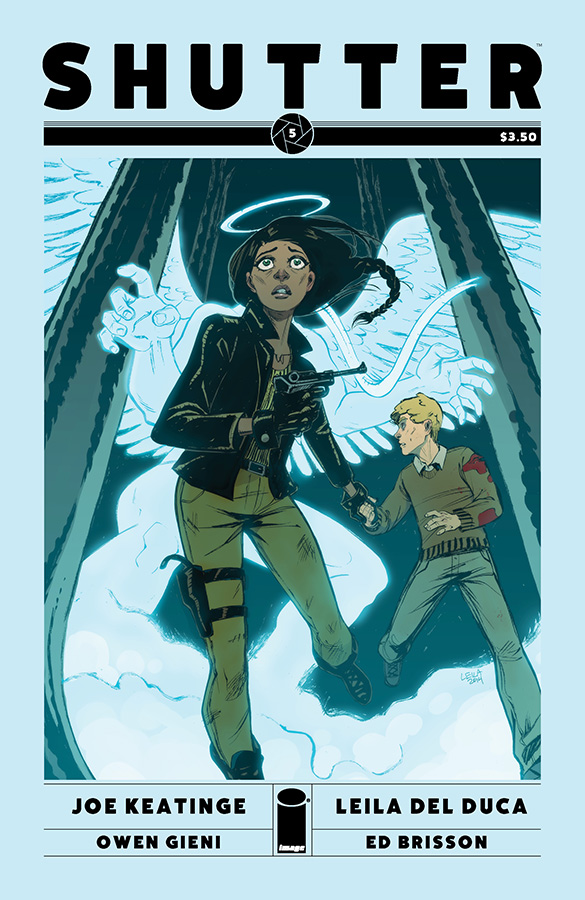
Shutter05_Cover.jpg

In Major Issues, we look at one newly-released comic book each week. Now updated Mondays.

Gardner Mounce

Shutter #5
Written by Joe Keatinge
Art by Leila del Duca, Owen Gieni
Published by Image Comics
Published: 8/13/2014

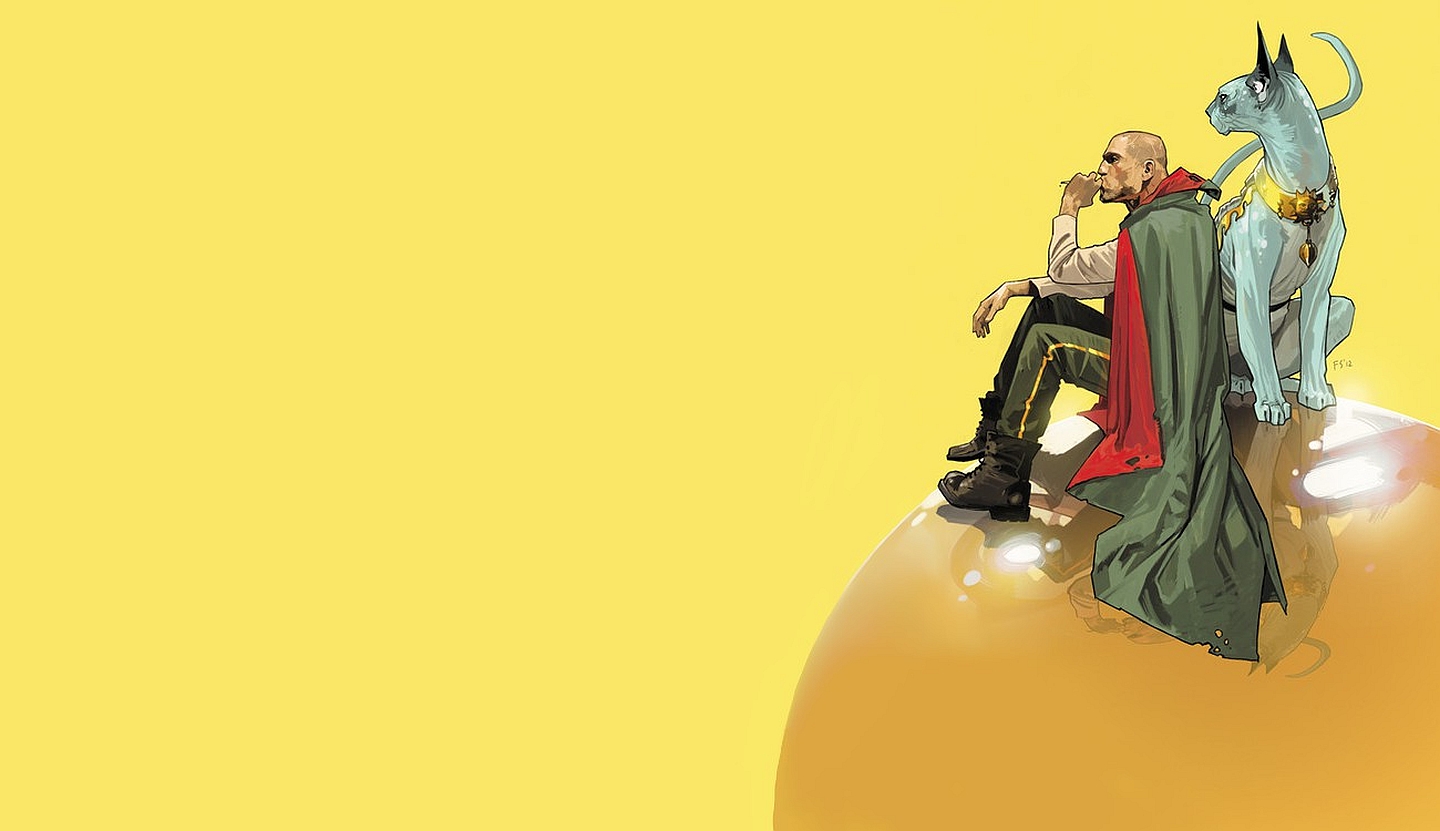
In its first five issues, Shutter has suffered from being married to its influences. Critics and readers have accused it of sharing too many similarities with Saga. There are too many analogues not to. Saga’s Lying Cat is Shutter’s Alarm Cat. Saga’s Alana is Shutter’s Kate Kristopher. Saga’s no-holds-barred world building with its television-headed technocrats and armless spiderwomen is reflected in Shutter’s ghost assassins, living-dead butlers, and cat mafias.

However, Shutter differs from Saga in a few important ways. First, Shutter is a family drama rather than a planet-hopping space opera. Sure, Shutter’s Kate Kristopher is an explorer, but our story begins after Kate’s last adventure with her father, when her father died tragically. It is the story of a grounded explorer, crippled by depression. Second, Saga’s narrator couches the story from a safe distance in the future where she can speak on the events with humor and forgiveness. Shutter has no narrator, no guiding voice to contextualize Kate’s struggle or assure the reader that, at some future time, all this will work out.

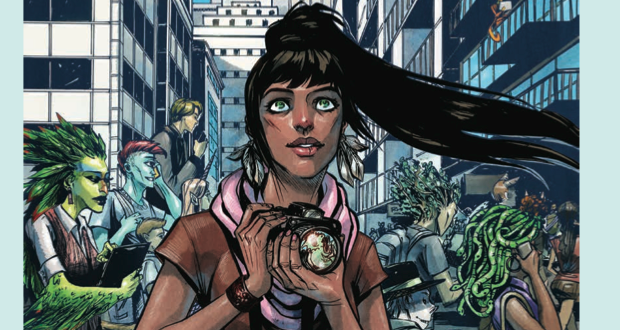
Comics are too often guilty of stripping female characters of both clothes and realistic personalities. Most women in comics are attractive, as if comic creators fear that unattractive female characters will be unpalatable to male readers–which is bullshit and insulting to both genders. Kate Kristopher is three-dimensional and independent, but, like the comic itself, is drawn too heavily from influences. She is a mixture of equal parts Hawkeye’s Kate Bishop and Saga’s Alana. She shares Kate Bishop’s off-beat humor and quirky vernacular, and Alana’s strength of character and knack of flying off the handle.

The first unique characterizing moment for Kate Kristopher happens at the end of issue 5 (no spoilers). It’s a game-changer, and comes so far out of left field that it makes you wonder how writer Joe Keatinge will handle the inevitable fallout. This is his chance to transform Kate from an amalgam of influences into a deeply flawed and unique person. But, if he fails, it will all have been for shock value.

SHUTTER-FEATURE.png

Should You Get It?

If you haven’t started Shutter yet, wait until the trade paperback of the first six issues hits stands. Due to the giant cliffhanger at the end of issue 5, issue 6 will show us if Keatinge has the chops to take the story in a fresh direction.

Gardner Mounce is a writer, speaker, listener, husband, wife, truck driver, detective, liar. When asked to describe himself in three words, Gardner Mounce says: humble, humble, God-sent. You can find him at gardnermounce.tumblr.com or email him at gmounce611@gmail.com 
Major Issues: Spread #2

2086925.jpg

In Major Issues, we look at one newly-released comic book each week. Now updated Mondays.

Gardner Mounce

Spread #2
Written by Justin Jordan
Art by Kyle Strahm
Published by Image Comics 7/6/2014

The post-apocalyptic story seeped into the cultural consciousness at the end of the nineteenth century with Mary Shelley’s novel The Last Man, and has been retold in countless incarnations since. We’ve our plague-pocalypses, zombie-pocalypses, pocalypse-pocalypses (this hasn’t been done yet?), all serving to sate our need to punish ourselves in fiction for how great of a job we’re doing fucking everything up. In such an over-saturated apocalypse narrative market, what must a new narrative do to stand apart and be successful?

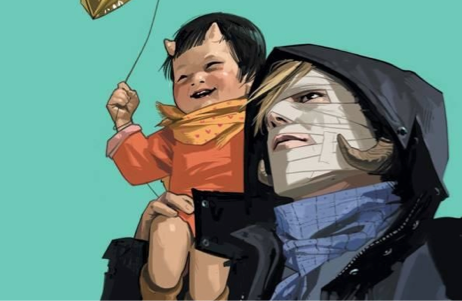
Not much, apparently. Spread’s first issue sold out its first two printings and is heading into its third, and the second issue sold out immediately. So what’s it about? How does it stand apart? Combining elements of John Carpenter’s The Thing, Cormac McCarthy’s The Road, and the baby-as-narrator device from Saga, Spread is an amalgam of things guaranteed to work. In a world ravaged by parasitic organisms capable of banding together into larger mega-organisms, a man named No must protect the world’s only hope: a baby actually named Hope, whose tears have the power to dissolve the parasites’ bodies. I’m not suggesting that Spread is bad. It’s actually a lot of fun. It combines the right elements of visceral art, disgusting monsters, creepy characters, and heady pacing. But if you’re looking for a fresh take on post-apocalyptic stories, look elsewhere.

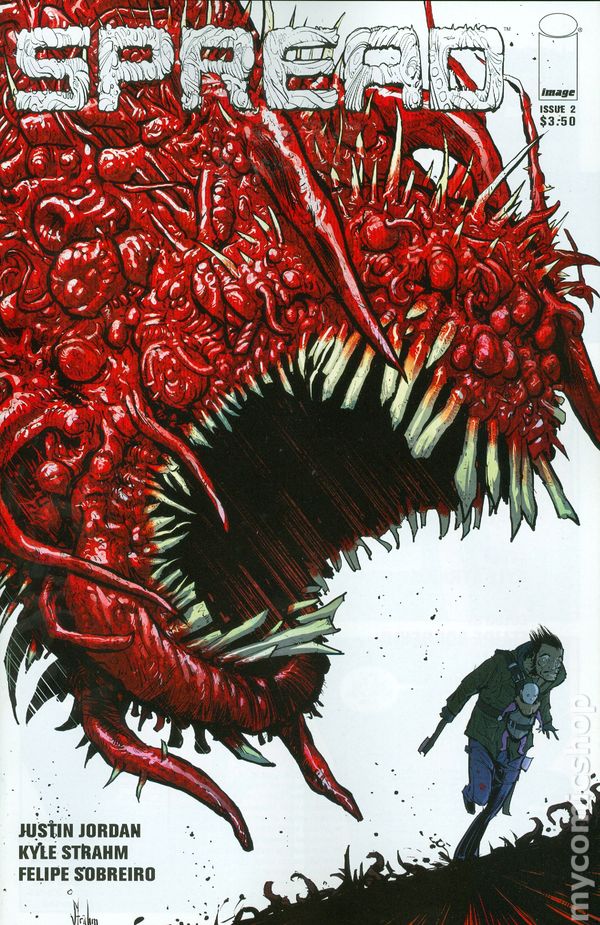
The story is strong and has been diligently introducing the right elements. In this issue, writer Justin Jordan introduces some new characters. First we meet Ravello, the Fabio-esque leader of a group of bandits. Unlike the other scarred, dirty characters of this world, Ravello is an unscathed Adonis–the visual antithesis to issue 1’s creepy thin man who has the power to spawn additional parasites. Then we meet the series’ first mega-parasite (pictured on the issue’s cover). And finally, baby Hope’s mother Molly, a totally capable mother who is in no way balls-out crazy. Though the story elements are strong and balanced, the story’s chief flaw is in taking itself too seriously. It rides too many familiar elements to not be self-aware and poke fun at its own premise.

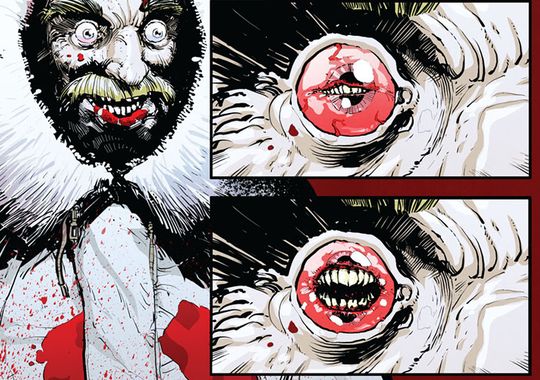
The art is bloody and visceral, and probably the series’ best element. Artist Kyle Strahm can handle anything Jordan throws his way, including parasites exploding from eyeballs and multi-mouthed worms. If there’s anything in this series that can be said to be funny, it’s in the gratuitous use of violence. It’s funny in the exploitative way of John Carpenter and Quentin Tarantino movies.

1404153101000-Spread-01-007.jpeg

The old parasite chewing through the eyeball bit. Too funny.

Should You Get It?

For post-apocalypse junkies only. You won’t find anything necessarily fresh in its pages, but if you need to feel that psychic catharsis by seeing humanity punished for all its mistakes, you could do worse than Spread.

Gardner Mounce is a writer, speaker, listener, husband, wife, truck driver, detective, liar. When asked to describe himself in three words, Gardner Mounce says: humble, humble, God-sent. You can find him at gardnermounce.tumblr.com or email him at gmounce611@gmail.com 
Major Issues: Low #1

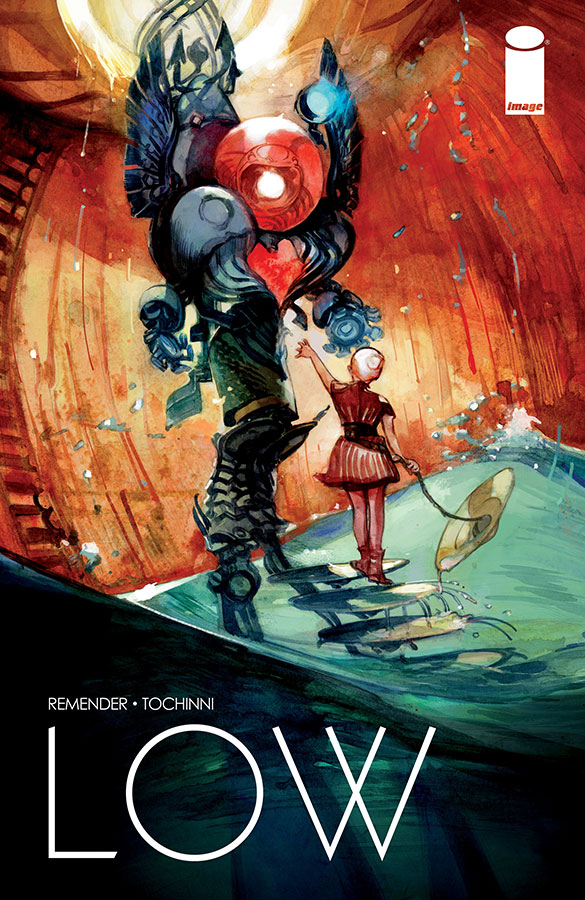
LowCover

In Major Issues, we look at one newly-released comic book each week. Now updated Mondays.

Gardner Mounce

Low #1
Written by Rick Remender
Art by Greg Tocchini
Published by Image Comics
Publication Date: 7/30/14

Louis C.K. has a great joke about telling his daughter that in millions of years, once she and everyone she knows is dead, the sun will explode and kill everyone on earth. There’s not much of a punchline other than the fact itself, and finding it funny might be the litmus test for whether or not you’d enjoy Rick Remender’s latest series Low, a story about humanity’s last ditch effort to escape an expanding sun by living in cities beneath the ocean surface. Remender–always the pessimist–says it’s a story about optimism. We’ll see.

Unlike Remender’s other currently-running series, Black Science, a no-holds-barred sci-fi story that is supposedly written without a plan, Low promises something more classic and structured. There’s a clearly defined ticking clock (the sun is expanding) and even some mustache-twirling bad guys. We meet Johl, his wife Stel, and their two children. They are descendants of the Caine family, a founding family of the underwater cities. In this issue, Johl and Stel take their two children out of the city for the first time and run into trouble with underwater savages.

Remender paces the first issue well, but flounders with the exposition. He mostly avoids his trademark pessimistic narration, and opts instead to stuff his characters with exposition-heavy dialogue. In the first scene, Johl and Stel have one very stilted post-coitus conversation about plot points. But thanks to artist Greg Tocchini’s ability to draw realistic body language, we pick up that the two are very much in love. They just don’t have a lot to talk about besides exposition.

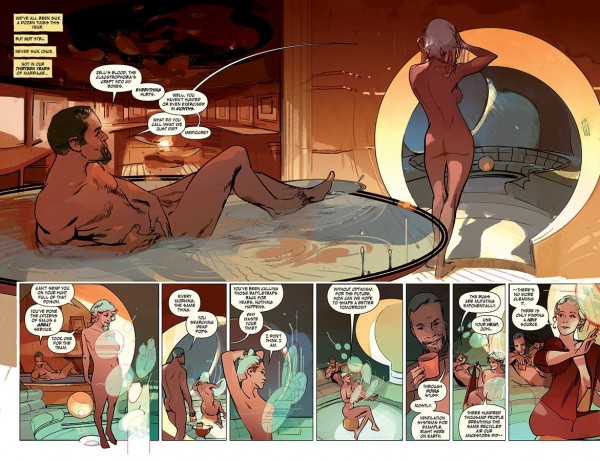
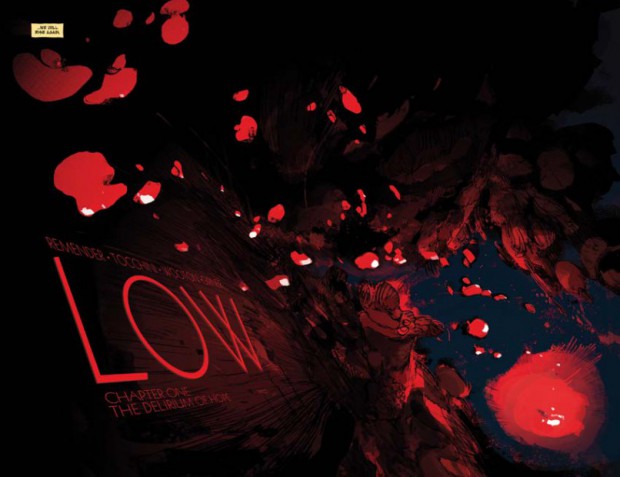
As for the art, Tocchini creates a visual vocabulary out of Low’s underwater aesthetic, especially in his use of spheres and circles. Not only are some of the panels themselves circular, but so are many aspects of the city’s architecture, and much of the technology is spherically designed. The spheres suggest air bubbles rising from oxygen tanks, the glass bubble that encases the city, the sun and the earth, and serves to indicate how fragile spherical things are in general.

Even better is Tocchini’s way of suggesting the central conflict with the color palette. The two-page title page separates the world into burning red and absolute black–the polarizing forces of the burning sun above and the crushing ocean depths below.

Low-001-003-e1406846459126.jpg

Between these two extremes is where our characters live, in warm amber and deep jade–suggesting human warmth and the more habitable ocean depths, but also suggesting how sandwiched our protagonists are between destruction above and oblivion below.

image2-600x461.jpg

Like most of Remender’s comics, I’m more excited by the art than the writing. Even in a comic about earth’s inevitable destruction, Remender’s writing comes off as heavy-handed. However, as long as he keeps pairing himself with artists like Tocchini who can add nuance and layers of meaning, I’ll keep coming back for more.

Should You Get It?

You could probably wait until the trade paperback of the first story arc. If you’re new to Rick Remender, I’d skip this and check out his series Deadly Class. It’s the best thing he’s got going right now.

Gardner Mounce is a writer, speaker, listener, husband, wife, truck driver, detective, liar. When asked to describe himself in three words, Gardner Mounce says: humble, humble, God-sent. You can find him at gardnermounce.tumblr.com or email him at gmounce611@gmail.com 
Major Issues: Trees #3

8665.jpg

In Major Issues, we look at one newly released comic book each week. Updated Fridays.

Gardner Mounce

Trees #3
Written by Warren Ellis
Art by Jason Howard
Published by Image Comics
Published: 7/24/14

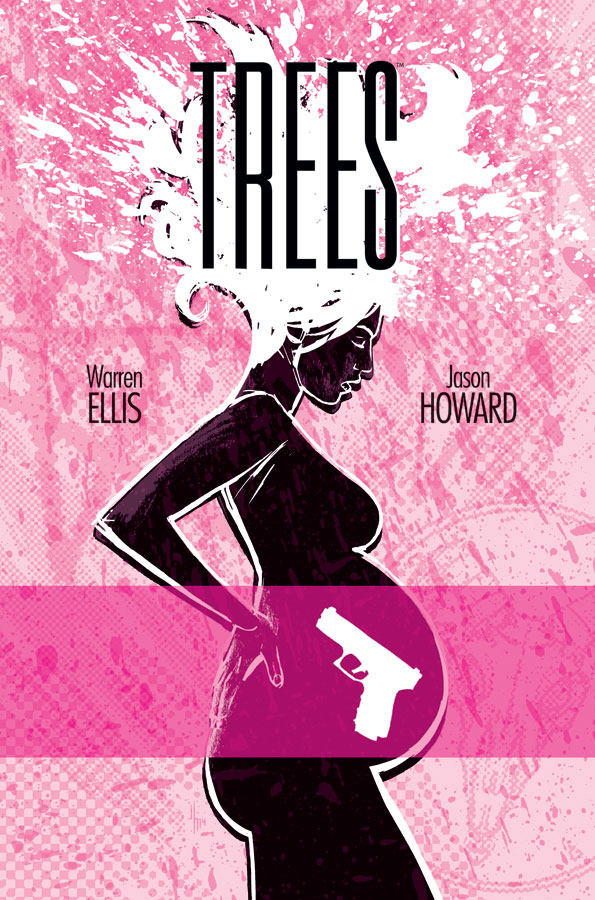
As pop culture would have it, there are two ways that aliens are going to invade. There’s the Invasion of the Body Snatchers/Men in Black type where one day we find out that the aliens have been living right under our noses for years. And there’s the Independence Day/The Hitchhiker’s Guide to the Galaxy type where the aliens just announce that they’re here and in a few seconds we’ll all be dead. The first thing we notice is that Will Smith has saved us from both types. The second thing we notice is that, in both scenarios, the aliens are accessible antagonists—they’re here among us for us to interact with or fight or whatever, or they’re above us in spaceships for us to throw rocks at. But imagine if an alien race left some undeniable symbol of their presence and utter superiority, and then just left us to scratch our heads about it.

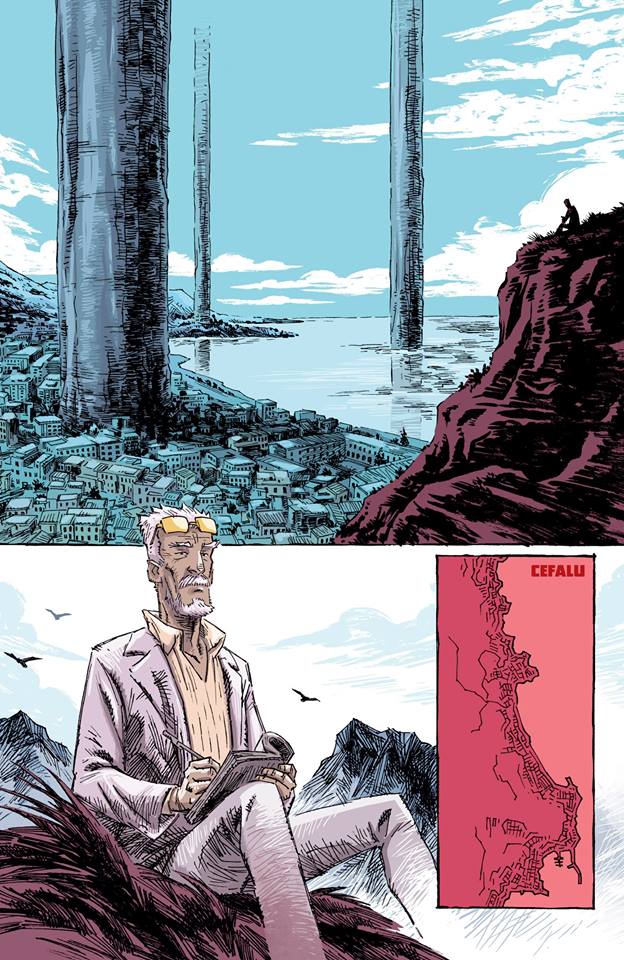
In Warren Ellis and Jason Howard’s Trees, an alien race has punctured the globe with monumental, sky-scraping towers (which humanity has dubbed “trees”)—and then vanished, like, your move, humans, and haven’t returned or made contact for over a decade. Less us-versus-them-story and more human drama, Trees tracks a number of story lines that span the globe, from an ex-professor in Cefalu and the fascist’s girlfriend who stalks him to scientists in Antarctica studying a mysterious black bloom growing at the base of a “tree.”

Ellis handles it all with incredible subtlety. A lesser writer would have written swathes of heavy-handed narration, but after some necessary exposition in the first issue Ellis constructs the world scene-by-scene with zero narration at all. A narrator-less story gives the sense that the reader knows just as much as the characters do about the trees—hardly anything. It also stresses the importance of the present moment: the world has halted since the trees arrived; they are ever-present, in nearly every scene; timeless and unchanging; dominating the landscape and laying waste to our sense of importance and human scale of time. Subtle also is Ellis’ dialogue. It’s been ten years since the trees arrived, so it’s only natural that people aren’t having exposition-heavy conversations about them. People are solving small problems on their own small stages, leaving the reader to synthesize bits of information to form the larger picture. The dialogue is smart, clipped, and avoids pandering.

Jason Howard is one of those imminently readable artists whose art is so functional that it’s almost invisible. It takes a keen eye to discern his moves. He uses the same types of panels over and over, and, taken together, the pages form a rhythm. There are the borderless panels that suggest timelessness, the bordered action panels that break the borderless panels up, and the white-backgrounded panels that strip the world down to action, reaction, and emotion. The borderless panels often establish expansive spaces like arctic vistas, sterile cafeterias, and “tree”-dotted Italian landscapes. These ground us in the sense of timelessness that the “trees” have imposed. These borderless panels are the arena on which the story takes place, and the places to which we always return: huge silent spaces punctuated by human action. Much rides on Howard’s colors, which he uses to establish mood. From cool conciliatory blues to altercation-accompanying yellows and pinks, his art is about subtlety.

Alien invasion stories are generally heavy on action and light on mystery. And we usually know the invaders’ intentions by the end of act one, which gives us plenty of time for preparing for fighting, fighting, and high-fiving over the fighting that just occurred. Trees stands apart because, first of all, there are no roles for Will Smith to play in the movie adaptation, and second of all, we don’t have any idea why the aliens dropped these “trees” down on us. To study us? To suck the life from our planet? To mess with us? The whole fun is that not knowing makes us feel out-of-the-loop and insignificant, and that fear of our insignificance spurs us. Fun, right?

tree-2.jpg

Should You Get it?

Absolutely. As a writer, Ellis is confident as hell, and treats his readers with respect. These first three issues have been slim on action and heavy on establishing world, character, and conflict. He will not spoon feed, he will not pander. This is a serious comic for serious readers, and as with almost any Ellis comic, will most likely have tremendous payoff. Though, I will say, this comic might be more satisfying in trade paperback form where you can read a lot in one sitting.

Gardner Mounce is a writer, speaker, listener, husband, wife, truck driver, detective, liar. When asked to describe himself in three words, Gardner Mounce says: humble, humble, God-sent. You can find him at gardnermounce.tumblr.com or email him at gmounce611@gmail.com 
Major Issues: Head Lopper #1 and What We Talk About When We Talk About Lopping Heads

Screen_20Shot_202013-05-16_20at_201.40.08_20PM_original.png

In Major Issues, we look at one newly released comic book each week. Updated Fridays.

Gardner Mounce

Head Lopper: Issue 1
Written and Illustrated by Andrew Maclean
Colors by Mike Spicer
Self-Published
Release: 7/9/14

Comic books are stuffed with “Badasses.” These are characters so “Awesome” they encroach upon the “Mythic.” These are the characters who, in the first scene, catch a flying fist to the astonishment of a gathered crowd. These are the characters who lie sleepless on motel mattresses, hardly aware of the lusty nude figures curled against them. These are the characters who barely keep cigarettes tucked into mouth corners. Whose silhouettes can be seen in a screen of smoke. Who don’t have pasts until issue four (The Past Issue), when it’s revealed that everyone they’ve ever met died in a car accident. These are the characters who have clipped, masculine conversations with clipped, masculine men of any race. Who command presence. Who walk unafraid down the middle of dark echoey streets. Who splash water on their faces. Who reveal weapons just long enough for their assailants to say, “Oh, shit.” Who stand in a circle of assailants, allowing the tension to build with the knuckle-cracking and the jeering. Who then attack every assailant with every limb all at once, and somehow even use the assailants’ limbs against them. Who then stand in the epicenter of all that violence and hurt and look off somewhere else, to some new fight, to some new arena in which they can prove themselves again.

The badass myth speaks to a desire that (some/most/all) men have to be validated for physical strength and cool detachment. Something that most comic book readers are not known for, if you can even believe that. The desire runs deep. That means that the badass myth, however played out it is, will be here as long as men reading comic books are. The flip side is that so will parodies (thank god).

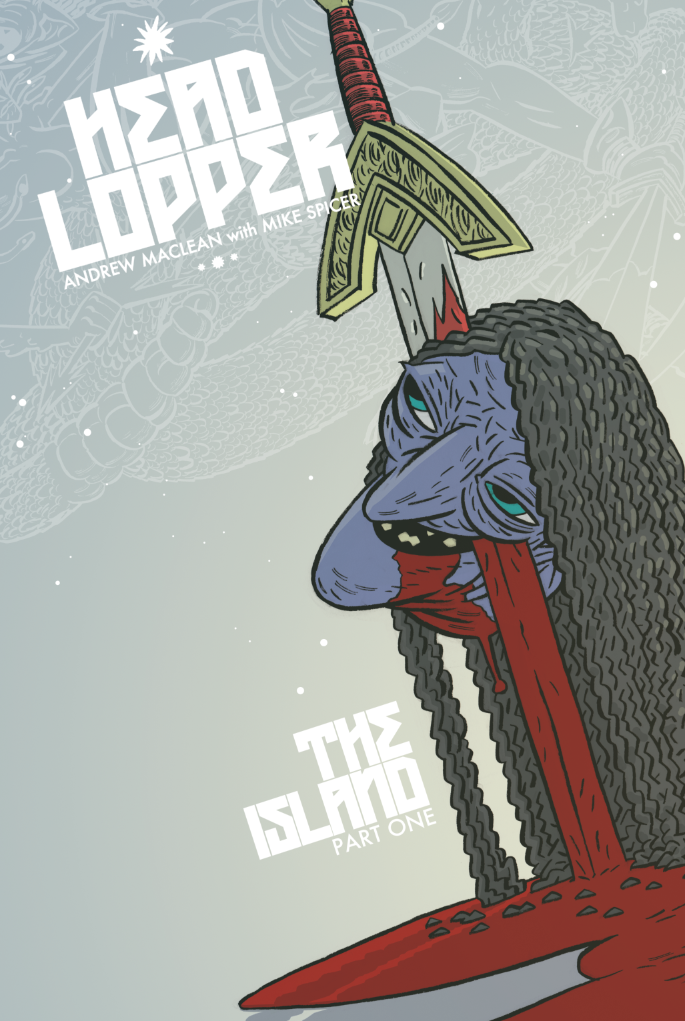
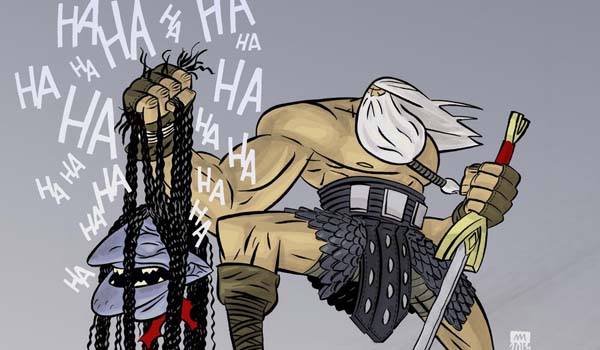
Head Lopper is one such parody. This self-described tongue-in-cheek “sword and monsters” comic is the story of a nomadic warrior, Norgal, and his unlikely companion, the severed head of Agatha the Blue Witch, who arrive on the Isle of Barra to slay a sea serpent. The promise of this series is lots of cartoon violence that toys with (and hopefully subverts) badass tropes and Nordic mythology.

Most of the tongue-in-cheekiness is carried by the art and dialogue and not the narration. There is hardly any narration, which is a good thing, since narration would have slowed down all the fun to be had lopping heads. A steady narrator would have also invited unnecessary backstory to a two-dimensional archetypal character who needs none. The Head Lopper is the Head Lopper is the Head Lopper. Who is the Head Lopper? The One Who Lops Heads. Anything more would run counter-purpose to the comic’s hack-and-slash readability. The story translates well visually, and the only major flaw in the writing in this issue is the dialogue. It never establishes a steady tone and see-saws between unpracticed “medieval speak” (people tend to say “indeed”) and the tongue-in-cheek modern dialogue that better suits it.

The art is simple, clean, and colorful. Maclean delivers wonderfully cinematic aspect-to-aspect panels that either establish setting and mood or cleverly show the passage of time and the silence between one head lopping and the next. Spicer’s colors really make this thing stand apart. He establishes a cool blue-green-gray-purple world and then tactfully splashes hot oranges and torrents of red to ratchet up the action. Characters are drawn in a simplified way, suggesting their archetypal, mythical roots–these are the symbols of masculinity.

Hopefully, in future issues, Maclean will make more use of his source material and give us something even more fun and subversive. Though there’s no guarantee, because as Maclean says, this is a sword and monsters comic–nothing more. True, it’s badass mythology, and played out, but what sets Head Lopper apart from the literally thousands of other comics of the brawn genre is that it doesn’t take itself too seriously. There are a thousand writers of badass stories out there, but very few who allow themselves to have a little fun with it.

header.jpg

Should you get it?

I wouldn’t recommend this comic to someone new to the art form. This is more for seasoned comic book fans who want a nice break from all the up-their-own-asses badassery. Plus, it never hurts to support a talented self-published writer/artist. Get Issue 1 at the publisher’s site or from digital comic stores like Comixology for $1.99.

Gardner Mounce is a writer, speaker, listener, husband, wife, truck driver, detective, liar. When asked to describe himself in three words, Gardner Mounce says: humble, humble, God-sent. You can find him at gardnermounce.tumblr.com or email him at gmounce611@gmail.com 
Major Issues: Saga #20 and Binge Watching vs. Actually Doing Something

image

In Major Issues, we look at one newly released comic book each week. Updated Fridays.

Gardner Mounce

Saga #20
Written by Brian K Vaughan

Art by Fiona Staples
Published by Image Comics
Release: 6/25/2014

Saga is not a comic for the faint of heart. It’s irreverent, crude, and pairs attraction with repulsion like a sociopathic sommelier. For example, this very NSFW picture of a naked woman with a spider vagina. Awesome! Saga is a mixed bag. It sometimes hits with you an ethical quandary, and sometimes hits you with arachnid genitals. Just like in life.

If you know nothing about the comic, it’s the story of Alana and Marko, citizens of the planet Landfall and its moon Wreath, respectively. Landfall and Wreath are at war, but since the destruction of one would mess up the other’s orbit, the war has been outsourced. It’s Star Wars meets Romeo and Juliet with a whole lot of Vonnegutian humor.

Of the many things Issue 20 deals with (drugs, dance lessons, …) it spends some of its time with Alana at her job at the Circuit (a television station, of sorts). She gets into a conversation with a coworker about what capital-g Good, if any, they’re doing as actors of the Circuit. The coworker says none; they’re drug-dealers, and the Circuit is the opiate for the masses. Alana counters by saying that as a kid she watched a Circuit show that irrevocably changed her views on poverty. But, her coworker counters, “What did you do? Join a nonprofit organization? Volunteer at a soup kitchen? Or did you lock yourself in a tiny room, shut the blinds and mainline every transmission like a junkie?”

This is a great question for our binge-watching culture, and the type of thing Saga is wont to ask. I’ll state it in another way: Is a story considered a failure if the audience doesn’t internalize the unique perspective and act on it?

It reminds me of a similar question brought up in Fahrenheit 451. In that book, the scholar-in-secret, Faber, argues that there are three things a healthy culture requires to avoid ossification: art with texture, leisure time to reflect upon that art, and the ability to act on the lessons learned from it. In our culture, I think that we do plenty of the first two, but do we allow ourselves to act on the implications of the art we engage with?

Allow me to completely derail this Saga train and talk a little about Orange is the New Black (no spoilers) because it’s a good example. Can we watch OitNB and shirk the onus to reform the prison system? Well, people do. But is this right? Are we avoiding the third step of Faber’s advice in Fahrenheit 451 and putting our society at risk of ossification? The best answer I can give is that social reform is a (possible) positive byproduct of good story, but not story’s objective.

The first thing stories do, as David Mamet says, is to order the universe into a comprehensible form. A story is working if your first inclination once an episode ends is to watch another one. That means you’re invested in its characters, in its world. It is ordering the universe into an exciting and comprehensible form and giving you some new perspective or understanding of it. And so a writer’s objective shouldn’t be “Well, I’m going to teach them all something,” but “I’m going to drop them into the world of story and show them (in an interesting way) a little of what it’s like to be these particular human beings.” If a story’s success was based on its ability to teach something, then we could reduce stories to preaching and pamphleteering. Our stories would all come to resemble The Pilgrim’s Progress. And, of course, stories are so much more than this. Great stores are like a black box we get dropped into. Once we get to the other side, we should be changed in some way. Maybe we don’t have a new answer, but we have a new perspective. In the case of OitNB, we see that the prison system is a dehumanizing system. It is not something the writers force on us like a sermon, but a condition of the characters’ lives. It is a necessary and unavoidable element of telling the story honestly.

But once we have that new perspective, is it wrong to not act on it? Are we watchers of OitNB immoral for locking ourselves in a dark room and binge-watching instead of working for prison reform?

Maybe you know more about the problem than I do, and maybe it’s not as bad as it seems, but based on what I know, I feel like I should do something. Am I going to go start a nonprofit? Rally in the streets? Honestly, no. But I will vote differently, and I will speak up in conversation. After all, maybe that’s the best way to effect social change–through stories, not through argumentative means, by showing how human lives are affected by the dehumanizing systems we have created, and creating empathy for them.

443816

Should you get it?

(Saga, not Orange is the New Black)

Yes. Though Saga has its weaknesses (almost all of the characters’ voices sound the same) it’s one of my favorite ongoing series. It’s smart, consistently hilarious, filled with bizarre environs and ridiculous characters, and very punk rock. It also raises great questions (see above article). You can get the trade paperback of the first six issues on Amazon or at your local comic book shop for $9.99.

Gardner Mounce is a writer, speaker, listener, husband, wife, truck driver, detective, liar. When asked to describe himself in three words, Gardner Mounce says: humble, humble, God-sent. You can find him at gardnermounce.tumblr.com or email him at gmounce611@gmail.com 
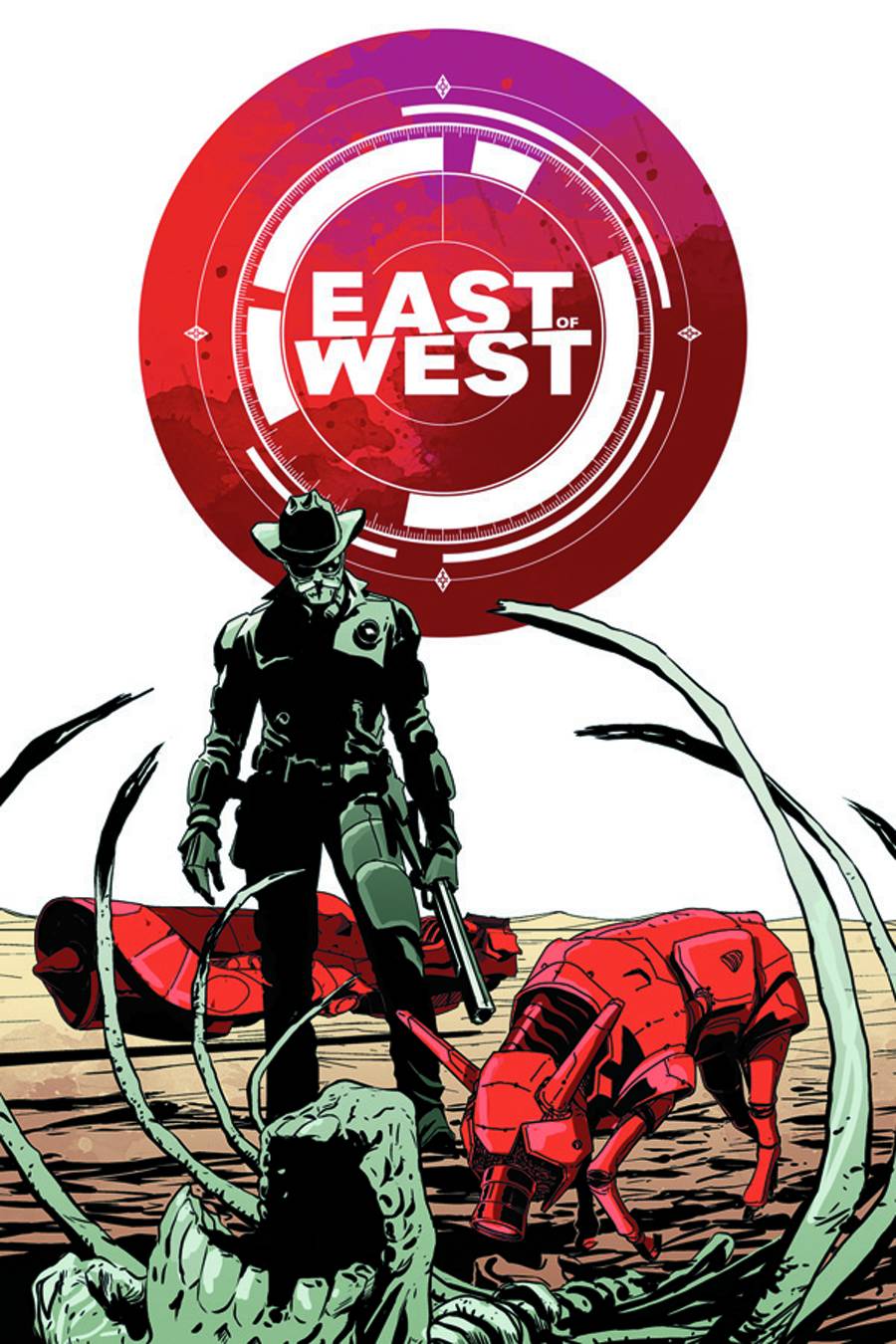
“East of West” Comic Review: Art that Shushes Your Inner Critic

east-of-west-3cover-artjpg-30b4bb_610w (1)

Gardner Mounce

As we consumers of culture grow older, our inner critic grows louder. A new band we might have liked ten years ago we now quickly brush off as a carbon copy of an earlier incarnation. The latest Coen brothers’ could never be as good as past efforts. With every passing year, we append new cultural experiences to our collected “Experience,” thus making it increasingly rarer to experience that work of art that shushes your inner critic so that you can actually enjoy it. Not to say that critiquing (or even tearing apart) works of art isn’t its own form of enjoyment. But that’s for another article.

STK527769.jpg

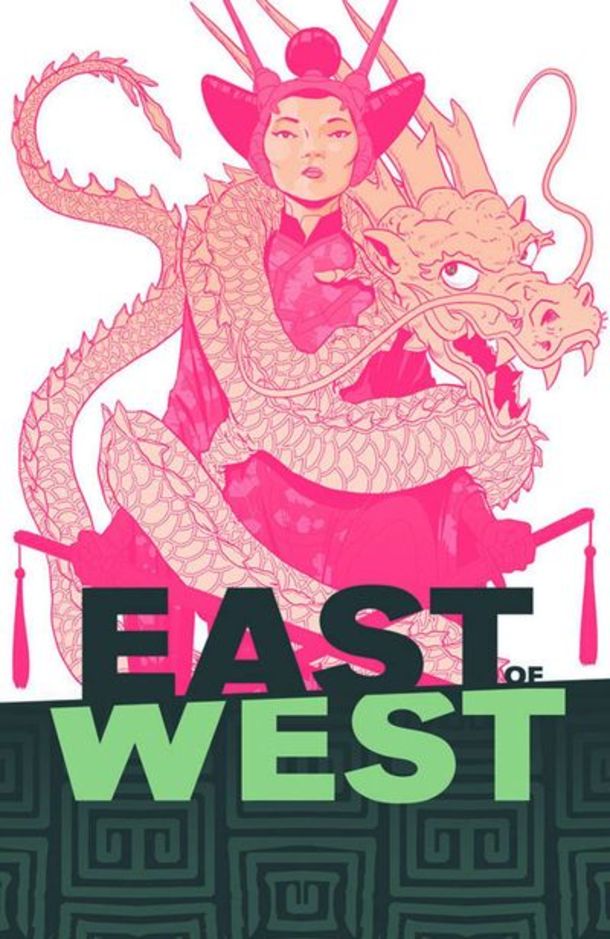
It wasn’t until undergrad that I got into graphic novels. It wasn’t until after grad school that I got into comic books. If you don’t know the difference, here’s a clip (courtesy of ABC Family) of someone asking the question and then two people kissing. All that to say, even though I haven’t been a lifelong fan, I feel that I’ve read enough to know when I’ve found that rare specimen. That specimen, in this case, being Jonathan Hickman’s and Nick Dragotta’s East of West.

How to describe it? I use the word “badass” selectively. Sure, I live in the South where badass is an endearment ascribed to everything from camouflaged iPhone cases to comely sunsets. I used it once at a Nine Inch Nails show when Trent Reznor kicked over his keyboard, and in spite of myself at a monster truck show when Grave Digger jumped an improbable number of wrecks. Like I said: I’m Southern.

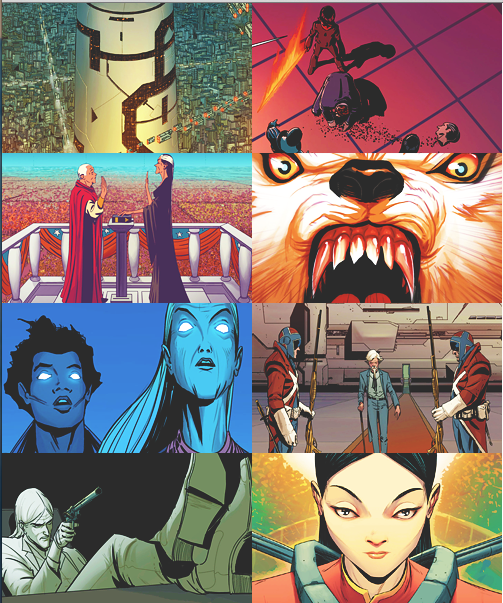
I think I want to give East of West that most Southern laurel because of how much weight Dragotta’s art carries, how every panel is filled with gravity and action and consequence, with no frills, nothing wasted. It’s like reading the storyboard of a Darren Aronofsky film: every shot means something. The following is a collection of unrelated panels (no spoilers) that I’ll use for example. Every shot is packed with a story that demands to be read, understood, savored.

Screen Shot 2014-06-10 at 5.10.11 PM.png

It’s the color palette, it’s the framing, it’s the energy in each panel that whispers “I know something you don’t know”, and so drives us onward. Dragotta fully realizes Hickman’s dystopian sci-fi world, a grand scale epic that includes vast cityscapes, a cadre of unique characters, and wonderfully offbeat technologies like horse-bikes. It’s artwork like this that primarily hushes my inner critic. Even if the story wasn’t good, the artwork alone sweeps you up. But the story. Oh, man, the story

If Sturgeon’s law is to believed, 90% of everything is crap. This is definitely true for comic books, where at least 80% of comics are about superheroes with dead parents–nothing lightweight about dead parents, but come on, comic book writers, pick a new backstory for Chrissake. The story behind East of West is…complicated. In a nutshell, it’s a dystopian sci fi story about three of the four horsemen of the apocalypse–Famine, War, and Conquest–who arrive on earth to end it all, but the fourth horseman, Death, doesn’t show. Death, personified as a colorless Clint Eastwood-esque cowboy, is off on an errand of his own. As the three horsemen track him down, elite members of the warring nation-states plot to end the world rather than settle their differences.

What makes the story so special is that Hickman embraces the essence of American mythology: there is not one, but many American mythologies. Contained in East of West is the myth of the cowboy, the religious zealot, the industrialist, the South vs. the North, the South (white wealth) vs. the South (free slaves), tradition vs. technology, the indigenous vs. the immigrant, and more. Hickman collects these multifarious mythologies and we get to watch them squirm. As crowded as that sounds, as rife as that premise is with the potential to wholly miss its mark, it somehow doesn’t. There are worlds contained in East of West, and, so far, its creators have told its story well enough that when I open up a new issue, my inner critic takes a walk.

Where to Start?

Luckily, the series is only 12 issues in. Get the first five in trade paperback for under $9 on Amazon or for around $10 at your local comic book store.

Gardner Mounce is a writer, speaker, listener, husband, wife, truck driver, detective, liar. When asked to describe himself in three words, Gardner Mounce says: humble, humble, God-sent.

Image: IGN

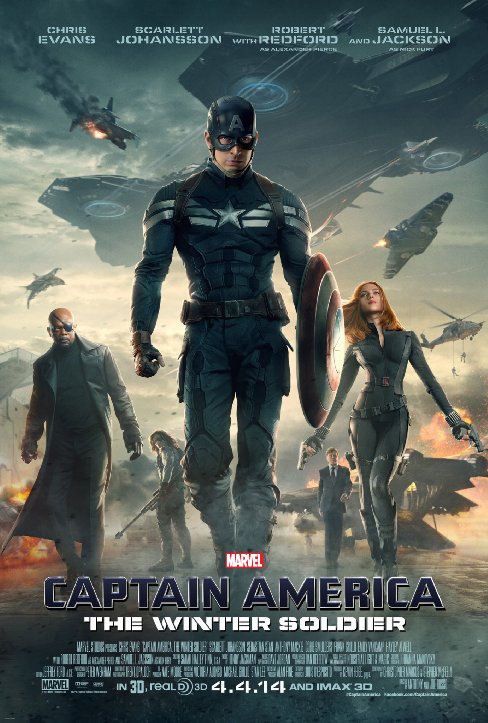
Should You See It: Captain America: The Winter Soldier

MV5BMjM2NzUzNzQwNl5BMl5BanBnXkFtZTgwMDQ1MDkwMTE@._V1__SX1537_SY723_

Andrew Findlay

In our rarely-running kinda-series Should You See It? we talk about movies that just came out. You can figure out the rest of the premise from the title of the series. That’s right: We talk recipes. Should you see Captain America: The Winter Soldier?

The movie opens with Captain (America) Steve Rogers jogging laps on the National Mall. His “jogging,” as a superhuman recipient of Dr. Abraham Erskine’s super-soldier serum, amounts to a full sprint for an Olympic athlete. He laps another jogger, a young, fit man, so many times that the other guy gets pissed off and tries to sprint to catch him, which progresses to two army veterans talking about war, which is ended by S.H.I.E.L.D. picking Cap up in a fast car. Solid intro.

The intro of Steve Rogers jogging says something important about the character: He actually needs to exercise and train to maintain his strength. He’s strong and great, but still pretty normal. I was amazed when Marvel took Captain America, clearly just the worst superhero ever when I was nine, and made him into one of the most appealing franchises in movies today. Nine-year-old me thought he was stupid because basically he is just in really good shape with a weird shield. Superman is invincible and Batman has an endless supply of cool toys, so what’s in it for a Steve Rogers fan? The appeal of Captain America, aside from the movies doing a great job focusing on the human side of him and helping audiences empathize with his life, is that he is the absolute, be-all end-all specimen of human perfection, but his superpowers end there. He’s the ultimate athlete, the ultimate patriot, and the ultimate gentleman, but he is still fundamentally human, unlike Superman, who has to shave with laser vision.

This is either the dumbest or the greatest thing I’ve ever seen. 

The fast car takes him to a jet which takes him to the location of the first action set piece. These set pieces are the definite high points of the movie. They are most of what the movie is, and for each and every one, I was literally leaning forward thinking, as much as I thought anything, “yes yes yes yes yes” on repeat until Captain America stopped slamming his shield into people’s faces. The combat is more complicated and varied than that, though. One scene in particular that stands out is an amazing car chase through Northwest D.C. with Nick Fury at the helm of an SUV that’s so well-equipped it’s really more of a spaceship. Samuel L. Jackson truly lives up to his laconic badass persona in this role, participating in one of the most exciting parts in a movie filled with super-soldiers. Marvel has been doing crowd-pleasing action for years now, and they have become exceedingly efficient at it.

Trinity_in_screens

Pictured: Stan Lee

The plot is believable and full of suspense. It never drags or makes you roll your eyes, which is admirable when a plot is serving mostly as spackle between action scenes. The twist (SPOILER – there’s a twist) is pretty horrifying and plausible when it happens, and gives Captain America plenty of opportunity for research on the relative durability of shields versus faces (hint: in 9 out of 10 studies, the shield demonstrated higher levels of durability). There are certain things that, if you think really hard about them, seem to not quite fit together right for plausibility or continuity, but if you’re thinking that hard about it, you’re doing it wrong, anyway. They’re seriously minor things that I hate myself for noticing, and you won’t think about them. This is not the awful era of the horrendous post-Keaton late-90s Batman movie. This is not Ben Affleck in Daredevil. Superhero movies are A Thing now, and any plot holes that exist aren’t big enough to fall through unless you dig them out yourself.

Should you see it? 

You should definitely see this movie. It is one of the best vehicles for action scenes this year, and it achieves what a lot of really impressive action movies don’t: Those over-the-top scenes are actually tied together really well with a strong story. Yes, the exploding and shooting and hitting are definitely the focus of the movie, but their weight doesn’t shatter the rest of the film into kindling.

Andrew Findlay has strong opinions about things (mostly literature) and will share them with you loudly and confidently. You can email him at afindlay.recess@gmail.com.

Image: IMDB