tv review

Life Lessons from Episodes of Louie: “Pamela 2” and “Pamela 3”

louie-3

Alex Russell

Louis C.K.’s critically acclaimed show Louie’s fourth season runs as two episodes every Monday night. Rather than just answering the question of “are these episodes good,” (because the answer is always yes) we’ll talk about the big lessons imparted in each episode. This week: the season ends.

Episode 13: “Pamela 2”

Whenever you see someone on television wake up after they’ve had sex, they look like no real person ever looks after sex. It’s just the way sex is always shot, it seems even more unrealistic than it does in, well, real life. Real sex is awkward and full of absurd, funny moments.

In Louie, when people have sex, they have to think about taking their shoes off. They have to have their pants taken off both legs at the same time. They have to figure out how to get to the bed, because no one just sits on a bed. They sit on a couch. The bed is later.

This may seem overly simplistic to point out. Louie is a show obsessed with the “what is real” question in a narrative sense, but it’s also a show fascinated by the mundane. Louis C.K. became one of the most famous comics in America on the strength of the mundane as a comedic source. His show is less about how it’s all funny and more about how it all is consistent. Everyone takes their shoes off before they have sex and no one knows how to do it. There’s no sexy — or even practical — way to take off your shoes in a hurry.

It’s not all sex, but everything is that moment. Everything is taking your shoes off quickly to not let a moment pass or convincing someone to do something spontaneous before they make a joke. Everything in life is making the moment what it can be before it passes. When Louie is a sad show, it’s about missing those moments. Sometimes it’s something else, and this one is mostly something else. Just go out there and try, dummy. That’s all you can do.

Episode 14: “Pamela 3”

The choice to run all 14 of these episodes over seven weeks seemed weird when this all started. But now, after all of the “Elevator” saga and “Pamela,” it’s clear that this was the only way to run this. It could have just as easily been a one-night binge, I guess, but then I’d be dead. This was all rough.

I don’t want to spend too much time on recapping the season, but let’s review for a very short paragraph. This is the season of a show on television where Louis C.K. rescued an old woman from a stuck elevator, went on dates with three women (four women, maybe, hard to say with the model), and opened for Jerry Seinfeld. That’s what happened. Oh, and he also went back in time to show the breakdown of his marriage and his childhood and his family and his psyche and…

…back to “Pamela 3.” Long-time viewers of Louie (hello, all 13 of you) know that Louie and Pamela have an aggressive — but familiar — relationship. They rag on each other and riff and talk in dumb voices. Even one of the most romantic moments in Louie history was Pamela getting on a plane as she yelled “wave to me, dummy,” which was mistaken for “wait for me.” Pamela and Louie have had chances, but they’ve always been caught up in the armor of acting like you don’t give a damn.

But they do. It’s just hard to tell someone else that you’re going to finally drop the cynicism or the sarcasm or whatever your deal is and engage with them. It’s hard to actually be a person, because jokes are easier a lot of the time. We make jokes at funerals because funerals suck. We’d rather not engage.

It’s an old lesson, far older than most of the ones in this season of Louie. “Pamela 3” is about not getting what you want, but it’s about something even better than that. It will make you more kind, and it’s something that I struggle with all the time. The lesson in the finale of this season of Louie has to be that you have to let other people be themselves, because that’s all anyone should ever be. If you do that, and you still like them, then that’s what love is. Not anything else.

We’ll be back next week with a different show. If you have suggestions, leave a comment.

Alex Russell lives in Chicago and is set in his ways. Disagree with him about anything at readingatrecess@gmail.com or on Twitter at @alexbad.
You Should Be Watching Season Two of Orange is the New Black

OITNB-logo

Stephanie Feinstein

Minor season two spoilers.

If you haven’t watched season one of Orange is the New Black, then stop reading this and go watch it now. NOW.

For those who have made it diligently through season one, rejoice! You are probably already done with season two!

On June 6, season two was released in its entirety on Netflix. A hit since the beginning, OITNB was a semi-experiment for Netflix, embarking into the world of truly original programming (I do not count the 4th season of Arrested Development as “original”). Along with other hits like House of Cards, this new generation of streaming television addresses directly the demographics and preferences of the target audiences. People were watching David Fincher movies, Kevin Spacey movies, and presidential/political dramas…. so they made a political Kevin Spacey drama, directed by David Fincher. We asked, they gave. In the case of Orange is the New Black, I guess we were all thirsting for some female drama that did not include Friday night dates or working at a hospital, where little focus can be given to a character’s wardrobe and men are not the only love option.

For OITNB, season one was good, but not amazing. I got really tired of the first-world problems of our main character, as the true storytelling was hidden among the myriad of inmates. Jenji Kohan, mastermind of the hit Weeds, is also the creator of OITNB, and she has gone on record that Piper’s story got us in the door, but what will keep viewers around are the otherwise untold tales of incarcerated minorities. Piper Kerman is a real woman, who did get incarcerated because of drug-running mistakes of her youth, she did have a fiance and a lesbian lover, but Piper Kerman only shares so much with Piper Chapman. Real people rarely make captivating television, so the glory of fiction rounds out less fascinating dents, and sometimes other people’s dents are more interesting. With a bevy of flashbacks highlighting key moments of the women’s lives, we glimpse depth and understanding beyond the orange and beige jumpsuits. Heavy issues of race, poverty, sexual violence, drugs, and motherhood are all addressed, in addition to a fairly scathing view of the privatized prison system. You do have to put up with a lot of Laura Prepon, though.

One of my favorite aspects of OITNB this season? Jodie Foster.

An occasional director for season one, Foster directed the opening episode of season two. Oh the fear! I am a great Foster fan, mainly because the fear she portrays on screen becomes so hauntingly real that it can give me nightmares (Silence of the Lambs, Panic Room). Foster pulled out all of the stops for this episode, drenching viewers in uncertainty and panic. Small homages to Hannibal Lecter, with beautifully placed airplanes, masks, and talks of false freedom. My skin crawled from the hungry looks of men, the implied violence around each turn, the tension of unknown destinations. It was a home run of an episode.

In the week since it all was delivered to Netflix, I have finished season two and I recommend it to everyone I see. Most of my issues with season one have since been resolved, the acting has increased, the story has power, and prison life has become fascinating. You should be watching it.

Stephanie Feinstein spends more time than she should yelling at her television, and that may never change. You can contact her at stephanie.feinstein@gmail.com

BBC’s Whites: Should You See It?

whites BBC

Jonathan May

In our rarely-running kinda-series Should You See It? we talk about movies that just came out. You can figure out the rest of the premise from the title of the series. That’s right: We talk recipes. Should you see BBC’s Whites?

BBC’s Whites follows one Roland White, head chef at the White House, a restaurant and hotel in a traditional British manor, as he attempts to abuse everything under his care in return for his own happiness. It’s unfortunate then for Roland, and everyone else, that he has no idea what happiness is. While he attempts to please himself in various ways, his tall, blond sous-chef, Bib, runs the kitchen. First episode in, Bib, at the end of his wits, demands help in the kitchen. The agency sends over a not-too-bright chap named Skoose, whose sole purpose in life is to make Bib miserable. Throw in a beautiful female manager and a doe-eyed, clueless server, and the rest basically writes itself, or appears to, in its effortlessness.

It’s good that the show centers on such an egotistical figure—a sort of comedic, pathetic Prince Hamlet to a crumbling Elsinore. Roland, in his pursuit of drinking and women, has abandoned his creativity, his friends, and a tight hand on his restaurant. An inspector’s visit doesn’t go so well, and we’re left to wonder where the humor is when someone essentially turns out to be a real asshole. As with most comedies that are built around someone you are supposed to hate, Whites makes sure that its ancillary characters are in dire need of viewer sympathy. Poor Bib is overworked; you almost weep for the thin bastard. And is the beautiful manager really dating a gay guy?

Should you see it?

This six-episode gem really never took off due to financial difficulty (the actors were all trained in a professional kitchen). It’s a shame because as the last episode ended, you could feel the show brimming with fresh energy for another round. Oh well. I can’t recommend this show highly enough. At 30 minutes each, the episodes are ripe for a Hulu binge. One pro tip: don’t watch hungry, because by the end, you’ll be trying to make every fancy thing you’ve never tried to make in your kitchen.

Jonathan May watches too much television, but he’s just playing catch-up from a childhood spent in Zimbabwe. You can read his poetry at owenmay.com, follow him on Twitter at @jonowenmay, or email him at owen.may@gmail.com.

Image: The Daily Mail

Life Lessons from Episodes of Louie: “In the Woods”

louie-3

Alex Russell

Louis C.K.’s critically acclaimed show Louie’s fourth season runs as two episodes every Monday night. Rather than just answering the question of “are these episodes good,” (because the answer is always yes) we’ll talk about the big lessons imparted in each episode. This week: Louie struggles with “do as I say, not as I do.”

Episodes 11 and 12: “In the Woods”

This episode is dedicated to Philip Seymour Hoffman. It is about drugs.

Louie catches his oldest daughter smoking pot. Louie gets upset. She says, “what do you even know about it?” Louie remembers. That’s all you need to know about the “what” of the episode.

It’s almost entirely told in flashback, which is amazing. There have been a number of reality jumps and flashbacks in Louie over the years, but this one is the most fully realized. It helps that it’s a kind of double episode. You feel the pain of Louie’s mother as she feels her son slipping away. You feel the distance of Louie’s father as he both tries to help and shrugs at the same time. You feel the world of young Louie, which is both the actual history of the character and a dream state.

“Real” Louie has a brother on the show, but the brother’s not in the flashback. In a previous episode, a flashback revealed his wife to be white when she’s black in the “reality” of Louie. This all means something.

It never matters what happens. It matters what you take away from it.

Teenage Louie in the flashback gets obsessed with pot. He dedicates his life to obtaining pot and escaping his boring life by getting high. An episode dedicated to a man who recently died of a heroin overdose is about pot, which at first seems weird…

…but it’s not about pot. It’s about the ways we hide from the people that care about us. It’s about booze and pornography and music and general deceit and exercise and biking and cooking and smoking and comic books and religion and politics and whatever else your particular crutch is, really. It’s about Louie, a teenager, who is getting high not because he’s mad or sad or lonely, but because he just is getting high. It costs him his sense of self. It costs him the girl — and the scenes where he and a young classmate look longingly at each other over the gulf of addiction are dreadfully perfect — and it costs him the closeness of his family.

Adult Louie has to decide how to turn this memory into a lesson for his daughter. He has to figure out what we all have to figure out: how do you make your past mistakes productive? He wants to be a warning, but when she asks him if he’s going to yell at her, he knows he has to be careful.

There’s no way to spoil this episode. This is the pause between “Pamela 1” and next week’s season finale of “Pamela 2” and “Pamela 3.” This whole season has been about Louie’s love life, but it’s been more interesting to see how we got to the version of adult Louie in the show. The explosion is more noteworthy, sure, but watching the fuse is more fun. Louie’s childhood isn’t necessarily atomic, but it’s sad and relatable because Louie is some version of who we all were and — some days — still are. This one is heavy on the intended morals, but I take the following:

Pay attention to who you were, if only to be damned sure you aren’t ever them again.

Alex Russell lives in Chicago and is set in his ways. Disagree with him about anything at readingatrecess@gmail.com or on Twitter at @alexbad.

Life Lessons from Episodes of Louie: “Elevator (Part 6)” and “Pamela (Part 1)”

louie-3

Alex Russell

Louis C.K.’s critically acclaimed show Louie’s fourth season runs as two episodes every Monday night. Rather than just answering the question of “are these episodes good,” (because the answer is always yes) we’ll talk about the big lessons imparted in each episode. This week: Louie rents a car in a hurricane and forgets himself.

Episode 9: “Elevator (Part 6)”

These are two very different episodes of television. It’s been difficult some times during this (especially during the previous five parts of “Elevator”) to draw a meaningful distinction between the two episodes. That is not difficult now.

They’re set up that way on purpose. “Elevator (Part 6)” is the conclusion of what’s now a film-length dramatic romance told in six parts. No one could have expected Amia to stay, of course, but the act of her leaving is still brutal. Louie, like so many of us, hoped that the joy he could draw from a relationship with a forced expiration date was worth the expiration itself. To get inside Louie’s head, I’ll just ask you: Was yours?

The episode also features a hurricane, but that’s all visuals. It’s shot in a way that nothing on TV right now really is; you’re constantly lost and worried for the characters. Louie is forced to drive into a New York storm that will remind you of another recent one, and honestly, I couldn’t help but remember friends I had in New York at the time and the reality of Sandy. As someone who has never lived near a coast, it just seems unimaginable.

As Louie the show is about showing the world of Louie the character’s New York, the in-show disaster does a great job. Louie is lost and often helpless, but he will drive into the storm to try. He knows the direction he wants to go — be it towards his family or towards love with Amia — but he has no idea about anything beyond that. We’ll sum it up as he does: Move towards your goals, even if you only have two birthday candles, a light bulb, a flashlight, and a banana.

Episode 10: “Pamela (Part 1)

The end of the “Elevator” saga brings the start of the “Pamela” one, and it’s not an easy episode to discuss. I’m dedicated to not “spoiling” Louie, but there is one central element to the episode’s ending that has to come up in a discussion of the episode. If you haven’t seen it and are going to, go do so.

Yeah, right? See what I mean?

Pamela is played by Pamela Adlon, the voice of Bobby Hill on King of the Hill and Louis CK’s wife on his earlier show Lucky Louie. She’s the closest to a real “love interest” that Louie has ever had — there are others, but they don’t even seem to be real people, which is a whole different discussion about the “reality” of Louie that I will have with you over a pot of coffee sometime — and she is also the closest character in tone to Louie himself. They’re brash at times and they’re sweet at times (in a fashion) and they’re there for each other when it matters.

Louie loves Pamela. Pamela loves Louie, but Louie says no because he’s with Amia. Amia goes back to Hungary, Louie tells Pamela he’s ready, Pamela says it’s too late. A tale as old as time, and I’m being serious.

How often have you only too late noticed that you had a connection with someone? Or maybe you did notice in time, but it was too late for them, or vice versa? These are the real ways we interact, and they’re especially real because we recognize everything that comes along with them…

…until we don’t. Louie tries to kiss Pamela very forcefully when he comes home to relieve her from babysitting his kids. Pamela’s not interested, but Louie says that she said earlier that she was. The show briefly deals with this earlier in the episode by having Louie and Pamela share a “why are you so mean to me” and “why do you like it?” exchange. It’s fortunate that we know these people, because it reduces some of the horror of Louie’s monstrous act and it explains some of Pamela’s reluctance as emotional armor. It doesn’t do either act of explaining enough, but that’s on purpose. This is supposed to be a gross scene, and it really, really is.

I’m very intrigued to see the second and third parts of “Pamela” to see how they address what is just a kiss, but is also something awful at the same time. The lesson from arguably the worst thing the show has made Louie do? It’s most important with Pamela herself, but it’s also an episode full of Louie making little choices (he sits next to a guy talking to no one on the train and later tells a man to not spit on the bus) that are noble but ultimately pointless. Louie’s scale for “good” is way off. Remember to actually be good when you can, not “good.”

Alex Russell lives in Chicago and is set in his ways. Disagree with him about anything at readingatrecess@gmail.com or on Twitter at @alexbad.
Symbols and Sociopaths: Hannibal Season 2, Episode 13

Hannibal season 2 finale

Jonathan May

Mega-spoiler alert.

So of course after asking for Cynthia Nixon’s character to come back for weeks now, the story gods deliver in the most obscene way possible, tightening the plot’s noose with bureaucratic nonsense. Of course Jack and Will are stymied now and must move forward by themselves. And then Abigail reappears! And then she kills Alana! And then Hannibal murders Jack, Will, and Abigail! People were killed with such rapid abandon I thought I was watching a short, homoerotic Shakespeare production with mood lighting. But let’s not kid ourselves, Shakespeare this wasn’t.

Like, what? The first thirty minutes were boring, boring, boring, and then the swift successive murders of the cast at large? I don’t even know what to say. Perhaps now is a good time to view properly Hannibal as a critique of the aesthete, free from financial concern. He literally walks away from the action, like so many bankers and traders during the recent financial collapse. I’m not going to claim that financial ruin as the results of others’ actions is tantamount to murder, but they share tragic qualities. If Hannibal simply walks away now, the chase is on. Maybe for the third season, Cynthia Nixon will helm the ship in pursuit of Lecter; perhaps we’ll go to Italy.

As for this season as a whole, I feel like too many tertiary characters were introduced only to be broiled. The lack of resolution with Jack’s wife Bella upsets me, as well. It’s as if by not showing her death, she experiences purgatory, always suffering in that bed. The only other one who makes it out of the fray (seemingly) is Freddie Lounds; she knew to get when the getting was good.

So folks, I’ll be tuning in for the beginning of season three, and if it’s a bunch of malarkey, I’ll be sure to tell you all about it.

Jonathan May watches too much television, but he’s just playing catch-up from a childhood spent in Zimbabwe. You can read his poetry at owenmay.com, follow him on Twitter at @jonowenmay, or email him at owen.may@gmail.com.

You can read our pieces about previous episodes here.

Image: NBC

The Pete Holmes Show is Canceled and Why I’m Not Quitting

tbs-features-pete-holmes-705x405_110420130454

Alex Russell

The Pete Holmes Show got 80 episodes on TBS. Per a very personal post from Pete Holmes himself, the variety/comedy/interview/sketch/whatever show is now over and will air its final episodes within the next month.

The comedy nerd world has been both insanely good and insanely bad to Pete. He’s one of the biggest comedians that your parents probably don’t also know, but he’s also the target of a metric ton of hate by way of his sometimes-infuriating-but-always-interesting podcast You Made it Weird and his career as a baby that sold insurance on television. If all you know about Pete Holmes is that he has a podcast where he sometimes talks about astral projection and healthy juicing for upwards of two (or three) hours a week and that he sold insurance on TV, sure, why did they give that guy a show is a reasonable question.

But he’s also one of the ten funniest people in the world right now, and that’s not something I say lightly. He’s a better standup than he is anything else, and 80 episodes of The Pete Holmes Show showed that he’s a pretty damn good “anything else.”

Every episode wasn’t always my favorite — though part of the joy of Pete Holmes is his persona that he sometimes calls “fun dad,” so he’s in on the joke that he’s sometimes just so much — but I watched every single episode because I was so in awe. Pete Holmes got to do sketches based on in-jokes and interview segments where he clearly ignored publicists. He got to make what “The Pete Holmes Show” without the italics would be if he had his say. He made his show.

This week we passed 10,000 total hits on Reading at Recess. This week we hit 175 unique posts from nine different people. Despite what I’d call “success,” I still almost gave up.

I started Reading at Recess earlier this year to have an outlet to write about culture. I figured that the world didn’t necessarily need another recap of Louie or an ode to Walter White. That said, I think there’s space for what we write about Louie and our thoughts about Walter White’s opposite on Fargo. I think there’s room for an Obama campaign worker’s review of Mitt as oddly humanizing. I think there’s room for covering things everyone else is talking about, like How I Met Your Mother‘s weird ending and Archer‘s lull of a season and why half of the audience of Girls seems to be watching for strange reasons.

At the end of the day, this is just a blog. It’s just a place that I hope you spend five minutes of your website time every weekday. But if it’s more than that, it’s somewhere you might learn something about feminism and parody in anime, or art design’s influence on gameplay in video games, or about data’s influence on politics.

What it hasn’t been is consistent. We’re all over the place. We’re a shotgun, not a sniper rifle. When you watch The Pete Holmes Show, you’re looking at what Pete wanted you to see. When you’re here, you’re kinda seeing something that’s far too unfocused.

We’re taking Thursday and Friday off to regroup. When you come back on Monday — and I do hope you come back on Monday — you’ll see something that looks a lot like what you’re used to, but better, more consistent, and more focused. You’ll see our real show, because it’s what we wanted to show you from the get-go.

Want to write for us? We’re accepting contributors! Reach out through our submit page.

Alex Russell lives in Chicago and is set in his ways. Disagree with him about anything at readingatrecess@gmail.com or on Twitter at @alexbad.

Image: TBS

Life Lessons from Episodes of Louie: “Elevator (Part 4)” and “Elevator (Part 5)”

louie-3

Alex Russell

Louis C.K.’s critically acclaimed show Louie’s fourth season runs as two episodes every Monday night. Rather than just answering the question of “are these episodes good,” (because the answer is always yes) we’ll talk about the big lessons imparted in each episode. This week: Louie looks at his love life and does not like what he sees; Louie deals with Mentos.

Episode 7: “Elevator (Part 4)”

It’s very difficult to separate “Elevator” into episodes. Louie has always been compared to film in a stylistic sense — it’s much more like film than television — but only now is the structure of the show an actual damn movie. “Elevator” concludes next week, but we already know enough to work with it now.

Louie owns up to the fact that he isn’t really doing anything productive with his love life, and that’s a hard thing to admit. We’ve all had to admit to a drunk friend that we’re in a relationship that’s well past the expiration date, but Louie’s got the opposite problem: He can’t actually date Amia, because she’s going back to Hungary soon. He can’t start a relationship.

Louie is a “dark” show. When I’ve met people that aren’t into it, the most common complaint is that it isn’t funny. There’s nothing funny about Louie’s plight with Amia, or with his struggles to stay cordial with his ex-wife so that his kids will be happy, or his general life in the world of the show. The laughs are there, but that can’t be why you show up.

During a flashback, Louie deals with one night on a trip where he and his then-wife stay in a hotel room. It is the most realistic portrayal of a long relationship I’ve seen in months, and it’s that realism that makes the show feel cinematic. It’s not an episode of television that happens in a hotel room; it’s a look into people that have to leave that hotel room and go back to life later. I don’t want to spoil it, but the lesson is the same one any good Eagle Scout knows: Be prepared.

Episode 8: “Elevator (Part 5)

It’s hard to say how the fifth part is without the sixth, but the problem in it for Louie could exist outside of any continuity. Louie has to deal with what his relationship with Amia means if it doesn’t mean sex.

The best part about this whole story is that Louie loves Amia as an ideal. He loves someone who seems nice and fun and happy, but he just doesn’t really know that much about her. This kind of love story makes my eyes roll in most situations because there’s nothing worse than someone in love with the idea of love. You want someone to love specifics, not just “the essence of Sarah.” No one’s essence alone will get you to year two.

It works in Louie because it helps Louie understand that he’s not actually furthering himself. He’s just spending time with someone that feels like a partner, not a partner. This same story would be a happy one in a rom-com. It’s more than a little sad here because it reinforces the idea that everyone is a person first, and if you love them as an ideal then you’re just not actually in love with anyone who really exists. You’re not being honest with them or yourself.

Louie‘s love story will conclude next week and with that episode will be a larger lesson. Today’s, though, is a healthy part of a grown-up diet: Love someone for who they are, because all of that other shit will fade in two months.

Alex Russell lives in Chicago and is set in his ways. Disagree with him about anything at readingatrecess@gmail.com or on Twitter at @alexbad.
Symbols and Sociopaths: Hannibal Season 2, Episode 12

Hannibal, episode 12

Jonathan May

Spoiler alert, as always.

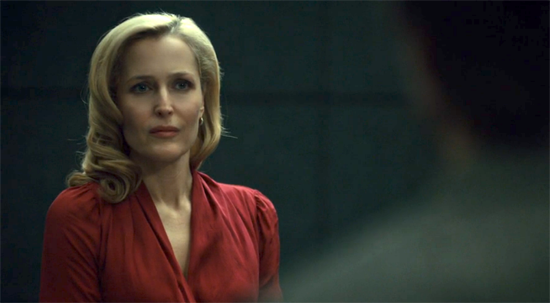
This episode was the kick in the pants that this season needed heading into the finale. What made this episode so big and bold? Gillian Anderson. She rocked her role as Dr. Bedelia Du Maurier, revealing everything in the suggestions and silences. Her ghostly, incantatory tone as she spoke there in the interrogation room gave me chills. And finally clarity was added, showing us what Jack and Will have been up to this whole time. Bedelia was fated to return as soon as she uttered her belief of Will’s innocence to him in the asylum. By bringing in someone who hasn’t been sullied by the lacklusterness of the past six or seven episodes, we, and the show’s characters, are able to take a step back and reevaluate the madness into which we’ve been drawn. Jack and Will are trying to bait Hannibal? Seriously? Though it’s easily their worst conceived plan, it does give great excuse for Will’s obsequious fanboy attitude toward Hannibal these past few weeks. What had bordered on the homoerotic now can be easily enough explained as an attempt at intimacy. And intimate we get.

Bedelia states that Hannibal can be made prey to his own aesthetic whimsy, a clever choice of words on her part, given how Hannibal views his victims. Ultimately this could be a critique of the aesthete, that echelon of society outside of financial worry, wherein one has time and means to enact one’s fantasies. How this will become a trap for Hannibal isn’t immediately apparent, but I predict they will have to dispense with this advice if they actually want to catch the bastard.

The scene where Hannibal convinces Mason Verger, by way of amyl nitrate, to scrape off his own face is wholly incredible; I was literally disgusted by the wet noises and the voice thinning out. Without the veiling of chiaroscurist darkness, this certainly wouldn’t have been able to air on network television. But this scene showed off what the production of this show can really do. And the episode as a whole was well shot; we had lots of close-ups of faces and people seen through the negative spaces left by others. These kinds of choices really make us examine everyone in a new light, which is perfect as we head into the final episode for this season.

So, what’s going down tonight? We know, via the first episode, that Jack and Hannibal will have their showdown. The catalyst for this could be anything, but I think it will have to do with Alana, who’s been strangely absent. Hopefully we’re over this whole Mason and Margot business. Now that NBC has bought a third season, we know this charade must continue. But if we’re left tonight with some horrible impossibility or vagueness, I might not be tuning in next time around.

Jonathan May watches too much television, but he’s just playing catch-up from a childhood spent in Zimbabwe. You can read his poetry at owenmay.com, follow him on Twitter at @jonowenmay, or email him at owen.may@gmail.com.

Hannibal airs Friday nights on NBC. You can read our pieces about previous episodes here.

Image: NBC

Life Lessons from Episodes of Louie: “Elevator (Part 2)” and “Elevator (Part 3)”

louie-3

Alex Russell

Louis C.K.’s critically acclaimed show Louie’s fourth season runs as two episodes every Monday night. Rather than just answering the question of “are these episodes good,” (because the answer is always yes) we’ll talk about the big lessons imparted in each episode. This week: Louie takes a woman to two stores on a date and has to decide if his daughter needs to go to private school.

Episode 4: “Elevator (Part 2)”

“Elevator” is a six-part episode, soeven at two episodes a week there’s much more to tell. Louie is in love with a woman he can’t really communicate with, though that leads to some outstanding pantomime in a drug store as the two try to exchange the idea of “hair dryer” back and forth.

Louie being in love with a woman who doesn’t speak English has some pretty obvious connections to his inability to communicate with women in general, and this wouldn’t be Louie if it stopped there. It’s not just that they can’t communicate, it’s that Louie the charactacter throws himself into something so fully that he turns down Pamela, the “love of his life” character on the show, when she comes back from Barcelona. Is Pamela back for Louie? Does Louie turn her down because he resents that she left, because he loves this new woman, or a little of both? This might be stand up for yourself when people act like assholes but with Louie, the flipside of that oft-given advice might be more important by the time this tale is told.

Episode 5: “Elevator (Part 3)

These two are also about Louie’s troublesome daughter Jane. Jane’s in trouble at school, but she’s acting out because she doesn’t buy into the established authority of the world. Louis C.K.’s comedy is a lot of things, but it’s definitely about the supposed “rules” that society needs to keep working. Things go poorly because people take too many cookies or they drive like assholes or they don’t leave their rental car at the counter. These rules, and our decisions to follow them, keep the whole damn puzzle together.

If that premise is Louis C.K.’s worldview, his jokes are about how we love to not play by those rules. Breaking down jokes is tough and mostly pointless, but the serious realities of Louie work the same way. Jane doesn’t like that she set up rules with a friend about time on a thing at the playground and the friend didn’t follow them. Jane’s not mean, Jane’s just frustrated that the world wasn’t fair when she was.

The episode is about love and how we fall in it, and our kids and how we want them to have better lives, and our lot in life and how we choose to view it. Louie runs into his doctor and a three-legged dog in the lobby of his building, and that scene doesn’t deserve me spoiling it. It does reinforce a beautiful lesson, though, and that’s that you can smash anything with a bat that you want, but you’ll always be your responses to the things you cannot change.

Alex Russell lives in Chicago and is set in his ways. Disagree with him about anything at readingatrecess@gmail.com or on Twitter at @alexbad.