Literature

Life After the Star Wars Expanded Universe: On Failing Samuel R. Delany’s Dhalgren

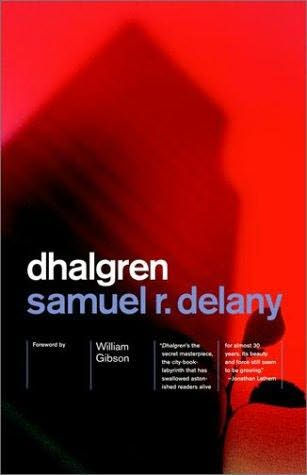
 Dhalgren cover

Andrew Findlay

In Life After the Star Wars Expanded Universe, we take a look at science fiction and fantasy, why they’re great, and what they say about where our species has been and where it’s going. 

Dhalgren is a 1975 novel by Samuel R. Delany, arguably his most successful critically and most likely his most successful commercially, with over one million copies sold. It took me a while, even devouring SF like I do, to find Delany. This is a shame, as the man really knows his way around a sentence. He’s also fucking insane, or at least wrote a fucking insane novel. To give you an idea of the strangeness inherent in the book, one of the very first events is a guy (the main character) walking down a highway, seeing a naked woman running across a field, going to her, having sex with her, then later approaching her in a meadow as she metamorphoses into a tree. Freaked out by this, he sprints back out to the highway to hitch a ride and talks with a long-haul trucker about artichokes. The trucker drops him off at his destination, Bellona, and it does not get less strange.

A_lone_tree_at_Caulside_-_geograph.org.uk_-_947847

Yup.

Bellona is a midwestern U.S. city that has undergone a vague cataclysm. No one really understands what happened, but a lot of the city burned down, and a lot of people moved away. What’s left is an anarchic-in-the-bad-way-unless-you-are-kind-of-an-asshole type social structure where people are just trying to get by and don’t really understand the place in which they live, but are powerfully drawn to it. Weird things keep happening. Our amnesic protagonist, who ends up taking the name Kidd, sleeps on a rooftop a few blocks away from the river the first night, then wakes up and cannot see the river. He enters a building by one door and leaves by the same door, only it exits in a different place. The city is constantly encased in a roiling dome of ash, smoke, and cloud. The one time this really clears away, there are two moons in the sky. The place is just weird, and the evocation of this strangeness is what this novel does best: it is huge on atmosphere. Reading it, you are as wandering and confused as the main character. The grimness and foreboding of the place flows underneath every word, like dark water through the sewers underneath a city. Also, strangeness never stops.

Chicago_in_Ruins_after_the_Fire_of_1871,_New_York_Times

Bellona is kind of like this, with less sunlight.

Our fearless protagonist finds a notebook in the city, one in which all the right-hand pages are filled in as someone’s journal. Paper is at a premium, so he uses the left-hand pages to write poems as he moves through the city, but he also glances at what has been written, and these pages sometimes reveal a written version of thoughts Kidd has already had. For example, one of the narrator’s thoughts (assumed to be the internal thoughts of Kidd, but who knows) is him reflecting upon his amnesia:

It is not that I have no past. Rather, it continually fragments on the terrible and vivid ephemera of now.

First off, look at that writing. Secondly, when he starts reading the journal, he finds this written in it:

It is not that I have no future. Rather it continually fragments on the insubstantial and indistinct ephemera of now.

He is amnesic, so he knows even less than the reader if he is the original writer of the journal, and other than tenuous speculation, there is nothing to indicate a final answer. This novel builds mystery and leaves it there, strong and swirling in mist. William Gibson referred to the novel as “a riddle that was never meant to be solved.” Good, because I am nowhere close. (While we’re talking about SF author reactions to Dhalgren, Philip K. Dick called it trash, and Harlan Ellison threw it across the room, never to return, at page 361. I am on page 349. Because it is so weird, it is very divisive in the community – some think it is incomprehensible pap, others think it is the best thing science fiction has ever done).

While we’re quoting, below is the first dozen or so lines of the book, to give you an idea if the style is something that appeals to you or not:

to wound the autumnal city.

So howled out for the world to give him a name.

The in-dark answered with wind.

All you know I know: careening astronauts and bank clerks glancing at the clock before lunch; actresses cowling at light-ringed mirrors and freight elevator operators grinding a thumbful of grease on a steel handle; student riots; know that dark women in bodegas shook their heads last week because in six months prices have risen outlandishly; how coffee tastes after you’ve held it in your mouth, cold, a whole minute.

So, I quit. Well, not really. This book is too much of a landmark, and there is way too much exciting stuff going on in it for me never to finish. It is really good, I just need some time. In the words of Led Zeppelin, “I can’t quit you babe, so I’m gonna put you down for a while.”

http://www.youtube.com/watch?v=nsmY0tFJEIE

There’s a reason 73% of American high-school males go through a Led Zeppelin phase. Led Zeppelin is fucking great.

The problem is not that it’s a bad book. It is amazing. The problem is, it’s fudge. Fudge is good. Fudge is an impressive and rewarding concoction. Eating fudge is better than eating, say, a ham sandwich. But if you eat nothing but fudge, it becomes hard to chew, sensorially overwhelming, and the culprit behind severe digestive problems. I need to eat a few ham sandwiches before returning to my 879-page platter of fudge. Delany crafted a highly experimental novel with a lot of innovative features, but digestibility was not one of his goals.

English_Fudge

The worst/best dinner you’ll ever have.

Quitting a book is the sovereign right of any reader. As I get older, I do it more and more. As a youth, it always seemed like it was my failure if I put down a book. This attitude had me finishing a lot of really terrible, highly acclaimed stuff. Now, it’s clearer that it is more the author’s failure than mine. If the author is not delivering, you owe them nothing, and buckling to the social pressure of what a “good” book is and reading it even when you don’t like it gives you misery you don’t need and wastes time you don’t have. I love reading the Big Books, the ones in The Canon, and it’s fine to have social opinion be one of the determining factors of whether you finish a book, but it cannot serve as the sole support of a bad book (Obligatory: The Corrections was super terrible. “I am a well-educated, white, heterosexual, cisgender male, my life is so hard, won’t you follow me as I explain my psychological hangups? Also, I’m a giant asshole and made all my problems for myself.”). So my hatred of The Corrections is sloshing over the rim of parenthetical address. In it, the main character’s life is messed up because, as a tenure-track professor, he had sex with one of his students and got fired. He broke the rules and regulations of his workplace and got canned. He’s super bitter about it, but what the hell did he expect? Can you imagine reading Crime and Punishment if, instead of going through the psychological anguish of nihilism versus meaning, despair versus hope, and anxiety versus acceptance, all Raskolnikov did was bitch about how that dumb old lady he murdered ruined his life and how unfair it all was? That’s The Corrections.

Okay, back on track. Yes, I am taking a break, but Dhalgren is amazing. Hopefully, I will read the remaining 530 pages, and there will be a companion piece up here in a few months titled “On Finishing Samuel R. Delany’s Dhalgren,” but there doesn’t have to be. Read good books, don’t read bad ones, regardless of the opinions of others. When people read books based solely on reputation, bad writers profit and good readers suffer.

Andrew Findlay has strong opinions about things (mostly literature) and will share them with you loudly and confidently. You can email him at afindlay.recess@gmail.com.
Major Issues: Spread #2

2086925.jpg

In Major Issues, we look at one newly-released comic book each week. Now updated Mondays.

Gardner Mounce

Spread #2
Written by Justin Jordan
Art by Kyle Strahm
Published by Image Comics 7/6/2014

The post-apocalyptic story seeped into the cultural consciousness at the end of the nineteenth century with Mary Shelley’s novel The Last Man, and has been retold in countless incarnations since. We’ve our plague-pocalypses, zombie-pocalypses, pocalypse-pocalypses (this hasn’t been done yet?), all serving to sate our need to punish ourselves in fiction for how great of a job we’re doing fucking everything up. In such an over-saturated apocalypse narrative market, what must a new narrative do to stand apart and be successful?

Not much, apparently. Spread’s first issue sold out its first two printings and is heading into its third, and the second issue sold out immediately. So what’s it about? How does it stand apart? Combining elements of John Carpenter’s The Thing, Cormac McCarthy’s The Road, and the baby-as-narrator device from Saga, Spread is an amalgam of things guaranteed to work. In a world ravaged by parasitic organisms capable of banding together into larger mega-organisms, a man named No must protect the world’s only hope: a baby actually named Hope, whose tears have the power to dissolve the parasites’ bodies. I’m not suggesting that Spread is bad. It’s actually a lot of fun. It combines the right elements of visceral art, disgusting monsters, creepy characters, and heady pacing. But if you’re looking for a fresh take on post-apocalyptic stories, look elsewhere.

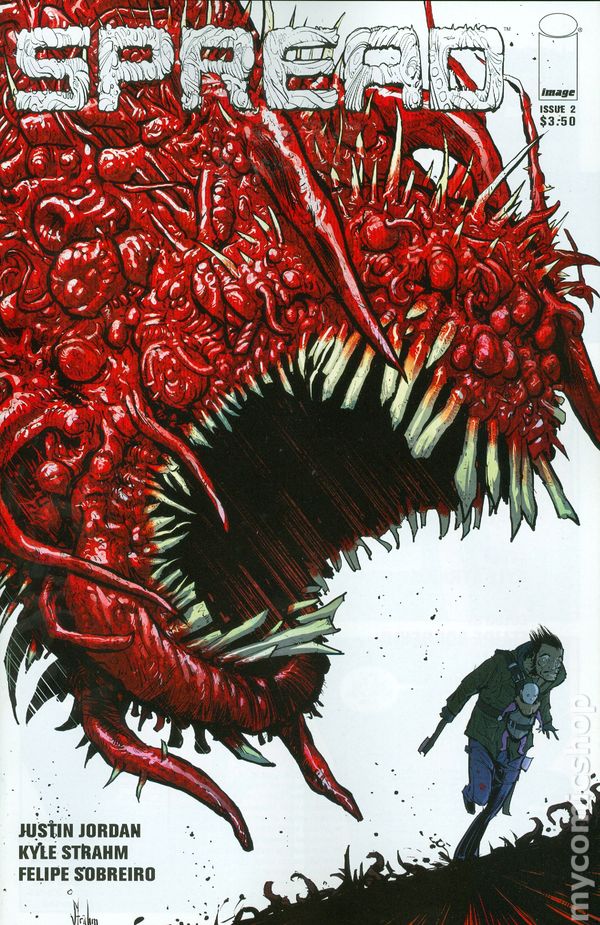
The story is strong and has been diligently introducing the right elements. In this issue, writer Justin Jordan introduces some new characters. First we meet Ravello, the Fabio-esque leader of a group of bandits. Unlike the other scarred, dirty characters of this world, Ravello is an unscathed Adonis–the visual antithesis to issue 1’s creepy thin man who has the power to spawn additional parasites. Then we meet the series’ first mega-parasite (pictured on the issue’s cover). And finally, baby Hope’s mother Molly, a totally capable mother who is in no way balls-out crazy. Though the story elements are strong and balanced, the story’s chief flaw is in taking itself too seriously. It rides too many familiar elements to not be self-aware and poke fun at its own premise.

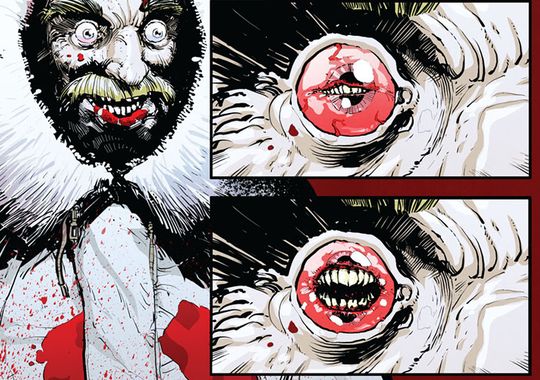
The art is bloody and visceral, and probably the series’ best element. Artist Kyle Strahm can handle anything Jordan throws his way, including parasites exploding from eyeballs and multi-mouthed worms. If there’s anything in this series that can be said to be funny, it’s in the gratuitous use of violence. It’s funny in the exploitative way of John Carpenter and Quentin Tarantino movies.

1404153101000-Spread-01-007.jpeg

The old parasite chewing through the eyeball bit. Too funny.

Should You Get It?

For post-apocalypse junkies only. You won’t find anything necessarily fresh in its pages, but if you need to feel that psychic catharsis by seeing humanity punished for all its mistakes, you could do worse than Spread.

Gardner Mounce is a writer, speaker, listener, husband, wife, truck driver, detective, liar. When asked to describe himself in three words, Gardner Mounce says: humble, humble, God-sent. You can find him at gardnermounce.tumblr.com or email him at gmounce611@gmail.com 

Major Issues: Low #1

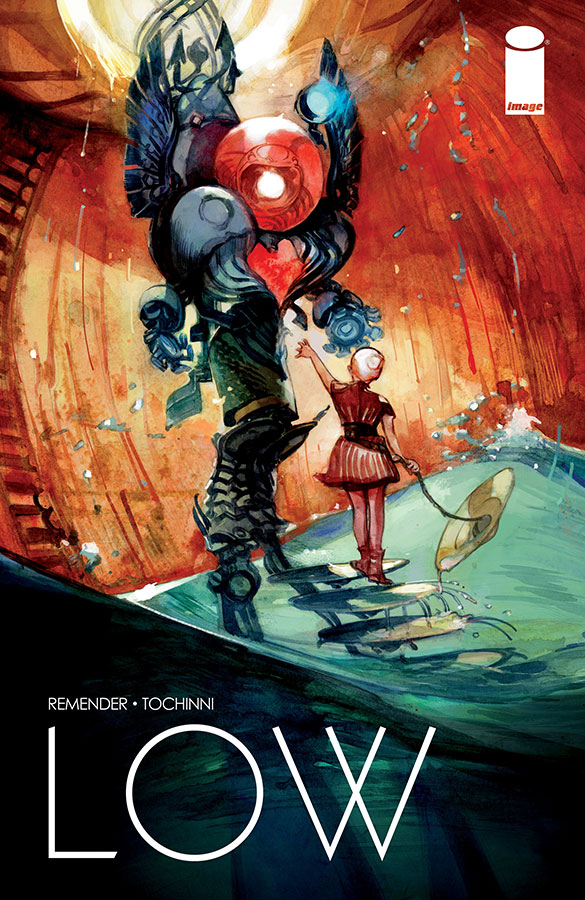
LowCover

In Major Issues, we look at one newly-released comic book each week. Now updated Mondays.

Gardner Mounce

Low #1
Written by Rick Remender
Art by Greg Tocchini
Published by Image Comics
Publication Date: 7/30/14

Louis C.K. has a great joke about telling his daughter that in millions of years, once she and everyone she knows is dead, the sun will explode and kill everyone on earth. There’s not much of a punchline other than the fact itself, and finding it funny might be the litmus test for whether or not you’d enjoy Rick Remender’s latest series Low, a story about humanity’s last ditch effort to escape an expanding sun by living in cities beneath the ocean surface. Remender–always the pessimist–says it’s a story about optimism. We’ll see.

Unlike Remender’s other currently-running series, Black Science, a no-holds-barred sci-fi story that is supposedly written without a plan, Low promises something more classic and structured. There’s a clearly defined ticking clock (the sun is expanding) and even some mustache-twirling bad guys. We meet Johl, his wife Stel, and their two children. They are descendants of the Caine family, a founding family of the underwater cities. In this issue, Johl and Stel take their two children out of the city for the first time and run into trouble with underwater savages.

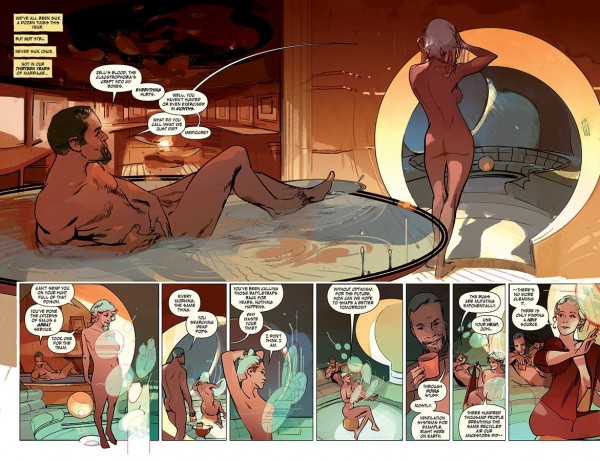
Remender paces the first issue well, but flounders with the exposition. He mostly avoids his trademark pessimistic narration, and opts instead to stuff his characters with exposition-heavy dialogue. In the first scene, Johl and Stel have one very stilted post-coitus conversation about plot points. But thanks to artist Greg Tocchini’s ability to draw realistic body language, we pick up that the two are very much in love. They just don’t have a lot to talk about besides exposition.

As for the art, Tocchini creates a visual vocabulary out of Low’s underwater aesthetic, especially in his use of spheres and circles. Not only are some of the panels themselves circular, but so are many aspects of the city’s architecture, and much of the technology is spherically designed. The spheres suggest air bubbles rising from oxygen tanks, the glass bubble that encases the city, the sun and the earth, and serves to indicate how fragile spherical things are in general.

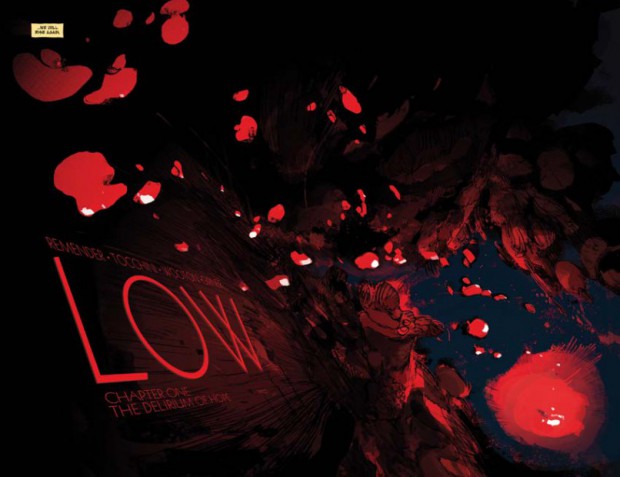
Even better is Tocchini’s way of suggesting the central conflict with the color palette. The two-page title page separates the world into burning red and absolute black–the polarizing forces of the burning sun above and the crushing ocean depths below.

Low-001-003-e1406846459126.jpg

Between these two extremes is where our characters live, in warm amber and deep jade–suggesting human warmth and the more habitable ocean depths, but also suggesting how sandwiched our protagonists are between destruction above and oblivion below.

image2-600x461.jpg

Like most of Remender’s comics, I’m more excited by the art than the writing. Even in a comic about earth’s inevitable destruction, Remender’s writing comes off as heavy-handed. However, as long as he keeps pairing himself with artists like Tocchini who can add nuance and layers of meaning, I’ll keep coming back for more.

Should You Get It?

You could probably wait until the trade paperback of the first story arc. If you’re new to Rick Remender, I’d skip this and check out his series Deadly Class. It’s the best thing he’s got going right now.

Gardner Mounce is a writer, speaker, listener, husband, wife, truck driver, detective, liar. When asked to describe himself in three words, Gardner Mounce says: humble, humble, God-sent. You can find him at gardnermounce.tumblr.com or email him at gmounce611@gmail.com 

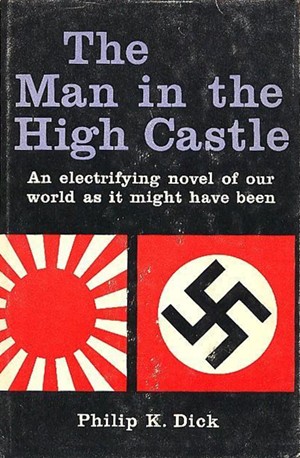
Life After the Star Wars Expanded Universe: Philip K. Dick’s The Man in the High Castle

The_Man_in_the_High_Castle

Andrew Findlay

In Life After the Star Wars Expanded Universe, we take a look at science fiction and fantasy, why they’re great, and what they say about where our species has been and where it’s going. 

Alternate histories are a strong subgenre within SF. They have been around forever. If you really want to stretch it, technically Livy wrote a hypothetical consideration of what would have happened if Alexander the Great had moved West towards Rome instead of conquering the East. He says Rome would have won, but I mean, his name was Titus Livius Patavinus, so. In 1490, the chivalric novel Tirant lo Blanch postulated a history in which the Turks never took Constantinople. 1953’s Bring the Jubilee told a story in which the Confederacy won the Civil War. There is an absurd amount of alt-history books out there, but few are as famous as The Man in the High Castle.

This type of fiction starts out by finding a historical pressure point one, two, ten decades ago, flipping what happened, then exploring the ramifications of the strange new world thus created. Here, the pressure point is Giussepe Zangara’s attempt to assassinate President-elect FDR. In The Man in the High Castle, he is successful. His VP takes over, does a bad job, and is replaced by a Republican president who fails to surmount the Great Depression and maintains the USA’s isolationist policies. The end result of all this is that Russia is conquered in ’41, England cannot stand alone against Germany and falls, and then the complete destruction of the Pacific fleet at Pearl Harbor makes America easy pickings. At the start of the novel, Germany controls the east of the United States, Japan controls the west, and the mountain and southwestern states form an autonomous American buffer zone between the two.

Touching a pressure point in history, like touching a pressure point in the body, sets off reactions far from the initial point of contact. The Nazis, their ideology unchecked by defeat, continue in their insane belief in a master race. This obscene self-confidence coupled with German technological prowess leads to the colonization of other planets. It also leads to Nazis hunting Jewish people all over the world and shipping them back to Berlin, and Nazi scientists spearheading a vaguely-referenced experiment in Africa that leads to the extermination of most of its populace. Again – the center of SF is extrapolation, and PKD extrapolates the Nazi dynamic of world-changing scientific progress built on human misery and their inhumanity to their fellow man. Same pattern, wider oscillation. As a brief aside on German technological prowess, NASA probably would not be what it is today without Wernher von Braun, who created the rocket booster system that put Neil and Buzz on the moon. He did the same kind of rocketry work for the Nazis, only it was weaponized as the V-2 rocket. Von Braun has always maintained he just wanted to work on rockets and had to join the Nazis to do so, and is reported as saying, upon hearing the news of the first successful V-2 bombing of London, “The rocket worked perfectly except for landing on the wrong planet.” This self-serving attitude and the avoidance of responsibility by wrapping himself in idealism (these rockets were built with slave labor) is beautifully satirized by Mort Sahl, the first modern stand-up comedian. The following joke is pretty much the whole reason for this aside, as it is one of the best I’ve ever heard: “I aim at the stars, but sometimes I hit London.”

Out west, the Japanese are comparatively benevolent colonizers. Throughout the Pacific states, the Japanese run things, but tend to be more lenient than their Nazi counterparts. Western Americans absorb much of the culture of their colonizers, including using the I Ching and adapting to Japanese systems of social advancement and behavior.

The first major plot concerns an intrigue between German and Japanese representatives to one-up each other. The Germans want to be the sole superpower in the world, and are covertly maneuvering against Japan. The Japanese are covertly maneuvering against Germany to defend themselves. The second major plot thread is that an author who lives in a fortress in the Rocky Mountain States (the High Castle) has written a book titled The Grasshopper Lies Heavy which is a piece of alternate history fiction that explores what might have happened if America had entered the war and the Nazis had been crushed. This book is very popular underground, and a couple of the characters decide to take a road trip to meet the man behind it.

Speaking of characters, most of these are cardboard-flat. In many of his books, PKD puts just enough in his characters to make them move around realistically, then lets them go. I still can’t decide if this means PKD is a master of simplicity, or if characterization is just not his strong suit.

There is a reason this is arguably PKD’s most acclaimed book. Sure, the characters might be stick figures, but the world they move around in is unsettlingly plausible and well-built. Americans grow up with “we are the greatest/we’re number one” hammered into their heads. Our President is regularly referred to (by us, anyway) as the leader of the free world. Even if you take Eddie Izzard’s joke about there being a lot of countries, none of whose mottos are “We’re #2!”, to heart, the USA still has an unparalleled level of power and influence in the modern world. Therefore, reading a book in which America is weak, colonized, subjugated by and dependent upon foreign powers creates a deeply personal sense of horror in the American psyche. The adeptness with which PKD constructs and directs this sense of horror makes this book well worth your time.

Andrew Findlay has strong opinions about things (mostly literature) and will share them with you loudly and confidently. You can email him at afindlay.recess@gmail.com.
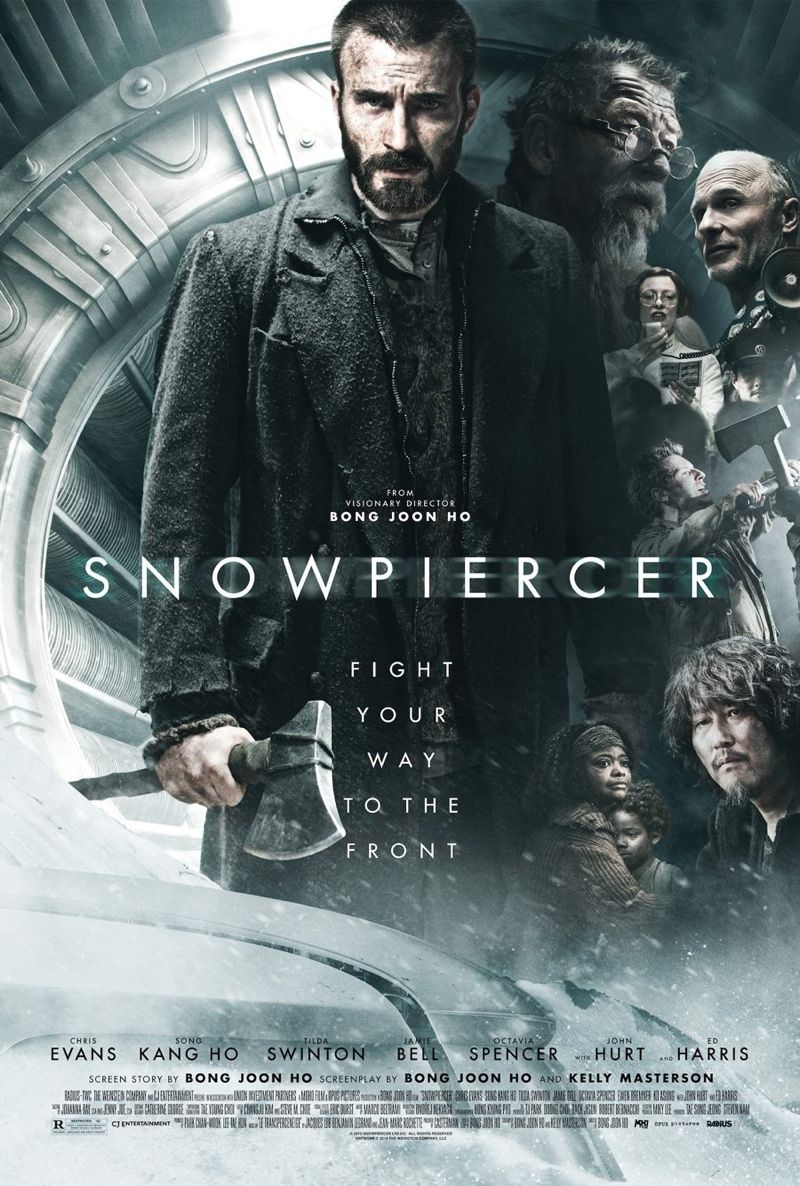
Life After the Star Wars Expanded Universe: Bong Joon-ho’s Snowpiercer

 Snowpiercer-Movie-Poster-Chris-Evans

Andrew Findlay

In Life After the Star Wars Expanded Universe, we take a look at science fiction and fantasy, why they’re great, and what they say about where our species has been and where it’s going. 

Snowpiercer is a delightful sci-fi concept film. The concept is that, amid concerns of climate change, humanity released a relatively untested “cooling” chemical into the upper atmosphere – an anthropogenic solution for an anthropogenic problem. By the way, if you are a person who still denies that something is happening to the climate and that humanity is largely responsible for it, please leave. Even offering a counterargument to deniers is creating a semblance of rational disagreement and debate, which only serves to allow major actors to continue down a path that, unmitigated, will quite literally end the world as we know it. Many scientists are worried that there is a point of no return, and that, once we pass it, there might be a runaway greenhouse gas effect that will radically alter the makeup of the only known body in the solar system that can support human life. Current governmental response to it is insane. Not only are they not freaking out, a full 58% of Republican lawmakers – over half of one major political party – doubt that it exists. The people responsible for legislating measures that might save us aren’t doing anything because a quarter of them are idiots. As a brief aside – a lot of climate change deniers are also evolution deniers. Evolution denial is similar to climate change denial, if the consequences of denying evolution made the whole human race lose their neocortex. That’s the thing – you can deny evolution all you want, and it will change nothing. Dismissing sound climate science, or even just fostering the appearance of any debate on the issue, weakens our ability to respond, in a measured and timely fashion, to a set of circumstances that could lead to mass famine, destruction, and loss of life. I don’t get it. During the Cold War, everyone was terrified of the world ending in a nuclear holocaust. There’s an outside chance the world might end if we don’t stop freely burning fossil fuels, and about a quarter of us are responding with  “Eh, fuck it.” (25% being the rough number of people that actually deny it. Probably a lot more don’t give a shit).

In Kim Stanley Robinson’s Mars trilogy, around 2128, Mars and its citizens stood as an oppressed colony of Terran corporate interests. Martians get a fighting chance when a major humanitarian crisis strikes Earth and diverts resources from harvesting efforts on Mars to relief efforts on the homeworld – the West Antarctic Ice Sheet collapses, dooming all Terran coastal areas with slow but inexorable inundation. Robinson, writing a far-future novel in 1996, trying to think of a semi-plausible disaster for purposes of his plot, came up with that. It happened eighteen years later. If that isn’t enough to terrify you, a science-fiction author’s future apocalypse scenario coming true less than two decades after his book was published, I don’t know what is.

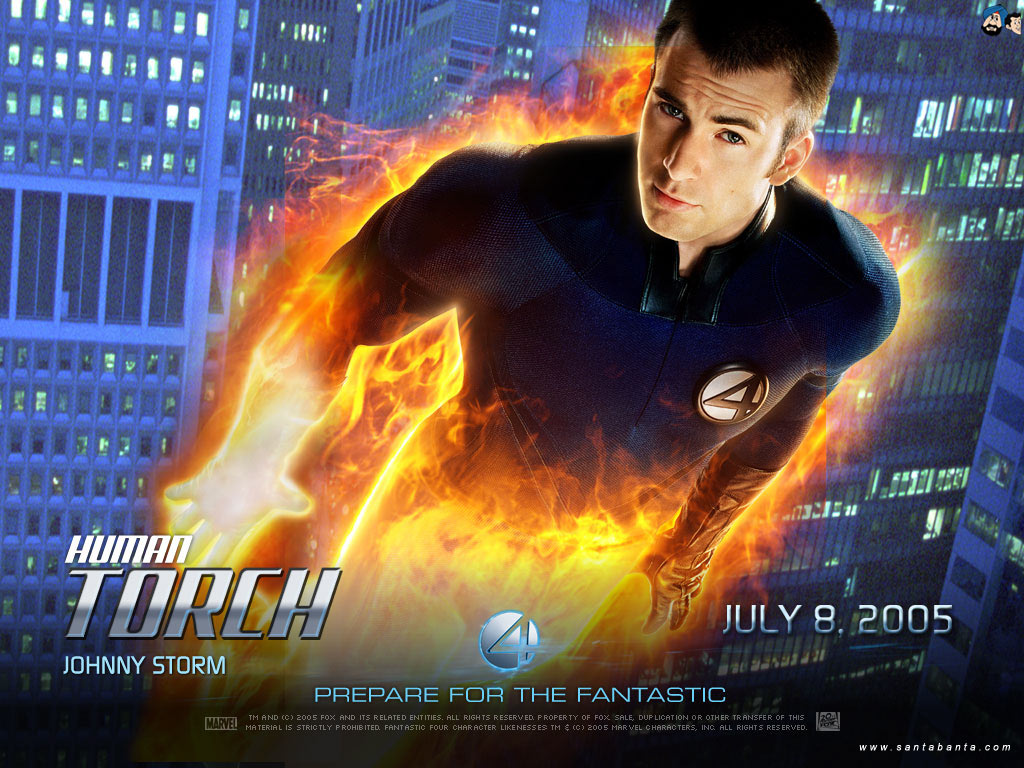
Anyway, they release this quick-fix chemical into the upper atmosphere, and the immediate consequence is that they cool the Earth to far below the threshold for sustaining an ecosystem. All life on Earth is flash-frozen, save for a small enclave on a constantly-moving train run by a perpetual motion engine. Snowpiercer is a great example of the type of science fiction that takes a real science problem from the world, extrapolates it, and then uses it as a backdrop to have Captain America beat the crap out of people. Chris Evans, of Captain America fame, plays the rebellion leader Curtis Everett. Don’t come here for that though – other than hitting people with blunt (or sharp) objects, he’s not very Captainy. This film is way too grim for that.

fan2d

He also starred in this movie. We do not speak its name.

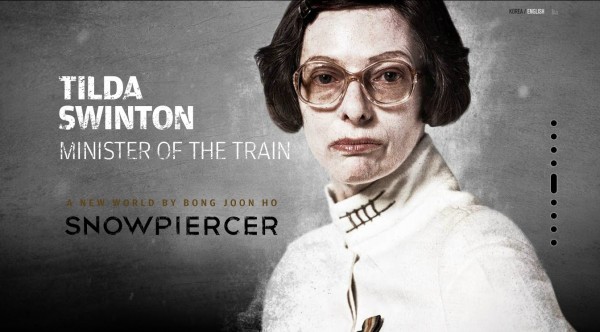
The grimness comes from the fact that on the train housing the last remnant of humanity, you have your first-class passengers, your coach passengers, and your oh-my-god-the-world-is-ending-let-me-on passengers. This last category is kept in constant poverty and misery, beaten by guards, and despoiled by the rich. They eat protein gelatin while first-classers eat steak and fish. They pile in squalid bunks while the rich lounge in private cars. The whole drive of the movie is Chris Evans’ character fomenting a rebellion, the stated purpose of which is to reach the front of the train and gain control of the engine, thus gaining control of the entire train. There is a lot of ingrained hierarchy and a lot of guards in place to keep them from doing just that. There is also a lot of propaganda, whereby the owner of the train is cast in a numinous aura of near-godliness. The lead propagandist is probably my favorite character in the film, and she is played marvelously by a ridiculous Tilda Swinton.

tilda

Oh, Tilda.

The most remarkable achievement of the film is its transformation of the vertical, metaphorical rich on top/poor on bottom dynamic into a horizontal, literal rich in front/poor in back dynamic. The protagonist and his band struggle through car after car, moving from industrial-revolution level squalor, to clean and economical, to absurdly elegant and polished. This results in visual cues signaling Curtis’ progress – the further up he gets, the nicer everything is. It is a physical diorama of oppression. Another thing the film does nicely is the action – there is plenty of gritty, bloody scuffling as they inch forward to the engine. Much of the killing is done with improvised weaponry, as the oppressed poor are of course not permitted firearms. Some of the scenes, while not nearly as cool, reminded me of the transcendental hammer hallway fight scene from Oldboy. If you have not seen Oldboy, it is on Netflix. You should probably see Oldboy. Here’s the scene I’m talking about:

This is pretty much what happens as they move through the train cars.

The movie is well worth seeing. Its idea-driven plot, its ambition, its worldbuilding, and its unique sets more than win it the right to your time. However, it does fall apart in some areas. First off, the majority of the characters are pretty simply sketched out. There’s no real change or development throughout the film. Also, the ending is one of the stupidest things I’ve ever seen. It’s fine, it’s fine – I still like the movie. But watch out for that ending. Overall, it’s nice to see small concept-driven sci-fi being produced as opposed to ginormous explosion-driven sci-fi (cough Transformers cough). Take an afternoon for yourself and check it out.

Andrew Findlay has strong opinions about things (mostly literature) and will share them with you loudly and confidently. You can email him at afindlay.recess@gmail.com.
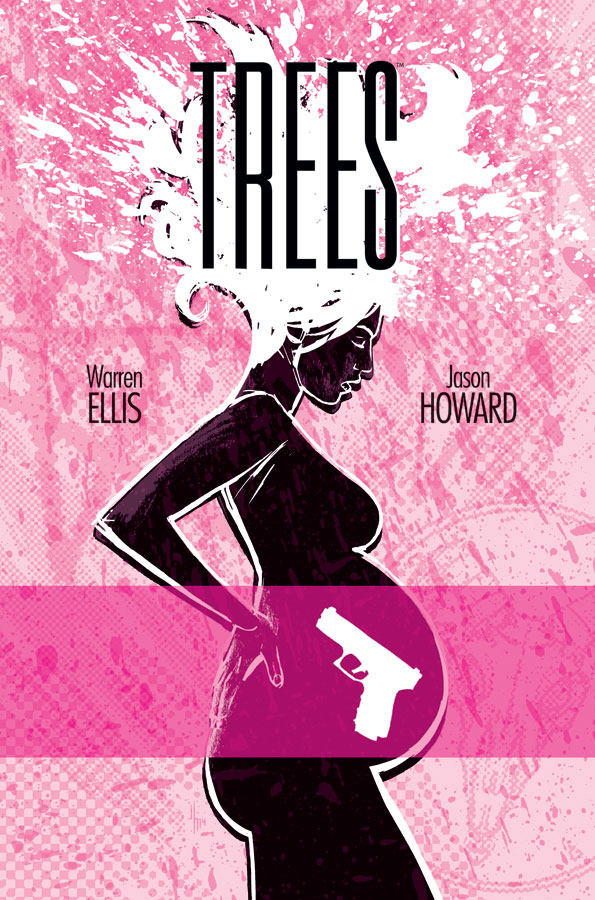
Major Issues: Trees #3

8665.jpg

In Major Issues, we look at one newly released comic book each week. Updated Fridays.

Gardner Mounce

Trees #3
Written by Warren Ellis
Art by Jason Howard
Published by Image Comics
Published: 7/24/14

As pop culture would have it, there are two ways that aliens are going to invade. There’s the Invasion of the Body Snatchers/Men in Black type where one day we find out that the aliens have been living right under our noses for years. And there’s the Independence Day/The Hitchhiker’s Guide to the Galaxy type where the aliens just announce that they’re here and in a few seconds we’ll all be dead. The first thing we notice is that Will Smith has saved us from both types. The second thing we notice is that, in both scenarios, the aliens are accessible antagonists—they’re here among us for us to interact with or fight or whatever, or they’re above us in spaceships for us to throw rocks at. But imagine if an alien race left some undeniable symbol of their presence and utter superiority, and then just left us to scratch our heads about it.

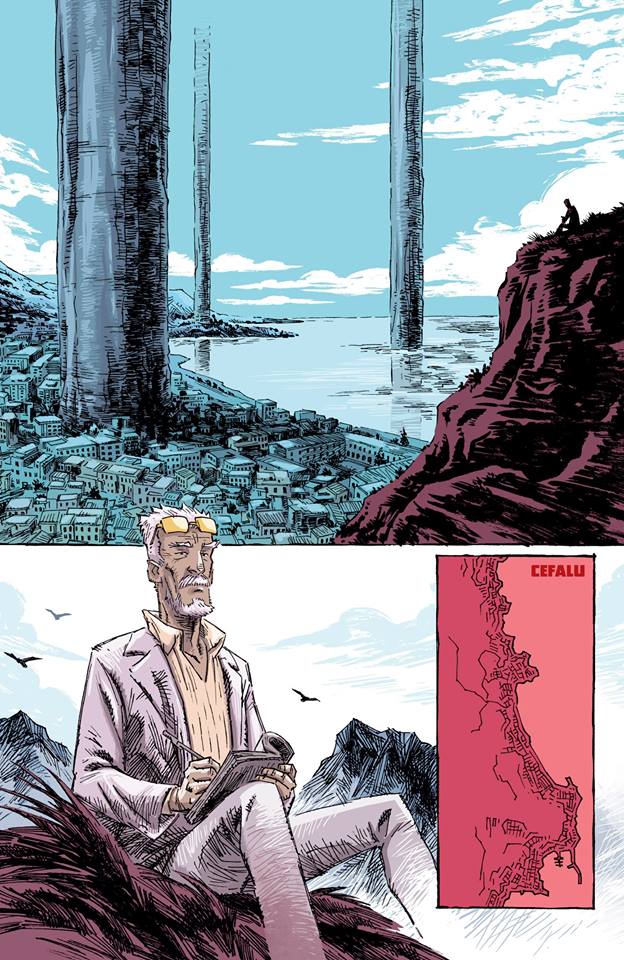
In Warren Ellis and Jason Howard’s Trees, an alien race has punctured the globe with monumental, sky-scraping towers (which humanity has dubbed “trees”)—and then vanished, like, your move, humans, and haven’t returned or made contact for over a decade. Less us-versus-them-story and more human drama, Trees tracks a number of story lines that span the globe, from an ex-professor in Cefalu and the fascist’s girlfriend who stalks him to scientists in Antarctica studying a mysterious black bloom growing at the base of a “tree.”

Ellis handles it all with incredible subtlety. A lesser writer would have written swathes of heavy-handed narration, but after some necessary exposition in the first issue Ellis constructs the world scene-by-scene with zero narration at all. A narrator-less story gives the sense that the reader knows just as much as the characters do about the trees—hardly anything. It also stresses the importance of the present moment: the world has halted since the trees arrived; they are ever-present, in nearly every scene; timeless and unchanging; dominating the landscape and laying waste to our sense of importance and human scale of time. Subtle also is Ellis’ dialogue. It’s been ten years since the trees arrived, so it’s only natural that people aren’t having exposition-heavy conversations about them. People are solving small problems on their own small stages, leaving the reader to synthesize bits of information to form the larger picture. The dialogue is smart, clipped, and avoids pandering.

Jason Howard is one of those imminently readable artists whose art is so functional that it’s almost invisible. It takes a keen eye to discern his moves. He uses the same types of panels over and over, and, taken together, the pages form a rhythm. There are the borderless panels that suggest timelessness, the bordered action panels that break the borderless panels up, and the white-backgrounded panels that strip the world down to action, reaction, and emotion. The borderless panels often establish expansive spaces like arctic vistas, sterile cafeterias, and “tree”-dotted Italian landscapes. These ground us in the sense of timelessness that the “trees” have imposed. These borderless panels are the arena on which the story takes place, and the places to which we always return: huge silent spaces punctuated by human action. Much rides on Howard’s colors, which he uses to establish mood. From cool conciliatory blues to altercation-accompanying yellows and pinks, his art is about subtlety.

Alien invasion stories are generally heavy on action and light on mystery. And we usually know the invaders’ intentions by the end of act one, which gives us plenty of time for preparing for fighting, fighting, and high-fiving over the fighting that just occurred. Trees stands apart because, first of all, there are no roles for Will Smith to play in the movie adaptation, and second of all, we don’t have any idea why the aliens dropped these “trees” down on us. To study us? To suck the life from our planet? To mess with us? The whole fun is that not knowing makes us feel out-of-the-loop and insignificant, and that fear of our insignificance spurs us. Fun, right?

tree-2.jpg

Should You Get it?

Absolutely. As a writer, Ellis is confident as hell, and treats his readers with respect. These first three issues have been slim on action and heavy on establishing world, character, and conflict. He will not spoon feed, he will not pander. This is a serious comic for serious readers, and as with almost any Ellis comic, will most likely have tremendous payoff. Though, I will say, this comic might be more satisfying in trade paperback form where you can read a lot in one sitting.

Gardner Mounce is a writer, speaker, listener, husband, wife, truck driver, detective, liar. When asked to describe himself in three words, Gardner Mounce says: humble, humble, God-sent. You can find him at gardnermounce.tumblr.com or email him at gmounce611@gmail.com 

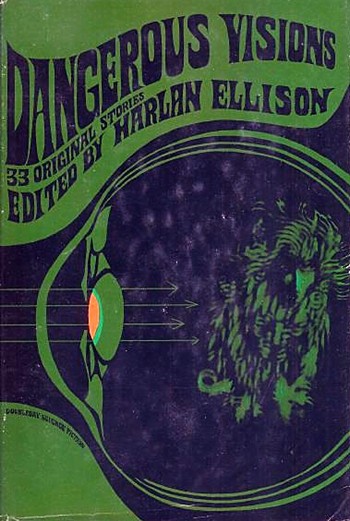
Life After the Star Wars Expanded Universe: Harlan Ellison’s Dangerous Visions

DangerousVisions(1stEd)

Andrew Findlay

In Life After the Star Wars Expanded Universe, we take a look at science fiction and fantasy, why they’re great, and what they say about where our species has been and where it’s going.

The title of this article is Harlan Ellison’s Dangerous Visions, but the book is actually the work of 32 different authors. Harlan Ellison serves as both contributor and editor. At the time, and in many ways still now, this was a New and Important book. Ellison put out a call for new, experimental, push-the-boundaries-of-the-genre type fiction, fiction that, due either to editorial opinion or censorship, could not get published in the contemporary market. What he collected is 33 stories, most of which are very good, a third of which are truly impressive, and a handful of which are kinda crappy. It is the distillation of a lot of ideas floating about in the heads of new SF writers at the time. In the 60s environment of general rebellion, experimentation, and radicalization, many SF writers wanted to push the limits of the form, aspire to the quality of general literature, and break with the aliens-and-robots standards of the past. While the ideas behind the movement had been circulating for a few years, Harlan Ellison gave them all a place to roost.

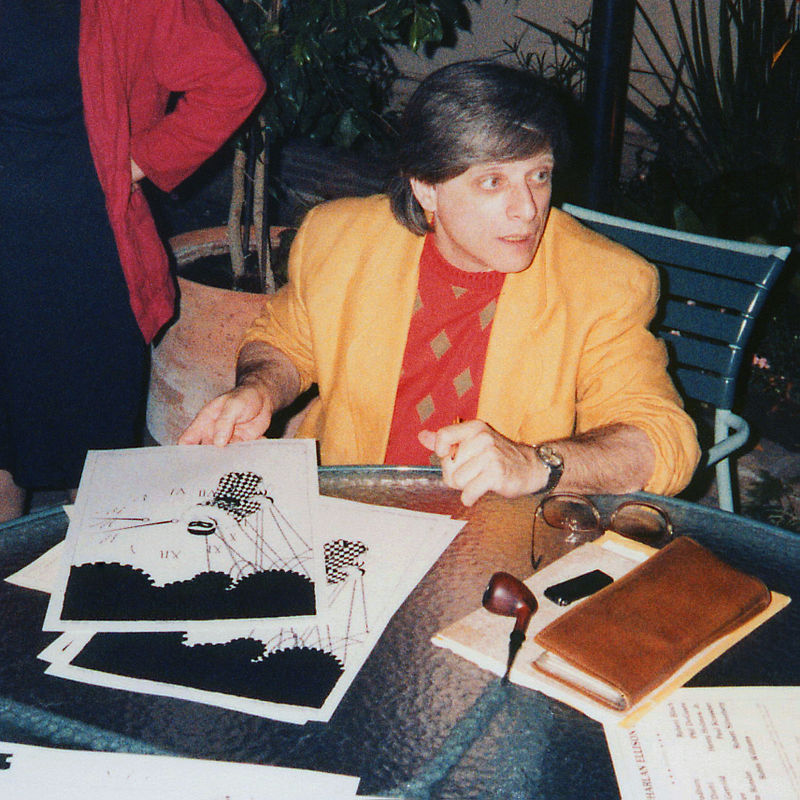
Harlan himself is a very interesting character. He is an important, genre-influencing author, with short stories like I Have No Mouth and I Must Scream, which you can read here, and which is one of the most terrifying stories I’ve ever found. He also spent a lot of time writing SF for television, and his “City on the Edge of Forever” is one of the most highly acclaimed Star Trek: TOS episodes ever. His accomplishments as an author have been slightly overshadowed by his accomplishments as an editor and SF personality, but that is only because he edited such an important anthology and he has such a unique personality. One word to describe that personality would be abrasive, and I probably don’t have to tell you any more than that he has a section in his Wikipedia article entitled “Controversies and disputes,” and that it takes up nearly half his entry, for you to get an idea of just how abrasive. This is the man behind one of the most important science fiction books ever written.

800px-Harlan_Ellison_at_the_LA_Press_Club_19860712

Harlan Ellison in the 80s. Possibly my favorite picture on Wikipedia. Why is there a pipe?

So what’s so great about this book he put together? It largely lives up to its ambitions, presenting stories that are highly experimental, that break social taboos, and that aspire to literary quality. “Evensong” explores a future where God is on the run from his chosen people, who have transcended his guidance, which would be controversial if published today, 47 years on. Larry Niven’s “The Jigsaw Man” is a horrifying portrait of a time when the incarcerated are cut into bits for their organs and body parts, thus conferring immortality on the unimprisoned. Philip K. Dick’s “Faith of our Fathers” explores a totalitarian world where the protagonist is dosed with anti-hallucinogens, and when he looks at the benevolent leader when sober, it isn’t human. In “Shall the Dust Praise Thee?” God shows up with his angels, all raring to blow their horns and start the Apocalypse, but all they see is dust and ashes. The angel responsible for turning the seas to blood can’t find the seas. Eventually, they find inscribed on the wall of a bunker, “We were here. Where were You?” In the amazingly named “If All Men Were Brothers, Would You Let One Marry Your Sister?” the happiest and most productive planet in the galaxy is so healthy because it actively practices incest, which, even as a thought experiment, is highly uncomfortable to read. I could keep on listing and describing the great stories in this book. I made a list of about twelve of them, but it would be better for you to just read it for yourself.

As groundbreaking as this book is, it is not without problems. It is open-minded about sex, taboo, and stylistic experimentation, but it strongly maintains some taboos while transgressing others. One example of this is when, in a story about gambling, the protagonist Joe finds himself playing craps with someone sinister. Fine, games of chance against the devil that don’t go so well for the other player are ingrained in our storytelling tradition. The problem is, when Joe starts getting worried about it, he “[finds] himself wondering if he’d got into a game with a [racial slur], maybe a witchcraft-drenched Voodoo man whose white make-up was wearing off.” What? In addition to the slur being a problem, the author decided to use blackness as shorthand for the hidden, threatening Other. Before, it was a game between compatriots, and as it turns sinister, the main character wonders if maybe he’s not playing against someone of his own race. That’s fucked up. Another example of backwards thinking is in a story called “Ersatz,” which is a pretty standard future-war post-atomic apocalypse story. A soldier finds his way to a care station and starts eating and drinking a bunch of ersatz stuff, because with the world basically over, they can’t get the real thing. He eats a steak made of bark, smokes tobacco made of not tobacco. The post-apocalyptic world is not a nice place, and so far this story is pretty standard. The ending of the story is one of the stupidest things I’ve ever read. It turns out that, in addition to the other ersatz comforts, the woman that works at the care station and who had attracted the attention of the soldier (there were descriptions of curves) turns out to be wearing a wig and a stuffed bra, and surprise, she wasn’t born a woman. The reason this is the stupidest ending I’ve ever read is that the soldier’s response to this is hitting Eleanora (that’s her name) and running back out into the wasteland, without armor or weapons, to certain death. First off, really? A hardened soldier is so terrified of a penis that he runs in terror to certain death? Secondly, this is a really disgusting portrayal of trans women. This is a story about how everything humanity used to enjoy is fake. The big reveal was supposed to be, oh no! even sexytimes with women are now fake! What it really communicates is the author’s ignorance, and what it states is that trans women are fake women, which is actively reactionary, not ground-breaking. Let me quote part of the ending for you: “He struck the creature with all the strength in his fist, and it fell to the floor, weeping bitterly, its skirt hoisted high on the muscular, hairy legs.” So if you are surprised by a trans woman, who is a fake woman, the correct response is physical violence towards “the creature.” That is the moral of this disgusting little polyp of a story.

Polypen_einer_Gorgonie

A nice picture of a sea polyp, as you probably don’t want to see a picture of the type of polyp I have in mind.

The editor of this anthology also has problematic attitudes towards homosexuality. In one introduction to a story, he communicates that families with weak fathers often end up raising homosexual children. In another intro, he discusses the old aphorism that you should never meet the person behind the art you love, which, yes, but one of the examples he uses is “the writer of swashbuckling adventures [turns out to be] a pathetic little homosexual who still lives with his invalid mother.” What? Is Ellison implying that he is pathetic because he is gay? Is there something wrong with living with and caring for your sick mom? It’s just weird, and it’s an indication that, however progressive they were then (Ellison participated in the 1965 civil rights march from Selma to Montgomery), you knock one piece of backwards, reactionary thought garbage down, and there’s more bullshit to take its place. There’s also a story, “Riders of the Purple Wage,” wherein a man’s girlfriend says yes, let’s have unprotected sex to have a baby. She changes her mind afterwards and goes to her bathroom to use spermicide. This future contraceptive method is a bottle of some sort that you can insert into the relevant orifice, push the relevant button, and spray the relevant area with spermicide. Since this is the future, one bottle is good for 40,000 sprays. The boyfriend (the fucking protagonist) becomes so enraged at this that he superglues the contraceptive bottle inside of his girlfriend and makes the button stuck, thus continuously and painfully injecting spermicide into her. I’m not sure if this was supposed to be comical or what, but it comes off as horrifying. Hi, you don’t want to do with your body what I want you to do with your body, I will therefore practice violence upon you and cause you great and humiliating physical harm.

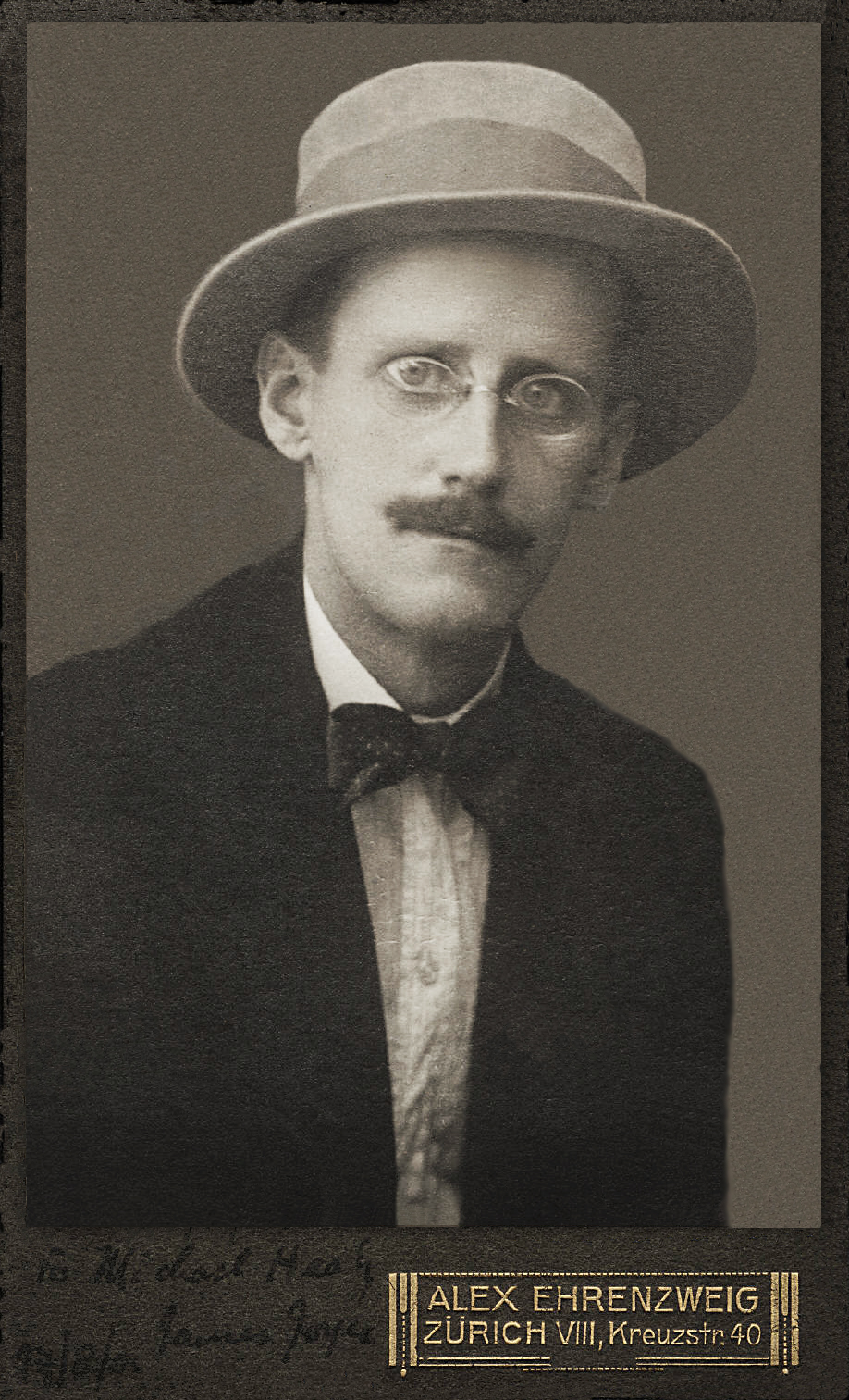
Aside from the repugnant stance on some social issues, some of the stories are just not that great. There’s one that is told from the POV of a three-year-old as he thinks about how square his parents are. There’s another, “The Man Who Went to the Moon Twice,” wherein a kid in a small town lies about going to the moon and becomes a local sensation because everyone is too bored to check facts, and then he does it again as an old man because he is sad that no one cares about him (big twist: it’s noteworthy that he’s been to the moon as an old man because at that time, Mars is the main colony). The whole story is just really boring and saccharine. Also, one of the most celebrated stories in the anthology, “Riders of the Purple Wage,” of violence-against-women fame, gets credit all the time for being “Joycean.” Man, there are about two pages at the beginning of this story that are lyrically inventive and that require some exertion to figure out, and then it falls back into pretty standard narrative technique. Ulysses is “Joycean” because it is inexhaustibly inventive, and nearly every single chapter showcases a new, different, and innovative style. This guy writes confusingly for two pages and gets credited as “Joycean?” No.

James_Joyce_by_Alex_Ehrenzweig,_1915_restored

This man’s work was Joycean. Not sure anyone else’s ever was.

This book is rife with problems. Let me restate that. This book is not rife with problems, but whenever a problem rears its head, it’s a huge one. As a book that purports to be on the cutting-edge of social advancement and fearless in its striking down of taboos, the reactionary attitudes of some of these authors towards many aspects of social justice are highly incongruous. It might have been impressively open-minded for 1967, but not so much for 2014. You should still read it, though. One reason is that it is a monolith in the field of SF’s past and helped set the stylistic tone for a generation of writers. Another is that, as truly repugnant as some of these stories are, the grand majority of them are not, and the anthologized nature of it means that even if Henry Slesar writes like an asshole, you can still enjoy the weird, mind-bending visions of Lester del Rey or Philip K. Dick contained in the same book. In addition, it is important to read and understand even the repugnant stories, as their presence in a book lauded as taboo-breaking in the 1960s underline the nature of social progress – there is no finish line, and we must always move forward.

Andrew Findlay has strong opinions about things (mostly literature) and will share them with you loudly and confidently. You can email him at afindlay.recess@gmail.com.
Video Games as Literature and The Novelist’s View of Work/Life Balance

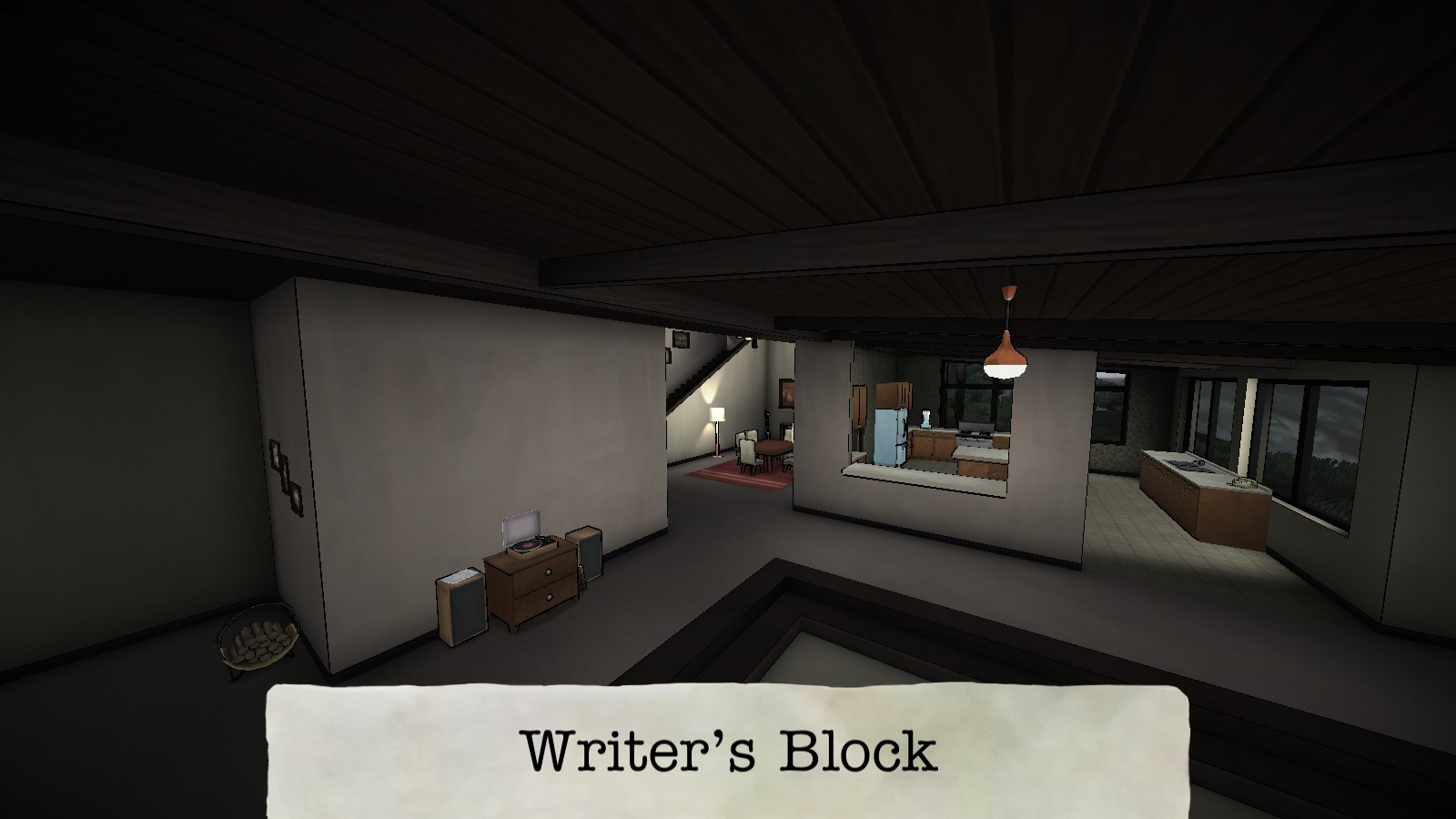
novelistwritersblock

Alex Russell

If you’ve ever had to make a hard choice between work and the rest of your life, well, that’s normal. The Novelist is about what happens when you make the wrong one. Oh, and they’re all wrong.

You play The Novelist as a ghost that’s inhabiting a vacation house by the water. The Kaplans (Dan, Linda, and their son Tommy) are on vacation for the summer, and they each want something different out of the trip. Dan wants to finish his second book. Linda wants to work on her painting. Tommy wants to have a fun summer. You might say to yourself that those don’t sound like they’re at odds with each other, but in the world of The Novelist they are violently opposed to one another.

The game unfolds over a series of chapters all centered around important events in the summer. In one chapter, the Kaplan family has to deal with a funeral. In another, Linda has an art show in town. In another, Tommy has a friend over. They all start out as mundane pieces of a family’s life, but the game’s actual narrative is all in how you respond to them.

It’s an interesting choice that you’re not any of the characters. You influence decisions by wandering around the house during the day and observing each family member. Once you feel like you have a grasp on what everyone wants, you signal the family to go to sleep. Then you whisper your choice to the family while they sleep. Whatever you decide will play out in a cut scene, and the results will influence how everyone feels about everyone else (and themselves) in the days to come.

For example, I decided to focus on Linda’s happiness in my playthrough. On one day, I opted to have Dan spend a night talking with Linda instead of working on his novel or playing with Tommy. The next day, Linda felt better about her marriage, Dan felt worried about his book, and Tommy felt neglected by both parents. Me? I felt really sad for everyone.

novelistdialogue

The choices are tough because each choice is also the lack of two other choices. It’s intended to simulate life — if you go out tonight and drink with your friends you don’t get anything done at home, etc — but it’s brutal nonetheless. You know Dan has to finish his novel over the summer, but every single choice of “write” instead of “play with your son” or “talk to your wife” drives him away from his family emotionally. Any choice to not do exactly what the family’s young son wants makes him miserable. I guess that’s realistic to a degree, but it’s too much sometimes. As another example, if you choose to have Dan not play with Tommy and a toy car outside, Tommy leaves the car in the rain and it gets ruined. What is sadder than a lonely child’s ruined toy?

I didn’t side with Tommy very often. My version of Tommy drew angry crayon drawings of his father neglecting him. My version of Linda, who was happy with her art career but unhappy with her husband, never seemed to get exactly what she wanted. My version of Dan was a wreck. Your milage may vary, but it’s hard to imagine any set of choices resulting in true happiness for these people.

It’s certainly true that any choice means you’re eliminating others, but it needn’t be this stark. I don’t want to give away any of the endings, but by only siding with Tommy a handful of times I essentially ruined the kid. It had a really damaging effect on me; I was actually saddened that I had failed this digital child. In that sense I have to say that the narrative (or the narrative in my playthrough) really works. The feelings are real, they’re not “video game feelings.”

The Novelist is a little repetitive – the gameplay isn’t worth mentioning at all, it’s even less of a traditional “game” than Gone Home – and it’s frustrating at times. The challenge of keeping all three people happy is a kind of story-based The Sims; every mood bar is depleting at the same rate, and you’ve gotta keep them all happy to win. I don’t know that I “won” The Novelist, but the mental image of that car in the mud is going to stick with me for a long time.

Alex Russell lives in Chicago and is set in his ways. Disagree with him about anything at readingatrecess@gmail.com or on Twitter at @alexbad.

Life After the Star Wars Expanded Universe: Philip K. Dick’s The Three Stigmata of Palmer Eldritch

TheThreeStigmataOfPalmerEldritch(1stEd)

Andrew Findlay

In Life After the Star Wars Expanded Universe, we take a look at science fiction and fantasy, why they’re great, and what they say about where our species has been and where it’s going.

Editor’s note: an earlier version of this article mentioned that Philip K. Dick took a lot of LSD and wrote solely genre fiction. They’re both only partially true, and the article has been updated as a result.

Philip K. Dick is the ultimate psychedelic writer. His explorations of the mutability of reality and the fragility of the human psyche are vivid, incisive, and hallucinogenic. Roberto Bolaño described him as “a kind of Kafka steeped in LSD and rage.” However much altered states influenced his writing, PKD did not actually do that much LSD – it gave him unpleasant experiences. Yup, he was just your run-of-the-mill, square, SoCal writer, ingesting massive quantities of amphetamines as he wrote feverishly, and as he wrote this book, he hadn’t even tried LSD for the first time. As I explain the concept of this book, it is very important to remember that Dick had not yet ingested lysergic acid. He was this crazy beforehand. I’m assuming every single novel PKD ever wrote deals with the nature of reality, its uncertainty and unknowability. I can definitely declare that each one I’ve read by him has always had someone losing their goddamn mind. In this 1965 novel, Dick explores the ramifications of self-medication when the medicine you use is powerful enough to make the universe drunk.

This book starts out in the far future, with many of the trappings of futuristic societies. Due to climate change, it is now too hot to be safely outside, and people have to wear special AC suits to prevent combusting while walking to work. The rich and powerful of the world vacation in Antarctica, which is nice and balmy. Most of the moons and planets of the solar system are colonized, but not happily. The UN runs the world, and in order to preserve humanity from the crumbling, condemned planet Earth, they instituted a draft for emigration. A certain percentage of Earthlings have to be induced to go to space colonies. They have to be induced because colonization sucks. On Mars, there’s nothing to do but tend your dying farm and hang out in your subterranean bunker. Well, that and taking powerful psychoactive drugs. Most of the action of the novel centers around the use of Can-D, a “translation” drug. Can-D is useless without Perky Pat Layouts, a company that makes miniature versions of all the stuff that can be found on Earth (this company also illicitly manufactures the drug). Think Polly Pocket, but extremely realistic.

Sol454_Marte_spirit

Your new backyard, colonist!

It is so realistic because Can-D “translates” its users into the world of the layout. Therefore, if you take Can-D, some type of fungal hallucinogen, while sitting in front of a layout with a beach and a convertible, you get to spend a set amount of time living the life of either Pat, the woman, or Walt, her boyfriend, as they enjoy a seaside holiday. For some reason, the hallucination is dependent upon the layout – if you want to take a beach vacation, you better buy miniaturized beach towels and sun umbrellas. A feature that further complicates this already strange experience is that there are only two possible surrogates for the drug-user’s consciousness: either mini-Pat or mini-Walt. Women become Pat, and men become Walt. This means that if three male/female couples trip together in front of the same layout, all three women will be in Pat, and all three men will be in Walt, directing each as one member of a group conscious. Supremely weird, but honestly, if you were exiled to a barren sandscape where, if you’re lucky and terraforming is advanced enough, you might be able to go outside, wouldn’t you indulge in powerful psychotropics? Everyone in this book does, and that is the most plausible part of it – the human reaction to complete loss and mental stultification is to take stimulation wherever it can be found.

The conflict in the book starts when Palmer Eldritch, a kind of insane, spacefaring Richard Branson, returns from a ten-year voyage to Proxima Centauri with another fungus – Chew-Z. He begins marketing it immediately, and the Perky Pat people react with professional terror, because Chew-Z is a reality-altering drug that requires no layout, which means it is perfectly poised to put them out of business. Chew-Z is similar to Can-D in that it creates an alternate mode of existence for whoever takes it. However, it is much more powerful than Can-D. It can translate you into whichever existence you most want to be in – it is chewable wish-fulfillment. The problem is that, whatever new universe you make for yourself, Palmer Eldritch is there, and he exerts some type of control over your personal reality. If that sounds creepy, wait till you hear what his stigmata are: giant metal teeth, robotic eyes, and a metal arm. These are the three indicating marks you see on the people in your hallucination if Eldritch is taking control of them. Worst. Trip. Ever.

super-01

If I could hallucinate my very own universe, it would be the one in which the Nic Cage Superman movie happened.

A lot of the framework of this novel is pretty generic SF – spaceships that move fast and zip between planets, strange genetic therapies, and space colonization, but the social analysis and the ontological questions raised by drug use in this book make it interesting. First off, it is absolutely believable that the disaffected and depressed legions of press-ganged colonists would escape their bleak existence through whatever means necessary. The implications of their method of escape is also terrifying – if this creates a vivid surrogate reality, how do you tell when the high is over? Do you ever get out? Is this reality any less real than the one you experienced pre-dosing? Does it matter if it is or isn’t? These questions are hammered home again and again, and their lack of resolution strengthens the sense of loss and uncertainty and creepiness that permeate the book.

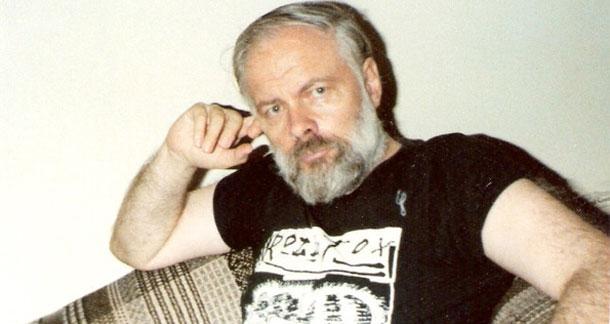
philip-k-dick-primer

I love this man.

Philip K. Dick is fast carving out a very special place in my brain. I went on an expedition through his work after rewatching Blade Runner a couple of weeks ago. I have moved through three of his novels in the past couple of weeks, and each one is extraordinary. He went through a lot of his life very poor because, despite his prodigious output, he had trouble making money because critics relegated him to the genre fiction backwater. His catalog is overwhelmingly genre fiction, undoubtedly and unapologetically. What is important though is that this man always, always swung for the fences. It’s like he couldn’t help it. The characters might be lopsided, the plot might have pacing issues, and the setting might be overly lurid or unbalanced, but every one of his novels ends with you questioning existence, reality, and your conception of yourself. I have been a committed atheist for half my life, and one of his books had me (briefly) seriously considering the benefits of Gnostic Christianity. His writing is that powerful – while other books might explore what the problem is, his has you worrying over what “what” even signifies. I will take a sloppy book that asks what existence is any day over a perfectly-balanced artifact of a book that explores the problems of one neurotic family whose daddy didn’t give out enough love (I will never stop hating you, The Corrections).

Andrew Findlay has strong opinions about things (mostly literature) and will share them with you loudly and confidently. You can email him at afindlay.recess@gmail.com.
Images: Lit Reactor and IGN

Major Issues: Head Lopper #1 and What We Talk About When We Talk About Lopping Heads

Screen_20Shot_202013-05-16_20at_201.40.08_20PM_original.png

In Major Issues, we look at one newly released comic book each week. Updated Fridays.

Gardner Mounce

Head Lopper: Issue 1
Written and Illustrated by Andrew Maclean
Colors by Mike Spicer
Self-Published
Release: 7/9/14

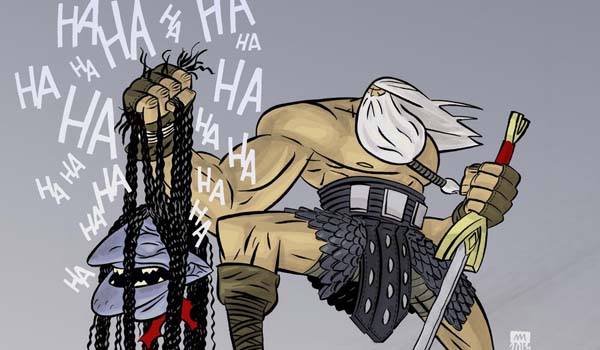
Comic books are stuffed with “Badasses.” These are characters so “Awesome” they encroach upon the “Mythic.” These are the characters who, in the first scene, catch a flying fist to the astonishment of a gathered crowd. These are the characters who lie sleepless on motel mattresses, hardly aware of the lusty nude figures curled against them. These are the characters who barely keep cigarettes tucked into mouth corners. Whose silhouettes can be seen in a screen of smoke. Who don’t have pasts until issue four (The Past Issue), when it’s revealed that everyone they’ve ever met died in a car accident. These are the characters who have clipped, masculine conversations with clipped, masculine men of any race. Who command presence. Who walk unafraid down the middle of dark echoey streets. Who splash water on their faces. Who reveal weapons just long enough for their assailants to say, “Oh, shit.” Who stand in a circle of assailants, allowing the tension to build with the knuckle-cracking and the jeering. Who then attack every assailant with every limb all at once, and somehow even use the assailants’ limbs against them. Who then stand in the epicenter of all that violence and hurt and look off somewhere else, to some new fight, to some new arena in which they can prove themselves again.

The badass myth speaks to a desire that (some/most/all) men have to be validated for physical strength and cool detachment. Something that most comic book readers are not known for, if you can even believe that. The desire runs deep. That means that the badass myth, however played out it is, will be here as long as men reading comic books are. The flip side is that so will parodies (thank god).

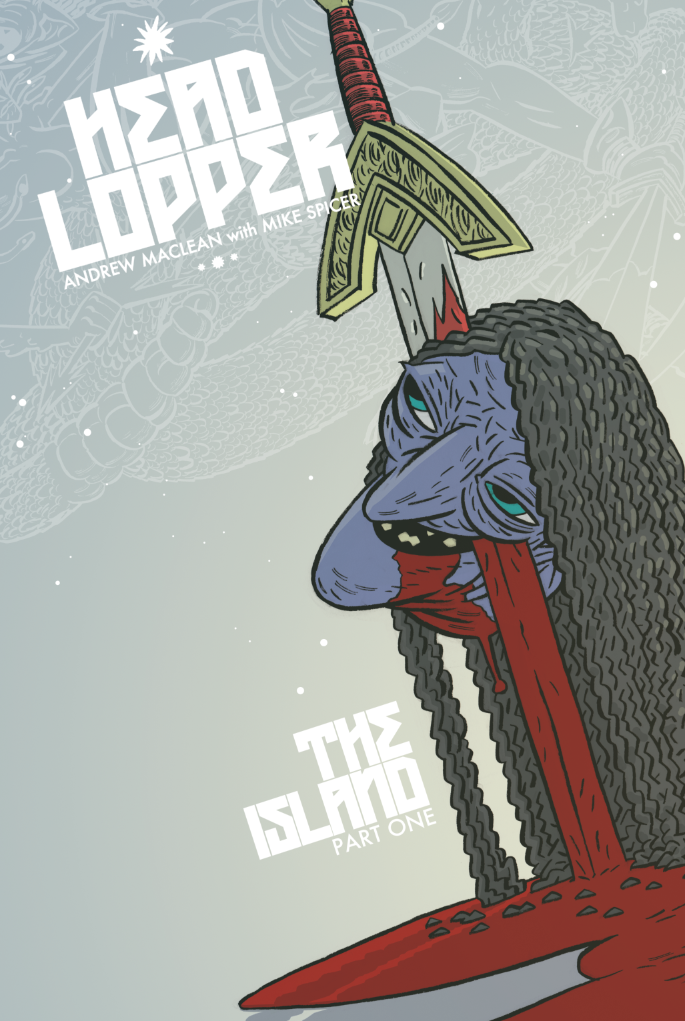
Head Lopper is one such parody. This self-described tongue-in-cheek “sword and monsters” comic is the story of a nomadic warrior, Norgal, and his unlikely companion, the severed head of Agatha the Blue Witch, who arrive on the Isle of Barra to slay a sea serpent. The promise of this series is lots of cartoon violence that toys with (and hopefully subverts) badass tropes and Nordic mythology.

Most of the tongue-in-cheekiness is carried by the art and dialogue and not the narration. There is hardly any narration, which is a good thing, since narration would have slowed down all the fun to be had lopping heads. A steady narrator would have also invited unnecessary backstory to a two-dimensional archetypal character who needs none. The Head Lopper is the Head Lopper is the Head Lopper. Who is the Head Lopper? The One Who Lops Heads. Anything more would run counter-purpose to the comic’s hack-and-slash readability. The story translates well visually, and the only major flaw in the writing in this issue is the dialogue. It never establishes a steady tone and see-saws between unpracticed “medieval speak” (people tend to say “indeed”) and the tongue-in-cheek modern dialogue that better suits it.

The art is simple, clean, and colorful. Maclean delivers wonderfully cinematic aspect-to-aspect panels that either establish setting and mood or cleverly show the passage of time and the silence between one head lopping and the next. Spicer’s colors really make this thing stand apart. He establishes a cool blue-green-gray-purple world and then tactfully splashes hot oranges and torrents of red to ratchet up the action. Characters are drawn in a simplified way, suggesting their archetypal, mythical roots–these are the symbols of masculinity.

Hopefully, in future issues, Maclean will make more use of his source material and give us something even more fun and subversive. Though there’s no guarantee, because as Maclean says, this is a sword and monsters comic–nothing more. True, it’s badass mythology, and played out, but what sets Head Lopper apart from the literally thousands of other comics of the brawn genre is that it doesn’t take itself too seriously. There are a thousand writers of badass stories out there, but very few who allow themselves to have a little fun with it.

header.jpg

Should you get it?

I wouldn’t recommend this comic to someone new to the art form. This is more for seasoned comic book fans who want a nice break from all the up-their-own-asses badassery. Plus, it never hurts to support a talented self-published writer/artist. Get Issue 1 at the publisher’s site or from digital comic stores like Comixology for $1.99.

Gardner Mounce is a writer, speaker, listener, husband, wife, truck driver, detective, liar. When asked to describe himself in three words, Gardner Mounce says: humble, humble, God-sent. You can find him at gardnermounce.tumblr.com or email him at gmounce611@gmail.com