Major Issues: Low #1

LowCover

In Major Issues, we look at one newly-released comic book each week. Now updated Mondays.

Gardner Mounce

Low #1
Written by Rick Remender
Art by Greg Tocchini
Published by Image Comics
Publication Date: 7/30/14

Louis C.K. has a great joke about telling his daughter that in millions of years, once she and everyone she knows is dead, the sun will explode and kill everyone on earth. There’s not much of a punchline other than the fact itself, and finding it funny might be the litmus test for whether or not you’d enjoy Rick Remender’s latest series Low, a story about humanity’s last ditch effort to escape an expanding sun by living in cities beneath the ocean surface. Remender–always the pessimist–says it’s a story about optimism. We’ll see.

Unlike Remender’s other currently-running series, Black Science, a no-holds-barred sci-fi story that is supposedly written without a plan, Low promises something more classic and structured. There’s a clearly defined ticking clock (the sun is expanding) and even some mustache-twirling bad guys. We meet Johl, his wife Stel, and their two children. They are descendants of the Caine family, a founding family of the underwater cities. In this issue, Johl and Stel take their two children out of the city for the first time and run into trouble with underwater savages.

Remender paces the first issue well, but flounders with the exposition. He mostly avoids his trademark pessimistic narration, and opts instead to stuff his characters with exposition-heavy dialogue. In the first scene, Johl and Stel have one very stilted post-coitus conversation about plot points. But thanks to artist Greg Tocchini’s ability to draw realistic body language, we pick up that the two are very much in love. They just don’t have a lot to talk about besides exposition.

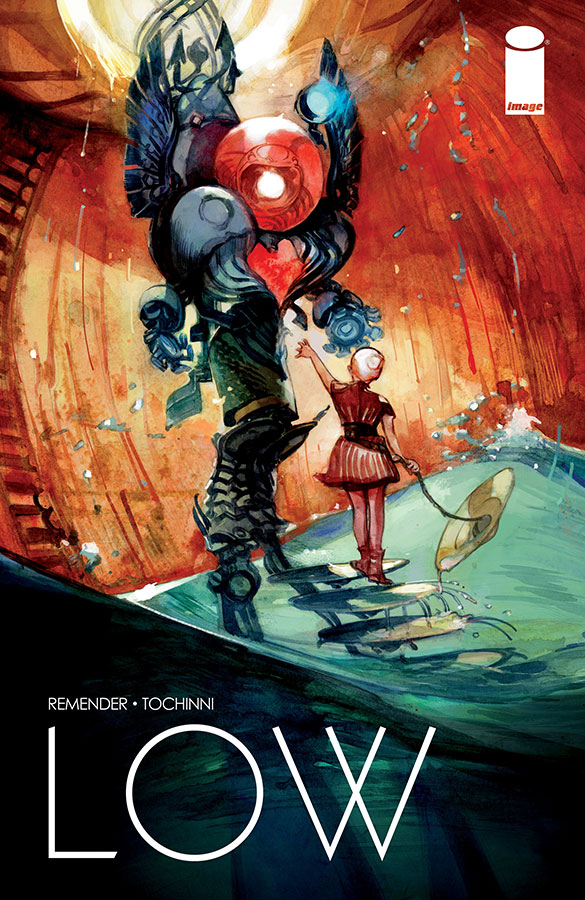
As for the art, Tocchini creates a visual vocabulary out of Low’s underwater aesthetic, especially in his use of spheres and circles. Not only are some of the panels themselves circular, but so are many aspects of the city’s architecture, and much of the technology is spherically designed. The spheres suggest air bubbles rising from oxygen tanks, the glass bubble that encases the city, the sun and the earth, and serves to indicate how fragile spherical things are in general.

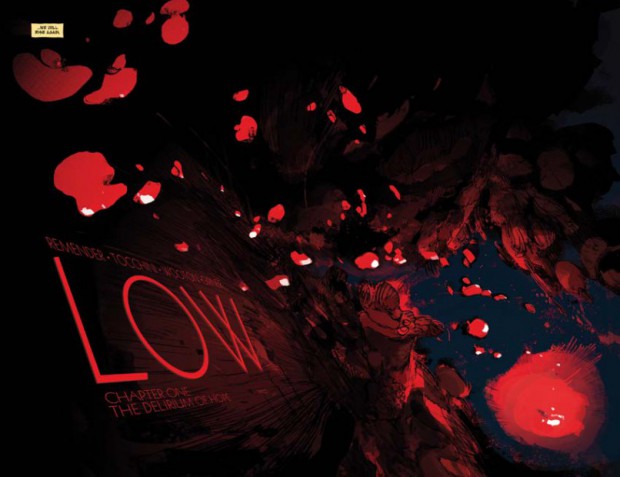
Even better is Tocchini’s way of suggesting the central conflict with the color palette. The two-page title page separates the world into burning red and absolute black–the polarizing forces of the burning sun above and the crushing ocean depths below.
Low-001-003-e1406846459126.jpg

Between these two extremes is where our characters live, in warm amber and deep jade–suggesting human warmth and the more habitable ocean depths, but also suggesting how sandwiched our protagonists are between destruction above and oblivion below.
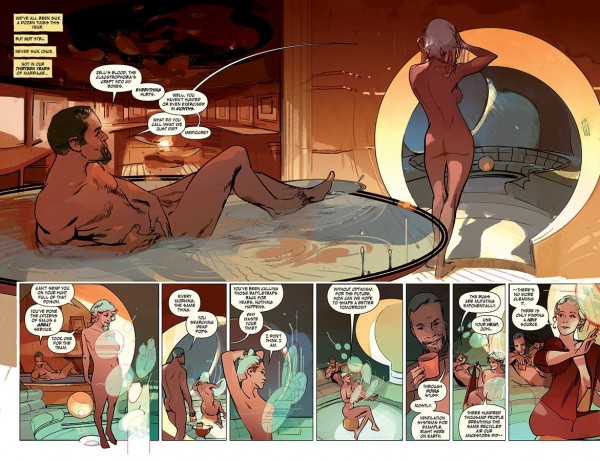
image2-600x461.jpg

Like most of Remender’s comics, I’m more excited by the art than the writing. Even in a comic about earth’s inevitable destruction, Remender’s writing comes off as heavy-handed. However, as long as he keeps pairing himself with artists like Tocchini who can add nuance and layers of meaning, I’ll keep coming back for more.

Should You Get It?

You could probably wait until the trade paperback of the first story arc. If you’re new to Rick Remender, I’d skip this and check out his series Deadly Class. It’s the best thing he’s got going right now.

Gardner Mounce is a writer, speaker, listener, husband, wife, truck driver, detective, liar. When asked to describe himself in three words, Gardner Mounce says: humble, humble, God-sent. You can find him at gardnermounce.tumblr.com or email him at gmounce611@gmail.com 
Song of the Summer? Caribou’s “Can’t Do Without You”

“Can’t Do Without You” by Caribou 

Jonathan May

My quest for the perfect summer song has taken me through many genres. This track, by Canadian recording artist Caribou (the moniker of Dan Snaith), probably best fits in the dance genre, although it’s much quieter than any traditional dance floor track. The full album Our Love will be out this October; the artist released this song online in June of this year.

I was initially taken aback by the song’s simplicity. Though it adds layers and volume as it progresses, the track centers on the simple lyrics “I can’t do without you,” which captures a quiet emotional center around which the song revolves. The powerful statement “I can’t do without you” obviously holds two meanings: one, that the speaker can’t survive without the addressee, and two, that the speaker can’t perform in any sense of the infinitive without the addressee.

The song’s musicality is ultimately a result of the piling on of various layered dance elements, but the slow build with which they’re constructed really captures a summertime mood. What begins as a quiet emotional statement takes on synthesized development and percussive strength as it swells; ultimately the song’s various elements accrete into something that verges on the electronic-epiphanic before fading into silence. I appreciate the song’s singular focus and its formulaic progression because they give familiarity to a feeling that can often be ambiguous. Whether the listener empathizes or not, the song still makes a beautiful statement, perfect for a summer afternoon with someone dear.

Jonathan May watches too much television, but he’s just playing catch-up from a childhood spent in Zimbabwe. You can read his poetry at owenmay.com, follow him on Twitter at @jonowenmay, or email him at owen.may@gmail.com

Life After the Star Wars Expanded Universe: Philip K. Dick’s The Man in the High Castle

The_Man_in_the_High_Castle

Andrew Findlay

In Life After the Star Wars Expanded Universe, we take a look at science fiction and fantasy, why they’re great, and what they say about where our species has been and where it’s going. 

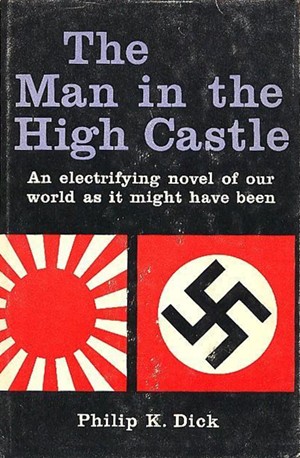
Alternate histories are a strong subgenre within SF. They have been around forever. If you really want to stretch it, technically Livy wrote a hypothetical consideration of what would have happened if Alexander the Great had moved West towards Rome instead of conquering the East. He says Rome would have won, but I mean, his name was Titus Livius Patavinus, so. In 1490, the chivalric novel Tirant lo Blanch postulated a history in which the Turks never took Constantinople. 1953’s Bring the Jubilee told a story in which the Confederacy won the Civil War. There is an absurd amount of alt-history books out there, but few are as famous as The Man in the High Castle.

This type of fiction starts out by finding a historical pressure point one, two, ten decades ago, flipping what happened, then exploring the ramifications of the strange new world thus created. Here, the pressure point is Giussepe Zangara’s attempt to assassinate President-elect FDR. In The Man in the High Castle, he is successful. His VP takes over, does a bad job, and is replaced by a Republican president who fails to surmount the Great Depression and maintains the USA’s isolationist policies. The end result of all this is that Russia is conquered in ’41, England cannot stand alone against Germany and falls, and then the complete destruction of the Pacific fleet at Pearl Harbor makes America easy pickings. At the start of the novel, Germany controls the east of the United States, Japan controls the west, and the mountain and southwestern states form an autonomous American buffer zone between the two.

Touching a pressure point in history, like touching a pressure point in the body, sets off reactions far from the initial point of contact. The Nazis, their ideology unchecked by defeat, continue in their insane belief in a master race. This obscene self-confidence coupled with German technological prowess leads to the colonization of other planets. It also leads to Nazis hunting Jewish people all over the world and shipping them back to Berlin, and Nazi scientists spearheading a vaguely-referenced experiment in Africa that leads to the extermination of most of its populace. Again – the center of SF is extrapolation, and PKD extrapolates the Nazi dynamic of world-changing scientific progress built on human misery and their inhumanity to their fellow man. Same pattern, wider oscillation. As a brief aside on German technological prowess, NASA probably would not be what it is today without Wernher von Braun, who created the rocket booster system that put Neil and Buzz on the moon. He did the same kind of rocketry work for the Nazis, only it was weaponized as the V-2 rocket. Von Braun has always maintained he just wanted to work on rockets and had to join the Nazis to do so, and is reported as saying, upon hearing the news of the first successful V-2 bombing of London, “The rocket worked perfectly except for landing on the wrong planet.” This self-serving attitude and the avoidance of responsibility by wrapping himself in idealism (these rockets were built with slave labor) is beautifully satirized by Mort Sahl, the first modern stand-up comedian. The following joke is pretty much the whole reason for this aside, as it is one of the best I’ve ever heard: “I aim at the stars, but sometimes I hit London.”

Out west, the Japanese are comparatively benevolent colonizers. Throughout the Pacific states, the Japanese run things, but tend to be more lenient than their Nazi counterparts. Western Americans absorb much of the culture of their colonizers, including using the I Ching and adapting to Japanese systems of social advancement and behavior.

The first major plot concerns an intrigue between German and Japanese representatives to one-up each other. The Germans want to be the sole superpower in the world, and are covertly maneuvering against Japan. The Japanese are covertly maneuvering against Germany to defend themselves. The second major plot thread is that an author who lives in a fortress in the Rocky Mountain States (the High Castle) has written a book titled The Grasshopper Lies Heavy which is a piece of alternate history fiction that explores what might have happened if America had entered the war and the Nazis had been crushed. This book is very popular underground, and a couple of the characters decide to take a road trip to meet the man behind it.

Speaking of characters, most of these are cardboard-flat. In many of his books, PKD puts just enough in his characters to make them move around realistically, then lets them go. I still can’t decide if this means PKD is a master of simplicity, or if characterization is just not his strong suit.

There is a reason this is arguably PKD’s most acclaimed book. Sure, the characters might be stick figures, but the world they move around in is unsettlingly plausible and well-built. Americans grow up with “we are the greatest/we’re number one” hammered into their heads. Our President is regularly referred to (by us, anyway) as the leader of the free world. Even if you take Eddie Izzard’s joke about there being a lot of countries, none of whose mottos are “We’re #2!”, to heart, the USA still has an unparalleled level of power and influence in the modern world. Therefore, reading a book in which America is weak, colonized, subjugated by and dependent upon foreign powers creates a deeply personal sense of horror in the American psyche. The adeptness with which PKD constructs and directs this sense of horror makes this book well worth your time.

Andrew Findlay has strong opinions about things (mostly literature) and will share them with you loudly and confidently. You can email him at afindlay.recess@gmail.com.

Tough Questions: What’s the Most You’ve Ever Eaten in One Sitting?

question-mark

Every week we ask everyone who hangs out around here to answer a tough question. This week:

What’s the most you’ve ever eaten in one sitting?

Rules are simple: how much is too much, but still not enough? When did you let yourself go on purpose? What the hell is wrong with you, grosso?

Alex Russell

I’ve already talked about competitive ice cream contests and I’ll never get into the time we had a ramen eating contest (do not do this), but mine has to be at goddamned Cheeburger Cheeburger. I was in my early 20s — that’s when everything dumb happens in your life I hope — and I had totally forgotten that I’d agreed to go to an eating contest at a burger place. They had some dumb thing where you eat a full pound burger and get your name on the wall. I forgot, so I had a huge meal. I ate mashed potatoes and meatloaf and felt that kind of awful/good full… and then I got a call reminding me to go to this burger place. I showed up and death marched through a full burger. My time was pitiful, but I did it. There’s a picture of me on the last bites staring into the camera/the abyss, and you can see the folly of human experience all over my face. Never underestimate the importance of the unimportant to someone in their early 20s.

Jonathan May

Memphis has a Texas de Brazil restaurant located downtown; for those unfamiliar with the concept, you basically are given a plate to load up on the salad bar and accoutrements, leaving some room for meat. When you saunter back to the table, a small circle, flipped either on green on one side or red on the other, indicates whether you are ready for meat service (which could be a gay punk band’s name). Then, waiters come around with skewers of garlic-roasted sirloin, pork chops, filet mignon, you name it. And then, plate full, you go to town. Now, it’s a bit pricey, so my family goes just a few times a year. But when we do, I deliberately eat a ton the day beforehand to enlarge my stomach, followed by nothing the day of to really get the hunger going. I can safely say I’ve eaten about five pounds of steak in one sitting, with no exaggeration. I’m no competitive eater or anything, but when I’m there, surrounded by the finest of Memphis’ tourist crowd, my stomach is a limitless plane of existence, capable of consuming all before it. The eventual food coma follows, coupled with remorse.

Brent Hopkins

The most I have ever eaten in a sitting would be two large pizzas. I was having one of those gaming binges and hadn’t eaten in awhile, so I just went to town. I am not sure how I put all of that cheese and crust away, but I did. I also promptly got sick and threw up sauce, but I did manage to get them both down in one go. I would say this was one of my greater “not proud” moments.

Andrew Findlay

There are probably a few dozen tie answers to this question in my life, but one that stands out is high school, Red Sun China Buffet. The same extremely competitive person that rage-ate a Vermonster challenged me to an all-you-can-eat buffet contest. This led to a piling-in of variously fried chickens, beefs, and noodles. I can’t remember exactly what I got to, but whatever it was, it wasn’t pleasant. I want to say about five or six entirely full, grease-laden plates. She only got to one plate below me. I mostly just didn’t want to move for the rest of the day, but something I will never forget is that, after she drove us back to her house, she fell out of her car and rolled around on her front lawn for a little bit, screaming due to the stomach pain she caused herself through hubris. She knows who she is, and if she is reading this today, I would like to share a message with her:

Gardner Mounce

I love to eat, but I’ve never been able to achieve legendary feats of stuffing myself, except as a teenager when it was normal for me to come home from school and eat two bags of Cheetos Puffs in one sitting. I didn’t do this all the time, but even doing it one time is disgusting in retrospect. And not because I don’t like Cheetos–because I do. Eating two bags isn’t even all that much food, but just look at the calories: 3,150 per bag. I had two bags. That’s 6,300 calories, or three times the amount of calories the average human should eat in a day, and 6,000 times the amount of shame any human should have to endure.

Colton Royle

In Mexico, in Aguas Calientes I believe, there is a little taco restaurant called Jugo’s. You can have “inside” tacos (beef and avocado), or “outside” tacos (chicken and onions). I had 15 inside tacos. This sounds like a lot until I looked over and saw my friend Hunter after he had pounded away 31 outside tacos. It all became this big competition each year and things got out of hand. Guppies.

Worst Best Picture: Is You Can’t Take It With You Better or Worse Than Crash?

you-cant-take-it-with-you-dinner2

Alex Russell

In “Worst Best Picture” we search every single Best Picture Oscar winner of all time from 1927 to present to uncover the worst of them all. Conventional wisdom says that 2005’s winner Crash is the worst winner in history. We won’t stop until we’ve tested every last one. Read the the first, our review of Crash, here. Posts will be relatively spoiler free, but there may be some details revealed. Today’s installment is the 1938 winner You Can’t Take It With You. Is it better than Crash?

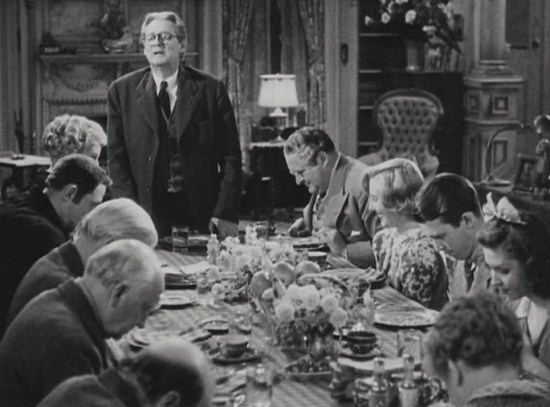
Frank Capra directed two movies that won Best Picture. One of them, It Happened One Night, is one of the greatest love stories ever told. The other one is You Can’t Take It With You, and it’s a goddamned mess.

It’s supposed to be a romantic comedy about how money isn’t everything. The title comes from the idea that it doesn’t matter how much money you’ve got because, of course, “you can’t take it with you.” Sure, okay, I get that. It’s all about what you are inside, man. Everybody love everybody.

It is that, but it’s a lot of other things, too. Jimmy Stewart (who is barely in this damn thing) loves a girl from a weird family. His family needs her family to sell their house so his family can expand and keep making sprockets or whatever. It’s very The Lorax. There are no shades of gray. The good guys are wacky and don’t want to sell, the bad guys are stuffy and need them to sell. There’s your Romeo and Juliet love story set up, but it basically doesn’t matter.

It’s almost unbelievable how little of this movie is about the central love story. It’s the driving force for everything, but it fades away as the two patriarchs turn the movie into a spirited debate about if money and status matter or not. The rich guy can’t believe he has to talk to these silly people, which sounds pretty standard for a story like this, but…

I really have to point out how far this movie goes to remind the viewer that the poor family is “strange.” The entire movie rests on the viewer understanding the conflict between greed and contentedness, but it’s absurd how far they go to explain this. At first it all makes sense. The family argues with the IRS over income tax, which is fine. Then they… make unlicensed fireworks and set them off all over their house in the middle of the city. Okay, cool, 1938. Whatever you say. I guess that’s a thing now. Then, a man in a silly mask runs up from the basement to scare the police so they can go back to their xylophone song.

You Can’t Take It With You is off the rails from the very first scene. The absurdity is ticked up to 11 early, so it has nowhere to go to get crazier when it wants to. As a result, nothing ever matters more or less than anything else. People behave like lunatics, it’s really close to Duck Soup levels of silliness. The plot is fine and a few of the performances are well done, but this is a really silly movie, even beyond the parts that need to be silly to drive the plot.

The Best Part: The IRS scene is pretty great. A straight-laced IRS agent yells at a family playing the xylophone about income tax for five minutes. It feels like a Mr. Show sketch.

The Worst Part: The craziness is too crazy in general, but when a cop tells an old man “you’re playing Boogeyman, eh?” because he has a silly mask on for no reason, you start to wonder how this whole damn thing was allowed to happen. It’s not a bad movie, but it’s out of control.

Is It Better or Worse than CrashBoth movies have big “lessons.” You Can’t Take It With You has a big courtroom scene to explain itself. Crash has a car crash. Neither movie is really very good at getting below the surface (racism bad, money bad, got it) but You Can’t Take It With You is really trying. I don’t think you can fix Crash, but you could fix You Can’t Take It With You with more love story and less… xylophone.

Worst Best Picture Archives: Crash | Terms of Endearment | Forrest Gump | All About Eve | The Apartment | No Country for Old Men | Gentleman’s Agreement |12 Years a SlaveThe Last Emperor | The Silence of the Lambs | The Artist | A Man for All Seasons | Platoon | The Lord of the Rings: The Return of the King | The King’s Speech | Rain Man | The Departed | The Bridge on the River Kwai | Marty | Gigi | It Happened One Night | Driving Miss Daisy | Shakespeare in Love | Wings | Midnight Cowboy | Rocky | Gone with the Wind| Chicago | Gladiator | Cavalcade | The Greatest Show on Earth |

Alex Russell lives in Chicago and is set in his ways. Disagree with him about anything at readingatrecess@gmail.com or on Twitter at @alexbad.

Image: Screen Insults

Song of the Summer? Disclosure – Latch

Jonathan May

Disclosure – “Latch”
PMR Records

On my quest for the perfect summer song, I seem to have stumbled back in time, or so my radio would have me believe. Though the song came out from British dance-pop band Disclosure in 2012, it didn’t really quite make the charts on our side of the pond until it was used in So You Think You Can Dance during a routine, after which point it sky-rocketed into hourly rotation on the pop stations. The song itself is incredibly simple, built on a tale of enrapture within desire. The accompanying video reinforces the lyrical motifs by drawing pairs of lovers into constructed tableaux of lights, water, and ample second-base. We’re given two straight and one lesbian pairs, which added at least some shade of variety. However, the variety ends there.

The song has all the potential for a summer hit. It’s dance-y, easy to sing the chorus, and has a hip, sexy video. So why am I on the fence? We’re given nothing outside a world of pure desire. I understand the song has a particular focus (most do), but the exact representation of the subject matter displayed so matter-of-factly within the video eliminated the possibility of any tension. It’s definitely more of a radio song than an “experience” in any way, which is 100% fine with me. I expect little of pop music these days, and this song certainly holds more aural pull than most. The chorus (“Now I’ve got you in my space/I won’t let go of you/Got you shackled in my embrace/I’m latching on to you”) at least has some erotic edge even. Given the general ennui assigned BDSM these days (due to 50 Shades and the like), it’s nice that at least musically we are given something restrained (no pun intended) and simple that’s not vulgar. While this doesn’t reinvent the love song, the song deserves some volume this summer on a slinky night.

Jonathan May watches too much television, but he’s just playing catch-up from a childhood spent in Zimbabwe. You can read his poetry at owenmay.com, follow him on Twitter at @jonowenmay, or email him at owen.may@gmail.com

Worst Best Picture: Is The Greatest Show on Earth Better or Worse Than Crash?

greatestshow_2149879i

Alex Russell

In “Worst Best Picture” we search every single Best Picture Oscar winner of all time from 1927 to present to uncover the worst of them all. Conventional wisdom says that 2005’s winner Crash is the worst winner in history. We won’t stop until we’ve tested every last one. Read the the first, our review of Crash, here. Posts will be relatively spoiler free, but there may be some details revealed. Today’s installment is the 1952 winner The Greatest Show on Earth. Is it better than Crash?

People hate this movie. It constantly makes lists of worst Best Picture winners. I read a lot of the worst lists to inform my own journey through these movies and man people hate the circus epic The Greatest Show on Earth. Is it really all that bad?

Let’s get this out of the way first: this is not a very good movie. It feels 20 or 30 years older than it actually is, mostly because no one edited it at all. You could cut more than half of the movie out and still be left with a full story. It’s a circus story, but it’s far too in love with the pageantry of the circus itself. “Murder your darlings” they say, but like the worst Tarantino movies (looking at you, 40-minute diner scene in Death Proof) this just goes on and on.

It’s supposed to be a love triangle. Brad (Charlton Heston, before he became a lunatic) doesn’t have time for love. He’s too busy running the business end of the circus to notice that his girl Holly (Betty Hutton) is in love with the new trapeze guy The Great Sebastian (Cornel Wilde, who gives a pretty awful performance). The German elephant trainer Klaus (Lyle Bettger) — what else could he have been named in 1952, I guess — is also in love with Angel (Gloria Grahame), but Angel has no time for him. Everyone falls in and out of love with each other for various reasons. That’s supposed to be what this is about.

It’s not, though, because director Cecil B. DeMille fucking loves the circus. You know you’re gonna get some circus when you watch a movie called The Greatest Show on Earth, but at one point there’s a ten minute scene of people taking down a circus tent, complete with narration about “the giant’s skin coming down.” It’s a quasi-documentary about circus life, and it’s straight up boring. The love stories aren’t enough to make a great movie, but the documentary elements aren’t really anything at all. They wouldn’t be out of place on a nature show from 40 years ago. They’re goddamned terrible, and they’re shoehorned in between every scene.

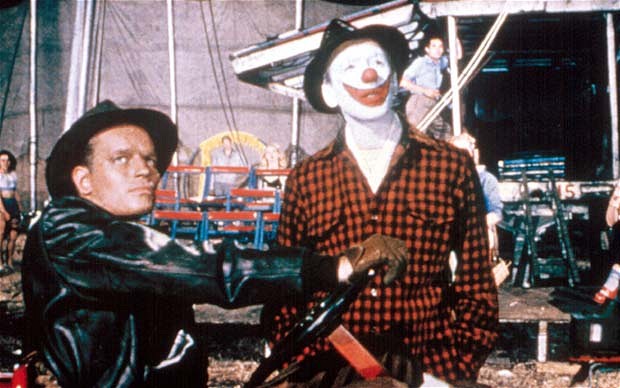
Jimmy Stewart is also in this weird damn movie as Buttons the clown. Buttons is a doctor who mercy killed his terminally ill wife, and now he’s hiding out in greasepaint at the circus. It’s really an interesting idea, especially in the non-digital world of 1952, and the movie deals with it far too rarely.

The biggest problem is that it’s just plain boring. It’s far too long and the good parts are few and far between. Most of the performances — outside of Charlton Heston’s cartoonishly “serious” Brad and Cornel Wilde’s “how much are you paying me again” The Great Sebastian — are fine. The problem here is that no one ever asked the question “is 90 minutes of circus footage too much?” It really, really is, but in a world that includes some truly awful movies with Best Picture on their DVD box, you shouldn’t hate The Greatest Show on Earth. You just shouldn’t watch it, either.

The Best Part: Jimmy Stewart gets a lot of love for his portrayal of Buttons. Most of the blurbs about this movie on other lists basically say “it sucks, but Buttons is interesting.” I think that’s a fine summary, but I really enjoyed Gloria Grahame’s character, Angel. She’s almost murdered by an elephant at one point. How do you play “almost murdered by an elephant?” I’d say she’s set the gold standard.

The Worst Part: The ending is outrageously stupid, but this is the spot where we need to talk about this train scene. Steven Spielberg is on the record saying that the climactic train wreck in The Greatest Show on Earth (stop it with the *spoilers*, you weren’t going to watch this, were you?) was a huge influence on him. It’s true that it was a technological marvel at the time, but it’s really funny to watch the toy train scene now. If you want a worst part that doesn’t have to do with how the movie has aged, go with that stupid damn ending. Motivations like “I love you because the movie is over” are a sign you’re watching something dumb.

Is It Better or Worse than Crash? There’s no discussion of race at all in The Greatest Show on Earth. The only black people in the entire movie are in the crew that sets up the circus tent. But there is a comparison between the two that has nothing to do with race. Both movies are full-on hamfisted. They’re both trying to do something (talk about racism and show a love for the circus) and neither one does a great job of anything else. The problem with one movie is the problem with the other; both movies eschew interesting characters and pacing for “message.” Racism bad, circus good. Both movies are failures because their components don’t support the bigger message, they just fall down like a BAD CIRCUS TENT I HATE THAT I MADE THAT JOKE.

Worst Best Picture Archives: Crash | Terms of Endearment | Forrest Gump | All About Eve | The Apartment | No Country for Old Men | Gentleman’s Agreement |12 Years a SlaveThe Last Emperor | The Silence of the Lambs | The Artist | A Man for All Seasons | Platoon | The Lord of the Rings: The Return of the King | The King’s Speech | Rain Man | The Departed | The Bridge on the River Kwai | Marty | Gigi | It Happened One Night | Driving Miss Daisy | Shakespeare in Love | Wings | Midnight Cowboy | Rocky | Gone with the Wind| Chicago | Gladiator | Cavalcade |

Alex Russell lives in Chicago and is set in his ways. Disagree with him about anything at readingatrecess@gmail.com or on Twitter at @alexbad.

Image: Telegraph

Postmodern Rapture – The Leftovers Episode Five – Gladys

article-2654110-1EA2AAB600000578-391_634x356

Colton Royle

Every week Colton Royle discusses the newest episode of HBO’s new show about a new kind of rapture, The Leftovers. You can also read our review of the book the show is based on.

Spoilers on this ride.

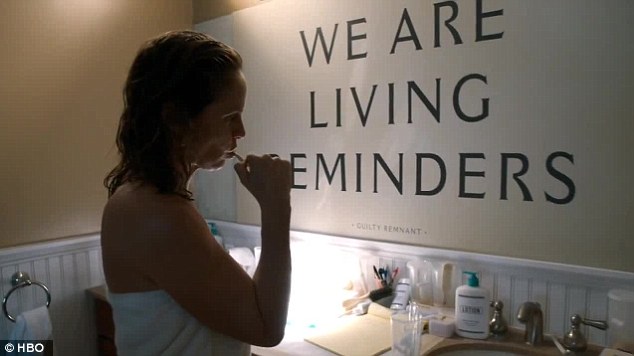
Alright, so another episode that starts violently and leaves the rest of our time this week in a slow grind. Gladys’s stoning could be viewed in religious terms with Matt Jamison’s of the Jesus and Thomas conversation. And there is some interesting play between fire, burning, Gladys’s cremation, and the conversation between Laurie and the Guilty Remnant leader over burning in reference to doubt. It’s more ambiguity, and that could be cool, someday.

But is anyone really surprised at the character shifts in this episode? Laurie doubles down in the cult, right after doubting everything, and this after divorce papers are presented. Matt tries harder to invade people’s lives. Liv Tyler decides to join, for real. And Kevin cries into a pillow after yet another existential night episode. It’s not like we weren’t prepared for this.

What we really weren’t prepared for was an offer for Kevin told over the phone to remove the Guilty Remnant from the face of the Earth. Kevin doesn’t talk much, but we can barely hear the other line. A show cannot have both sides of the call with neither making sense, and it played like a bad take. Don’t try good storytelling by making key information obscure.

Kind of like having someone writing, “Neill” on a “doggy bag” and placing it in front of a house without any foreshadowing or directorial stunt pilot maneuvers. I supposed we’re meant to wait until the big reveal episode some time later when we go, “Wow, I had no idea that was Neill,” but just leaving fragments of a story like batons to be picked up later is not a good way to write. In fact, whether it involves way-too-quick flashes in a psychologist session with Kevin, horrifically slow panic attacks with Laurie,  fire nerf gun peer pressures with Jill, or paper bags, most directorial moves on The Leftovers feels intense without earning it. People say things like that all the time, but I mean it: it’s literally impossible to feel their sadness. The people are gone, and it’s been three years.

Okay, so, real quick, more parallels to lack of family ties. Nora and Matt are obviously not having it. Kevin and Laurie getting a divorce, Liv Tyler belongs to no one, Jill will not hug her father while he is in post-drinking sad times. Gladys had no family to mourn for her violent death. Tommy’s phone got broke… I GET IT.

One thing I do enjoy is the occasional dark humor. Last time it was the twins’ funny Jesus drop off, while the alarm this time going off right when he got the phone call for the agent in Washington was a nice touch.

Maybe I’m missing the point, But when I see a sneak peek of the next episode and it involves Nora holding an armed grenade in public, I feel as though someone else missed it.

Colton Royle is a reader of mostly American fiction and non-fiction. He is currently teaching in Fort Worth, Texas.

What I Did With My Summer Vacation: Bob’s Burgers

Bobs-Burgers

Alex Russell

In What I Did With My Summer Vacation we explore shows you should catch up on during TV’s slowest season. This week: how Bob’s Burgers is what Modern Family isn’t.

The Simpsons didn’t get nominated for an Emmy this year, and that’s apparently big news. I haven’t been a Simpsons watcher for some time now, but I know that it being left off the nominations list speaks to how much animation on TV has changed lately.

Bob’s Burgers is about to return to finish its fourth season (it comes back on October 5, my birthday, so thanks, Fox). The show started hemorrhaging viewers in the fourth season, so if you’ve been gone, it’s time to come back. You can’t let this one die on us. Bob’s Burgers is the only place on television that “heart” isn’t a dirty word.

Modern Family, one of the most popular shows on television, is built on the idea of “heart.” It’s a kind of The Wonder Years moral machine where someone learns a lesson and then tells it to the audience. In an episode about learning to love your gay son, Dad learns his lesson visually and then explains it through narration just before the end of the 22 minutes. It’s insulting on a colossal scale. It’s lazy and it’s infuriatingly bad television.

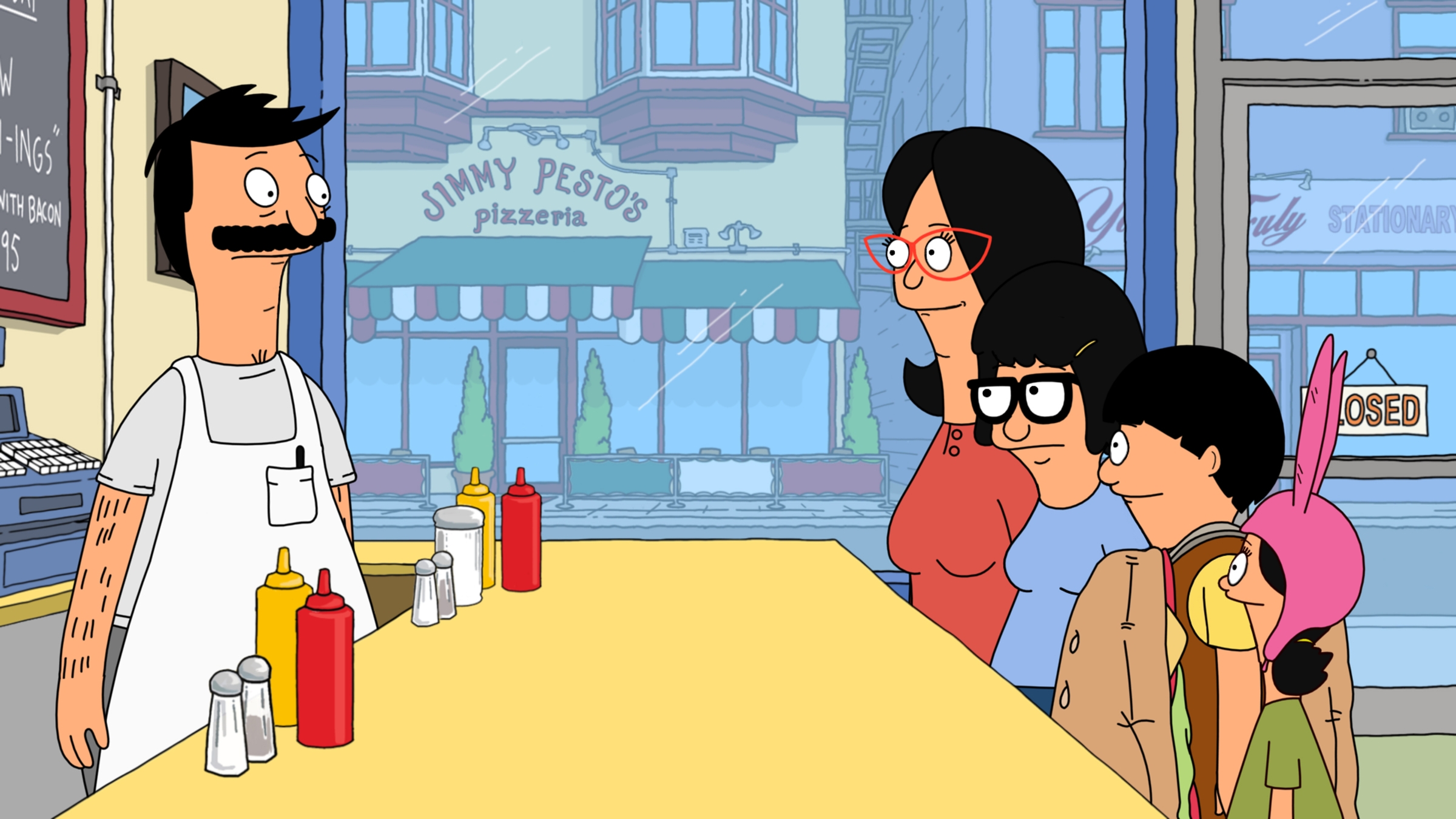
Bob’s Burgers has episodes that are also about learning things, but it has mastered “show, don’t tell.” The family in Bob’s Burgers has to learn to love each other through some pretty tough times, but they do so without turning to the camera and saying “you know, we have to learn to love each other through some pretty tough times.” It’s television, animated or no, the way it’s supposed to be.

You can read elsewhere about how the voice acting is amazing or how the music is the glue that keeps the show together. A note on that last bit, you absolutely should check out Song Exploder‘s episode about the theme song. You can read elsewhere about how it’s smart and funny and quick and worth your time. All I want you to know is that the last show on earth about being good to your family — without a garbage tagline at the end or a heartwarming guitar song — is coming back soon. Go watch the last few so you’re ready.

You can watch Bob’s Burgers on Netflix or Fox’s website or, on television, I guess. You’re so smart, you find it.

Alex Russell lives in Chicago and is set in his ways. Disagree with him about anything at readingatrecess@gmail.com or on Twitter at @alexbad.

Life After the Star Wars Expanded Universe: Bong Joon-ho’s Snowpiercer

 Snowpiercer-Movie-Poster-Chris-Evans

Andrew Findlay

In Life After the Star Wars Expanded Universe, we take a look at science fiction and fantasy, why they’re great, and what they say about where our species has been and where it’s going. 

Snowpiercer is a delightful sci-fi concept film. The concept is that, amid concerns of climate change, humanity released a relatively untested “cooling” chemical into the upper atmosphere – an anthropogenic solution for an anthropogenic problem. By the way, if you are a person who still denies that something is happening to the climate and that humanity is largely responsible for it, please leave. Even offering a counterargument to deniers is creating a semblance of rational disagreement and debate, which only serves to allow major actors to continue down a path that, unmitigated, will quite literally end the world as we know it. Many scientists are worried that there is a point of no return, and that, once we pass it, there might be a runaway greenhouse gas effect that will radically alter the makeup of the only known body in the solar system that can support human life. Current governmental response to it is insane. Not only are they not freaking out, a full 58% of Republican lawmakers – over half of one major political party – doubt that it exists. The people responsible for legislating measures that might save us aren’t doing anything because a quarter of them are idiots. As a brief aside – a lot of climate change deniers are also evolution deniers. Evolution denial is similar to climate change denial, if the consequences of denying evolution made the whole human race lose their neocortex. That’s the thing – you can deny evolution all you want, and it will change nothing. Dismissing sound climate science, or even just fostering the appearance of any debate on the issue, weakens our ability to respond, in a measured and timely fashion, to a set of circumstances that could lead to mass famine, destruction, and loss of life. I don’t get it. During the Cold War, everyone was terrified of the world ending in a nuclear holocaust. There’s an outside chance the world might end if we don’t stop freely burning fossil fuels, and about a quarter of us are responding with  “Eh, fuck it.” (25% being the rough number of people that actually deny it. Probably a lot more don’t give a shit).

In Kim Stanley Robinson’s Mars trilogy, around 2128, Mars and its citizens stood as an oppressed colony of Terran corporate interests. Martians get a fighting chance when a major humanitarian crisis strikes Earth and diverts resources from harvesting efforts on Mars to relief efforts on the homeworld – the West Antarctic Ice Sheet collapses, dooming all Terran coastal areas with slow but inexorable inundation. Robinson, writing a far-future novel in 1996, trying to think of a semi-plausible disaster for purposes of his plot, came up with that. It happened eighteen years later. If that isn’t enough to terrify you, a science-fiction author’s future apocalypse scenario coming true less than two decades after his book was published, I don’t know what is.

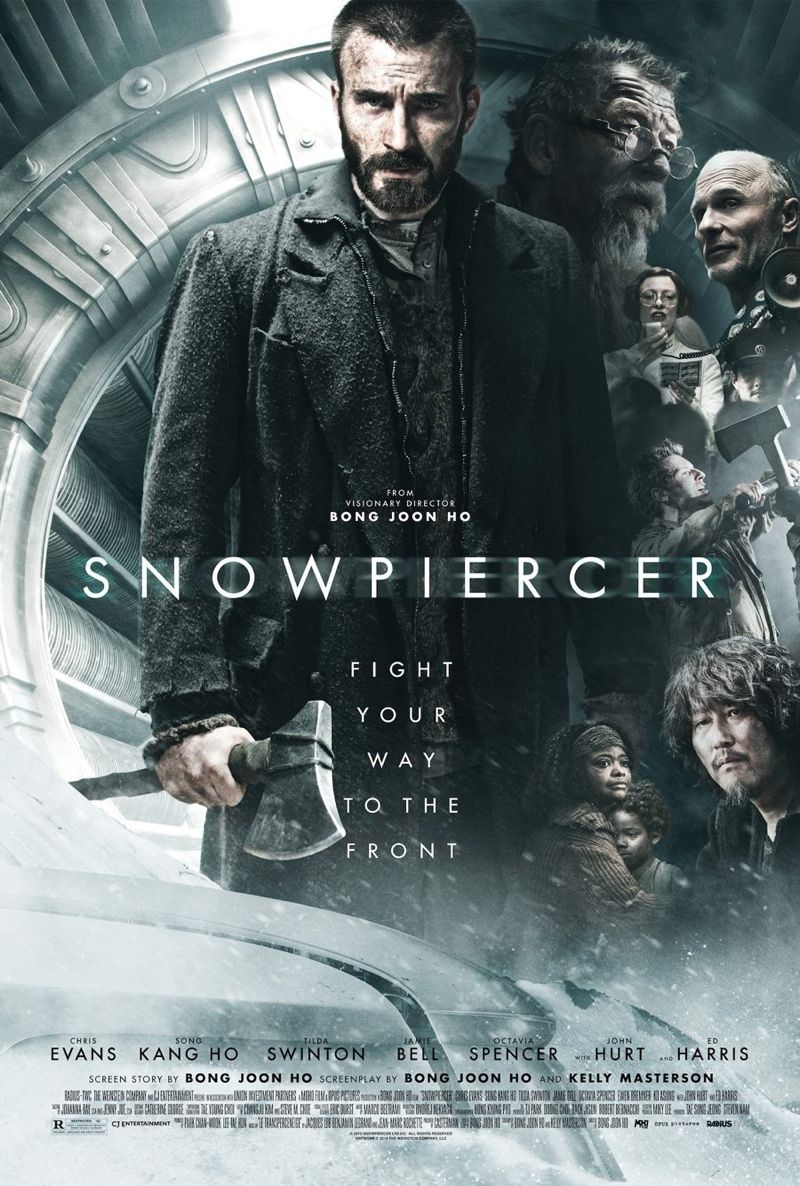
Anyway, they release this quick-fix chemical into the upper atmosphere, and the immediate consequence is that they cool the Earth to far below the threshold for sustaining an ecosystem. All life on Earth is flash-frozen, save for a small enclave on a constantly-moving train run by a perpetual motion engine. Snowpiercer is a great example of the type of science fiction that takes a real science problem from the world, extrapolates it, and then uses it as a backdrop to have Captain America beat the crap out of people. Chris Evans, of Captain America fame, plays the rebellion leader Curtis Everett. Don’t come here for that though – other than hitting people with blunt (or sharp) objects, he’s not very Captainy. This film is way too grim for that.

fan2d

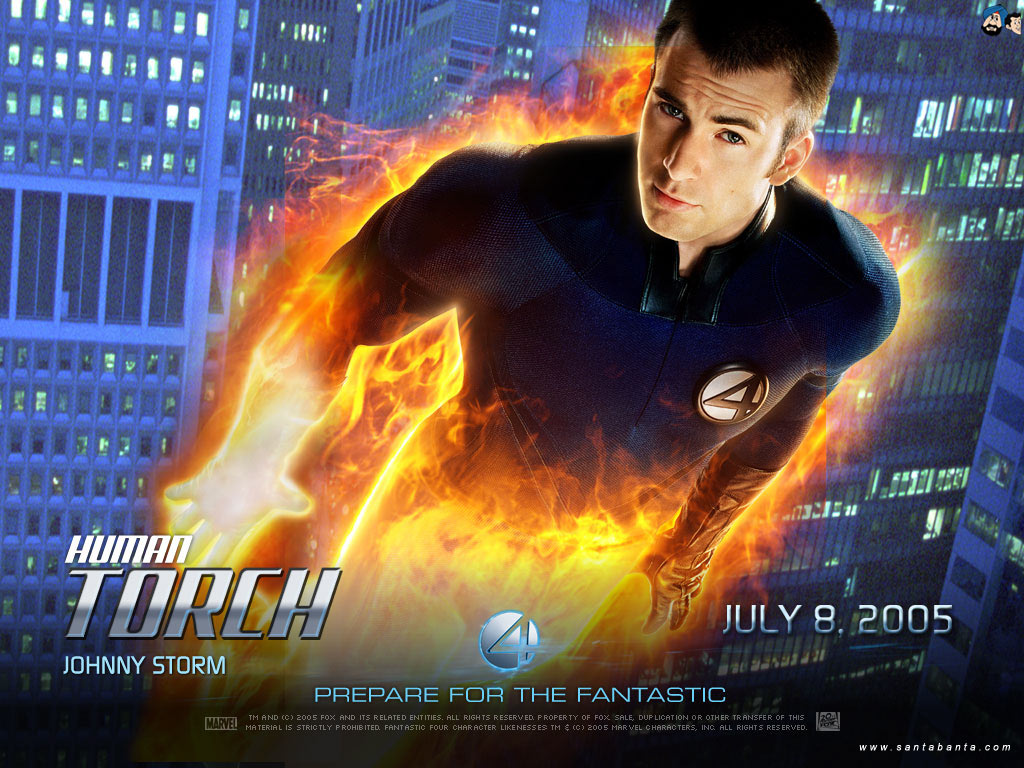
He also starred in this movie. We do not speak its name.

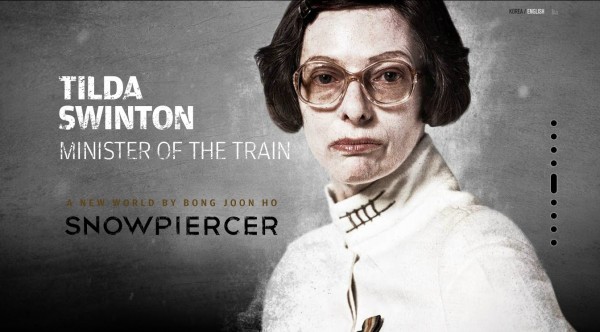
The grimness comes from the fact that on the train housing the last remnant of humanity, you have your first-class passengers, your coach passengers, and your oh-my-god-the-world-is-ending-let-me-on passengers. This last category is kept in constant poverty and misery, beaten by guards, and despoiled by the rich. They eat protein gelatin while first-classers eat steak and fish. They pile in squalid bunks while the rich lounge in private cars. The whole drive of the movie is Chris Evans’ character fomenting a rebellion, the stated purpose of which is to reach the front of the train and gain control of the engine, thus gaining control of the entire train. There is a lot of ingrained hierarchy and a lot of guards in place to keep them from doing just that. There is also a lot of propaganda, whereby the owner of the train is cast in a numinous aura of near-godliness. The lead propagandist is probably my favorite character in the film, and she is played marvelously by a ridiculous Tilda Swinton.

tilda

Oh, Tilda.

The most remarkable achievement of the film is its transformation of the vertical, metaphorical rich on top/poor on bottom dynamic into a horizontal, literal rich in front/poor in back dynamic. The protagonist and his band struggle through car after car, moving from industrial-revolution level squalor, to clean and economical, to absurdly elegant and polished. This results in visual cues signaling Curtis’ progress – the further up he gets, the nicer everything is. It is a physical diorama of oppression. Another thing the film does nicely is the action – there is plenty of gritty, bloody scuffling as they inch forward to the engine. Much of the killing is done with improvised weaponry, as the oppressed poor are of course not permitted firearms. Some of the scenes, while not nearly as cool, reminded me of the transcendental hammer hallway fight scene from Oldboy. If you have not seen Oldboy, it is on Netflix. You should probably see Oldboy. Here’s the scene I’m talking about:

This is pretty much what happens as they move through the train cars.

The movie is well worth seeing. Its idea-driven plot, its ambition, its worldbuilding, and its unique sets more than win it the right to your time. However, it does fall apart in some areas. First off, the majority of the characters are pretty simply sketched out. There’s no real change or development throughout the film. Also, the ending is one of the stupidest things I’ve ever seen. It’s fine, it’s fine – I still like the movie. But watch out for that ending. Overall, it’s nice to see small concept-driven sci-fi being produced as opposed to ginormous explosion-driven sci-fi (cough Transformers cough). Take an afternoon for yourself and check it out.

Andrew Findlay has strong opinions about things (mostly literature) and will share them with you loudly and confidently. You can email him at afindlay.recess@gmail.com.